I think there may be a tendency for the here-present audience to overanalyze and underpractice.
I think the following information is important for understanding this problem matter:
(1) Anyone attracted to this site will likely be a highly intelligent individual.
(2) IQ is more closely bundled around 100 for girls than it is for guys.
Implication: This here audience is mostly male.
(3) People with IQ differences of more than 2 standard deviations don't get along that great (aren't peers).
(4) Socialization with peers at a young age is crucial to social development.
(5) Primary schools bundle together people of all IQs indiscriminately.
Implication: Most of us in this here audience have been stunted in our social development by lacking peers early on, when it's important.
Implication: Because extreme IQs are much rarer in girls than in guys, we have to either compete for a few highly intelligent, intellectually stimulating females who may share our lack in social skills, OR settle for merely above average IQ females who may lack some intellectual sparkle, but may be easier to find and better socially developed.
(6) You don't learn to dance by watching videos of people dancing, and you don't d...
just to correct a bit here, Natalie Portman apparently has a rather high IQ, her being a multilingual Harvard graduate and all... Poor example is all I'm saying, not questioning your point (yet)
Of course, in any domain, whether, music, dance, attracting mates, or practicing medicine or law, those who have valuable skills may wish to prevent others from acquiring or using such skills in order to preserve a monopoly and one convenient way to do so is to declare the process of acquiring such skills to be immoral or illegal.
I've always found "Just be yourself" to be particularly unhelpful advice.
"Just be Brad Pitt" is better advice, but still not helpful.
I also have a practical advise to those who try to improve their social skills especially in the dating space.
Learn some real partner dance!
By "partner dance" I mean something that requires real partnering skills like salsa, swing or tango, (rather than hip-hop or techno, etc. that have no real partner dancing scene and culture).
Although I don't do it for pick-up or dating reasons (I am married with children), I have been dancing salsa for a few years and I recognized a lot of positive effects:
But first of all: It is an awful lot of fun. Imagine that you to go to work or to a conference in a city you've never been before and at the end of the day you can be ...
Socialization is a social/cultural problem in a larger sense. The fact that nowadays most people learn their social skills in High School is bound to be problematic. Since we no longer have much of a ritualized, entrenched system for socializing our youth, they largely learn their social skills from other teenagers - the blind, gullible, hormonally confused and deeply irrational leading the blind etc. They go on to carry the resulting status games, irrational behaviour -- and scars -- into the rest of their lives and the whole of society. This explains much of our (barely) post adolescent culture and politics.
Socializing with their peers isn't nearly as important as socializing with ordinary folks in society. Schools artificially stick a bunch of kids of the same age group together with one 'authority figure'; naturally, they learn to socialize from other kids and form 'kid culture' and act like a bunch of monkeys.
Rather than go to school and learn how to be kids, it's much better to let kids meet the neighbors and learn how to be people. Your neighbors may vary.
That sums things up for me. To paraphrase Katie Lucas, every piece of interpersonal skills advice I've come across has, at its kernel, a very small section labelled "do magic here" -- or at least it often seems like magic to those who need that kind of advice in the first place.
As a member of that lower caste, I'm always interested in the possibility of systematizing social/dating skills. I'm currently looking into books, videos, etc. intended for autistic and Asperger people. I am neither (as far as I know), but it seems like they're the most likely to receive clear, algorithmic (so to speak) advice, because there's a recognized medical need for it. Probably it's easier for society to sympathize with them than with your run-of-the-mill geek with poor social skills, even if there are similar solutions to both of their problems. (I don't mean to belittle the problems faced by actual autistics, who absolutely do deserve that sympathy, but I also think that there should be no shame in applying the same solutions (if they work) to similar types of problems when they are faced by non-autistics.)
I'm trying a few such books right now. I might be back with some recommendations if any of them help.
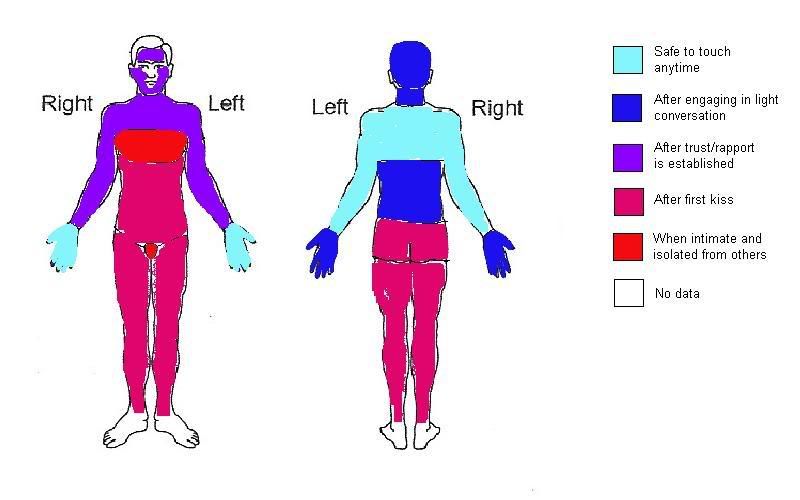
I'm with you on this. One small step I've taken is to compile all the rules I've aggregated from various sources about when and where it's okay to touch a woman (in the sense of "it would not be considered out-of-line to do this, though you may be politely asked to stop") into a chart. When I posted it on another forum, it became simultaneously the funniest and truest artwork I have ever produced.
ETA: Okay, because of the interest, I'll post it. Some disclaimers:
1) This is intended to give socially inept guys assurance against false accusations of being a "perv" or "too aggressive". Adhering to the chart will only mean that you will not be so labeled, and that women that complain to their friends or the venue's manager will receive little sympathy. It does not mean it is the optimal time to touch or that you won't be turned down (you should thereafter stop), just that you are within acceptable behavior boundaries and should stand your ground if you get flak.
2) To make the image less offensive, a man's body is color-coded. It refers to a woman, of course.
3) You can zoom in, at least if you permit javascript from enough domains.
With that said, here's the diagram. You'll probably laugh, or deem it true, or both.
Cute!!! I would note that most men are too conservative with touch in general. What you're touching is not always as important as that your touching, which immediately establishes an intimacy not achievable by mere conversation. The woman will let you know in one way or another if she wants you to stop, but she will almost never say she wants you to start, or even know it herself. Learning how to give a backrub is probably a good idea.
I second the backrubs. Backrubs are excellent. Nonthreatening (well, assuming you don't say anything creepy while near the neck, or stray south), casual, they feel awesome, and they're easy to segue into from the other party stretching or just saying "my back is killing me". I do recommend asking rather than just starting on one, though. Certain back problems don't react well to them, and there might be hair or a necklace or something to get out of the way, and they can be delivered in a startling way if begun without warning.
IMO, the views that rational analysis and manipulation in social context (esp. with regard to mating) is immoral or dehumanizing is based on observations that a lot of people who consciously employ such techniques often have the wrong objective function.
Consider this analogue situation: If you raise children, you definitely do a lot of rational thinking about their needs, long term interests and try help them to develop, be safe, etc. This requires a lot of objective considerations, prioritizing, even conscious manipulations on several different levels. Nobody would say that this is wrong, dehumanizing or out of place. The reason that this is intuitively accepted is that you probably do this for the right reason: in the long term interest of your children. If you have the right objective function, it is not just fine, it is required.
I think that other social interactions should not be different in this respect. You should consciously employ techniques, objectively analyze and manipulate situations, but your objective function should include the interests of your peers as well. They will sense if you genuinely care about them: Even if you manipulate them, they will be still thankful later if it happened in their long term interests.
You don't become a "manipulative bastard" just because you are manipulative, but if you are also a bastard.
Taskifaction doesn't destroy romance any more than it destroys music or dance.
This one sentence alone is worth my upvote for its sheer truth. (Although
Sucking at stuff is not sublime.
is a close second.)
What is meant here by "magic?" To me, it seems that it is synonymous with effortlessness; anyone skilled in a craft makes it look easy. In order to create this magic, a person toils in private. Since no one saw the preparation, the result looks like it came from nowhere--i.e., magic.
From the shallow signaling angle, discussing problems as tokens of ability probably takes precedence over discussing tasks. In that case, one doesn't explain how to solve a problem, but is simply (implicitly) telling that one doesn't have the problem (or is able to solve it).
Online dating sites appear to offer a counterexample to the assertion that "society resists better attempts to taskify social interaction (especially dating and mating)".
The algorithm for what to do when you meet someone is simple.
As you admit, the simplicity of this algorithm is dependent on one's communication skills.
You talk about yourself and listen to them talk about themselves and ask them questions about themselves.
Interestingly, a lot of conventional dating advice insists that people shouldn't talk about themselves too much.
This is an example of advice that is trivially correct, but encourages the wrong focus. Yes, there is a danger of talking about oneself too much, but there is also a danger in talking about oneself too little.
In my experience, the best way to get someone to talk about themselves and open up is not to just start asking them questions. Instead, talk about yourself for a bit, and then ask them questions or simply shut up and they will often start talking about themselves. People tend to feel more comfortable opening up after you have shared something about yourself.
Another very common piece of dating advice is "ask open-ended question rather than close-ended or yes/no questions. Open-ended questions are great, but you can't just jump into them with someone you don't know very well, or when the conversation i...
I would recommend auditing a counseling class. My fiancee is studying to become a professional counselor, and has had at least one class on how to talk to people who might be reluctant to talk. She can transcend smalltalk with my relatives in just a few steps and have actual conversations with them, something I'd love to be able to do.
For most skills, some people attain a level of art which surpasses describable taskification. If you asked a professional athlete how he throws the ball, or how he runs, he might mention a few tricks, but he's not going to be able to communicate it to you; in his mind, he just does it. I coach a top university speech and debate-type team (Mock Trial); I find it easy to describe how to do basic things, but nearly impossible to describe how to do sophisticated things; it has to be demonstrated and the students have to understand it themselves, and many of th...
just getting out of the house.
...Damn! That's exactly the kind of vague advice that HughRistik decries. Imagine teaching an extraterrestrial alien to smoke cigarettes.
You: Open the pack.
Alien: (looks at pack in a puzzled way)
You: Just tear it open, man
Alien: (tears pack in half, cigarette bits fly everywhere)
...
You: Put the cigarette in your mouth.
Alien: (stuffs entire cigarette into mouth)
And so on, and so forth. "Get out of the house" is a totally useless piece of advice for the kind of person that needs it. Okay, I'm out of my house right now, what next? You remind me of Alicorn who wouldn't stop insisting that finding potential dates in your social circle is "easy" if you "just do it".
(Related: I've entertained the idea of suggesting to Alicorn that she apply her superior understanding of women to teach pickup to male students. I imagine her entering the classroom, glancing at the audience composed of actual average guys and going "...oh, you meant that kind of average? I had no idea such people even existed. Obviously, teaching them to approach women would be disgusting and a gross betrayal of my sex. I'm outta here.")
I wasn't trying to rail against Alicorn in particular. The general point is still worthwhile. The most evocative analogy I know is that males are entrepreneurs and females are customers: anyone who's ever been approached by slimy salespeople can empathize with most women by analogy, and anyone who's ever tried to sell a product to an uncaring world can empathize with most men. But by default neither side ever really understands how the other feels unless they take extreme pains to empathize, and most advice going over the fence ends up being useless or worse. Ethical advice given to men by women especially falls in this category, because you don't preach ethics to a starving entrepreneur who (unlike you) gets kicked in the face every goddamn day. It's... y'know... unethical.
It's the mental leap from "aw, I feel bad that you are having trouble selling your product" to "aw, someone should take pity on you to the point of buying your product" that presents the problem. I do feel bad for people who have trouble selling, but I categorically refuse to translate that into an obligation on the part of the target market! That kind of thinking scares the crap out of me, because that is the kind of thinking that leads to various evil behaviors up to and including rape.
Yes, but just the same, if you knew about someone having trouble selling a good product, and you took pity on them, one way you would probably not react is by approaching a group of such people and lecturing them in detail about all the unethical practices they shouldn't do, most of which only apply long after a sale, and many of which are commonly used by successful salespeople in a way that satisfies their customers.
And when you think about it, that's pretty much what you do here, if you apply the transformation:
make a sale --> get a date
unethical post-sale practices --> unethical relationship practices, abuse
annoying-but successful sales practices --> PUA techniques, feminist-disapproved language
See the problem?
In Analogy City there are a large number of people who have no education or work experience because they grew up on welfare and never had the opportunity for much of an education. A group of the nations best salespeople decides to do some community service and teach some of these people how to sell things on the street. Among what they teach:
Don't wait to be turned down. Wash that car's windows and then demand to be paid, don't ask first. Take their picture, demand money. Hand them a homemade craft, then demand to be paid, etc.
Be aggressive. The customer's money is your money, it just isn't in your pocket yet.
Look extra poor so that rich people feel sorry for you and give you more. Employing young children is ideal.
Go to neighborhoods Xington, Yville, and Zburg because thats where the unsuspecting rich liberals targets live and they won't be jaded enough to turn you away.
Nothing that is taught is illegal, quite. But some of the people in the city feel that teaching these methods is, nonetheless, irresponsible and dangerous. Do these people have a valid complaint? If they decided to replace the old salesperson teachings with something else would you be surprised if these ...
I seem to hold the uncommon view that both feminism and the teachings of most PUA types are compatible and good things
I agree that there is compatibility between pickup and feminism that is under-explored.
Both PUAs and feminists are heavily focused on the same thing: the needs and preferences of women, and how men can fulfill them. The amount of time and effort PUAs spend trying to figure out and cater to women's sexual desires is crazy. Furthermore, they often consciously make a choice to develop aspects of their personalities and identities that they know will be attractive to women.
Yet PUAs differ from feminists in their views of what women's preferences actually are. PUAs assess female criteria from what women respond to, which may not be the same as stated female criteria. Also, even though PUAs attempt to fulfill a subset of women's desires, they are not always trying to fulfill all of women's desires all the time.
Both PUAs and feminists make some errors in assessing female preferences, but feminists are more wrong: I would give PUAs a B+ and feminists an F (see this and this for some research on female preferences). (On average, feminist women differ from typical strai...
Okay then. For now, I suggest you consider the incentive structure that results from women who have held both of these positions at some time or another.
"Geez! Why can't this guy take a hint and buzz off?"
"Pff, only a complete wuss would go away just because I asked him to. If he were worth my time he would have kept it up."
This is an oversimplification of something very complex involving many subtle nuances.
I'm sure it is, but just for the record, your explanation isn't going to deconfuse any poor male who isn't deconfused to begin with. (Perhaps you already know that.)
Oh boy, I guess I'm one of the cowards.
I didn't downvote you for articulating an admittedly fucked up incentive structure. I downvoted you for bitterly criticizing all women because you find the behavior of some women to be inconvenient.
(Tangent: why dance around "fuck"? We all know what you meant, and I'm pretty sure this community has figured out that particular words aren't intrinsically evil.)
If you want to know what to do about the fucked up incentive structure that so irks you, it's really quite simple: don't be a dick. If you have to run the risk of ruining someone's evening or making them feel unsafe, that's really not worth a minor bump to your odds of getting laid on a particular night out.
Second, there's the dating pool. If dating capability feeds on itself, then prematurely complying with a request to leave will cause the dating pool to be dominated by disrespectful men, and women increasingly believe that their only option is a disrepectful man.
I've realized the same issue myself. At least, the "dating pool dominated by disrespectful men" part. It may not currently be the case that women believe that their only option is a disrespectful man. But I have noticed that some women seem to conflate high levels of care for their comfort and consent with wimpiness or a lack of masculinity.
If scrupulous men restrain themselves out of deontological moral principles, even if it's the "right" thing to do, what is the effect on the larger system? The effect is that our good little deontologists may select themselves out of the dating pool, leaving only men who are less scrupulous. That's good for women, how, exactly?
Silas is right that the incentive structure is broken. There are incentives for men to engage in advances that take risks with women's comfort levels (high-risk, high-reward), to fulfill common female preferences for excitement or being "...
It's fun to watch you discover the visceral horror of natural selection, especially sexual selection. Yea that's right, there is no ground floor, you fall forever. If females exhibit even a mild preference for bigger tails, or bigger brains, or higher persistence, or whatever else, then in relatively few generations the tails or brains or persistence will grow preposterously huge.
About your last paragraph: everywhere in nature runaway sexual selection involves females selecting males for a disproportionate value of some characteristic, never the other way around. A population's changes depend on the mating criteria of females, not the mating criteria of males.
Yes, this applies to apes as well. If an attractive woman offered me sex and I refused (most likely due to being busy with something or someone else), I'd want her to offer it again later. But in refusing I don't lie about my preferences: if I really mean to answer "never" I say "never", and if I mean "not now" I will say "not now". This is a frequent complaint leveled at human females: they often say words to the effect of "never" but later behave as if they'd said "not now", and vice versa.
And like I've explained several times already, I don't want to err in the direction if it means ceding the romantic world to men who are even less respectful of women
UNSOLICITED PERSONAL ADVICE- FEEL FREE TO IGNORE:
It seems to me that you'd be better off preferring women who are more direct and open about their preferences (since I assume you prefer this within a relationship as well as at its start), and taking explicit rejection at face level would help select for this.
You would indeed be filtering your dating pool, but in a fashion that accords with your preferences.
lack of ability to read her
When I read this, it made me wonder how much of my staunch insistence on obedience to stated preferences has to do with my identification of myself as unreadable. (People trying to guess what I want by looking at me do not do appreciably better than I would expect them to if they were presented with a written summary of the immediate context. Some people do worse than that.) But if I am unusually hard to read - and I may well be - then I should be cautious in generalizing my preferences to others with different relevant traits.
On several occasions, girls have given me their phone number after a friendly conversation, and when I called or texted, I got back an angry message from the girl, or her boyfriend, saying that she had a boyfriend and not to talk to her again (even when I was dating someone and was just looking for friendship). I can only assume that the boyfriend had issues and changed her mind.
It's more common to have a good conversation with a girl, have her give you her number and tell you to call her, and then have her screen your calls and never return them.
Silas explained one of the reasons this particular analogy doesn't hold. (You also argue against a straw man.)
As for political agenda: This is not the first time you have made statements of the kind should be considered . I greatly prefer your insights into rationality over your comments on anything to do with males. The quality of reasoning is almost incomparable.
I will now attempt to clarify:
Males developing social skills is great. Social skills are wonderful, rewarding things to have, and I think anybody who would like to learn to interact with other people politely and pleasantly should.
"Social skills as possessed by men (who are attracted to women)" is a much broader category than "the ability to get into sexual or romantic relationships with women (who are attracted to men)". You can use social skills to interact with family members, platonic friends, co-workers, neighbors, classmates, teachers, strangers, students, clients, employees, bosses, fellow members of any club or other social or hobby organization, and any other class of person you will ever interact with. Potential mates are only one of these categories, although of course there is overlap.
Social skills as used by men to get into sexual or romantic relationships with women do not consist entirely of things I would describe with "negative feminist language". Many of these skills are, at least potentially, honest, respectful, and non-threatening.
The attitude that the "target market" of the "product" of the man attempting to...
I seriously doubt there is anyone here who has committed rape or felt entitled to sex, for that reason. Here, what you find is a lot of men trying to overcome the lack of knowledge about how to get into a relationship. Men in that position are not the ones out committing rape, abusing girlfriends, abandoning their children, etc. Such victimizers already know how to get to the relationship step as second nature!
Now, with that said, there is a distantly-related (though not dangerous) feeling of entitlement that arises in discussions like these that needs to be addressed. Let me explain.
Let's say I'm told all throughout growing up, what is and is not appropriate behavior around women, and over time I internalize these rules, automatically identifying instances I see (of inappropriate behavior) as bad. This advice matches that given in popular, respected books about dating. And yet despite lots of interactions with women where I have romantic intent, I am utterly unable to generate interest in any of them.
First, let's get a few misunderstandings out of the way: Of course women are thinking, volitional beings who are not obligated to perform for anyone's sake and should not be vie...
Sure, you could stop at any point in this chain of reasoning, reject some inference and avoid #7. But the subset of people who won't, may do serious harm to poor Woman X - who never owed anyone anything.
It is your opinion that Woman X never owed anyone anything -- but the fact that you (and probably most people) feel that way is not sufficient justification for making the contrary opinion (premise #1) a thought crime.
Keep in mind that among the things we are in the business of doing here are (1) critically examining ethical intuitions, and (2) proposing and exploring potential means of (ultimately) improving the world that may not necessarily strike us immediately as "tasteful".
My feeling is that someone ought to be permitted on LW to argue, for example, that the law should compel Woman X to have sex in some circumstances. Suppose for instance that some commenter were to float the idea of sex as a form of judicially enforced community service for those convicted of certain crimes (perhaps as an alternative to incarceration). Would you consider this idea so dangerous that it ought to be censored, for fear of encouraging rape or sexual assault? I'm guessing (hoping) you wouldn't , even though it's clearly an example of discussing sex as an obligation, in a way quite foreign (even opposed) to the norms of our current society.
I imagine anyone capable of being reached by anti-rape arguments is not a psychopath; I also imagine that only psychopaths actually rape.
I really doubt this; surely acculturation against (or for) rape has an effect.
I can recognize the attitude from my youth and I think it is really counterproductive. It leads to the kind of bitterness expressed in this line:
a starving entrepreneur who (unlike you) gets kicked in the face every goddamn day.
a man who sees himself that way isn't going to be attractive to women. If you restrict yourself to thinking about meaningless sex, then yes it is true that the relationship between men and women is pretty asymmetrical. An average woman can probably consume as much meaningless sex as she wants without too much effort, whereas for most men there is a lot of effort involved in obtaining meaningless sex. However, if you consider quality monogamous relationships the situation is much more symmetrical. There is a significant search effort for both sexes in finding a quality compatible partner that reciprocates their feelings.
For most people long-term committed relationships are the goal, so for most people the world is fairly symmetrical. It may not feel that way in your early 20s though.
Is a pet theory a formerly stray theory that you decided to start feeding, because it was cute, and that you stroke in your super villain moments?
"But if you pick some social event or scene where there are likely to be people vaguely similar to you"
I suspect that for most of us, such scenes consist almost exclusively of dudes.
I have trouble meeting women, and it's due to three major constraints:
1) I'm not religious, so church is out.
2) Bars bore me.
3) I haven't identified any other venues where a 30-something guy can approach women in a sociable context.
These constraints may be typical of the Less Wrong readership.
The reason bars bore you, is probably that you lack the social skills.
That seems like an odd hypothesis. "Bored" is not how I describe my emotional state when I'm engaging in some activity for which I lack skill.
For my part, I find bars boring because there's nothing entertaining to do there. I don't even see how people have interesting social interactions in them; most bars I've been to have been very loud, and the people have been drinking excessively, such that one cannot even have an interesting conversation. But then, my hearing is terrible in loud places, so YMMV.
Personally, I think musicians who can actually play their instruments are capable of creating more "magical" music than musicians who can't. ... Sucking at stuff is not sublime. It's not sublime in art, it's not sublime in music, and it's not sublime in dance.
Nicely said.
The desire to have things "just happen" can help level the playing field. The more desirable a person is, the more likely "wait for the miracle" will work for them sometimes, the more likely they are to buy into it, and thus be available and/or desperate e...
The problem you're describing is big. Really big. Ignoring the issue of whether the advice being given is wrong, saying "be yourself" or "meet potential partners through friends" is breaking up one big problem into subproblems, which is helpful if you can get past that extra just they tack on. The real work still lies ahead, but that's still progress.
Given that it's such an important problem in people's lives, I am somewhat perplexed as to why it isn't covered in school. Given the effect choosing a mate can have, it should be a substantial part of the curriculum.
Society won't help you with it, if Robin and Thursday's arguments are right.
You can help yourself. In recent years there's been an explosion of information on how to get better at dating and social interaction, some of it even works.
I think the biggest reason that most dating advice sucks is that good advice is only possible if you actually view the realtime performance of the person and thus get an idea of what kind of mistakes they're making. Once you see what mistakes they're making, giving good advice becomes orders of magnitude easier. Then it would be called "teaching" instead of "advice-giving".
Can you say what you want without appealing to this "society"? "Society" is only people dealing with each other. What do you want some individual person to do, or not do, to fix the problems you see? Because I do not recognise the picture of "society" that you are drawing. I have never encountered the "Romantic" view outside of advice columns in women's magazines. The real people that I know generally do think deliberately about -- taskify, if you must -- how they deal with people. Just read a random collection of Li...
You're not the first to notice the problem, though Alicorn's terminology does make it a bit easier to describe. You should read the last chapter of David Friedman's "Hidden Order", "The Economics of Love and Marriage". He doesn't give any answers, but he approaches the same problem from a somewhat different angle.
I need more clarification of what I am calling the "Romantic" view
Indeed. I'm beginning to think you're not talking about Byron at all!
So, in summary, most dating advice isn't helpful because it's written by and for people who are already good at that. :o)
I can break this into some tasks I have solutions to.
Task 1: I am a severe agoraphobe. Solution: therapy helps, alcohol seems to help but makes it much worse on the hangover.
Task 2: I lack conversation skills. I want to not lack conversation skills.
2.1: Being myself involves giving non-sequitur after non-sequitur about my model collection. This upsets people! Solution: Join a model collectin' club and learn to tell model collecting sto...
http://ua.johntynes.com/content_comments.php?id=P1743_0_3_0
A clever appeal to people's fear of systematized socialization.
Any artist, whether in visual media, music, drama, or dance knows that the "magic" of their art is produced by mundane and usually heavily taskified processes. You can't "just" create a sublime work of art
Not even the very lucky and talented? Not a completely rhetorical question, this is all completely outside of my domain competence.
I think there may be a tendency for the here-present audience to overanalyze and underpractice.
I think the following information is important for understanding this problem matter:
(1) Anyone attracted to this site will likely be a highly intelligent individual.
(2) IQ is more closely bundled around 100 for girls than it is for guys.
Implication: This here audience is mostly male.
(3) People with IQ differences of more than 2 standard deviations don't get along that great (aren't peers).
(4) Socialization with peers at a young age is crucial to social developme...
I was just lamenting this morning how my todo list, a set of tasks for the next few days, was depressing me. When I wrote it, it was a great joy to get all these things out of my head, but now that all I had to do was follow them, it felt mechanical and boring. I could rewrite the list and gain some excitement about a few of the tasks that way, but instead I've been trying to figure out the why of this feeling, and your post gets me right back into it.
I think there's an ideal working state -- perhaps the state of Flow is describing it, or perhaps that's si...
Personally, I think musicians who can actually play their instruments are capable of creating more "magical" music than musicians who can't.
this statement requires a clarification for several terms: can "instruments" refer to a digital sequencer? turntable(s)? microphone, loop pedal, effects pedal, etc? a rewired speak and spell? a laptop running generative algorithms?
"Magical" might need a touch more clarification as well.
if it does include those, then the statement ends up a tautology; musicians who can play music well can play music better than those who can't play music well...?
I wish to point out that there is an important difference between censorship and saying that something ought not to be said. Censorship is taking steps to prevent the saying of a thing, or prevent it from being readily heard by interested audience members. Saying that a thing ought to be said does not call for censorship, nor imply that censorship is called for. For instance, I do not think that people ought to tell strangers on the street to smile, and I encourage people to refrain from doing that. I do not advocate preventing anyone who wishes to ignore this encouragement from telling others to smile, nor do I want to somehow protect all possible recipients of the smiling instruction from exposure thereto.
There is a difference there and I'd like to clarify that I have been referring to the broader concept here. When I refer to 'censorship' I am referring to attempts to control what people are free to be speaking through political manoeuvring. I include suggestions that people should be shamed for making statements on particular topics along with suggestions that said statements should be removed from view. If there was a word that emphasised the former category rather than the latter then I would use it instead. That sort of censorship is most relevant on lesswrong and far more insidious.
When I read Alicorn's post on problems vs tasks, I immediately realized that the proposed terminology helped express one of my pet peeves: the resistance in society to applying rationality to socializing and dating.
In a thread long, long ago, SilasBarta described his experience with dating advice:
In Alicorn's terms, he would be saying that the advice he has encountered treats problems as if they were tasks. Alicorn defines these terms a particular way:
Yet as she observes in her post, treating genuine problems as if they were defined tasks is a mistake:
Similarly, many straight guys or queer women can't just find a girlfriend, and many straight women or queer men can't just find a boyfriend, any more than they can "just become immortal."
People having trouble in those areas may ask for advice, perhaps out of a latent effort to turn the problem into more of a task. Yet a lot of conventional advice doesn't really turn the problem into the task (at least, not for everyone), but rather poses new problems, due to difficulties that Alicorn mentioned, such as lack of resources, lack of propositional knowledge, or lack of procedural knowledge.
Take, for example, "just be yourself," or "just meet potential partners through friends." For many people, these pieces of advice just open up new problems: being oneself is a problem of personal identity. It's not a task that you can execute as part of a step in solving the problem of dating. Having a social network, let alone one that will introduce you to potential partners, is also a problem for many people. Consequently, these pieces of advice sound like "let them eat cake."
Society in general resists the notion that socializing (dating and mating in particular) is a problem. Rather, society treats it as a solved task, yet the procedures it advocates are incomplete, dependent on unacknowledged contextual factors, big hairy problems of their own, or just plain wrong. (Or it gives advice that consists of true observations that are useless for taskification, like "everyone is looking for something different" in a mate. Imagine telling a budding chef: "everyone has different tastes" in food. It's true, but it isn't actually useful in taskifying a problem like "how do I cook a meal?")
Even worse, society resists better attempts to taskify social interaction (especially dating and mating). People who attempt to taskify socializing and dating are often seen as inauthentic, manipulative, inhuman, mechanical, objectifying of others, or going to unnecessary lengths.
While some particular attempts of taskifying those problems may indeed suffer from those flaws, some people seem like they object to any form of taskifying in those areas. There may be good reasons to be skeptical of the taskifiability of socializing and mating. Yet while socializing and dating may not be completely taskifiable due to the improvisational and heavily context-dependent nature of those problems, they are actually taskifiable to a reasonably large degree.
Many people seem to hold an idealistic view of socializing and dating, particularly dating, that places them on another plane of reality where things are just supposed to happen "magically" and "naturally," free of planning or any other sort of deliberation. Ironically, this Romantic view can actually be counterproductive to romance. Taskifaction doesn't destroy romance any more than it destroys music or dance. Personally, I think musicians who can actually play their instruments are capable of creating more "magical" music than musicians who can't. The Romantic view only applies to those who are naturally adept; in other words, those for who mating is not a problem. For those who do experience romance as a problem, the Romantic view is garbage [Edit: while turning this into a top-level post, I've realized that I need more clarification of what I am calling the "Romantic" view].
The main problem with this Romantic view is that is that it conflates a requirement for a solution with the requirements for the task-process that leads to the solution. Just because many people want mating and dating to feel magical and spontaneous, it doesn't mean that every step in finding and attracting mates must be magical and spontaneous, lacking any sort of planning, causal thinking, or other elements of taskification. Any artist, whether in visual media, music, drama, or dance knows that the "magic" of their art is produced by mundane and usually heavily taskified processes. You can't "just" create a sublime work of art any more than you can "just" have a sublime romantic experience (well, some very talented and lucky people can, but it's a lot harder for everyone else). Actually, it is taskification itself which allows skill to flourish, creating a foundation for expression that can feel spontaneous and magical. It is the mundane that guides the magical, not the other way around.
Sucking at stuff is not sublime. It's not sublime in art, it's not sublime in music, and it's not sublime in dance. In dating, there is nothing wrong with a little innocence and awkwardness, but the lack of procedural and propositional knowledge can get to the point where it intrudes ruins the "magic." There is nothing "magical" about the experience of someone who is bumbling socially and romantically, and practically forcing other people to reject him or her, either for that person of for those around. Yet to preserve the perception of "magic" and "spontaneity" (an experience that is only accessible for those with natural attractiveness and popularity, or luck), society is actually denying that type of experience to those who experience dating as a problem. Of course, they might "get lucky" and eventually get together with someone who is a decent without totally screwing things up with that person... but why is society mandating that romance be a given for some people, but a matter of "getting lucky" for others?
The sooner society figures out the following, the better:
1. For many people, socializing and dating are problems, not yet tasks.
2. Socializing and dating can be taskified to the extend that other problems with similar solutions requirements (e.g. improvisation, fast response to emotional impulses of oneself and others, high attention to context, connection to one's own instincts) can be taskified. Which is a lot of the way, but definitely not all the way.
3. Taskification when applied to interpersonal behavior is not inherently immoral or dehumanizing to anyone, nor does it inherently steal the "magic" from romance any more than dance training steals the magic from dance.
Until then, we will continue to have a social caste system of those for whom socializing and dating is a task (e.g. due to intuitive social skills), over those for whom those things are still problems (due to society's accepted taskifications not working for them, and being prevented from making better taskifications due to societal pressure and censure).