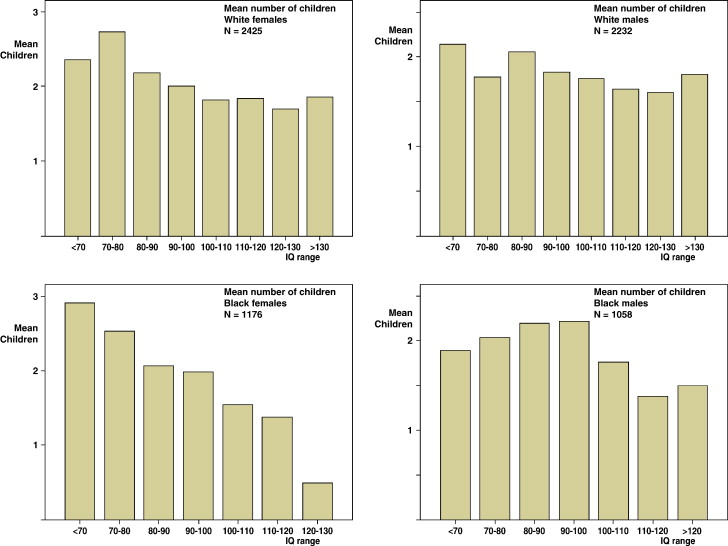
From what I know people of below average intelligence have higher fertility than people of average intelligence. I think modern civilization has changed the selective pressures massively from the ones that produced the current averages.
One of the sources off the top of my head
The pattern though it holds overall obviously isn't uniform for all groups, Black males for example do seem to in the US to be enjoying slight positive selection for a higher mean IQ (I need to crunch the numbers to see if this is so) or at least have peak fertility at about the US mean IQ, which is good. What concerns me however is the gender difference in these pressures (graph from the paper I link to). I fear that we will be selecting for gender dimorphism in abilities until we hit better reproductive technology. Prolonged education in a meritocracy is bound to eat up more female than male fertility due to the lost peak years of reproduction. Also we have the problem of men caring less about the socio economic status of the partners they choose to reproduce with than women. Extra status buys men more reproductive options later in life than it does for women in the same age bracket. This sucks quite a bit.
The artificial uterus can't come quick enough. Thought I think life extension and rejuvenation tech could also help if we could make pregnancies in the 50s and 60s healthy and convenient.
So I found this post quite interesting:
http://www.gnxp.com/blog/2009/03/gnxp-readers-do-not-breed.php
(I'm quite sure that the demographics of this site closely parallel the demographics on Gene Expression).
Research seems to indicate that people are happiest when they're married, but that each child imposes a net decrease in happiness (parents in fact, enjoy a boost in happiness once their children leave the house). It's possible, of course, that adult children may be pleasurable to interact with, but it seems that in many cases, the parents want to interact with the children more than the children want to interact with the parent (although daughters generally seem more interactive with their parents).
So how do you think being child-free relates to rationality/happiness? Of course, Bryan Caplan (who is pro-natalist) cites research (from Judith Rich Harris) saying that parents really have less influence over their children than they think they have (so it's a good idea for parents to spend less effort in trying to "mold" their children, since their efforts will inevitably result in much frustration). And in fact, if parents did this, it's possible that they may beat the average.
(This doesn't convince me in my specific case, however, and I'm still committed to not having children).