Jokes. Common sense (and evolutionary psychology) show that people like funny people.
How many people are always trying to remember a joke they heard? This seems like an easy solution.
Where do you get your jokes? I thought of this myself, but I only have a few, and I'm not sure where to find more.
Google.
Note: I didn't actually implement this productivity hack. Otherwise, I would share my deck.
Terrible idea that I can't help sharing:
The one sentence summaries (encoded as the "question", with the distribution name as the "answer") of various probability distributions here: http://en.wikipedia.org/wiki/List_of_probability_distributions . When possible, I'd like to see a chart of the pdf for various common parameter distributions and guess what the distribution is. Reversing this, I'd like to be told what the distribution is, and be told a few (i.e., three) (sets of) parameters, and visualize what the pdf/cdf would look like. This would be especially useful if all of these charts were in the same format.
I think "scaffolding" for other knowledge and short complete lists would be great:
Anatomical terms of location
Metric Unit Prefixes
Greek Alphabet
Human Glands
Vitamins
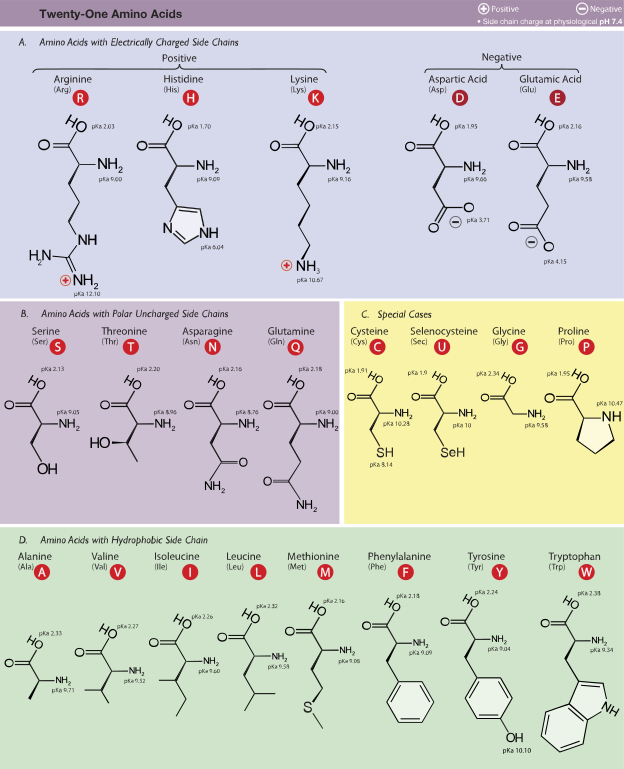
Amino Acids
Match Moons to Planets
If someone can find a good way to organize complexity classes, cell anatomy, or time periods I'd love you for that too.
Lists of the amino acids, vitamins, and greek letters are already in the anki "shared deck" section.
cell anatomy
What do you mean by this? Visualizations of organelles? Are you referring to the tissue level? If you can get more specific I might be able to help you make something, because this pursuit of building mental models of cells is something I'm also interested in.
I'm not quite sure what I'm looking for in this case, unfortunately. Just seems like something that could work well, matching pictures of cell-things with names of those things.
Biases from Wikipedia's list of cognitive biases. Cue: example of the bias; Response: name of the bias, pattern of reasoning of the bias, normative model violated by the bias.
Upvoted because this would be a great data set. However, there is too much in the response section. Each response should be as small of a piece of information as possible. See http://www.supermemo.com/articles/20rules.htm. Split those into three cards and you're fine.
http://www.mediafire.com/?1h4288axmg1zvpn,fry554cgj5w85r6
There's the cognitive neuroscience and lesswrong wiki cards. There's probably some sloppiness because they were generated by a script.
I'd like to see an anki deck that trains for a sort of conversational recital of interesting results in science. Often you might have a general, vague idea of the result for a piece of research, but you don't know the details that lend you gravitas in reciting them. For example, if you know the main author, the university, the decade, and so on, you come off as very knowledgeable. Whereas, if you just start off saying something like "Y'know, scientists found that bees dance to communicate," you can immediately see in their body language that they're thinking, "uh huh uh... what the fuck is this crackpot, idiot talking about?"
You're infinitely more credible if you say something like, "So, this Austrian ethologist and Nobel laureate, Karl von Frisch, observed in the late 60s that bees dance to communicate..."
I'd like to see the Anki manual itself turned into an Anki deck. No one has yet done this. I've not yet completed my incremental reading of that document, and I therefore lack a deck worth sharing.
One gets better results from learning before memorizing, and creating one's own deck makes a good way to understand a complex subject. That said, having an Anki deck for the Anki manual itself would make a fine set of training wheels for the bicycle, so to speak.
I'd like to see the Anki manual itself turned into an Anki deck. No one has yet done this. I've not yet completed my incremental reading of that document, and I therefore lack a deck worth sharing.
"Incremental reading" in the Wozinak sense? How are you doing that? (My biggest complaint with Anki is the lack of Incremental Reading capability.)
I use the Incremental_Reading_Extension and View_Size_Adjust add-ons. They work.
I can't compare them to SuperMemo, which I have not used. They do not work with AnkiDroid at all.
I use the IncrementalReadingExtension and ViewSizeAdjust add-ons. They work.
Jay, I've just been playing with these. They work. Technically. But the formatting all seems to be lost. It is much less pleasant to read an article grabbed from wikipedia when all the formatting and hyperlinking has been lost. Do you have a workaround for this problem that you use?
Do you have a workaround for this problem that you use?
To import web content into Anki Incremental Reading go to Tools->Preferences and uncheck "Strip HTML when pasting from clipboard".
To import web content into Anki Incremental Reading go to Tools->Preferences and uncheck "Strip HTML when pasting from clipboard".
And, to import pdfs (including academic papers or ebooks), pdf2htmlEX seems to work.
As I write in this comment detailing my strategy for using Anki to learn material from textbooks, Peter Gray's Psychology is particularly suited for ankification. Each page from that textbook comes with 1-3 marginal "focus questions" intended to guide the student in the process of learning the material. One can simply write these questions on the front side of the card, and on the back side write a brief summary of the paragraph(s) to which the questions refer. For an example of how a card written in this way would look like, follow the link above.
I've just started to use anki (so I've been thinking about this topic a lot).
What I plan to do is put my favorite motivational quotations on there. You could just use quotations in general as they are already short and they lend themselves easily to cloze deletions.
I've also got a book of proverbs. I've been going through it and using anki for the ones I like. Proverbs are also good because there has been a lot of research on embodied cognition recently and how visual images are much easier to remember. If you can get good at looking at concepts and then thinking of images/proverbs that illustrate the concept well, you will be well on your way to becoming a great writer. Even better, you'll become a great thinker because clear writing is clear thinking.
So, have you been doing this? What do you think of it now?
(I'm considering doing about the same for quotes)
I've not been doing it. I don't think I have enough material that I'm motivated to anki-fy, that I can make a habit of using it.
If I were going to start using it more, I'd use it for:
Thanks for reminding that I should probably use anki more.
So, have you been using Anki more? :D
(I've added a few quotes in Anki, but only when they contain useful information and not general motivation stuff)
For what it's worth, I never got into the habit of using Anki until I installed the mobile app on my smartphone. This happened about three years ago, and since then I've been using it on a daily basis, primarily during commutes. If your experience is limited to the web or desktop versions, do consider giving the mobile app a try.
I did use it on my phone more than anything when I did use it. I just don't have much information I want to memorize at the moment.
Pearl's causality stuff and Jaynes' Bayes stuff are probably something a lot of LW readers want to know better. I don't know how ankifiable they are, I have a very poor grasp of either. My impression is that probability math is a bit more loaded with hard to formalize background concepts (cf. Tim Gowers' musings about just what random variables are) than some other fields. This might make a straightforward flashcard approach less useful.
Category theory and abstract algebra seem to start with a bunch of basic definitions which you could memorize with flashcards, but getting anywhere in them even with the definitions handily uploaded in your brain takes quite a bit of mathematical maturity. I tried to do CT with Anki, but got bored quickly since I didn't have any study plan beyond that and am nowhere near the mathematical skill where I could just start doing interesting stuff by myself using the definitions.
It's a terrible idea to try to learn theorems by memorization, if all you want to do is pass math tests fine.. but if you want to understand mathematics it's definitely going to do more harm than good.
This one may violate the do not try to use SRS unless you understand it principle. But for those who understand mathematics, this book consists mostly of definitions, which are compact enough to use an anki deck for.
http://www.amazon.com/Mathematics-Web-Linked-Dictionary-Collins/dp/0060851791
Shit Rationalists say is a study guide for newbies that can be easily imported into an anki deck because it's short (as the great 20 rules for formatting knowledge mandate).
Just to be clear, what exactly do you mean by encoding this info in Anki decks?
To take an example from the cog neuro textbook, would the following work for inductive reasoning?
q: What do you call deriving an inference about a larger category by considering examples from within that category?
a: inductive reasoning
What about the reverse?
q: What is inductive reasoning?
a: deriving an inference about a larger category by considering examples from within that category
Would this be considered too long? Is this true of all of the terms on there?
2 is good, AIMA is good too, but probably not for everyone here. Others coming to mind
common thinking fallacies
math
Spaced repetition is a powerful learning tactic, and Anki is a good tool for it. There are some LW-relevant Anki decks here. But I wish there were more.
Which sets of knowledge are (1) likely useful to LWers, and (2) straightforward to encode into Anki decks without needing to be familiar with that field?
Some examples:
Which other sets of knowledge would you like to see Ankified? Please link to the actual knowledge set you'd like to see encoded.