Hermione is dead. Hermione Granger is doomed to die horribly. Hermione Granger will very soon die, and die horribly, dramatically, grotesquely, and utterly.
Fare thee well, Hermione Jean Granger. You escaped death once, at a cost of twice and a half your hero's capital. There is nothing remaining. There is no escape. You were saved once, by the will of your hero and the will of your enemy. You were offered a final escape, but like the heroine you are, you refused. Now only death awaits you. No savior hath the savior, least of all you. You will die horribly, and Harry Potter will watch, and Harry Potter will crack open and fall apart and explode, but even he in all his desperation and fury will not be able to save you. You are the cord binding Harry Potter to the Light, and you will be cut, and your blood, spilled by the hand of your enemy, will usher in Hell on Earth, rendered by the hand of your hero.
Goodbye, Hermione. May the peace and goodness you represent last not one second longer than you do.
There's reasons besides unfalsifiability for downvoting. Like poor logic, or asserting p=1, or writing so melodramatically that my eyes glazed over.
Edit: I stand by my downvote, for the last two reasons, but I'll give him props for a correct prediction.
Thanks for having my back, but I have to ask if I've missed the boat on some Less Wrong policies or unspoken understandings somewhere. What I said may have been a testable prediction, but I wasn't aware that people's posts had to be testable predictions to deserve upvotes. Am I required to list all my supporting evidence every time I make a future-looking statement? If I don't, or even if I do, must I disclaim them the way corporations do on quarterly earnings conference calls?
gwern said above that (s)he'd "be happy to record" my prediction. I had no idea my predictions were being recorded at all. I thought this was just a discussion forum. Is Less Wrong actually a simulation of the prediction markets from Three Worlds Collide? Is Less Wrong a subsidiary of Intrade? Do I have cash or prizes waiting for me somewhere thanks to one of my earlier correct predictions?
I thought it was pretty obvious that it was a direct response to the information and imagery in the chapter posted last night.
Yes, it was rambling and melodramatic and over-the-top; it was supposed to be amusing, while at the same time accurately expressing my belief that some seriously dark shit is coming.
Sorry for offending everyone.
Melodramatic
Well duh, that's what I was going for. It was supposed to be ridiculously over-the-top to the point where someone somewhere might be amused by it. I guess that prediction was foolish.
and without support.
Given the conversation we just read, and the imagery thereabout (lit by soft light at the beginning of the conversation, silhouetted as a black outline at the end), I hardly think it's without support. I think everything Hermione thought in that scene was absolutely correct. Quirrell was behind the plot, he did want her out of the way of his plans for Harry, and he will try to absolutely eliminate her next time.
Some actual tragedy in this story is far overdue, and Hermione's going to be the one to pay it.
One thing I find really interesting about this story is that nobody has any idea what's going on, and nothing is going according to anyone's plan.
(1) It seems clear that Hat and Cloak = Quirrellmort. Less clear, but still likely in my view, was is that the point of this plot was to eliminate those friends of Harry's who would make him resistant to manipulation by Quirrellmort ("Lessson I learned is not to try plotss that would make girl-child friend think I am evil or boy-child friend think I am sstupid," Ch. 66). Instead, while the plot may be the end of Harry's friendship with Draco, it's probably strengthened his bond with the morally pure Hermione, and convinced some members of the Wizengamot that Harry is Voldemort, which probably doesn't have a place in Quirrellmort's plans. Furthermore, Quirrellmort may not realize what he's done.
(2) It occurred to me that giving Draco Veritaserum might have made Lucius realize that Harry is not Voldemort. However, if you look at some of Lucius' dialog closely, the subtext appears to be, "Dark Lord, you have lost your humanity, and therefore cannot possibly understand the love I have for my son. I am willing to risk your wrath...
RE: your (1).
I think that Quirrelmort's aim was to turn Harry.
From Quirrel's point of view, Harry has shown incredible promise except for his pesky humanist streak. All Quirrelmort needs to do is to kill his faith in humanity off and he's ripe for the job of future Dark Lord. What better way to accomplish that than to have the wizarding world at large sentence the one person he believes to be wholly good (Hermione) to death? Dumbledore will refuse to help Harry destroy Azkaban and bust Hermione out, at which point Harry will lose all faith in him and his methods, and turn to Quirrel for help. Quirrel says, "Poor dear, didn't I tell you that people were basically evil if left to their own devices? They need a ruler to help them to be good. Let's break your chum out of Azkaban and take over the wizarding world for good measure as soon as we can, although I'm afraid that by the time we are in position to get her out and keep her out she'll probably be a vegetable..." So Harry and Quirrel sear Azkaban out of existence, free the crims (many of whom will now follow Harry into fire out of gratitude). Harry is left with a broken England and a broken Hermione and the only th...
I'd earlier made this point. The key
And the reason it is easy for you to forgive such fools and think well of them, Mr. Potter, is that you yourself have not been sorely hurt. You will think less fondly of commonplace idiots after the first time their folly costs you something dear.
In the Wizengamut:
But by then he'd (Harry) already declared war on the country of magical Britain, and the idea of other people calling him a Dark Lord no longer seemed important one way or another.
When their idiocy threatened something dear to Harry, he declared war on them. Mission accomplished. I've been wondering if Harry is ever going to remember that conversation. It's just so obvious. All that's missing is the "told ya so" speech from Quirrell.
convinced some members of the Wizengamot that Harry is Voldemort, which probably doesn't have a place in Quirrellmort's plans.
Quirrellmort has already pontificated on the benefits of ambiguity, and his desire to let both sides think Harry is on their side.
Harry: “On our first day of class, you tried to convince my classmates I was a killer.”
Quirrell: “You are.” Amusedly. “But if your question is why I told them that, Mr. Potter, the answer is that you will find ambiguity a great ally on your road to power. Give a sign of Slytherin on one day, and contradict it with a sign of Gryffindor the next; and the Slytherins will be enabled to believe what they wish, while the Gryffindors argue themselves into supporting you as well. So long as there is uncertainty, people can believe whatever seems to be to their own advantage. And so long as you appear strong, so long as you appear to be winning, their instincts will tell them that their advantage lies with you. Walk always in the shadow, and light and darkness both will follow.”
Scaring the Dementor may have saved his bacon. Blackmailing someone is a positive utility move. Blackmailing someone who seriously believes they can destroy hundreds of unkillable soul-eating monsters, and backs that up is a move with totally unknown utility, possibly very, very negative.
It seems both Harry and Dumbledore are missing one of the big payoffs of Harry saving Hermione: making it very attractive to become his freind. There's no explicit enemy around at the moment, so he can't rally minions like Dumbledore did by using the threat of Voldermort; love might be his best option.
Everyone knows that Draco was trying to be Harry's friend.
He almost died for his trouble, and Harry's not the one that saved him.
Friends with Harry -> Interact with crazy mudblood girl -> Crazy Mudblood girl tries to kill you, and Harry defends her.
Hermione was a special case in many ways, they were already thought by many to be 'true loves' and she did save him from a Dementor, so it would be unlikely to count as a guarantee. Also Hermione did still have significant costs from this, she was imprisoned, exposed to Dementors, her reputation ruined and now she is bound to the service of the (possibly Dark) Lord Potter. So not an insurance scheme I'd be particularly willing to take up.
I think the most interesting part of this chapter (82) is another two clues about the Harry's Dark Side/Voldemort connection:
"Why was there a part of him that seemed to get angry at the old wizard beyond reason, lashing out at him harder than Harry had ever hit anyone, without thought of moderation once the rage had been raised, only to quiet as soon as Harry left his presence?"
Hmm, Harry's dark side mysteriously hates Dumbledore but doesn't remember why..? This is just one more clue that his dark side is an obliviated Voldemort or a horcrux - Voldemort's memories influence his dark thinking even if he doesn't remember why.
Also,
" 'Step aside, foolish woman, if you have any sense in you at all -' An awful chill came over Harry as he spoke those words from his own lips, but he shook it off and continued."
This could just be a creepy thing to hear yourself say about your mother, but could it be even more creepy if you realized you'd already heard yourself say it? Thinking back to the Remembrall incident, it's likely Harry has memories of Voldemort that are slowly coming out...
Good insight! This would also explain why "Harry's worst memory" was something he shouldn't actually remember. If it was actually Voldemort's memory passed through Harry's loyalties and emotional valuation, it might be the thing that popped out. Which also makes Harry having revealed this memory to Dumbledore in Ch 82 pretty significant, and suggests a radically different interpretation to this text:
..."It's a funny thing," Harry said, his voice wavering like something seen through underwater. "Do you know, the day I went in front of the Dementor, what my worst memory was? It was my parents dying. I heard their voices and everything."
The old wizard's eyes widened behind the half-moon glasses.
"And here's the thing," Harry said, "here's the thing I've been thinking about over and over. The Dark Lord gave Lily Potter the chance to walk away. He said that she could flee. He told her that dying in front of the crib wouldn't save her baby. 'Step aside, foolish woman, if you have any sense in you at all -'" An awful chill came over Harry as he spoke those words from his own lips, but he shook it off and continued. "And afterward I k
"Why was there a part of him that seemed to get angry at the old wizard beyond reason...
Because that's what taboo tradeoffs are all about. You feel a sacred value that cannot be traded for a mundane one. The human response to a threat to a sacred value is anger. Also, at least in Harry's case, the anger seems to be a defense mechanism of the sacred values against reason. Get pissed off as a means of mental evasion. The part that defends the sacred values will lie, refuse to think, and refuse to see reality. Also, there's some resentment at Dumbledore at making him see his own inconsistency and self duplicity.
It is interesting. EY is treading perilously close to politics here. As I think about politics, almost all idiocy centers on various Taboo Tradeoffs, where some sacred value is at odds with a seemingly mundane one, and the idiocy floweth.
The sacred values that worked in small bands on the savannah don't scale to people in societies of hundreds of millions trying to make collective decisions. What are people to do? Is it true that humans can't live any other way?
I'm interested in seeing what he has to say on this.
I don't think it has anything to do with magic and horcruxes. It's a human problem. That's why it's interesting.
I think you're right. If Eliezer is keeping the Harry-as-horcrux plot element, and we're still living in a world without souls or an afterlife, the horcrux in Harry would be a part of Voldemort's memories and personality, because that's what a "soul" really is.
I don't know if it's been mentioned before, but this probably explains Quirrel's trances. He has distributed a large part of his mind across several parts of the globe he no longer has access to. This means his mind can't function properly 100% of the time. (Would his mind function better when he's near Harry?)
Or, instead of your mind being distributed across multiple processors, a horcrux is a copy. And if you're killed, you survive not as a ghost, but by virtue of the fact that there's still a copy of you extant and functioning in the world. The same way uploading counts as survival.
Which means that by filling the world with horcruxes, Voldemort is executing the Hansonian strategy of flooding the labor market with EMs.
ETA: Hey, would Voldemort care what happened to a copy of himself? Perhaps the "power Voldemort knows not" is TDT. :)
Interestingly, the copy of Voldemort we get to see in canon is very much a static copy. He comes back fifty years later with the exact same plan that he abandoned before. It's not even a good plan; his older self abandoned it since it would arouse suspicion and wouldn't particularly help him in his goals. Hell, diary-riddle could have just not written on the walls in blood and succeeded easily. It's like that instance of him had not only failed to grow at all since he created the diary horcrux, but it was perpetually fixated on the state of mind it's creator had at the exact moment of creation.
Obviously HPMoR is different from canon, but it seems like an interesting parallel.
Thinking back to the Remembrall incident, it's likely Harry has memories of Voldemort that are slowly coming out...
The far easier explanation for this, which does not have all the problems of being an ridiculousness easy and yet unknown method for detecting of Obliviation having occured is that Harry forgot that he is strictly forbidden to use a Time-Turner in view of the public!
Something that bothers me: what do fights involving the Killing Curse look like? What is it that made Voldemort so much more powerful and the conclusion of Lily vs Voldemort so foregone? His ability to pronounce the phrase faster?
Avada Kedavra seems like the Snitch of combat technique; trumps everything most of the time and dumbs the whole thing down.
In canon, when Dumbledore and Voldemort fought in Order of the Pheonix, they weren't just launching high level spells like missiles, they were apparating around and manipulating the landscape around them. On one occasion, Dumbledore has Fawkes catch an Avada Kedavra for him (reducing him to a chick,) and I believe he may also have blocked another with an animated statue (although that might have been a different spell.)
I was extremely disappointed that the movie adaptation reduced their confrontation to a highly pyrotechnic instance of magical arm wrestling. J. K. Rowling may not have thought all her ideas out properly, but at least she managed to show that when wizards of Dumbledore and Voldemort's caliber duel, they get creative.
After the Azkaban sequence, Quirrell mentions Avada Kedavra as a technique that can't be blocked and must be dodged, and therefore essential to magical duels. So that's half your answer. If spamming AK isn't the dominant strategy, it follows that there must be other considerations: perhaps it takes more time to execute, or drains more magical power.
In canon I believe it requires actual hatred for the target, not mere killing intent, which would limit its usefulness for people who aren't YA-lit Nazi pastiches, but I'm not sure if we can consider that reliable in MoR. It doesn't seem to fit comfortably into the fic's themes.
In canon I believe it requires actual hatred for the target
In HPMoR too: Chapter 25: "Who'd been silly enough to build in a spell for Avada Kedavra that could only be cast using hatred?"
It doesn't seem to fit comfortably into the fic's themes.
Perhaps update your model on what the fic's themes are?
If anything, HPMoR makes a person's mind-state even more significant than in canon. It buffs up the Patronus charm, it affects pretty much anything having to do with Dementors (how they look like, whether you can hear them, how much they affect you, even how they act like or whether they'll obey you), it directly affects how the Sorting Hat will behave towards you (as it borrows intelligence from your own mind), spells don't work if you only know the incantation and nothing else about them, "knowledge" can't pass backwards more than 6 hours, knowledge of powerful charms can't pass through books at all as it requires person-to-person communication...
Hmm, you're right. Odd that Quirrell was able to use it on Bahry, then. My model of Quirrell(mort) allows for him killing obstructive strangers if it happens to be expedient and not feeling at all bad about it, but hating them? That seems a little personal to mesh well with what we've seen of his style.
I've never parsed "cast with hatred" as "you must hate the target." In canon, Crouch Jr. as Moody demonstrates it by killing a spider (although I suppose it's possible he's an arachnaphobe.) I imagine that it's like the patronus charm, which you can cast by calling up a happy thought, even if you weren't already happy. Even if Quirrelmort doesn't hate everyone personally, I doubt he has any trouble calling up feelings of hatred.
In his Author's Note, EY mentions that he's considering releasing the next plot arc in one fell swoop, instead of doing weekly chapter releases. Personally I prefer the weekly chapter releases for the following reasons:
I was wondering if other people felt the same way, or if I'm alone in preferring the weekly releases to a one-fell-swoop release.
I would much prefer to have them released all at once. I could read them and re-read them at my own pace. There would still be plenty to discuss. The cliff-hangers mean that I currently think about each update more than is productive. It would be nice if the disruptive effect they have on the rest of my life was more localized.
Mostly, though, I'm happy to read it whenever EY gets around to posting it.
I have no strong preference either way on this issue, but I suspect that spacing the updates out is more useful.
One reason for this is that a lot of updates means that the story spends more time on the first page of ff.net's HP story list. The HP fandom is one of the most active ones and stories tend to get bumped off the first page quite fast. To that end, I also think it would be a good idea to occasionally update the story at some other time of the day than the usual 7 PM Pacific Time. Who knows, maybe that alone would bring in some readers who miss the story again and again for no other reason except that it's updated at an inconvenient time of day.
The communal aspect shouldn't be overlooked, either, and having time to discuss chapters is definitely a legitimate reason to draw out the process. This doesn't apply to everyone, of course; I gave myself five minutes to think of solutions for the end of chapter 80 and refrained from discussing them with anyone, and I doubt I'm the only one who plays the game that way.
IMO, the optimal update rate would be once per four or five days. Enough time for folks to talk things over if they wish, but not so long that the anticipation has the time to collapse.
I'd like to predict that whatever actually happened with Dumbledore and Narcissa, it will turn out to have been foreshadowed by whatever happened in Chapter 17 between Dumbledore and the chicken.
That is, I can't actually figure out whether he seriously burned a chicken alive, made it look like he burned a chicken alive, or that actually is what a Phoenix looks like right before regenerating. But he appeared to set fire to a chicken, and I predict that he used essentially the same move on Narcissa, as suggested by the law of conservation of detail.
I don't think its possible that he just whisked her away with Phoenix-travel, as this apparently doesn't actually look anything like someone burning alive, viewed from the outside. But whatever he did with the chicken at least looked enough like burning to fool Harry:
The chicken's beak opened, but it didn't have time for so much as a single caw before it began to wither and char. The blaze was brief, intense, and entirely self-contained; there was no smell of burning.
But faking her death (and even the type of death) doesn’t really match the rest of the story. There’s no obvious reason not to return her after he thought Voldemort was gone, or at least to let Lucius know what happened in case she’s alive and didn’t want to return—which is unlikely, we had no indication that she was really unhappy or didn’t wish to be a part of her son’s life—or if she died in some much-less-objectionable way (he could give Lucius the memory).
But he never thought Voldemort was permanently gone in the first place. The Hogwarts inner circle knew Voldemort was still around as of the beginning of the story. And in any case, he's still maneuvering against Lucius, so he has an incentive to uphold the notion that he will not cooperate with blackmailers and that he will resort to equal retaliation, even while his greater enemy is absent.
Oh, no, he did much worse:
He switched her brain with that of a chicken (with Magic!), then burned the chicken alive—in her body—so that the chicken’s thrashing around in horrible agony left marks around the room (while he forced Narcissa to watch, with Magic!). Then he kept Narcissa alive (with Magic!) in the chicken’s body, to keep company to Fawkes; he kept her hidden (with Magic!) right near his perch, so that every time Fawkes re-spawned she was reminded of what her captor was capable of. Then he burned her in front of Harry (with Magic!) just because he thought it was funny :-)
By the way, Lucius is not actually mad because he killed her—Dumbledore told the first part the above to him, but he kept silent about the details because it was embarrassing to have his wife turned to a chicken. That’s why Dumbledore had trouble during the trial; he felt a bit embarrassed about having killed Narcissa after all.
Also, Draco actually picked “fire” as his army’s symbol because he’s secretly fantasizing about being burned alive.
Okay, I was wrong. It's not at all likely that Dumbledore had the prophecy and Lily's death in mind when he turned Lily against Snape. He hadn't yet become willing to make that sort of tradeoff when the two of them were in school. And it beggared belief in any case that he could have correctly predicted the effects of his actions on Snape so many years in advance. So, no. Whatever his intentions were back then, if he's responsible for the prophecy, he merely capitalized on the outcome.
Despite that, I think it's now a little more probable that Dumbledore deliberately sacrificed the Potters, hoping to defeat Voldemort with Lily's sacrificial protection.
"After the day I condemned my brother to his death, I began to weigh those who followed me, balancing them one against another, asking who I would risk, and who I would sacrifice, to what end."
It also looks significant that Harry twice enumerated Lily's options as: leave, or stay and cast a curse. Voldemort offered her a third choice.
..."Very well," said the voice of death, now sounding coldly amused, "I accept the bargain. Yourself to die, and the child to live. Now drop your wand so that I can murder you.&
- What's the probability that Avada Kedavra will leave a scar, when it has never left a scar before?
As far as I know it has left a scar on every single person who has survived it!
So one thing to notice in this chapter is the parallel between Dumbledore's situation during the War and Harry's situation in court. In particular, the price of a life was one hundred thousand Galleons in each case. That the price should be the same makes the story more dramatic and the moral lesson more clearcut, but neither of those are a reason for something to actually be true in HPMOR, are they?
It could easily be a coincidence. One hundred thousand Galleons is a nice big round number, and so two big-number-pickers might both pick it for that reason, the same way people write songs about what they would do if they had a million dollars and not $1,349,921. I'm not discounting that as an explanation, but I will note that Lucius Malfoy was a high-ranking Death Eater and probably knew about the Aberforth ransom. And given that he had recently been talking about the death of his wife, it should have been salient. And he did suddenly take a cold smile on his face as he demanded compensation of one hundred thousand Galleons. And he certainly expected it not to be paid.
If we assume he assumes Harry is Voldemort, which seems like a good assumption given his recent behavior, he wo...
Was it another dig at Dumbledore?
It wasn't just a dig, it was a stab. My rereading of the passage leads me to think that Lucius gave that number expressly because of Dumbledore. Remember, Lucius knows that Dumbledore doesn't bargain - and that he gave up on his brother, rather than pay a hundred thousand. Lucius wanted his offer to be rejected, and he was counting on Dumbledore to reject his offer. That explains Lucius's cold smile when he made his offer. And also his confusion, and reassessment, when Harry strong arms Dumbledore into giving assent ... "You pretend you can destroy Azkaban, and Dumbledore pretends to believe it."
It also explains Dumbledore's extremely heavy handed reaction to Harry's decision. The hundred thousand triggered his memory of Aberforth, and to see Harry then choose differently, invalidates Dumbledore's beliefs at some level. Always a painful thing.
Harry, why are you going to classes? Why is he not talking to Lucius, to Draco, to Dumbledore, or Quirrel? Hell, even Cornelius Fudge could probably use a chat right now.
I feel Quirrel's frustration, and it burns.
(Dumbledore, apparently, does not realize yet that Harry was involved in Azkaban, or realized it all along and does see a reason to act on that knowledge. That seems hard to believe given that he forgot Harry's parents were dead.)
Did anyone notice the bit about the Philosopher's Stone? I had initially assumed that the PS was following canon, and the reason that the PS remained intact in Hogwarts was that Voldemort made no attempt on it and bypassing the incredibly elaborate protectings (per book 1) prompting its destruction by Dumbledore & Flamel.
But now we have Harry suggesting it be moved, Dumbledore agreeing and it not being moved because Flamel wants it at Hogwarts. Well, in book 1 when they discovered it could not be kept safe at safest place #2 (Gringotts) they moved it to safest place #1 (Hogwarts) and when safest place #1 failed, they just destroyed it. Dumbledore breathes no word of destroying it, despite both him and Flamel consenting to it in canon.
And notice, if you check MoR carefully, at no point is Harry aware that the guarded object is the Stone; nor has Flamel been mentioned anywhere near Harry as creator of the Stone - Flamel has only come up in conversations with Dumbledore/McGonagall/Snape/Quirrel. (Although the topic is one would expect to be of keen interest to Harry: the Stone, recall, grants immortality or at least anti-aging.)
Conclusion: Eliezer has diverged from canon and caref...
If Dumbledore believes that Harry's action told Voldemort that blackmailing will be effective again, shouldn't he now proceed to move Harry's parents to safety at Hogwarts, as Harry suggested when the issue was raised after Azkaban?
On the other hand, he doesn't currently have much in the way to offer potential kidnappers.
...unless a family member of someone locked up in Azkaban takes him at his word that he's capable of destroying the place. I'm not sure Harry would pause even as long as he did for Hermione if that was the price demanded for the safe return of his adoptive parents. The narrative demands of the story make that unlikely, though.
Honestly, Harry is placing far too little weight on the hypothesis that Hermione actually did do exactly what she confessed to under Veritaserum.
Story-logic would indicate that she is indeed innocent, and we as readers have evidence that someone has indeed been messing with her mind, but Harry doesn't know what we as readers know. And, to be honest, in a similar situation in the real world, I'd also conclude that the 11 year old probably did indeed do exactly what she is accused of doing.
Story-logic would indicate that she is indeed innocent, and we as readers have evidence that someone has indeed been messing with her mind, but Harry doesn't know what we as readers know.
Harry's had 7 months to know that Hermione isn't a sociopath or a psychopath, that she's a very kind and moral and ethical person instead.
What's the prior probability he should therefore assign to this person, out of all of Hogwarts, to be the one to commit a cold-blooded murder on another 11-year-old kid? I think he's giving the hypothesis of her actual guilt pretty much all the weight that it deserves - effectively zero.
Outside view: when someone in a similar situations does do something horrible, all of his friends and family insist that they "have no idea how he could have done something like this".
Well, sure, but it's also an allegory for everyone sent to prison for using marijuana by politicians who somehow manage to care more about other things than about smashing the life of some nice person who never hurt anyone; and an allegory for the public response to 9/11/2001. Et cetera. If story events only allegorized one insanity at a time, the story would have to be three times as long to make the same set of points.
My belief is and has always been that she did it, and was not given false memories, nor Imperiused or controlled in any way beyond the Groundhog Day attack. Eliezer believes that humans are hackable (cf. AI box experiments) and this Hermione storyline is showcasing it. Hat-and-Cloak had to find the right hack by proof and error, but once he found it, it was just ordinary words and no magic which influenced Hermione to "freely" decide to murder Draco (just like the AI gatekeepers who "freely" let the AI escape).
ETA: by "proof and error" I meant "trial and error". I guess the reason for the mental typo is the Spanish equivalent "prueba y error".
I'm surprised that people think saving Hermione for ~$3.4MM was expensive. It does mean Harry needs money soon, but if her intelligence plus magic gets her a VP position at an investment bank, she can earn up to $.5MM per year (worked example: [1]). And Harry and Hermione could almost certainly come up with a better (ethical) plan.
Some presumably sophisticated real-world investors have actually invested in people in this way, e.g. investing $250K for a 2% stake in a "technologist's" income (worked example: [2]).
Again, Harry does need money soon-ish; but even if his magical hedge fund doesn't pan out, the-Boy-Who-Lived should be able to secure ten house-sized loans (abroad if necessary; Unbreakable Vows greatly reduce credit risk, and there must be people other than Draco who see the value of loaning money to HPJEV.)
(There are many possible objections, but both of these kids are really smart and have years to think about it. And magic.)
[1] Hermione takes five years to get to VP level, then saves an average of ~.5MM/year for fifteen years. After twenty years, she gives all of her savings to Harry and is freed from all further obligations. Harry has earned ~30% per year over...
1) Those numbers are about American finance in 2011. British finance in 1991 probably did not have salaries quite that ridiculous. But more importantly:
2) As Dumbledore explains, it's not this rescue price that is the problem, so much as all the cumulative rescue prices Harry's enemies will now expect him to pay for each of his friends (not necessarily once, either... Hermione could well be attacked again).
Congrats to all the people that figured out that the death of Aberforth was likely causally connected to the death of Narcissa Malfoy.
It was indeed logical and elegant that the two non-canon deaths we know about should be connected to each other...
I think we're starting to outgrow the original spec for the lesswrong.com discussion functionality. Plenty of discussions from previous threads were not strictly related to the most recent chapter, and I can think of a few such threads I'd like to start, but I'm holding off because I know that as soon as a new chapter is posted, all past threads will be made obsolete by the creation of a new discussion page.
What are everyone's feelings about putting some dedicated forum software on a subdomain of hpmor.com?
I do know that these discussions are responsible for a significant percentage of Less Wrong's traffic, and obviously I don't know what the actual statistics are, but I do know that all my Less Wrong binge sessions have been instigated by links from commenters (which would still be made on external forums) or by links from the Author's Notes (which are not part of Less Wrong) or by other causes, none of which were related to my posting in the MoR discussions here.
So unless raw pageviews and user accounts are very important to this advertisement-free site, I think it's at least possible that Less Wrong might not be adversely affected by these discussions moving to a closely related external site. But again, I don't know any relevant statistics, and there may be a lot of considerations I haven't thought of, so please don't crucify me if this was a blasphemous suggestion.
One possible deterrent to implementing that might be that people who initially came here to discuss the story might also participate in other non-HP related reading activities, such as going through the Sequences and discussing other posts, becoming better rationalists in the process. I don't have the statistics either though so I don't know how accurate this is.
If the 'How did you come to find less wrong' thread is accurate, a lot of people came here through HPMoR. I'm not sure how many would have come if the HPMoR forums were elsewhere, but it seems like a non-negligible fraction of the community.
I got here through HPMoR, too, but not at all because of these discussions; I got here through Eliezer's links in the Author's Notes. Indeed, I had no idea this was the primary venue for MoR discussions until the link on hpmor.com made it obvious. I don't think it was very obviously linked to from anywhere on FFN before; or at least, I never saw it.
If we had dedicated forums, I think a series of banner "ads" ("Learn everything Rationalist Harry knows by reading the Sequences at Less Wrong", etc.), in addition to the frequent links to MoR-related posts by commenters, might be just as good as (or maybe better than) these suboptimal discussion threads for awareness and traffic.
Having just started following these threads, I've decided to reread the entire fic from the beginning. I'm only in chapter two, but has anyone considered why Harry has a 26 hour sleep cycle? This always seemed like a bad excuse to get Harry a time turner to me, and when I was reading it the first two (I think?) times, I excused it as bad writing. Now I'm thinking it may be deliberate, and my model of EY was wrong. Perhaps Horcrux!Harry has control (strongly put) over Harry for two hours every day, and this is the rise of his odd sleep cycle.
Perhaps Horcrux!Harry has control (strongly put) over Harry for two hours every day, and this is the rise of his odd sleep cycle.
So you're thinking a Fightclub sort of control? I don't think that works: we have no unexplained gaps and things happening of themselves, or characters whom Harry could be hallucinating (Quirrel doesn't work). And the problem goes away with the Time turner, which a Horcrux!Harry wouldn't. As well, existing Horcrux!Harry moments seem evenly spaced out through the day (like in the latest plot arc, which was noon-1ish, IIRC).
"The first rule of the Bayesian Conspiracy is that you don't talk about the Bayesian Conspiracy. To laypeople, I mean."
"The nth rule of the Bayesian Conspiracy may be deduced from the (n-1)th rule."
No, no, "The first rule of the Bayesian Conspiracy is that you talk about the Bayesian Conspiracy just as much as a typical member of the general population does."
That is really interesting. But I can't help but feel like I'm violating his privacy when I read that:
"Likewise, please do not mirror or duplicate this page."
In light of that, it's difficult for me to feel OK reading it on WayBack Machine...
I admit I'm kind of surprised. You thought you could have Quirrell give Harry a spelled-indestructible diary for no apparent reason and that wouldn't be a red herring?
As I've said recently I think Eliezer severely overestimates the readiness of people to let go of perceived patterns.
The indestructible diary was meant by Eliezer to be a red herring for the duration of a couple paragraphs, until the readers were told it was the diary of Roger Bacon, not Tom Riddle. At which point, I suppose readers were supposed to smile at themselves for being deceived.
But of course readers just pattern-matched "indestructible diary" to "super-significant plot-point and Horcrux" and wouldn't let go.
It's also the sort of disorder that people are told to suck up and deal with if they get it in real life. I mean, I'm sure there are some people who get lucky, but a lot of others get misdiagnosed as being bad sleepers who just stay up late. There is, IIRC, no cure other than rearranging your life. Harry's parents get marked as understanding and caring (and affluent). And the magic world gets to show off it's 0th world status.
Although I agree that it sounds mostly like a contrivance to get him a time-turner. They do have sleep spells afterall.
You were monstrously unfair to Dumbledore, said the voice Harry had been calling Slytherin, only now it also seemed to be the Voice of Economic Sensibility and maybe also Conscience.
This is awesome.
I noticed this gem on my second reading of Chapter 81:
"As we have far exceeded our allotted time, I now, in accordance with the last decision of the survivors of the eighty-eighth Wizengamot, adjourn this session."
My interpretation is that there was no time limit for sessions during the time of the 88th Wizengamot, and one session went on so long that some of the lords and ladies starved to death — or died of old age. I don't know which is funnier.
Shouldn't the next small chapter have been posted already, according to the time mentioned in ch.82?
EDIT TO ADD: Eliezer has posted it as an author's note.
Dumbledore seems a bit off in equating the two situations. Lucius isn't threatening to send Hermione to Azkaban in the hope of getting something from Harry/Dumbledore; in fact he made clear that he would rather send her to Azkaban than receive the money. Therefore paying of the blood debt does not equal giving in to blackmail and Harry can save her while still maintaining a consistent position of not giving in to blackmail. Engineering similar situations without making apparent that they are engineered (and therefore blackmail) is probably too impractical to be worth the effort.
That Lucius' intention was not to blackmail Harry, does not change the fact that now Lucius and Harry's other enemies know that Harry would be willing to sacrifice any amount of money to save a friend.
One thing I found very interesting - it was Voldemort who blinked first when families were targeted.
Dumbledore suggests a plausible explanation for this when he says "If my opponent had been Lucius, perhaps." Suggests that Lucius is not a rational agent in the sense that he will make negative expected value moves for the sake of vengeance. Voldemort, however, is a rational agent in that sense.
Though I'm not sure Voldemort "blinked," exactly. Voldemort probably didn't care if the families of Death Eaters were killed in retaliation for things done to family members of the Order of the Phoenix. Instead, he made the following calculation: (1) I can afford to tell Lucius I will torture him to death (and maybe kill his baby boy) if he does anything stupid in retaliation for Narcissa's death and (2) but if I go on killing family members of my opponents, my Death Eaters may rebel to protect their families, Dark Mark or no.
It's interesting in part because Harry is right that the behavior is unusual. Historically, the group that (1) is led by a strong leader who encourages personality cults, (2) doesn't believe in the rule of law, and (3) resorts to violence at the slightest excuse is not the group that unilaterally ends dynamics like hostage taking and hostage killing.
But that story sounds like just the kind of political justification the Death Eaters would tell their children.
Exactly. But in your theory, Lucius isn't a Death Eater, he's an Imperius victim. So why would he do everything he could to raise his son to want to grow up to be a Death Eater?
And since no one believes it anyway, why would he tell it to the Longbottoms, who certainly won't believe it, unless it were true?
Literally the very next sentence was
"Ignore him," Madam Longbottom said, the instruction addressed to Harry as well as Neville. "He must spend the rest of his life pretending, for fear of your testimony under Veritaseum."
And I agree that it's incongruous for Lucius to speak to Voldemort "in the spirit of friendship", I just think it's more incongruous with the Imperius narrative.
Considering that he was winning the war before making his untimely exit in the early 80s, this strategy seems overly complicated.
You seem to be doing the opposite than what the quote indicates, trying to find ways in which Voldemort supposedly benefitted, in order to present him as the person behind every ploy.
If Voldemort benefitted from his supposed defeat at the night of Godric's Hollow, we've not yet seen how.
If Voldemort benefitted from the burning of Narcissa Malfoy, we've not yet seen how.
You are following the exact opposite process than the quote indicates. Which may be okay, after all it's only one technique, not the ONLY possible technique, but nonetheless quoting it as an explanation for your reasoning seems misguided.
How much of the cost of saving Hermione was announcing that Harry responds to blackmail? He made his entrance onto the stage of players in a way that cannot endear him to any of the others. No matter what he did, he would antagonize Lucius, but he demonstrated an extreme disrespect for the rules of the game and preserving the existing order is in the interests of all the players. Not to mention, he implicitly declared challenge to the ministry of magic. If he actually had the power that Lucius believes he does, he might get away with that, but he canno...
He does have the ability to turn the world into a lake of fire, true. All powerful wizards have this ability and it is implied that every magical power in the world would turn against him if he tried anything that foolish. He has a giant hammer which he dare not use, if only because he's not evil. Also, he is still amazingly vulnerable to almost any adult wizard who wishes him ill - powerful weaponry doesn't imply a powerful defense. He might have been able to assassinate every member of the Wizengamot, but I doubt he would have survived the attempt. If it comes to open warfare he's toast, and his stunt made it much more likely that someone would decide he had stepped over the threshold of open warfare. He's safe for now at Hogwarts, but it was still stupid.
The first item was "I will not go around provoking strong, vicious enemies"
Good advice, and advice Harry failed to follow.
HP:MoR 82
The two of them did not speak for a time, looking at each other; as though all they had to speak could be said only by stares, and not said in any other way.
Wizard People, Dear Readers
He gives up on using his words and tries to communicate with only his eyes. Oh, how they bulge and struggle to convey unthinkable meaning!
Was there any inspiration?
So Draco will have to build political power without the benefit of growing up in Slytherin. I wonder if Lucius will try to influence other families to pull their kids out of Hogwarts too?
... So.
Prediction, since I can't be bothered to put it on predictionbook: Harry will apologize by sending Dumbles a list of people versus Galleons - an implicit admission of a mistake.
If he apologizes he'll probably either do it in person or in a similar way to last time, when he apologized for being unfair after Fawkes started shouting via Flitwick.
One major problem with such a list is that he currently doesn't know how difficult it would be to earn more money.
I'm going to dismiss this hypothesis because I don't think Eliezer would be happy to have HPMoR's discussion threads taken over by the inevitable "How many Galleons is Person X worth?" disputes.
I'd like to give an updated version of my thinking about the Night of Godric's Hollow:
1) The official story requires Avada Kedavra to behave in very funny ways against a love shield (a normally invisible kill turning a body into a burnt crisp.) Furthermore, as far as I can tell, the only way it can be known to be true is if someone cast prior incantum on Voldemort's wand. Which seems unlikely, because Bellatrix snatched it (See Ch. 53).
2) This indicates the good guys are lying or deceived. Possible reasons
a) Godric's Hollow was a trap laid by the good guy...
..."The Dark Lord came to Godric's Hollow," said McGonagall in a whisper. "You should have been hidden, but you were betrayed. The Dark Lord killed James, and he killed Lily, and he came in the end to you, to your crib. He cast the Killing Curse at you. And that was where it ended. The Killing Curse is formed of pure hate, and strikes directly at the soul, severing it from the body. It cannot be blocked. The only defense is not to be there. But you survived. You are the only person ever to survive. The Killing Curse reflected and rebounded and struck the Dark Lord, leaving only the burnt hulk of his body and a scar on your forehead. That was the end of the terror, and we were free. That, Harry Potter, is why people want to see the scar on your forehead, and why they want to shake your hand."
The storm of weeping that had washed through Harry had used up all his tears; he could not cry again, he was done.
(And somewhere in the back of his mind was a small, small note of confusion, a sense of something wrong about that story; and it should have been a part of Harry's art to notice that tiny note, but he was distracted. For it is a sad rule that whenever you are most i
I'm noticing the Hugo nominations just came out. I'm not sure about which category it would be eligible for, but I think it would be worth trying to push for a nomination next year. For one thing, HPMOR is definitely in the same class as Ender's Game, which did win a Hugo.
From a cursory glance, it seems that the categories it'd be eligible for are "Best Novel"(>40k words) and "Best Fan Writer"(non-paid work). I'd advise the latter, because the competition will almost certainly be lighter.
Why would you go for the former - what's the reasoning here? Yes, it's gotten praise from some writers, but not the kind of rapturous praise that would give it the most important prestigious prize they have. MoR is amazing for a fan work... and good for a novel. Is this some sort of satisficing reasoning, where it's better to be nominated for best novel than win best fan work?
You only get one shot at the awards. My best calibrated guess is that MoR has a chance at best novel somewhere between 'not a chance in hell' and 5%, while best fanwork moves the odds of victory to 50+%. Which one do you think is better?
(I'm also a little concerned that EY is casually making what looks to me like an incredibly obvious mistake.)
Which is precisely why I am asking these questions, because there are many ways Eliezer could conclude it's a good idea:
he has non-public information
the rules favor MoR in some way I am unaware of
etc.
'Nothing bad happens to' two-boxers either. Do I really need to explain that loss of a gain is as bad as a gain of a loss?
Yes. First, the Constitution specifies that if a work is ever successfully nominated, it cannot be nominated again, so MoR can only be done once. (Examining the categories carefully, pg 6-7, it may or may not be technically possible that MoR could be nominated in one year for Best Novel and then Eliezer himself - on the strength of fandom arising from MoR - nominated for 'Best Fan Writer'.)
Second, the rules get very complex on pg 8 about multiple categories, which is why I did not bring it up before:
...3.8.2: The Worldcon Committee shall determine the eligibility of nominees and assignment to the proper category of works nominated in more than one category.
3.8.3: Any nominations for "No Award" shall be disregarded.
3.8.4: If a nominee appears on a nomination ballot more than once in any one category, only one nomination shall be counted in that category.
3.8.5: No nominee shall appear on the final Award ballot if it received fewer nominations than five percent (5%) of the number of ballots listing one or more nominations in that category, except that the first three eligible nominees, including any ties, shall always be listed.
3.8.6: The Committee shall move a nomination fro
I'm curious as to what would have been your original probability estimate for "Given that Eliezer writes a Harry Potter fanfiction, it becomes the most popular Harry Potter fanfiction on the Internet."
I would have assumed that the proper reference class was all your other fiction, which as much as I enjoyed them, were all short compared to MoR even the popular ones like 'Three Worlds Collide'. (One of my favorites, the Haruhi fanfic, was, what, 2 pages on FF.net?) Short fanfics cannot become the most popular, so I would have assigned it a very low probability. Had you asked an estimate for 'wrote a full trilogy of HP fanfic novels', my estimate would be quite different. I won't pretend to know what it would have been. (I remain surprised and amused that it has become as large and popular as it has been, and that you now procrastinate on both your rationality book(s) and the Center by writing MoR. Truly, fortune passes everywhere!)
Or, for that matter, getting out of the AI Box.
Oh, I would've bet for you back on SL4. You already had succeeded in getting SIAI running, after all. (Although here again the counterfactual gets hard - I barely remember what I was like back...
Anyway, it seems some provision should be made in case MoR isn't eligible.
If MoR doesn't win Best Novel because it isn't eligible, then gwern wins, that's clear to me at least.
EDIT TO ADD: I think that, conditional to MoR being an official nominee, I'd assign 40-50% chance to it winning Best Novel. But I think it's the "official nominee" step that's the hard part. I'd assign only 20% chance or less to the commitee allowing it as such an official nominee for Best Novel. For fear of JKR's potential ire, for fear of losing status for the Hugo awards by having fanfiction compete on it, for fear of setting a precedent for other fanfictions.
JKR's statement does not, I believe, have the force of law, it only describes her current disposition, and she's free to go back on it any time. She may consider being nominated for a Hugo to be equivalent to the other things she disapproves of.
can put "No Award" above anything they think sufficiently underserving.
Cute story I saw 12 days ago on urth.net:
I read an interview with Roger Zelazny, and he said that the reason he called the story "No Award" was because he noticed that, since the ballots were alphabetical by author, he always wound up right before No Award. He wanted to have two "No Award"s in a row and cause confusion. Unfortunately for his dastardly plot ( :) ), it didn't get nominated for anything.
You're assuming that Best Fan Writer and Best Novel are equally valuable awards. This is not even close to true.
I have twice already pointed out that possibility.
If anyone can track down number of votes in the different categories, it would be a way of checking on my opinion.
It would be good information, yes. As far as I can tell, there may be some very recent records of recommendations by the Nebula members (and also claims of considerable politicking, so an appeal by Eliezer to fans would be far from unprecedented nor especially effective).
The Hugo voting system is pretty complicated, but apparently they've released detailed statistics since the 1980s - one of the first quotes in that 1997 analysis is
...This idea that hardly anyone votes on the fan Hugos is perhaps the most widespread of the misconceptions I alluded to...
The most recent data is for 2011. Best Novel took 1813 ballots, with 779 vs 753 for #1 vs #2 (as I said, complicated - it's IRV).
The fan categories are fanzine, fan artist, and fan writer; the last had 323 ballots, with 70 vs 40. So in other words, just to get within spitting distance of Best Novel #2, you would need almost twice as many ballots as we...
Rachel Aaron
OK, she's apparently not self-published, so I've added two interviews with her to the article as references. EDIT: And would you believe it, I forgot Hanson is a Notable person and so his recommendation on Overcoming Bias also counts.
But you're probably thinking of the Nebula, which is voted on by members of the SFWA. The Hugo is a reader award, voted on by the attendees of Worldcon.
I thought it was the other way around, but OK. That will help, but one wonders how much - the awards overlap a fair bit. (A quick count suggests 1/3 winners the same over the past 15ish years.)
I'm honestly a bit nonplussed at the idea that reader reception of HPMOR has been insufficiently enthusiastic to try for a Hugo.
The question is which Hugo.
It's fairly routine for a [FF.net] review to say that HPMOR is the best thing they've ever read out of all of fiction...I don't know what level ought to be required.
Gee, I wonder how that could possibly be less-impressive-than-it-looks evidence...
Is the prior that low or something?
Yes. Can you name a single fanfic that has ever won either prize for best novel? I can't. Keeping in mind that fanfics long predate the Internet, that many noted authors got started as fans or were published in fanzines (Charles Stross being the most recent example I can think of), etc. So Laplace's law gives us a starting point of single percents, and it only gets worse if we take into account nominations as well...
What should the world look like if HPMOR does have a chance of winning Best Novel?
Well, see above. Acceptable substitutes would include reviews and praise by the sort of people whose reviews & praise predict other nominees or winners - Brin is a good start, but we're talking novels that are discussed or reviewed in all the major SF organs and sell into the hundreds of thousands or millions, so the n should be into the dozens for starters.
So it (not very surprisingly) came to pass that Draco was not sent back to Hogwarts, at least not yet.
Might be some pressure off of Harry to actively harass Dumbledore what with the enemy pledge. Especially as Draco might be unable to continue with his part of the deal. Though Harry is probably curious at this point himself what the real deal is.
I'd still call it possible that someone else did the deed and Heh just took credit for the good of all, but the probability of him being directly responsible got boosted as he was depicted to consider it important ...
Draco compared his awakening as a scientist to unknowingly participating in a ritual that irreversibly sacrificed his belief in blood purism.
I was under the impression that Draco thought that that was literally what happened.
Parseltongue speakers don't just talk with snakes, they command them.
English speakers have no greater ability to command than speakers of most other languages.
Or perhaps snakes are disallowed because then the Gryffindors would ask to be allowed pet lions.
And you wouldn't want an explicit rule against pet lions, because then the Gryffindors would definitely have secret pet lions.
Harry is being unfair to his mother.
She did not throw away everything for nothing.
She wagered something of such little value it was practically nothing, a life in which she did not do everything she could to save her infant son, against a test she had very little chance of passing, singlehandedly taking down the Big Bad.
When the cost is so low the bet is less foolish.
She wagered something of such little value it was practically nothing, a life in which she did not do everything she could to save her infant son,
This is a rather blatant method of disguising a deontological ('ethical') demand as a utilitarian calculation. You can easily transform any deontology of "Do X" into a utilitarian calculation by asserting 'I assign zero utility to my life if I fail to do X'.
But it does not seem likely that this was truly what was going through Lily Potter's mind.
The current chapter is destroying my head (like Quirrel's humming) - Bones's story is consistent with some of Quirrel, but has so many problems with other stuff.
But OK, we can assume that Bones is telling the truth 100% about the past person, even if Quirrel is not him or related to him, and speculate who it is. She specifies he's Noble, so we don't have a lot of canon characters to go through. I initially thought it was Regulus Black since it fit the Noble Houses last scion disappeared during the wizarding war.
And then I remembered a year was cited. He wa...
Something doesn't quite fit.
It is too clever and too impossible, which was ever Voldemort's signature since the days he was known as Tom Riddle.
Dumbledore knows that Voldemort is Tom Riddle, so the double-game wouldn't have worked. Maybe Dumbledore only found out that they were one and the same later on?
I noticed a typo:
"The old wizard nodded, but his eyes still seemed distant, fixed only on the road head."
Road head is a little bit different from road ahead.
This has probably been mentioned before, but:
a) what if primary goal of this plot was never hurting Draco or Hermione, but to weaken Harry by making him relinquish his money/his claim to the debt from Lucius? Either the money or the claim to the debt that House Of Malfoy has towards him could be something that is dangerous to a hitherto unknown plan of H+C, which is why H+C devised a plot which would strip Harry of both. A genius (like Quirrelmort) could have predicted that Harry might offer either, in exchange for freeing Hermione. In fact, it might have...
There's a passage for that in Chapter 9.
Harry knew pi out to 3.141592 because accuracy to one part in a million was enough for most practical purposes. Hermione knew one hundred digits of pi because that was how many digits had been printed in the back of her math textbook.
I'm actually annoyed by this. Since the next digit is 6, he should be rounding to 3.141593, not truncating at 3.141592.
ch. 82 stepped on my toes just a tiny bit, because I'd been planning a piece of short meta-fanfiction (and by planning, I mean that in the 4 months since I had the idea, I've written 2 paragraphs of it, or so) in which Harry among other things referred to Hermione as of "infinite value" to him.
Now it's gonna look a bit redundant and repetitive if I ever do finish it up -- though on the upside, it seems I had a decently good feel for Harry's character. :-)
Dark rituals involve permanent sacrifice. The way I see it, Dumbledore sacrificed his capacity for love in order to win the war. And he isn't going to get it back, no matter how much Harry's words make him want to have it back.
That wasn't a dark ritual, it was just a choice. Like any hard choice, it forced him to seriously weigh his values against each other, and it's hard to go through that completely unchanged, but that doesn't mean it completely rewrote his character.
You can love others and acknowledge that there are some things you can't sacrifice, even for love.
Well, Draco has probably already been removed from Harry's side of the gameboard, so at least Harry doesn't have to worry about honoring his promise to take Dumbledore as his enemy.
I don't think Harry's promises work like that, he seemed very earnest about them.
The thing that still gives Harry some room to maneuver is that he still doesn't know if Narcissa Malfoy was burned alive, or if Dumbledore just arranged it to appear that she was burned alive. This was one of the explicitly declared conditions, that if she wasn't burned alive, Harry will get to decide by himself whether to still go ahead with the pledge or not.
And there's also the secondary possibility that she was burned alive, but that it wasn't Dumbledore who arranged it to happen, he just took credit for it afterwards to serve his purpose of protecting the families of the Order of the Phoenix.
I hope Draco hasn't been removed from the story. I liked the convert Draco storyline as an example of what "raising the sanity line" would really look like.
Given all the character development Draco has undergone (best example is the scene with Goyle), I think it unlikely that he disappears, never to return. I would interpret that occurrence as evidence that raising the sanity line is not possible in magical Britain.
I am confused as to why Dumbledore tolerates Quirrell's presence at Hogwarts: he clearly suspects Quirrell, and we've just seen that he can be exceedingly ruthless. At the very least, one would expect Dumbledore to put heavy security precautions in place around him (along the lines of tracking his movements, etc).
One hypothesis that would partially explain this, along with many other things, is that Quirrell might be a fragment of Voldemort's soul that disagrees with the other fragments, or at least with Voldemort himself. (Or, equivalently, that it has pe...
It's not a very strong curse - examples of it firing are things like "becoming headmaster"(Snape), "being exposed as a somewhat-icky creature"(Lupin), or "being a bad teacher"(Summers). Hardly the sort of thing I'd try to weaponize.
(Edited to remove Umbridge example - see below)
The professor might instead abscond with valuable school property and adopt a new identity.
The curse is basically an outcome pump with the specification "Defense Against the Dark Arts professorship vacated by end of year." It's difficult to exploit something with a possibility space that large (discounting obvious tricks like "bet against the professor lasting the year," which by now nobody would fall for anyway.)
Thought I'd post the two typos I found here, since there seems to be no other place aside from fanfic.net (and I don't know if EY is still looking there):
On Asch's Conformity experiment: The correct answer had obviously been C. The other 'subjects', the condeferates, had one after another said that X was the same length as B.
"There was the part of her which said that right was to go on being a heroine, and stay at Hogwarts, she didn't know what was going on but a heroine wouldn't just run away. The voice of every storybook she'd ever read with a her...
Anyone remember this ....
"And the reason it is easy for you to forgive such fools and think well of them, Mr. Potter, is that you yourself have not been sorely hurt. You will think less fondly of commonplace idiots after the first time their folly costs you something dear. Such as a hundred Galleons from your own pocket, perhaps, rather than the agonizing deaths of a hundred strangers."
Now he's gone and spent a hundred THOUSAND Galleons on a friend's folly, and I don't think Quirrelmort would've expected that.
On the other hand he internally declared war on magical Britain when it looked like they would cost him something dear to him, i.e., Hermione.
But by then he'd already declared war on the country of magical Britain, and the idea of other people calling him a Dark Lord no longer seemed important one way or another.
I, and others, interpret the scene exactly oppositly from how you seem to.
I'm not sure I get what Harry's evidence for being able to summon the Phoenix is. It seemed more like wishful thinking to me. Any ideas on why he believed he could do that?
(The following is a meta sort of question about the eventual total length of MoR, as it pertains to certain comments by the author.)
Crbcyr xrrc fnlvat gung jr unir Jbeq bs Tbq gung gur fgbel vf zber guna unysjnl jevggra. Ba jung qngr qvq Ryvrmre fnl guvf, naq jung jrer uvf rknpg jbeqf?
V'ir frra zber guna bar crefba fnl guvatf yvxr "gur fgbel vf jenccvat hc", ohg gung uneqyl frrzf cbffvoyr, hayrff jr fbzrubj jenc hc gur ubepehk vffhr va n fvatyr nep, be vtaber vg pbzcyrgryl. V guvax vg'f zhpu zber yvxryl gung jr'er, fnl, 55% guebhtu gur fgbel, engure guna 85%. Naq V qba'g oryvrir gung gur raq bs gur fpubby lrne vf tbvat gb znex gur raq bs gur fgbel.
... Wonderful.
Why do you keep doing this to us, Eliezer? Exactly once in the past, oh, four weeks or so has the chapter not ended on a cliffhanger. :p
Eh, well. So.... I wonder what Harry's response to this will be? It's not clear that he can do anything, but I can't imagine he'd be particularly happy with just leaving Draco to Lucius.
Ah. To me, a cliffhanger is ending on any dramatic moment - any point where you'd say "But what does he do neeeext?!" Which for me at least is the case here: I'd at least like to see Harry's reaction.
I just wanted to drop in to say that this song on the very popular nerdy YouTube channel vlogbrothers by Hank and John Green closely echoes the spirit and values of HP:MoR. Nerdfighters (the community centered around John and Hank's videos) would be a great potential audience for this fic. I think fans of Hank Green in particular would really appreciate this, because he is known as the "science and math" brother. Hank has often been excited about advancements in medicine in the past, and has supported things that the general public may consider i...
Wow. Chapter 84 has a MAJOR revelation. Not something anyone has been trying to guess, I think, but might we want to start a new thread anyway? I think maybe people should get a chance to puzzle out the significance of 84 on their own, before reading others' speculations. And this thread is getting long besides. So I submit my commentary in rot13:
[Comment retracted to be put in new thread.]
I am disappointed that these two geniuses spent a lot of time pontificating on profundities, but couldn't seem to find a neuron to spare to solve the problem. Harry owes 60k. It seems ridiculous that the Sorceror Supreme and budding Dark Lord who plans to remake the Galaxy to his preferences are helpless to raise a little coin.
Defeat Death? No Problem. Become a God? Won't even break a sweat. Raise some cash? Oh noes, we're dooooomed!
A few minutes have effectively passed in-story since they returned from the Wizengamot, so there's no need for them to rush to raise money for a debt coming due after 6 years. And very clearly Dumbledore's point was that it was bad strategy to agree to pay up, not that Harry would be utterly incapable to pay up.
Downvoted for annoying use of sarcasm instead of attempting to understand where either the characters or the story are coming from. It's easy for a reader to snark at everything that happens. Your snark doesn't indicate intelligent commentary though.
but couldn't seem to find a neuron to spare to solve the problem. Harry owes 60k.
Sheesh, you didn't even realize that the problem Dumbledore was indicating was not that Harry owed 60k.
I don't think you're trying very hard here.
locating the hypothesis
Privileging the hypothesis of a meaningful afterlife rather than Occam's razor that it doesn't exist or it is the same as ghosts and photographs. (This is one argument against death being good: the wizarding world is in a vastly epistemically superior position to Muggles as far as evidence for life after death goes, but Harry pokes holes in it anyway.)
stanford prison experiments...Dominance hierarchies
The mechanisms by which religion and other sadistic beliefs can spread.
the scientific method...Bayes theorem
Do I really need to explain this one?
delayed gratification
Useful for having the patient to investigate and hold off on conclusions (which lead to confirmation bias & backfire effects - you missed those).
the efficient market hypothesis
That one's just criticizing canon's worldbuilding. (I think. Imaginative suggestions about how that could be related are welcome - perhaps an argument from silence that if the afterlife existed the market would be exploiting it somehow?)
Privileging the hypothesis of a meaningful afterlife rather than Occam's razor that it doesn't exist or it is the same as ghosts and photographs.
Okay, against an opponent who says that death is good because there is a good afterlife, I can see how this one would work. That's not an argument that death is bad, of course, or clearly an argument against 'accepting death' (whatever JKR meant by that), but it's progress. The chapter itself doesn't mention death at all though.
The mechanisms by which religion and other sadistic beliefs can spread.
And your ...
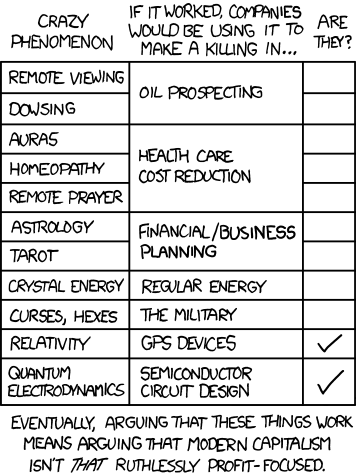
The new discussion thread (part 15) is here.
This is a new thread to discuss Eliezer Yudkowsky’s Harry Potter and the Methods of Rationality and anything related to it. This thread is intended for discussing chapter 82. The previous thread passed 1000 comments as of the time of this writing, and so has long passed 500. Comment in the 13th thread until you read chapter 82.
There is now a site dedicated to the story at hpmor.com, which is now the place to go to find the authors notes and all sorts of other goodies. AdeleneDawner has kept an archive of Author’s Notes. (This goes up to the notes for chapter 76, and is now not updating. The authors notes from chapter 77 onwards are on hpmor.com.)
The first 5 discussion threads are on the main page under the harry_potter tag. Threads 6 and on (including this one) are in the discussion section using its separate tag system. Also: 1, 2, 3, 4, 5, 6, 7, 8, 9, 10, 11, 12, 13.
As a reminder, it’s often useful to start your comment by indicating which chapter you are commenting on.
Spoiler Warning: this thread is full of spoilers. With few exceptions, spoilers for MOR and canon are fair game to post, without warning or rot13. More specifically: