these norms destabilising society in other ways?
Quality and quantity were the only sex-related problems that came to mind?
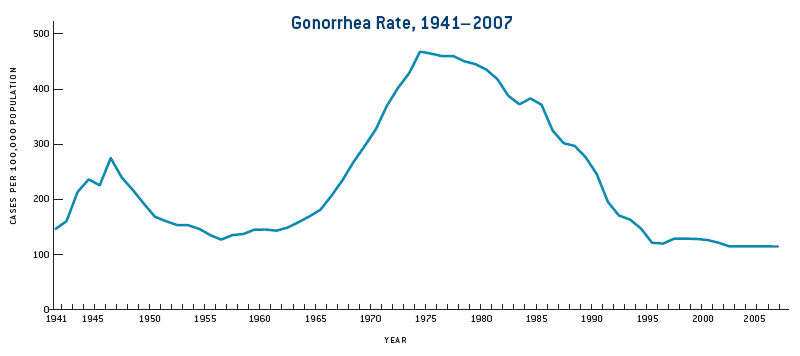
Pregnancy, particularly pregnancy out of wedlock, and venereal disease are the traditional sex-related problems. Both of them are massively higher after sexual liberation. (Out of wedlock births are also exacerbated by welfare, which is part of a larger political discussion.)
Births out of wedlock are somewhat difficult to hide from government record-keepers in developed countries like the US, though they may be possible to hide socially (which is what most people care about anyway). Out of wedlock births among African Americans are currently at ~70%; in 1940, a full generation before the civil rights era, it was 19%.
Venereal disease is a bit harder to compare to last century (whereas we have out-of-wedlock rates going back quite a bit), and there are issues with diseases (like syphilis) becoming treatable and overall medical care (including reporting) increasing. But the impact of the Sixties on American gonorrhea rates is still clear. (It also seems likely that gay liberation contributed to the AIDS epidemic- but the primary comparison there is to Cuba, where those with AIDS were quarantined. Unsurprisingly, quarantine reduces transmission rates.)
(It also seems likely that gay liberation contributed to the AIDS epidemic- but the primary comparison there is to Cuba, where those with AIDS were quarantined. Unsurprisingly, quarantine reduces transmission rates.)
What about Africa? Sure, there are all sorts of problems making that comparison, but it shows that anti-gay attitudes aren't particularly protective. Also, of course, attitudes were much more conservative in late-15th and 16th century Europe, but syphilis did pretty well. Looking at the rates of HIV infection by state, Cook's PVI only acco...
I've seen Jonathan Haidt mentioned on Less Wrong a few times, and so when I saw an article about (in part) Haidt's new book elsewhere, I thought it would be an interesting read. It was, but not for the reasons I expected. Perhaps it is unfair to judge Haidt before I have read the book, but the quotes in the article reveal some seriously sloppy thinking.
Haidt believes that there are at least six sources of moral values; the first five are harm/caring, fairness, loyalty, authority, sanctity/disgust. Liberty was recently added to the list, but doesn't seem to have made it into this article. He claims that liberals (in the American sense), care mostly (or only) only about the harm and fairness values, while conservatives care about all five. I myself am a one-foundation person, since I consider unfairness either a special case of harm, or a good heuristic for where harm is likely to occur; my views are apparently so rare that they haven't come up on Haidt's survey, and I haven't met anyone else who has reported a score like mine.
While Haidt describes himself as a "centrist", he argues that "you need loyalty, authority and sanctity to run a decent society." There are at least three ways that this claim can be read:
(1) Haidt's personal moral foundations actually include all five bases, so this is a tautology; of course someone who thinks loyalty is fundamental will think a society without loyalty is not decent. From the tenor of the article, this is at least psychologically plausible.
(2) The three non-universal values can be justified in terms of the common values. This is the interpretation that seems to be supported by some parts of the article, but it has its own issues.
(3) Haidt cannot tell the difference between (1) and (2). Most of the article makes this claim entirely plausible.
Here's one example of Haidt's moral confusion:
"In India, where he performed field studies early in his professional career, he encountered a society in some ways patriarchal, sexist and illiberal. Yet it worked and the people were lovely."
First, was Haidt surprised to find people with different politics than his to be personable? Had he literally never met a conservative before?
Second, what does it mean to say that the society "worked", or that the people were "lovely"? Indian society privileges men and certain castes over women and other castes. I say this not to denigrate India specifically, since there's no society in which women are treated equally to men, but to explain that India does have serious problems. Literacy rates among women are 68% of that of men, to pick a random statistic. And, of course, violence against women is endemic. Haidt reports that he "dined with men whose wives silently served us and then retreated to the kitchen." What does he suppose would have happened if one day one of those women refused to serve, or even, after serving, sat down at the table to join the discussion?
Of course, even this is an upper-class concern; lower class Indian women are far more likely to work outside the home, in order to survive. Apparently in some parts of India, public toilets charge women (who can ill afford it) but not men. And I can only assume that the situation was worse when Haidt was there, at least a decade ago.
Haidt rationalizes this by saying, "I was able to see a moral world in which families, not individuals, are the basic unit of society...". Perhaps this is the story that they tell (and perhaps they even believe it). But history shows that when women can find alternatives, they don't choose to live like this. So there is both a harm and a fairness concern here. Haidt, having seen the loyalty/authority story, comes to ignore the harm/fairness story. He follows this by an anecdote focusing on the harm caused by individualism, since he is apparently incapable of justifying the non-universal foundations on their own terms.
Here's another case of this confusion. Haidt claimed that among street children in Brazil, the "most dangerous person in the world is mom's boyfriend. When women have a succession of men coming through, their daughters will get raped," he says. "The right is right to be sounding the alarm about the decline of marriage, and the left is wrong to say, 'Oh, any kind of family is OK.' It's not OK."
In this instance, Haidt is switching the goalposts. His moral foundation test is designed to isolate the five foundations. But here, there is clearly harm in addition to any violation of tradition. He doesn't exactly say which non-harm foundation he wants to invoke here -- that is, what the mothers' violation is. Impurity is the only plausible choice. This, of course, brings to the front one of the most common real effects of the "purity" foundation: to disempower women.
I should add that there is no citation on this data; it also doesn't seem to appear in the book (at least, not that I could find via Google Books). A quick glance through Google does not reveal a plausible source for this. So where did he get it from? Probably not via direct observation (how would he have observed these rapes?). He must have heard it from Brazilians. Well, if that's true, then these Brazilian women must know it. And since nobody wants their daughter to get raped, this must mean that they have a very good reason for inviting these men in -- maybe the alternative is starvation. Recall that we're talking about "street children" here. I just can't imagine a woman saying, "yeah, he's going to rape my daughter, but I really love him!" But I think it's actually more likely that this is just the sort of rumor that the Catholic Church would want to spread, to combat unmarried cohabitation. It gets its memetic strength from blame-shifting/just-worldism: "If you didn't want your daughter to get raped, why did you shack (literally?) up with this guy?"
It's true that there are dangers from non-related men, as Sarah Blaffer Hrdy discusses in _Mother Nature: Maternal Instincts and How They Shape the Human Species; there are also potential benefits. Hrdy's book (which I haven't finished reading yet) discusses both, and also vastly complicates the view of what "traditional" family is. She presents multiple equilibria, some more common among farmers and others more common among foragers (to use Robin Hanson's language). A Brazilian shantytown doesn't really fit well into either framework, so it's unclear whether norms adapted for either would be effective.
So does Haidt believe that nontraditional families are wrong because they violate purity? Or because they're harmful? The standard conservative reply to this is that our traditions evolved because they were useful (i.e. prevented harm), and to erase the traditions without understanding the value that they provided is an mistake. This is put in a delightfully patronizing way by Chesterton -- notice how he will "allow" you to clear away a tradition as though it were his decision to make.
And it is in fact relatively easy to come up with evolutionary psychology just-so stories as reasons for why loyalty, authority, and purity would have been useful in the ancestral environment. (The same is true of fairness). Authority, for instance, might help with collective decision making. Maybe it's best for the tribe to go take the left fork, and it might be better to take the right fork. But it is almost always better for them all to take the same fork, than it is to split up. If there's one tribal leader, then they can make that decision and have others agree with it. This isn't a case of group selection; every individual of the group benefits from coordination. I describe this as a "just-so story" here because it would be extremely difficult to find evidence for whether in fact a specific moral intuition evolved for a specific reason. Haidt's book apparently presents some of these arguments in the context of group selection, but in this particular example, group selection (or even kin selection or reciprocal altruism) isn't a necessary part of the hypothesis; treating groups as part of the environment (rather than as the unit of evolution) is sufficient.
Moral foundations theory is perhaps useful descriptively, in that, if it were shown to be something beyond a just-so story, it would explain why there are five (or six, or more) foundations as opposed to one or two. It is, however, missing a piece: why are there people who don't share all five foundations? The evolutionary argument is not useful prescriptively, because evolution only cares about harm (and only certain kinds of harm), and once we decide to see moral questions in terms of harm, then questions of actual harm can screen off the other evolved heuristics. Yes, humans are Adaptation-Executers, not Fitness-Maximizers. So there are lots of cases where we follow our evolved intuitions rather than the pressures that selected for those intuitions. But we are also apparently adapted to contemplate moral philosophy. So when we find ourselves justifying an evolved intuition A in terms of another evolved intuition B, we might consider B more fundamental. And if there are cases where A isn't explainable in terms of B, five-foundation people just get stuck. This, perhaps does explain the one- or two-foundation view; it's what happens when you ask "why?" once, and throw out everything that doesn't actually have an answer. When you ask a second time, you're getting into the realm of meta-ethics. Instrumental five-foundation people (such as Haidt, probably), wouldn't get stuck -- but they would fall back to harm.
Maybe there's another argument for the three non-universal foundations, but Haidt doesn't make it. Does he feel that, by defining something as a "foundation", it doesn't need an argument? But if so, why does he keep reaching for harm as an explanation?
As a descriptive theory, Haidt's moral foundation framework helps explain some of the differing moral values people have. Haidt seems to wrongly interpret it as a useful prescriptive tool. However he has not presented any reason to think that it is, in fact, useful prescriptively, and has presented several reasons to doubt it.
[Added later:]
None of this is to say that there are no reasons to be conservative. You could be conservative instrumentally (as Haidt seems to be), or you could be conservative because you really do consider all five bases to be inherently valuable (you could also do both at once, but that should make you slightly suspicious that you're rationalizing). There's no inherent problem with either of those. Haidt's problem is that he wants to have it both ways; he want to present the non-universal foundations as inherently valuable, but all his actual arguments are about their instrumental value.