while it takes some time for the memory structures of the brain to degrade due to ischemia
This goes counter to all I know on the topic, subject to how severely you interpret "degrade". Can you source it, or explain how you formed that opinion?
Regarding your proposed solution, we can do one better (just an injection):
"Rabbits with blocked windpipes have been kept alive for up to 15 minutes without a single breath, after researchers injected oxygen-filled microparticles into the animals' blood."
Source: Journal Nature. Lipid foam, baby!
By 'some time' I mean on the order of a few hours. This is drawn from a few things, notably people who have recovered from medical death under cold conditions after multiple hours, and the relatively recent discovery that most of the numbers originally thrown around for irreversible brain damage (three to five minutes) are actually due to cell suicide when the patient is too rapidly reoxygenated, and many brain cells may remain viable for several hours. Additionally, the synapses, which are our primary point of concern in cryonics, are less volatile than the oxygen metabolism of the cell proper, which are likely to be the first thing to go.
On the other note, a synthetic oxygen carrier / oxygen-doped particles would certainly be an improvement, if it's that effective. I wonder if it would be practical to keep a syringe on my person at all time, and wear a bracelet giving instructions for administration.
Good thought; certainly there is a lot that can be improved with field cryonics and relatively little thought is given to this very important problem. (I suspect no small amount of magical thinking even among cryonicists).
Note the risk though; tPA (a fast-acting anticoagulant) is routinely given for stroke patients but it has a significant risk of causing hemorrhagic stroke, especially in old people.
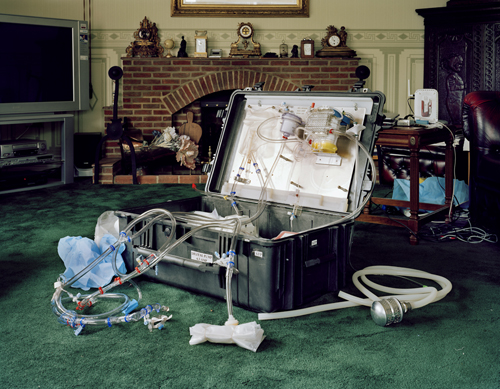
I don't know if you can make a perfusion pump fit into a shoebox, especially not without very good funding. I do remember a case where a standby team (With a slightly-more-than-briefcase-sized perfusion pump, I think it was this) was working on one of those resusci-anne dolls and they mishandled the pump, causing a whole mess:
I will add one thing that the reporter didn‟t because he had left the room to photograph some of the other CUK members before he lost his light to the setting sun. And that is that the venous blood reservoir bag in the circuit of the ATP exploded due to a misplaced clamp. The reporter apparently missed the timid request made to the meeting‟s hostess, Sylvia Sinclair, for a mop and towels to clean up the water that was all over the kitchen. While it is true that cryonicists often have no choice but to undertake to provide and deliver care for themselves, it is equally true that they should not attempt to do so in ways that make the situation worse for the patient than had they taken a simpler approach that was, in fact, within their ability to master. I had spent most of that day at the meeting trying to convince the CUK group that rather than the ATP, what they really needed was to use a simple, inherently „safe‟ open circuit system open circuit system equipped with a microbubble detector and auto-line clamp, to start cryoprotective perfusion as soon as was logistically feasible and to follow that with cooling of the patient to dry ice. Source (Emphasis mine).
If it were feasible (To make an automatic shoebox-sized HLM or general perfusion pump), it would be worked on, because then you don't have to pay all those expensive hemodialysis technicians (Trivia: Mike Darwin is one) and cardio perfusionists, who remain the only people capable of operating such machines in a manner that is safe for the patient.
I guess the goal isn't to achieve perfect perfusion, but simply to reduce the number of red blood cells in the brain while cooling the brain, to avoid clotting and slow ischemic damage. In the case of an emergency deployment of such a device, you're already going to experience significant ischemia, one way or another. Though I can see how embolisms could be catastrophic. I don't know if it would be possible to make such a device simple enough to be operated by an amateur while still being safe to use.
Blood clotting is not caused by red blood cells but by platelets. They do get caught up by the clot spreading around them and then act as parts of the barrier, but removing them too fast would actually increase ischemia because they're what carry the oxygen.
(By the way, I hope that the cryoprotectant solutions contain high concentrations of dissolved oxygen. Not nearly as good as having the actual RBCs, but you can increase the amount (supersaturation) by keeping it under pressure.)
Anyways, given that perfusion is already taking place (and this is removing all of the components of the blood including the platelets), the other option is to disable the blood clotting cascade, for example by administration of anticoagulants such as warfarin. I don't know if this is already done. You would also have access to more "extreme" types of anticoagulation, chemicals (or higher doses) that aren't on the medical market because the effects are normally too strong.
I suppose another option would be to suggest that the patient to start taking anticoagulants before death. I'm not sure whether that would have legal implications though.
Blood clotting is not caused by red blood cells but by platelets.
I thought ischemic tissue caused RBCs to form Rouleaux complexes. Even without RBC's, ischemia causes plenty of changes that have effects functionally equivalent to clotting: Swelling of myocytes and the endothelium, subsarcolemmal and endothelial blebs, et cetera.
I suppose another option would be to suggest that the patient to start taking anticoagulants before death. I'm not sure whether that would have legal implications though.
This is certainly helpful and doesn't seem to have been done in past patients, but we're mostly talking about unexpected settings here, where no standby is available. I don't think it has any legal implications, at least the Best's article doesn't mention any.
See the third paragraph of Coagulation - the diagram of the blood clotting cascade is on the right. I've never heard of rouleaux having a role in blood clotting - a quick PubMed search turned up this case study, but it was due to mutations in the protein fibrinogen.
I don't think it has any legal implications, at least the Best's article doesn't mention any.
I was thinking that since the drugs are dangerous (even more so if you're already in a weakened condition), it would be viewed as attempting to hasten their death. Especially if someone overdosed either deliberately or accidentally.
I've never heard of rouleaux having a role in blood clotting
They block blood vessels and prevent perfusion, which is why it's equivalent to clotting.
As long as you recognize that clotting is a different process. =)
It's been a few years since I studied this, but as far as I know, the physiological significance of rouleaux (including whether they block blood vessels) is unknown - don't forget that they're in equilibrium with the non-rouleaux form. Although cold temperatures will slow down that equilibrium, and possibly cause the problems you're referring to.
As long as you recognize that clotting is a different process. =)
Of course.
It's been a few years since I studied this, but as far as I know, the physiological significance of rouleaux (including whether they block blood vessels) is unknown - don't forget that they're in equilibrium with the non-rouleaux form.
I wouldn't know, but Mike Darwin says they are harmful:
[...] irregular aggregation of RBCs rouleaux formation has a profound negative impact on perfusion.
I would have been much more convinced by data from a controlled experiment. A lot of things could cut off flow, as you pointed out, and there are a lot of things going wrong in a dying person. I'm actually not sure why he brought rouleaux into it - my understanding is that we already know the RBCs clump and that this blocks capillaries.
In any case, the main point I was trying to make was that reducing the number of RBCs in the brain is probably not the best way to go, unless we can figure out an alternative way to supply oxygen. Destroying the RBCs and letting the hemoglobin travel freely would probably help, but that would set off all sorts of damaging physiological responses as well.
Read the linked article.
The diameter of the average RBC is ~7.7μ, about 1μ larger than the diameter of the average brain capillary. In order for RBCs to pass through capillaries it is necessary for them to deform (and in so doing place the maximum amount of surface area in contact with the vascular endothelium to facilitate gas exchange). RBC deformability is critically dependent upon RBC intracellular adenosine triphosphate (ATP) concentration being adequate. With periods of ischemia of ~ 7 minutes, RBCs become depleted of ATP and become rigid, making passage through brain capillaries more difficult (higher arterial pressure required) or impossible.
In-house research conducted by the author has demonstrated that the cerebral microcirculation remains profoundly compromised for 30-60 minutes following reperfusion, even when circulation is restored using cardiopulmonary bypass. Brain parencymal and endothelial cell swelling, as well as changes in the zeta potential of the red blood cells, may all be contributing to the extensive blood sludging and microvascular stasis observed after reperfusion following 10 minutes of global normothermic ischemia in the laboratory.
I already read it. That quote doesn't say anything about rouleaux or clotting; it just describes one of the mechanisms (other than clotting) by which brain ischemia occurs. Can you be more specific?
Blood clotting is not caused by red blood cells but by platelets.
I thought ischemic tissue caused RBCs to form Rouleaux complexes. Even without RBC's, ischemia causes plenty of changes that have effects functionally equivalent to clotting: Swelling of myocytes and the endothelium, subsarcolemmal and endothelial blebs, et cetera.
I suppose another option would be to suggest that the patient to start taking anticoagulants before death. I'm not sure whether that would have legal implications though.
This is certainly helpful and doesn't seem to have been done in past patients, but we're mostly talking about unexpected settings here, where no standby is available. I don't think it has any legal implications, at least the Best's article doesn't mention any.
See the third paragraph of Coagulation - the diagram of the blood clotting cascade is on the right. I've never heard of rouleaux having a role in blood clotting - a quick PubMed search turned up this case study, but it was due to mutations in the protein fibrinogen.
I don't think it has any legal implications, at least the Best's article doesn't mention any.
I was thinking that since the drugs are dangerous (even more so if you're already in a weakened condition), it would be viewed as attempting to hasten their death. Especially if someone overdosed ei...
I just read this article (which is well worth reading for anyone interested in cryonics). One of the important things that the article points out is that, while it takes some time for the memory structures of the brain to degrade due to ischemia, one of the more rapid effects is blood clotting in the fine capillaries of the brain after fairly brief ischemia. This reduces the flow of cryoprotectant, and causes large swathes of neural tissue to be frozen, instead of vitrified, which would be catastrophic for personal identity. While this is not a problem for best-case 'standby' cryonics, it is a problem for those who cannot afford a standby team, or are simply hit by cars.
Being an engineer, my first thought is that this is ridiculous, and there has to be a better solution to the problem. It may be possible to build a device, maybe the size of a shoe box, which can be deployed in the field by a minimally-trained amateur (like a defibrillator), and perfuses the brain with cold saline and anti-coagulants -- or even a synthetic oxygen carrier). I'm picturing a cylinder of fluid, large needles with sterilizing caps for tapping the jugular and carotid arteries, and a gas cylinder to provide pressure. You'd simply break a chemical cold pack, put a plastic neck brace in place and insert the needles, and press a button.
Such a device could even be useful to non-cryonicists, as a way to prevent ischemic injury in people found medically dead at the scene of an accident, during transport to the hospital.
Does anyone with more of a medical background know if such a machine would be at all feasible? I can't imagine it would be expensive to construct.