Wasn't sure if posting my not-very-considered answers was in the spirit of the exercise, but since you're hoping for more answers, here are mine. (And despite taking a QM class that discussed the Stern-Gerlach experiment, I'd somehow forgotten that S-G used an inhomogeneous magnetic field. So I might as well solicit some schoolin' from LW on this topic.)
Q1. If "When exactly does the atom align itself?" means "When does the atom start changing trajectory in response to the magnetic field?", I'd say it does that as soon as it enters the field. If it means "When can we say the atom has a single, unambiguous spin direction?", I'd say that's not until the atom hits the screen — before then it's in a superposition of spin up and spin down states.
Q2. As the atoms all travel unimpeded through the first S-G field, through the holes, and then through the reverse field, I guess they'd remain in a 50/50 superposition the whole way along. So they're just as "unaligned" or "aligned" as they were when they started. Presumably most of us would say the silver atoms were originally "unaligned" when they came flying out of the furnace, in which case we'd have to say they're still "unaligned".
Q3. I'd see two equally bright blobs, like those I'd have seen on the original screen, only further apart (because the two groups of atoms move further apart as they propagate, since the spin down particles have downward velocity relative to the spin up particles).
Q4. I'd observe either an atom continuously accelerating upwards or an atom continuously accelerating downwards. Once the atom enters the S-G apparatus and I see the accelerometer needle start moving, it's no longer in a superposition; it's either spin up or spin down, and I observe it accelerate accordingly.
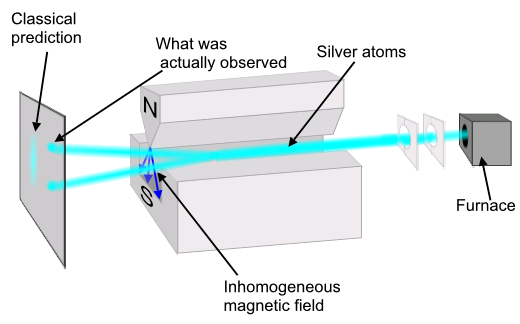
This post is prompted by the multitude of posts and comments here using quantum this and that in an argument (quantum dice, quantum immortality, quantum many worlds...). But how does one know if they understand the concept they use? In school a student would have to write a test and get graded. It strikes me as a reasonable thing to do here, as well: let people test their understanding of the material so that they can calibrate their estimate of their knowledge of the topic. This is an attempt to do just that.
Let's look at one of the very first experiments demonstrating that in the microscopic world things are usually quantized: the Stern-Gerlach experiment, in which measured angular momentum is shown to take discrete values. The gist of the experiment is that in a varying magnetic field the tidal force on a magnet is not perfectly balanced and so the magnet moves toward or away from the denser field, depending on the orientation of its poles. This is intuitively clear to anyone who ever played with magnets: the degree of attraction or repulsion depends on the relative orientation of the magnets (North pole repels North pole etc.). It is less obvious that this effect is due to the spatially varying magnetic field density, but it is nonetheless the case.
In the experiment, one magnet is large (the S-G apparatus itself) and one is small (a silver atom injected into the magnetic field of the large magnet). The experiment shows that an unoriented atom suddenly becomes aligned either along or against the field, but not in any other direction. It's like a compass needle that would only be able to point North and South (and potentially in a few other directions) but not anywhere in between.
If necessary, please read through the more detailed description of the experiment on Wikipedia or in any other source before attempting the following questions (usually called meditations in the idiosyncratic language used on this forum).
Meditation 1. When exactly does the atom align itself? As soon as it enters the field? At some random moment as it travels through the field? The instance it hits the screen behind the field? In other words, in the MWI picture, when does the world split into two, one with the atom aligned and one with the atom anti-aligned? In the Copenhagen picture, does the magnetic field measure the atom spin, and if so, when, or does the screen do it?
Hint. Consider whether/how you would tell these cases apart experimentally.
Meditation 2. Suppose you make two holes in the screen where the atoms used to hit it, then merge the atoms into a single stream again by applying a reverse field. Are the atoms now unaligned again, or 50/50 aligned/anti-aligned or something else?
Hint. What's the difference between these cases?
Meditation 3. Suppose that instead of the reversing field in the above experiment you keep the first screen with two holes in it, and put a second screen (without any holes) somewhere behind the first one. What would you expect to see on the second screen and why? Some possible answers: two equally bright blobs corresponding to aligned and anti-aligned atoms respectively; the interference pattern from each atom passing through both holes at once, like in the double-slit experiment; a narrow single blob in the center of the second screen, as if the atoms did not go through the first part of the apparatus at all; a spread-out blob with a maximum at the center, like you would expect from the classical atoms.
Hint. Consider/reconsider your answer to the first two questions.
Meditation 4. Suppose you want to answer M1 experimentally and use an extremely sensitive accelerometer to see which way each atom is deflecting before it hits the screen by measuring the recoil of the apparatus. What would you expect to observe?
Hint. Consider a similar setup for the double-slit experiment.
This test is open-book and there is no time limit. You can consult any sources you like, including textbooks, research papers, your teachers, professional experimental or theoretical physicists, your fellow LWers, or the immortal soul of Niels Bohr through your local medium. If you have access to the Stern-Gerlach apparatus in your physics lab, feel free to perform any experiments you may find helpful. As they say, if you are not cheating, you are not trying hard enough.
By the way, if anyone wants to supply the pictures to make the setup for each question clearer, I'd be more than happy to include them in this post. If anyone wants to turn the meditations into polls, please do so in the comments.
Footnote: not posting this in Main, because I'm not sure how much interest there is here for QM questions like this.