This doesn't apply in all countries. In UK for instance, it is common to have a standing charge (flat fee per day) as well as a usage charge (fee per kWh). Or some utilities charge a high price for the first few kWh, and then a lower price for subsequent kWh, which has a similar effect. See here for some details.
My perspective is US-centric, but from what I'm aware the per kWh price in most countries for most people is well above the marginal costs. Many places do have a daily or monthly charge but that tends to be $10 or less--not even close to high enough to recover all the fixed costs associated with a customer. Looking through some of the Scottish Power rates that you linked to, the daily charge doesn't get much higher than 30p. That helps mitigate the issue a bit, but it's still there. In that case, retail kWh prices--after the standing charge--is still over 10p / kWh. Wholesale rates look like they're 4.5p in the UK (which should be a good proxy for short run marginal costs) so there's still a big gap.
Even where there is a single price (a price per kWh) it is not true that the "correct" market price is just the marginal cost...
As far as I'm aware, economic theory says the "correct" price for electric utilities is lower than where the actual price is. It's probably easier to visualize on a graph like this one. (I'm saying the difference between Pf and Pr, at least in some cases, may be higher than the externality, which is a real-life example of what the op is talking about). If that's not standard economic theory though let me know as it's an area of interest to me.
The market correction mechanism you described works for most industries but electric utilities are typically treated as natural monopolies, the optimal number of suppliers is one. But even if that 's not true (i.e. it's not actually optimal), in many places regulation only allows one supplier so the market forces described couldn't work. The result is that the average /kWh price customers pay is higher than the average marginal costs (optimal society price) and it continues indefinitely because new firms can't come into the market. There isn't large profits made though because they're pricing at the regulated price (at the average total cost) and not at the monopoly price (again, easier to visualize on the graph linked to above).
It's probably easier to visualize on a graph like this one. (I'm saying the difference between Pf and Pr, at least in some cases, may be higher than the externality, which is a real-life example of what the op is talking about).
I think that, strictly, Stuart was arguing that the difference between Pm and Pf exceeds the externality cost, which may well be true. However, politically it is of course much easier to force a polluting monopoly to lower its price (to Pf) than to subsidise said monopoly still further. It is also economically more efficient (the...
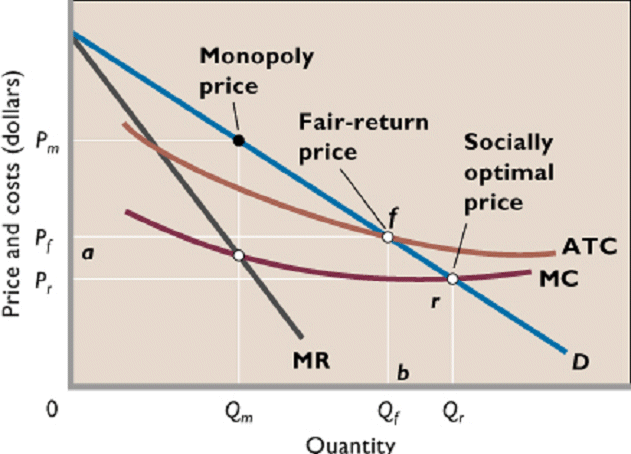
Example nicked from this online Berkeley lecture.
Monopolies are bad (morality and economics agree here).
Firms that pollute are bad (morality and economics agree here).
What about monopolies that pollute?
What about strong monopolies that pollute and receive government subsidies?
Well...
Pollution, and other negative externalities, cause firms to produce too much of their product. That's because they don't pay the full cost of the product, including the impact of pollution.
The equilibrium behaviour for monopolies is to produce too little of their product, to keep prices and profits high.
So a monopoly that pollutes is subject to two opposite tendencies: the unpriced-pollution tendency to produce too much, and the monopolistic tendency to produce too little. If the effects are of comparable magnitude, then the monopoly might be much closer to social optimum than a free market would be (the social optimum, incidentally, will generally involve some pollution: we need to accept some pollution in the production of fertiliser, for instance, in order to have enough food to stop people starving).
In fact, if the monopolistic effect is too strong, then the firm may under-produce, even taken the pollution effect into account. In that case, we can approach closer to the social optimum by... subsidising the polluting monopoly to produce more!!
And that, my friends, is why economics is not a morality tale.