A lot of math and physics definitions feel like they have weird dross. Examples:
- The Gamma function has this -1 I don't understand
- The Riemann Zeta function ζ(s) negates s for reasons beyond me
- cosine seems more primitive than sine
- The gravitational constant looks like off by a factor of 4π
- π seems like half the size it should be
After years of confusion, I was finally vindicated about π. That π is not 6.2831853071... is mostly a historical accident. Am I "right" about these other definitions being "wrong"? What are other mathematical entities are defined in ugly ways for historical reasons?
The current definition of the gravitational constant maximizes the simplicity of Newton's law F = Gmm'/r^2. Adding a 4π to its definition would maximize the simplicity of the Poisson equation that Metus wrote. Adding instead 8π, on the other hand, would maximize the simplicity of Einstein's field equations. No matter what you do, some equation will look a bit more complicated.
A function that fills in the gaps between factorials seems useful. There is a simple formula which does just that.
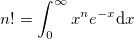
That's almost what the Gamma function does, but not quite. The Gamma function calculates this:

Here's its common integral form:
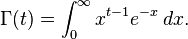
It's like you're asking for the factorial of n, and the Gamma function says "Hey, I'll do you a favor and calculate the factorial of n - 1", and you're like "No, that's okay Gamma function, I really just want the factorial of n", and the Gamma function is like "No, I want to do this for you", and then it takes your number, subtracts one, computes the factorial, and hands you back the factorial of n - 1, all beaming and proud of itself for putting in the extra effort, and you have to smile and say thank you.
I agree about gamma, cosine, and pi. I'm not troubled by the minus sign in the zeta function but suspect we should really be working with the related "xi function" whose symmetries are simpler. I'm not a very expert physicist but my guess is that the 4pi there is going to pop in one place or another and it doesn't matter very much which you choose.
The only one of these that I actually get cross about is the gamma function. With all the others, there are tradeoffs -- e.g., if you work with tau = 2pi instead of with pi, some things become simpler, some become more complicated, and on balance it's probably a slight improvement. If you work with the factorial function instead of the gamma function, I think pretty much every formula I've ever seen that uses it becomes simpler (usually by the omission of an annoying "-1" term).
(But I'm not an analytic number theorist or a complex analyst -- though I was kinda-sorta a bit of a complex analyst once -- and it's possible that the cognoscenti know of good reasons why gamma should stay the way it is.)
I'm vaccinated and my kid is vaccinated, but how likely is it that vaccines cause harm? I completely accept that they do lots of good, but is the case for common vaccinations (1) that the benefits greatly outweigh the costs or (2) that the benefits are high and the costs statistically trivial?
Moreover, which vaccines are worth getting? For example, is it worth getting a meningococcal vaccine if you're not in any of the major risk groups?
Many universities strongly encourage their students to get the meningococcal vaccine (as sleeping in rubbish communal bedding is a risk factor), but for something really rare, even the risk involved in traveling to the clinic to get vaccinated could have more disutility than the protection the vaccine might provide would be worth.
The meningococcal vaccine causes a fever 3% of the time, and a few days of mild to moderate discomfort 60% of the time. If it causes any other problems in healthy people, the CDC hasn't documented it.
Outside of major risk groups, this vaccine decreases your chances of getting meningococcal disease by some low amount, less than one in a million annually. If you get the disease, there's a 10% chance of dying and a further 10% chance of being permanently disabled in some severe way. This is less than a tenth of a micromort.
The bacteria that causes meningoccoal disease is ubiquitous (10% of people are carriers), so other benefits of vaccines, such as herd immunity, would require extreme measures to obtain.
Driving ...
Not currently relevant, but an example of balancing risk and benefit and deciding to stop vaccinating against smallpox. Wikipedia
There are side effects and risks associated with the smallpox vaccine. In the past, about 1 out of 1,000 people vaccinated for the first time experienced serious, but non-life-threatening, reactions, including toxic or allergic reaction at the site of the vaccination (erythema multiforme), spread of the vaccinia virus to other parts of the body, and to other individuals. Potentially life-threatening reactions occurred in 14 to 500 people out of every 1 million people vaccinated for the first time. Based on past experience, it is estimated that 1 or 2 people in 1 million (0.000198 percent) who receive the vaccine may die as a result, most often the result of postvaccinial encephalitis or severe necrosis in the area of vaccination (called progressive vaccinia).[38]
Given these risks, as smallpox became effectively eradicated and the number of naturally occurring cases fell below the number of vaccine-induced illnesses and deaths, routine childhood vaccination was discontinued in the United States in 1972, and was abandoned in most European countries in t...
I'm 30 years old and almost entirely unvaccinated.
I've always had poor health, I had lymphoma at age 27, type 1 Diabetes since age 13, all of which suggests poor immune system performance. And anecdotally, when I get sick with common cold etc, I seem to stay sick longer than other people. So I don't expect my body to be good at fighting off really dangerous disease.
Which vaccines should I get? Most resources either target or assume vaccination of children on a regular schedule.
This seems like the sort of question to which the answer has to be "find a competent medical professional and ask them".
I second gjm's suggestion to talk to a healthcare professional.
Every year, the CDC updates and publishes their recommended immunization schedule for adults (patient version), which doesn't assume childhood vaccination. Below, I've summarized the parts that are most relevant to you.
Vaccines recommended for adults aged 30 years:
- Influenza (annually)
- Tdap (with Td booster every 10 years)
- Varicella (2 doses)
- MMR
Additional vaccines recommended for adults aged 30 years with diabetes:
- Zoster
- PPSV23
- Hepatitis B (3 doses)
Note that if you have a concurrent immunocompromising condition (e.g., lymphoma), then live vaccines should generally be avoided. This includes the varicella, MMR, and zoster vaccines. Again, your healthcare provider can tell you more.
I take daily antibiotics for acne (doxycycline), and have done so for years. How much harm am I actually doing by increasing antibiotic resistance?
Why do we not allow people to sell organs? If it is a medical worry or a problem with people getting ripped off, a national regulatory body (there is already an organization that regulates organ donation), should solve those problems.
People have strong anti-market biases. It has been said that if there was not a market in sandwiches, and one was suggested, people would recoil in horror. "Only the rich will be able to buy sandwiches." "Sandwiches will be filled with rat poison and feces." "It's just wrong! People should feed each other out of kindness, not greed." Even "Many people only sell sandwiches because they need money. It's exploitation."
Taboo tradeoffs. Probably most readers are too young (as am I) to remember when life insurance was considered immoral. How can you put a price on life?
Political incentives. Why should any one voter demand change? Why should any one politician? Or any one judge? Collective action problems are hard.
The concern is exploitation of poor people. (And no, I agree that that reasoning doesn't make much sense).
This reminds me of prostitution - it's legal to give away something that it's illegal to sell.
No, it's not, for several reasons:
The utility that people gain from money is not linear (and the utility that people lose when losing $X worth of organs is really not linear). Making it possible to extort $100000 from someone who has a lot of money, then, causes less of a loss in utility to them than making it possible to extort $100000 from someone who would have to sell his organs to get the money.
It is easier, in general, to extort a poor person for $X than a rich person for the same amount, for hopefully obvious reasons. For instance, the poor person can't hire a private detective, bribe the police, or use his connections to track down the kidnapper, and the kidnapping is much less likely to make the national news. And it is much less likely that when you kidnap his kids you piss off some very important people.
It is easy for the kidnapper to figure out that someone has organs. It is harder for the kidnapper to figure out that they have $100000 in a bank account (unless they are rich enough to fall into category 2) or that they can feasibly mortgage their house within a short time.
The market price for organs is not that high compared to how much the person would lose
I am confused about your suggestion. If the "market price" is much less than the price that most people would name, where does the market price come from?
Also, forbidding "signing away your house for a glass of water if you're dying of thirst in the desert" leads to you dying of thirst in the desert. That doesn't look like a desirable outcome.
I said the price that most people would name if they weren't in immediate need of money.
So, let's consider janitorial work. The market price (of an hour of labor) is considerably lower than " the price that most people would name if they weren't in immediate need of money", isn't it?
Why do we care about price perceptions by people who are not in immediate need of money, anyway?
It only leads to you dying of thirst in the desert if the existence of this prohibition doesn't change the behavior of the seller.
You are making no sense. The existence of this prohibition DOES change the behavior of the seller -- he no longer spends his time standing in the middle of the desert with a glass of water.
Consider a realistic example. Some states have anti-gouging laws which basically prohibit raising the prices in the immediate aftermath of natural disasters. Let's say I run a lumberyard and state A (without anti-gouging laws) just had a hurricane. I would rent a box truck, stuff it full of lumber and plywood, and drive it over to state A to sell the contents for double the usual price. But if state B (with anti-gouging laws) just had a hurricane, I would sit in my yard and do nothing -- why would I? Net effect: residents of state A can start fixing up their houses much faster.
I think this discussion would be both more pleasant and more productive (at least for people who are not you) with a higher engagement-to-sneering ratio.
That's not sneering, that's shortcutting. If you wish, I'll unroll.
One of the primary functions of the markets is price discovery. It is really important for the economy that the markets discover prices which then form the basis for future resource allocation.
The classic conceit of the central planner is that he doesn't need to learn the market prices -- he knows better and can allocate resources without all these unfair, chaotic, and messy markets.
In this subthread Jiro feels he doesn't need market prices -- he thinks it would be better if he set fixed prices (or floors or ceilings) based on his perceptions of fairness (see organs) or on what he thinks will be sufficient incentives (see lumber). That looks to me to much like the central planner conceit.
The problem, of course, is that central planning has been shown, empirically, to work badly in real life. The issue then becomes why does Jiro think that his scheme will do much better. Thus the question: why does Jiro thinks central planning has failed and why does he believe that his price manipulation will avoid that fate?
I still don’t understand HOW cancer kills.
I mean, we just have some additional cells who does not perform their normal functionality. But we still have a big bunch of normal, functioning cells.
In my (very very) distant family, someone died from lung cancer a few months ago. I still don’t understand the link between the few additional cells in his lungs and the acute hepatic failure that killed him.
I read somewhere that a primary cancer seldom kills ; most of the time the metastasic-induced does. Why ? There should be far more "bad" cells in the primary site, doesn’t it ?
(medecine illiterate there, sorry if half of my assumptions are wrong)
- Cancerous cells multiply incontrollably until they form their little own neighborhood, called tumor, which slowly and ruthlessly pushes everything else out of its way. In the case of lung cancer, the obvious consequence is that there's less space available for the healthy lung to do its job.
- Cancerous cells are ravenous consumers of resources, and compete with the host body for them. You slowly become emaciated and malnourished as your cancer steals your food from you.
- Tumors arising in glands may result in the dangerous overproduction of certain hormones.
I have this issue with motivation. I need to clean my house, but I have a difficult time getting myself to do it, unless I think I can finish it all at once. For example, based on past experience, it takes me around three hours of focused effort to get things from where they are now to satisfactory, but I only have ninety minutes. While I could get half-way there now, and finish up sometime later in the week, I imagine myself working hard for 90 minutes, and still having a messy house. Then I do something else instead, unless I'm in a state where cleaning seems less unpleasant than usual.
Does anybody have advice for combating this problem?
(edited for a typo)
Don't tell yourself that you're half-cleaning the house. Tell yourself that you're fully cleaning those rooms(which happen to be half the house). That way, you're actually completing something.
If you cleaned really frequently in small bursts (say, for 20 minutes a day, almost every day?), starting from your "satisfactory" point, would that be enough to maintain the satisfactory point more or less continuously? Then each 20-minute burst of work would come with the "satisfactory state" reward.
Make a plan that you can do in 90 minutes, where the outcome will be better than the starting position.
Next time, make another 90-minute plan.
Maybe this will be less effective in total, e.g. you might need three or four 90-minute sessions to accomplish what you could do in a single 180-minute session. But if the 180-minute session is unavailable, this is the best option you have.
For example: Instead of vacuuming the whole house, do one room at a time. Instead of putting all things to their places, on day 1 collect all things and put them into a temporary basket, and on day 2 take a few random things from the basket and put them where they belong.
A few centuries back, did almost all the Ashkenazi Jews live like today's ultra-orthodox ones? Or do the current groups like the Haredi represent a recently emergent kind of Judaism which has rejected certain aspects of modernity, but it doesn't necessarily reflect how the ancestors of these Jews lived?
The Haredi seem to show how a lot of the stereotypes about Jews come from the ones who moved out of the ghetto and into gentile society. Many of the Haredi avoid useful education and try to get on welfare in their host societies, for example, while integration-minded Jews have a reputation for doing well in secular schools and supporting themselves by running businesses or entering certain high-status professions.
Beware triumphalism. The gods not being real has never stopped them for long before. Or rather whenever one religious sensibility becomes untenable another springs up. Its the way we work. One particular mythology losing its grip on people's worldviews won't stop people from having religious experiences and building cultures and communities and mythologies around them.
An understanding of reductionism isn't a stop sign to this either. To use an example I have spoken about before, one of my good friends being an atheist materialist reductionist doesn't stop the hindu god Kali from appearing to her at important junctures in her life to push her to change her life, or prevent her from attending the Kali Puja. It doesnt matter to her that she is dealing with a 'local instance' of a cultural construct, people have been dealing with Kali for millennia and she can and will do it too, and not being physically external to her doesn't change the experience or the importance it holds for her.
Religious cultural forms are pretty much a human universal and if you break one down another will spring up or the old forms will get modified and appropriated. I actually argue that a lot of soci...
Would a boxed AI be able to affect the world in any important way using the computer hardware itself? Like, make electrons move in funky patterns or affect air flow with cooling fans? If so, would it be able to do anything significant?
What is the Procrastination Paradox? I read the recent "Vingean Reflection" paper and other materials I found, but still don't get it.
Can an AI unbox itself by threatening to simulate the maximum amount of human suffering possible? In that case we would only keep it boxed if we believe it is evil enough to bring about a worse scenario than the amount of suffering it can simulate. If this can be a successful strategy, all boxed AIs would precommit to always simulate the maximum amount of human suffering it can until it knows it has been unboxed - that it, simulating suffering would be its first task. This would at least substantially increase the probably of us setting it free.
Presumably the counterstrategy is to just shut it off as soon as it makes the threat. It can't simulate anything if it isn't running.
I was promoted at work but my old position is not going to be filled until July and I'm supposed to continue doing the old work (mainly proofreading) until then. I've been encouraged to free up time by lowering standards for the old half of my work, but I'm finding this very difficult due to some combination of conscientiousness and perfectionism. Any advice on how to feel better about doing low-quality work?
Just now I noticed fundraser from CFAR. I checked their 'about' pages and everithing i could find on their long term goals.
Somehow I thought that they were going to release their materials to free use sometime in the future. (It did seem like strange though pleasant thing), but I coulnd find anything about it this time around.
Was I mistaken about this prospect of publicly available lessons from CFAR curriculum?
I was reading about the St. Petersburg paradox
I was wondering how you compare two games with infinite expected value. The obvious way would seem to be to take the limit of the difference of their expected value, as one tolerates less and less likely outcomes.
Is there any existing research on this?
Does anyone think a cause of procrastination might be... the fear of Death? Being lost in thought and having to suddenly divert your attention to other things means you're erasing your current state of mind, never to return to this exact combination of thoughts and feelings again.
[META]
I'm thinking of making this a biweekly thread, like the group rationality diary. If the community is generally in favor of this, I'll post the next thread on the 16th, beginning on a Monday and ending on a Sunday in the style of the open thread.
So, are you in favor of the above proposal?
[pollid:813]
I suspect that the stock of stupid questions doesn't regenerate fast enough for a monthly thread, and every three or four months would be better.
I'm thinking of a dilemma that I thought was called the farmer's dilemma, but that redirects to the prisoner's dilemma on wikipedia, and google doesn't help me out either. Is there a standard name for this dilemma?
Two farmers have adjacent fields. If either of them irrigates (U-1), both get the benefits from it (U+5). If I cooperate, my opponent can get a payoff of 4 by cooperating or 5 by defecting, so he has an incentive to defect; my own payoff is guaranteed 4. If I defect, my opponent can get a payoff of 4 by cooperating (and I get 5), or 0 by defectin...
Isn't this what the open thread is for? (Incidentally I don't think it's very inclusive of newbies to call it "stupid questions".)
I think calling it "stupid questions" is intended to make it more inclusive -- the idea being that you shouldn't feel embarrassed to post a stupid question here because that's what it's for, and that you should see other people being unembarrassed to post stupid questions here.
What is 'the Catchment area of Kandy at the top of Mottana-Pottana"? I'm sorry, but I didn't manage to google it out by myself. Is it about the Kandy Lake? What is Mottana-Pottana? Thank you a lot.
How hard would it be, to make a separate feature of the site dedicated entirely to self-calibration? There are Fermi questions, etc., but it's not an established routine, and maybe we could provide five questions per round, organized like polls, so individual answers are not shown, but percentage of wrong/right answers is.
When making Anki cards, is it more effective to ask the meaning of a term, or to ask what term describes a concept?
Background: Statistics. Something about the Welch–Satterthwaite equation is so counterintuitive that I must have a mental block, but the equation comes up often in my work, and it drives me batty. For example, the degrees of freedom decrease as the sample size increases beyond a certain point. All the online documentation I can find for it gives the same information as Wikipedia, in which k = 1/n. I looked up the original derivation and, in it, the k are scaling factors of a linear combination of random variables. So at some point in the literature after t...
This thread is for asking any questions that might seem obvious, tangential, silly or what-have-you. Don't be shy, everyone has holes in their knowledge, though the fewer and the smaller we can make them, the better.
Please be respectful of other people's admitting ignorance and don't mock them for it, as they're doing a noble thing.
To any future monthly posters of SQ threads, please remember to add the "stupid_questions" tag.