A better test of an Objectivist's sense of humor, perhaps?
http://www.savethehumans.com/instantgrat/thelist/objectivist_sex/index.shtml
Back during what one might call my Objectivist phase -- I prefer to think of it as the time during which I was processing Objectivism -- I was worried, just a little, when I didn't much appreciate a lot of the "jokes" about Objectivism and its adherents. That list reassured me that, yes, I was still able to laugh at my beliefs when appropriate.
"If I want to make a funny political cartoon, I have to put in some effort. Go beyond the cached thought. Use my creativity. Depict Bush as a tentacle monster and Science as a Japanese schoolgirl."
Yikes. This is scary because a tentacle monster and a Japanese schoolgirl would have been my first thought.
Would jokes where Dilbert's pointy-headed boss says idiotic things be less funny if the boss were replaced by a co-worker? If so, does that suggest bosses are Hated Enemies, and Dilbert jokes bring false laughter?
I'd call that character humor, where the character of the boss is funny because of his exaggerated stupidity. It wouldn't be funny if the punchline was just the boss getting hit in the face by a pie (well, beyond the inherent humor of pie-to-face situations). Besides, most of the co-workers say idiotic things too!
Dilbert is less a satire and more a documentary. The amusement comes from us realizing how screwed up it is that large corporations work this way. We laugh like a man who just realized he was mortally wounded and none of his savings accounts he sacrificed earlier opportunities at hedonism for matter anymore.
The pointy-haired boss is presented as a Hated Enemy, but not just because he's a boss; it's because he's a boss and an idiot.
There are other considerations. Substituting a celebrity known for their zany improv humor and lack of personal dignity for Bill Gates would probably ruin the joke. You need someone who takes themselves seriously enough for the joke to work.
There's also an element of schadenfreunde involved. As Mel Brooks once noted: "Tragedy is when I cut my finger. Comedy is when you fall into an open sewer and die."
Would jokes where Dilbert's pointy-headed boss says idiotic things be less funny if the boss were replaced by a co-worker? If so, does that suggest bosses are Hated Enemies, and Dilbert jokes bring false laughter?
I don't think this is true in general of Dilbert strips, but I would venture that it is true of an awful lot of Dilbert style or associated "humor".
Scott Adams' jokes about pointy headed bosses are 'release of tension' jokes : the tension that arises from having to live with the species. You could call it, being constrained to live in absurdity. In that sense, some say they serve rather to avoid the phb becoming a hated enemy. You can't hate someone while laughing at his foibles. I guess that is the distinction, we're laughing at the phb's absurdity, not at his discomfiture. There is no such tension with a co-worker, hence no joke.
Robin: Dilbert has always had a number of defective coworkers too, most notably Wally. Different characters have different personalities, and random scrambling of actions with disregard to personality would destroy humor, but all Dilbert characters are frequently mocked (except maybe Dogbert?).
Let's say my friends and I make crass jokes about our Hated Enemy: stupid people. If we don't find similar jokes made by our Hated Enemy about People Like Us funny, is that because we're cultish or because jokes about scientists being stupid simply don't work? Would that explain why I'd find Godzilla Bush stomping on Science funny but not Scientist Godzilla stomping on Truth? (I'd find the latter funny if Scientist Godzilla was stomping on a Truth church; that would be adorable.)
This is a valid point: to reverse a joke you can't just change the labels around, because jokes that apply to stereotypes only make sense when they apply to a stereotype that people know about. In your case you might try laughing at a joke about a mathematician who's so deep in thought that he walks into traffic.
I should have.
I was actually thinking of an (apocryphal) story I heard once about a physicist driving to work who absent-mindedly drove halfway there on a set of railroad tracks.
"But humor more than most, because humor relies on surprise - the ridiculous, the unexpected, the absurd.
(Satire achieves surprise by saying, out loud, the thoughts you didn't dare think. Fake satires repeat thoughts you were already thinking.)"
Actually I've always felt a large part of humour is depicting saying what everyone thinks but nobody says. How many comedians make jokes about spouses, traffic, their own minority, how often are those jokes things people in the audience don't already think about?
"A building labeled "science", and a standard Godzilla-ish monster labeled "Bush" stomping on the "science" building. Now there are people who will laugh at this - hur hur, scored a point off Bush, hur hur - but this political cartoon didn't take much effort to imagine."
It gave me a little chuckle, but not just because I dislike Bush (if a similar, but valid, joke was made about a politician I support my reaction would be much less, but still humorous). It's funny because none of the premise are things that are really in debate, none denies that Bush and scientists, or scientific institutions, rarely agree. Even the part about Bush being a big dumb brute isn't in huge contention (I rarely hear Bush supporters claim intellect as an attribute). The humour is in the fact that something so political, nuanced, and abstract, is put as bluntly as possible, that Bush is a big stupid brute stomping on science.
Gates with a pie in the face is nothing more than schadenfreude, something that might make me smirk if I was particularly displeased with Microsoft that day but not something that can really be classified as humour.
The tentacled monster I have to admit I didn't really find funny, I can see it has more levels than the stomping monster but it lost the brazenness of the stomping Bush monster.
In fact for an improvement on the Bushzila I'd suggest that instead having a Bush King Kong demolishing the building by using a giant cross as a pickax. All the bluntness of the original but also including his Religious motivations (could add some damage to the cross from it being used as a pickax if you want to suggest he's abusing religion).
Actually I've always felt a large part of humour is depicting saying what everyone thinks but nobody says. How many comedians make jokes about spouses, traffic, their own minority, how often are those jokes things people in the audience don't already think about?
I suspect that the "You think it, I say it" brand of comedy is more about signalling and/or wish-fulfillment than any thing else. Alternately, the surprise could be derived from the comedian saying things that the audience didn't expect to anyone to say out loud, which would explain why this kind of schtick quickly loses it's charm as you can predict the jokes by asking yourself what you'd think in thesituation, but wouldn't say (of course this requires that the audience be good enough at metacognition to complete the pattern).
Personaly, my theory is that humor is derived from seeing the unexpected, and realizing that we should have expected it.
Actually I've always felt a large part of humour is depicting saying what everyone thinks but nobody says.
Actually, there are a lot of standardized hostile jokes. It could be that they're things people say frequently, but it's usually limited to a joke context.
"Requiring someone to laugh in order to prove their non-cultishness [...] doesn't quite work."
But if they don't laugh, and it's not sufficiently obvious that the joke is too obvious, doesn't the lack of laughter serve as (rather weak) Bayesian evidence of cultishness?
Which suggests—
Q: How many Overcoming Bias readers does it take to change a lightbulb? A: None; the RAND experiment showed that lightbulbs are worthless.
Q: How many Overcoming Bias readers does it take to change a lightbulb? A: Just one, but first they have to calculate (P(change|light)P(light))/((P(change|light)P(light) + P(change|no-light)*P(no-light)).
"How many Overcoming Bias readers does it take to change a lightbulb?" "I think four. What do you think?" "Um, I was going to say 'One,' and then the punchl—" "Okay, then 2.5?"
If you don't find the above funny, consider raising P(we're-a-cult).
I laughed at the first one. The second one was too high-entropy, complicated without the unexpected coherence that would make the surprise. The third one, I had to follow the link to get, and then it wasn't surprising enough to be funny.
I should mention - in case it's not obvious - that different people sometimes have different tastes in humor?
"One application: If you find yourself in a group of people who tell consistently unfunny jokes about the Hated Enemy, it may be a good idea to head for the hills, before you start to laugh as well..."
Another step on the path to hermit mountain.
Robin: "Would jokes where Dilbert's pointy-headed boss says idiotic things be less funny if the boss were replaced by a co-worker? If so, does that suggest bosses are Hated Enemies, and Dilbert jokes bring false laughter?"
Not really...consider, "The inmates are running the asylum.", i.e., clueless idiots are in charge and ruining our lives. When a co-worker is an idiot and is ruining his own life it is just pathetic.
Aaron: "Even the part about Bush being a big dumb brute isn't in huge contention..."
I don't mind when a brilliant scientist calls Bush dumb, but I find it ironic when, as is often the case, the person calling Bush dumb has an IQ below 120, is scientifically illiterate, and has no achievement comparable to POTUS. Clearly a high IQ scientist will respect neither Bush's intelligence nor his scientific knowledge...I feel pretty much the same about politicians of all flavors. Given his innate limits, I give Bush some credit for doing what he feels is right, too many politicians seem motivated only by personal benefit.
I give Bush some credit for doing what he feels is right
We have no end of fools who feel one way or another. How about giving people credit for doing what they think is right? Or even better, what they can demonstrate to be correct?
Caledonian - very good point indeed.
Robin; 'is the boss a typical hated figure?' Is that a sarcastic comment? Have you ever had a boss? The low-level people unite around shared distaste for their bosses, who unite in a similar distaste for the guys higher up, and so on. This is the normal social dynamic of the workplace, surely?
Eliezer, can't wait to use that retort upon not laughing at someone's rubbish joke:
"Why didn't you laugh?" "Too high-entropy, complicated without the unexpected coherence that would make the surprise."
Caledonian: "We have no end of fools who feel one way or another. How about giving people credit for doing what they think is right? Or even better, what they can demonstrate to be correct?"
I don't believe a person with an IQ around 125 and the skill to get elected POTUS is a fool. I respect intelligence and knowledge but those are not the only or even the most important traits necessary for leadership.
I don't really want to defend Bush. I just don't find him any worse than Clinton, Kerry, or Gore. I was also curious to see the reaction to my post. I found the concept of "Happy Death Spirals" interesting and wondered if it would be demonstrated on this thread.
How many Singularitarians does it take to change a light bulb?
Zero! You can't change a light bulb that's brighter than you.
...what? Singularitarians are dim? Are you mocking people who say you can't build an intelligence greater than yourself?
How many Singularitarians does it take to change a light bulb?
Zero; they let their extrapolated volition decide whether to change it.
Steven wins the thread.
Personally I suspect that the IQ of a political leader is somewhat independent of their decision making abilities. Judgement, in the sense of obtaining and assessing the opinions of experts, is much more valuable, and while there is some correlation with IQ the two are quite different qualities.
WRT to Bush, regardless of his actual IQ, he strongly portrays an image of a person who isn't particularly intelligent. Whether this is deliberate, or a side effect of an effort to portray other qualities ("trustworthiness" "down to earthness"), it is strongly conveyed in the media and I'm sure it's a quality he could change in his public persona if he really cared to. The fact that he continues to portray a "simple" image, which among other things carries with it an anti-intellectual and anti-science bias, means that jokes about his intelligence are quite valid.
How many Singularitarians does it take to change a light bulb? Zero; they let their extrapolated volition decide whether to change it.
I'm sorry, but this is exactly what I mean by overly obvious failed jokes. "Singularitarian" associates to - return the first cached thought - "extrapolated volition". There's no gotcha, no surprise.
Suppose you ask:
Q: How many Eliezer Yudkowskys does it take to change a light bulb?
If you let your mind return the first cached answer, it will come out something like:
A: Two. One to change the light bulb, and one to say something about the Singularity or rationality.
Hahaha dull thud.
You've got to say something non-obvious like:
A: One, but he has to write another twenty Overcoming Bias posts before he gets there.
A: One, because the thought of two or more Eliezer Yudkowskys is too terrifying to even contemplate.
A: The problem of changing a single light bulb without turning the whole universe into light bulbs involves so many hidden difficulties that you essentially have to write a complete Friendly AI.
A: The thirty-seventh virtue of changing light bulbs is the little screech it makes when you screw it in.
A: Two, because if you just said "one", it wouldn't be funny.
Etc. Think past the first thought!
Q.How many Eliezer Yudkowskys does it take to change a light bulb?
Q. How many seed AIs does it take to implement the coherent volition of humankind?
A. Just one, but after four years of thinking about it, I still think it is the wrong thing to implement.
(Oh, you wanted funny?)
No, no, no. The key is not to think past the first thought. The key is the take one of the first thoughts, and find a response that will unexpectedly harmonize with it. The more obscure the seed concept of the response, the less likely that the audience will recognize it, and the weaker the humorous harmonization will be.
When the movie Bob Roberts came out, I was pretty conservative in my politics, but I still found the movie incredibly funny. This is a testament to how good the movie was; my enjoyment/agreement ratio was quite high.
On a related note, I think that is why I have so much appreciation for this blog; I have never found a site that I disagree with so much yet still sincerely enjoy. Again, my enjoyment/agreement ratio is through the roof.
If an Objectivist, innocently browsing the Internet, came across a depiction of Ayn Rand as a Japanese schoolgirl lecturing a tentacle monster, and still didn't laugh, then that would be a problem.
This one caused actual spluttering hot drinks. Once in me when I read it, the second in my girlfriend when I sprung it on her. CANNOT UNSEE.
The introduction, choice of example case, and drift of this post, makes me recall my own "political cartooning" of Bush 10 years ago which is just perfect in this context. It takes the form of the claim that the Python computer language shell passed (a fascinating approximation to) the Turing test with the following patriotic responses to inquiries :
| >>> 'USA' in 'CRUSADE'
| True
| >>> filter(lambda W : W not in 'ILLITERATE','BULLSHIT')
| 'BUSH'
Totally off topic, but can someone point me to an explanation of this paragraph?
You might say that a predictable punchline is too high-entropy to be funny, by that same logic which says you should be enormously less surprised to find your thermostat reading 30 degrees than 29 degrees.
I am not sure I get it, but I think it's that that if people commonly didn't actually care about temperature except to 5 degrees accuracy, then you might expect to see it set to a round number. On the other hand, my thermostat IS set to single-degree accuracy even though it can't maintain such a precise temperature.
As the saying goes, analyzing a joke is like dissecting a frog—it kills the frog and it's not much fun for you, either. Yeah, i found out the hard way. Took up ridiculously ambitious projects to teach a program to differentiate semantic and/or homographic puns vs non- puns.. Ofcourse, failed spectacularly, and only while writing it up did i realize why that was a bad experimental design in the first place. To paraphrase, HPMOR, "It(the plot) required more than 5 things to go right to work" :-P
Many UR readers have had the priceless educational privilege of growing up behind the Iron Curtain. These readers will identify Professor DeLong's tone at once: it is the tone of the Soviet humor magazine Krokodil. I will take the liberty of Anglicizing, and call it "crocodile humor." Extremely educated readers may also be familiar with the Nazi variant, as found in Der Stürmer and the like. The material is different, of course, but the tone is unmistakable. We'll hear a good deal more of it in the next four years.
Crocodile humor is the laughter of the powerful at the powerless. It is not intended to be funny. It is intended to intimidate. Those who laugh, as many do, are those who love to submerge themselves in a mob, feel its strength as theirs, chant and shake their spears as one. Professor DeLong and his tribe have certainly backed the strong horse in our little moment of hipparchy, and even those of us who mock the rite must respect its anointed, in the ancient way, as conquerors. A reactionary always respects strength. But the powerless, too, can laugh.
http://unqualified-reservations.blogspot.com/2008/11/president-obama-with-little-perspective.html
The crocodile humor is DeLong's post, specifically the run-like-the-wind-Skittles bit. DeLong is being sarcastic and mocking the belief of folks like Pinkerton or those discussing Obama's less savory connections that publicizing it to any degree could hope to make a difference. It's the laughter of the powerful (the liberal side of the continuum who know that nothing short of assassination could stop Obama - 'the strong horse' - from winning at that point) at the powerless (the reactionaries).
In other words, things I don't find funny are objectively bad. You want the right not to laugh at jokes you don't find funny, don't go around acting like you determine what is and isn't funny.
And fitting in with other people often necessitates doing things you don't like. It's part of living in a society. Laughter is not just some involuntary spasm you have when you find something funny. It's also a way to communicate with others. Furthermore, it makes you feel good, so learning to do it more often can make life a lot better. It's step one for anyone with anger problems.
Oh, and I don't personally find any of the jokes in here funny. Your Objectivist joke isn't funny to non-Objectivists. It's just absurdism, with no set up to be released.
It's funny when you realise that Godzilla was an unforeseen consequence of Science used for evil purposes. Godzilla is actually a metaphor for the dangers of science. So, you ironically made a cartoon that makes sense.
But you misunderstand humour. Humour is mostly about building rapport. So for smart people that could involve jokes that are intelligent. But that doesn't make intelligence the defining characteristic for humour.
I know I'm 8 years late on this (only started reading LessWrong a year ago)- does anyone have a good, snappy term for the quality of humor being funny regardless of the politics? There have been times when I was amused by a joke despite disagreeing with the political point, and wanted to make some comment along the lines of "I'm a [group attacked by the joke] and this passes the Yudkowsky Test of being funny regardless of the politics", but I think "Yudkowsky test" isn't a good term (for one thing, I have no idea if Yudkowsky actually came up with this originally).
(actually, a more generalized term of the art principle including humor would be useful. Although the only time I could think when I might have wanted to apply that was when I first listened to the ISIL theme, and that was a somewhat different attitude from my reaction to people who don't murder their ideological opponents coming up with a funny joke.)
Followup to: Politics and Awful Art
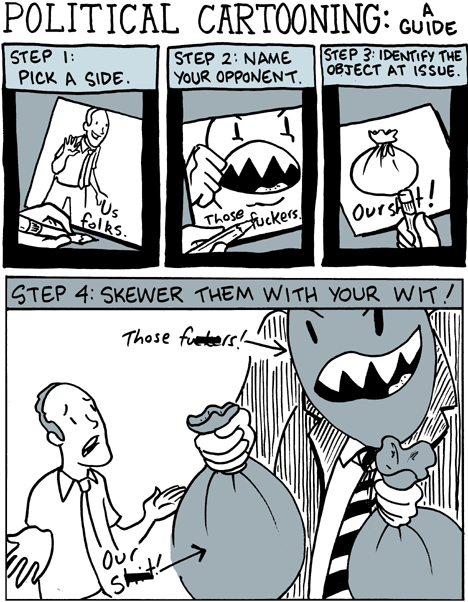
There's this thing called "derisive laughter" or "mean-spirited laughter", which follows from seeing the Hated Enemy get a kick in the pants. It doesn't have to be an unexpected kick in the pants, or a kick followed up with a custard pie. It suffices that the Hated Enemy gets hurt. It's like humor, only without the humor.
If you know what your audience hates, it doesn't take much effort to get a laugh like that—which marks this as a subspecies of awful political art.
There are deliciously biting satires, yes; not all political art is bad art. But satire is a much more demanding art than just punching the Enemy in the nose. In fact, never mind satire—just an atom of ordinary genuine humor takes effort.
Imagine this political cartoon: A building labeled "science", and a standard Godzilla-ish monster labeled "Bush" stomping on the "science" building. Now there are people who will laugh at this—hur hur, scored a point off Bush, hur hur—but this political cartoon didn't take much effort to imagine. In fact, it was the very first example that popped into my mind when I thought "political cartoon about Bush and science". This degree of obviousness is a bad sign.
If I want to make a funny political cartoon, I have to put in some effort. Go beyond the cached thought. Use my creativity. Depict Bush as a tentacle monster and Science as a Japanese schoolgirl.
There are many art forms that suffer from obviousness. But humor more than most, because humor relies on surprise—the ridiculous, the unexpected, the absurd.
(Satire achieves surprise by saying, out loud, the thoughts you didn't dare think. Fake satires repeat thoughts you were already thinking.)
You might say that a predictable punchline is too high-entropy to be funny, by that same logic which says you should be enormously less surprised to find your thermostat reading 30 degrees than 29 degrees.
The general test against awful political art is to ask whether the art would seem worthwhile if it were not political. If someone writes a song about space travel, and the song is good enough that I would enjoy listening to it even if it were about butterflies, then and only then does it qualify to pick up bonus points for praising a Worthy Cause.
So one test for derisive laughter is to ask if the joke would still be funny, if it weren't the Hated Enemy getting the kick in the pants. Bill Gates once got hit by an unexpected pie in the face. Would it still have been funny (albeit less funny) if Linus Torvalds had gotten hit by the pie?
Of course I'm not suggesting that you sit around all day asking which jokes are "really" funny, or which jokes you're "allowed" to laugh at. As the saying goes, analyzing a joke is like dissecting a frog—it kills the frog and it's not much fun for you, either.
So why this blog post, then? Don't you and I already know which jokes are funny?
One application: If you find yourself in a group of people who tell consistently unfunny jokes about the Hated Enemy, it may be a good idea to head for the hills, before you start to laugh as well...
Another application: You and I should be allowed not to laugh at certain jokes—even jokes that target our own favorite causes—on the grounds that the joke is too predictable to be funny. We should be able to do this without being accused of being humorless, "unable to take a joke", or protecting sacred cows. If labeled-Godzilla-stomps-a-labeled-building isn't funny about "Bush" and "Science", then it also isn't funny about "libertarian economists" and "American national competitiveness", etc.
The most scathing accusation I ever heard against Objectivism is that hardcore Objectivists have no sense of humor; but no one could prove this by showing an Objectivist a cartoon of Godzilla-"Rand" stomping on building-"humor" and demanding that he laugh.
Requiring someone to laugh in order to prove their non-cultishness—well, like most kinds of obligatory laughter, it doesn't quite work. Laughter, of all things, has to come naturally. The most you can do is get fear and insecurity out of its way.
If an Objectivist, innocently browsing the Internet, came across a depiction of Ayn Rand as a Japanese schoolgirl lecturing a tentacle monster, and still didn't laugh, then that would be a problem. But they couldn't fix this problem by deliberately trying to laugh.
Obstacles to humor are a sign of dreadful things. But making humor obligatory, or constantly wondering whether you're laughing enough, just throws up another obstacle. In that way it's rather Zen. There are things you can accomplish by deliberately composing a joke, but very few things you can accomplish by deliberately believing a joke is funny.
Part of the Politics Is the Mind-Killer subsequence of How To Actually Change Your Mind
Next post: "Human Evil and Muddled Thinking"
Previous post: "Politics and Awful Art"