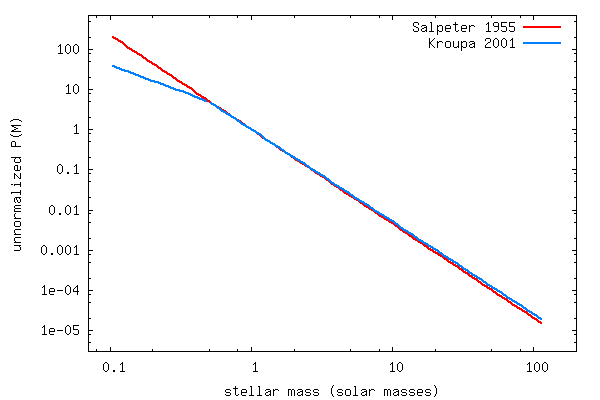
That depends on something called the "initial mass function" for a star forming region - the frequency distribution of masses produced. See http://model.galev.org/help/help_imfs.png for two estimated mass functions for our galaxy.
Until recently the consensus was that since the initial mass function was pretty similar throughout our own galaxy under very different environments, it should be similar in other places too. More recently there's been some controversial claims that 'Early type' (elliptical) galaxies may have a systematically different mass functionn than spirals that also varies by galaxy mass, see http://astrobites.org/2012/02/16/the-imf-is-not-universal/ . Other research seems to contradict this, see http://astrobites.org/2014/12/08/counting-stellar-corpses-rethinking-the-variable-initial-mass-function/ . These papers become technical to a point at which I get lost pretty easily in reading them. If I am reading the paper referred to in the first link correctly though, their findings if true are consistent with one of two scenarios: either the mass functionin massive elliptical galaxies is biased towards the formation of large amounts of small stars, or it is biased towards the production of large amounts of large stars which are now dead and contributing excess compact mass in the form of dead star remnants. Both would be consistent with the data (which comes in the form of ratios of luminosity to galactic mass) but a mass function like that of most spirals would not be.
If the mass function stuff turns out true, I'm pretty sure it would distort the shape of the curve of star formation referenced in this post one way or another, but not change its ultimate form.
This is the first in a series of posts I am putting together on a personal blog I just started two days ago as a collection of my musings on astrobiology ("The Great A'Tuin" - sorry, I couldn't help it), and will be reposting here. Much has been written here about the Fermi paradox and the 'great filter'. It seems to me that going back to a somewhat more basic level of astronomy and astrobiology is extremely informative to these questions, and so this is what I will be doing. The bloggery is intended for a slightly more general audience than this site (hence much of the content of the introduction) but I think it will be of interest. Many of the points I will be making are ones I have touched on in previous comments here, but hope to explore in more detail.
This post references my first two posts - an introduction, and a discussion of our apparent position in space and time in the universe. The blog posts may be found at:
http://thegreatatuin.blogspot.com/2015/07/whats-all-this-about.html
http://thegreatatuin.blogspot.com/2015/07/space-and-time.htm