We'll fill the stars and conquer death. The spark of intelligence and sentience will not extinguish.
No we won't, barring new physics. Even if our civilization avoids catastrophe and invents great improvements in therapies for aging, or brain emulation, that won't let us change the 2nd law of thermodynamics, or prevent the distant galaxies from accelerating out of our reach.
But we can claim every star that now burns. Even if in the vast, long, unimaginably long future of this universe, complexity itself must someday die, we should at least do what we can in the meantime. Perhaps we can't beat physics, but we do have some headroom still!
I found this thread to be "vapid and melodramatic" at first, but I now recognize that humanity did indeed lose something highly valuable with the death of Neil Armstrong, outside and beyond the tragedy that is inherent to the death of any mind.
A spark of intelligence and sentience, a very keen observer, but also, literally the first member of our species to transcend to another world, even if it were for a very brief time. Within a decade or two, human kind will likely no longer have visitors to other worlds among us. Were I a journalist, I would write: "A small death for a man, a giant leap backwards for mankind."
Armstrong, and his fellow Apollo astronauts are to us like the astronauts in Carl Sagan's novel Contact. Ambassadors from the Blue Dot to the vast dead Cosmos. Humanity no longer has it's eyes facing outwards to the other pebbles, to the other stars that burn with unspent opportunity. With their deaths we lose the steady gaze of those who look up, since they have been there, whereas we have not. We lose their voices, and their dreams of someday returning, of someday going beyond 1969.
O you who turn the wheel and look to windward,
Consider Phlebas, who was once handsome and tall as you.
May his footprints someday be lost to the footprints of many.
Someday going beyond 1969 is a crazy ambitious idea today, but seemingly wasn't so crazy before the late seventies/mid-eighties. I'm too young to tell, but it seems this ambition went from bold to crazy somethime around end of the cold war, perhaps as the salient threat of thermonuclear doom faded.
But we can claim every star that now burns.
No, we can't. As I said, distant galaxies that we can see today are receding, such that no probe we send can ever reach them. Barring aliens already nearby, they will burn unclaimed.
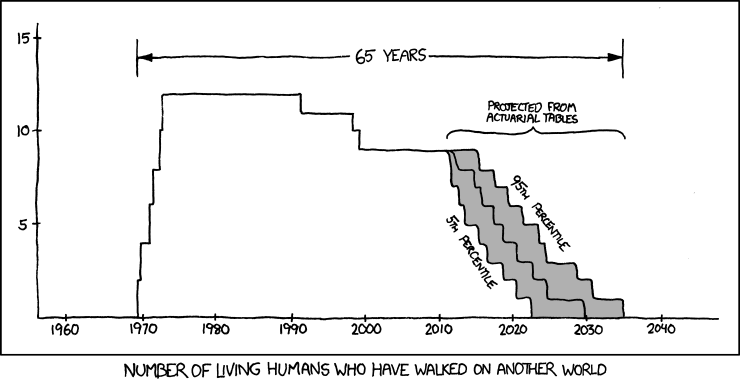

The sad news broke tonight : Neil Armstrong, the first human to ever walk another world, died today. We lost him forever. He died before we could defeat death.
Once again the horror of death strikes. This time, in addition from wiping from us forever a hero of humanity, he wiped from us forever a memory that will never exist again. Never again will a human being be able to experience being the first to walk another world. That beautiful experience is lost forever too, along with all the memories, dreams, desires and wishes that made Neil Armstrong.
But thanks to him, humanity made a giant leap. We'll fill the stars and conquer death. The spark of intelligence and sentience will not extinguish. That's the best we can do to honour him.
Source : http://www.reuters.com/article/2012/08/25/us-usa-neilarmstrong-idUSBRE87O0B020120825