I don't know if you can make a perfusion pump fit into a shoebox, especially not without very good funding. I do remember a case where a standby team (With a slightly-more-than-briefcase-sized perfusion pump, I think it was this) was working on one of those resusci-anne dolls and they mishandled the pump, causing a whole mess:
I will add one thing that the reporter didn‟t because he had left the room to photograph some of the other CUK members before he lost his light to the setting sun. And that is that the venous blood reservoir bag in the circuit of the ATP exploded due to a misplaced clamp. The reporter apparently missed the timid request made to the meeting‟s hostess, Sylvia Sinclair, for a mop and towels to clean up the water that was all over the kitchen. While it is true that cryonicists often have no choice but to undertake to provide and deliver care for themselves, it is equally true that they should not attempt to do so in ways that make the situation worse for the patient than had they taken a simpler approach that was, in fact, within their ability to master. I had spent most of that day at the meeting trying to convince the CUK group that rather than the ATP, what they really needed was to use a simple, inherently „safe‟ open circuit system open circuit system equipped with a microbubble detector and auto-line clamp, to start cryoprotective perfusion as soon as was logistically feasible and to follow that with cooling of the patient to dry ice. Source (Emphasis mine).
If it were feasible (To make an automatic shoebox-sized HLM or general perfusion pump), it would be worked on, because then you don't have to pay all those expensive hemodialysis technicians (Trivia: Mike Darwin is one) and cardio perfusionists, who remain the only people capable of operating such machines in a manner that is safe for the patient.
I guess the goal isn't to achieve perfect perfusion, but simply to reduce the number of red blood cells in the brain while cooling the brain, to avoid clotting and slow ischemic damage. In the case of an emergency deployment of such a device, you're already going to experience significant ischemia, one way or another. Though I can see how embolisms could be catastrophic. I don't know if it would be possible to make such a device simple enough to be operated by an amateur while still being safe to use.
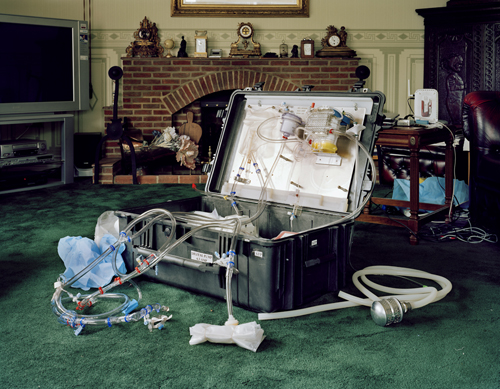
I just read this article (which is well worth reading for anyone interested in cryonics). One of the important things that the article points out is that, while it takes some time for the memory structures of the brain to degrade due to ischemia, one of the more rapid effects is blood clotting in the fine capillaries of the brain after fairly brief ischemia. This reduces the flow of cryoprotectant, and causes large swathes of neural tissue to be frozen, instead of vitrified, which would be catastrophic for personal identity. While this is not a problem for best-case 'standby' cryonics, it is a problem for those who cannot afford a standby team, or are simply hit by cars.
Being an engineer, my first thought is that this is ridiculous, and there has to be a better solution to the problem. It may be possible to build a device, maybe the size of a shoe box, which can be deployed in the field by a minimally-trained amateur (like a defibrillator), and perfuses the brain with cold saline and anti-coagulants -- or even a synthetic oxygen carrier). I'm picturing a cylinder of fluid, large needles with sterilizing caps for tapping the jugular and carotid arteries, and a gas cylinder to provide pressure. You'd simply break a chemical cold pack, put a plastic neck brace in place and insert the needles, and press a button.
Such a device could even be useful to non-cryonicists, as a way to prevent ischemic injury in people found medically dead at the scene of an accident, during transport to the hospital.
Does anyone with more of a medical background know if such a machine would be at all feasible? I can't imagine it would be expensive to construct.