A large probability distribution over many variables allows one to deduce the direction of the causal arrows and rebuild a causal graph.
Agreed, but I don't see the relevance. EDT isn't "get a joint probability distribution, learn the causal graph, and then view your decision as an intervention;" if it were, it would be CDT! The mechanics behind EDT are "get a joint probability distribution, condition on the actions you're considering, and choose the one with the highest expected value."
Incidentally, what do you think CDT should do in the Newcomb problem?
I think this is the causal diagram that describes Newcomb's problem* (and I've shaped the nodes like you would see in an influence diagram):
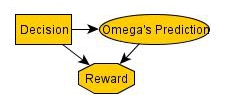
From that causal diagram and the embedded probabilities, we see that the Decision node and the Omega's Prediction node are identical, and so we can reduce the diagram:
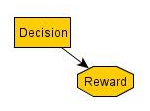
One-boxing leads to $1M, and two-boxing leads to $1k, and so one-boxing is superior to two-boxing.
Suppose one imports the assumption that Omega cannot see the future, despite it conflicting with the problem description. Then, one would think it looks like this (with the irrelevant "decision" node suppressed for brevity, because it's identical to the Omega's Prediction node):
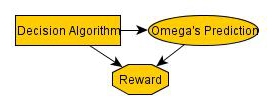
Again, we can do the same reduction:
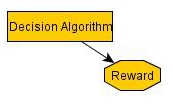
One-boxing leads to $1M, and two-boxing leads to $1k, and so one-boxing is superior to two-boxing.
*Note that this is the answer to the real question underlying the question you asked, and I suspect that almost all of the confusion surrounding Newcomb's Problem results from asking for conclusions rather than causal diagrams.
Ps: your graphs are very similar to mine: http://lesswrong.com/lw/f37/naive_tdt_bayes_nets_and_counterfactual_mugging/
I stumbled upon this paper by Andy Egan and thought that its main result should be shared. We have the Newcomb problem as counterexample to CDT, but that can be dismissed as being speculative or science-fictiony. In this paper, Andy Egan constructs a smoking lesion counterexample to CDT, and makes the fascinating claim that one can construct counterexamples to CDT by starting from any counterexample to EDT and modifying it systematically.
The "smoking lesion" counterexample to EDT goes like this:
EDT implies that she should not smoke (since the likely outcome in a world where she doesn't smoke is better than the likely outcome in a world where she does). CDT correctly allows her to smoke: she shouldn't care about the information revealed by her preferences.
But we can modify this problem to become a counterexample to CDT, as follows:
Here EDT correctly tells her not to smoke. CDT refuses to use her possible decision as evidence that she has the gene and tells her to smoke. But this makes her very likely to get cancer, as she is very likely to have the gene given that she smokes.
The idea behind this new example is that EDT runs into paradoxes whenever there is a common cause (G) of both some action (S) and some undesirable consequence (C). We then take that problem and modify it so that there is a common cause G of both some action (S) and of a causal relationship between that action and the undesirable consequence (S→C). This is then often a paradox of CDT.
It isn't perfect match - for instance if the gene G were common, then CDT would say not to smoke in the modified smoker's lesion. But it still seems that most EDT paradoxes can be adapted to become paradoxes of CDT.