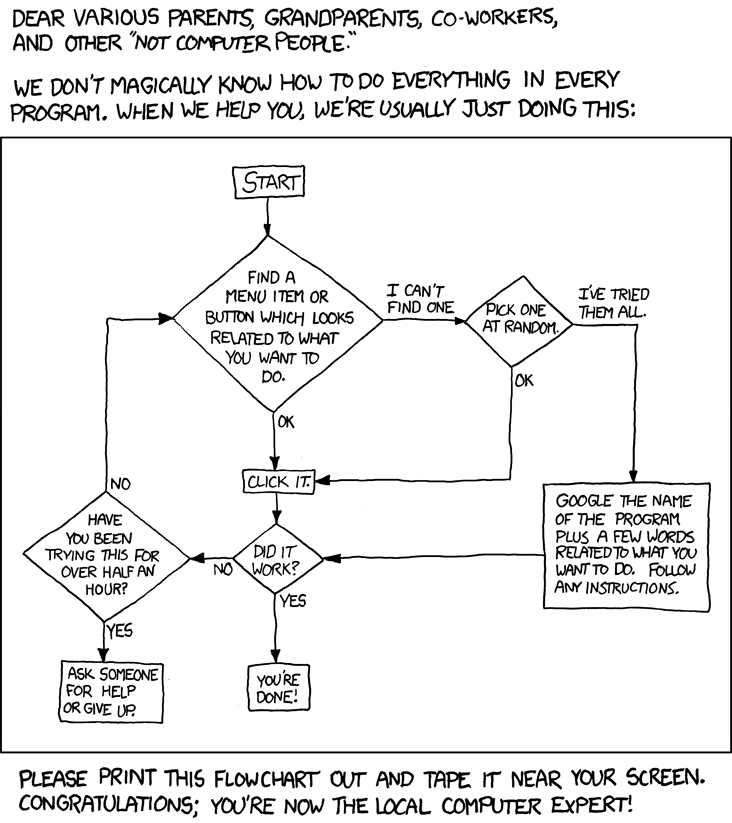
It's a nice joke, but I don't think it's actually good advice. There is a lot of background knowledge about how most computer software works that goes into actually executing the steps of this or similar procedures, e.g.
- knowledge defining the “looks related” relation
- knowledge about which things are likely to be destructive enough to exclude from “pick one at random”
- knowledge about what “it worked” consists of when the shortest path to the goal is more than one step
But you acquire that background knowledge faster when you follow the procedure.
My mother is retired, and sits paralyzed in front of the computer not knowing what button to press. I try to explain that you're unlikely to break anything, so just start looking around.
I initially tried giving my mother the "you're unlikely to break anything" advice as well, then reconsidered after she'd followed that advice and gotten malware on the computer.
I learned most of what I learned -by- breaking things.
For example, I learned how page files worked because American Online and Dungeon Keeper both tried to seize them for themselves, and if Dungeon Keeper was run, AOL wouldn't run subsequently without a reboot. Research on the issue turned up that disabling page filing would fix it, which led me to research page filing to see what disabling it would do.
I didn't think of this until the recent munchkin post, but one solved problem is what financial instruments to invest in. The answer is index funds with low fees in a tax advantaged account. Vanguard has some good funds with fees as low as 0.1%. Unless you're a professional investor (and maybe not even then) your chance of beating index fund performance over the long term is tiny. Not quite winning the lottery tiny, but maybe winning a big stuffed animal at a rigged carnival game tiny.
That's the Vanguard Emerging Markets Stock Index Fund and indeed I own some of that. However it's a relatively small part of my portfolio. The risk and variance are much higher, and the risk and variance of a single country index fund would be higher still. This fund dropped more than 75% during the 2008 crash and still hasn't recovered. The expense ratio ranges from about 0.2% to 0.33%, higher though not hugely so than domestic and total international index funds.
Most investors, especially those with smaller portfolios or who have a shorter time horizon, are probably better off with something like the Vanguard Total International Stock Index Fund which includes a developing markets component, but also includes Asia and Europe, or the Vanguard Total World Stock Index which adds the United States to the mix.
No; you are incurring extra fees due to your likely extra trading, diseconomies of scale, and uncompensated risk due to less diversification.
At least for people with the right personality profile (relatively high openness, above bottom decile of extroversion), CouchSurfing seems to have solved the problem of finding cheap (indeed, free) and comfortable short-term accommodation in a foreign city.
At least for me, getting up when the alarm clock rings used to be almost impossible and I kept staying in bed for 12 hours a day unless there was something that I absolutely had to get up in time for. Anders Sandberg's caffeine pill trick solved that problem for me, and it has worked for over five years now:
...This week I have experimented with a new way of getting up in the morning. My problem is that Anders-Sleepy has different goals than Anders-Awake, and is quite adept at resetting the alarm clock. Now I, Anders-Awake, has found a way around this self:
I set my alarm to 6:00 and 8:00. At 6:00 I go up, take a 50mg caffeine pill, and go to bed again. Then I sleep and wake up rested and energetic around 8.
In my case the time for the pill to start working seems to be 1.5 hours. A dose of one pill ensures that I wake up (but still yawning) while two pills makes me start the day much more quickly. The added benefit is of course a regular sleep schedule.
I ran into the problem of a late night one of the days, where I remained awake until 3:30. In this case I adjusted the program slightly, taking the pill at 7:00 and sleeping to 8:30, this seemed to work and the rest of the day was effici
The problem of transferring large files over the internet has been solved by Dropbox or similar services.
"How do I get stronger?" has been solved and the solution is Starting Strength.
Evidence: The set of my friends who are strong is exactly the set of my friends who do / have done Starting Strength or a close variant. Also, I used to lift with several competitive power lifters (including someone ranked top 100 nationally in the deadlift) and they unanimously advocated it.
These are relatively large N and effect size btw, i.e. I know at least 15 people who've done SS and they're out-benching the non-SS'ers by 20 pounds on the low end, and 100 pounds on the high end (I pick bench because it is the exercise most people are familiar with; the gap for other things like squat is more like 50 pounds on low end, 200 pounds on high end).
I wouldn't call SS the end-all, be-all solution for getting stronger, that would more closely be something like "progressive overload using compound exercises (or whatever you want to get stronger at) while under caloric surplus and having decent macro/micronutritional spreads. Also sleeping well and not having any other unusual health problems".
SS is a great program for beginners, but any other program that fits the above should work (like stronglifts). I also wouldn't recommend SS to intermediate or advanced lifters, when linear progression is no longer possible.
I would be very cautious about any claim that any "problem" is totally, finally, and uncontroversially solved.
When a problem gets to that point, no one is calling it a problem.
And even then, better solutions may come along.
How can I keep warm when going outside on a blustery fall day? Wear clothing.
How can I eat without spending all my time hunting? Buy food from other people who specialize in that.
How can I retain key thoughts more precisely than by mere memorization? Write them down.
Other "solved problems" from early human history:
How can I find out if all the sheep have come in from the field? Count them as they are going out, and count them again as they are coming in.
How can I remember how many sheep that person owes me? Write down their name, the word "sheep", and the number of sheep.
How can I resolve conflicts with someone without fighting, when just talking it out with that person doesn't seem to be working? Find some person whom we both respect, have each of us explain their view on the situation, and follow the respected person's advice.
Yes, but even so, there may be lots of problems that I think are 50% solved or maybe wide open and that it turns out are maybe 95% solved (loosely speaking), and I'd still like to hear about those.
You can start whatever threads you want! You have the power! (What question should you have replaced that question with, I wonder...)
As far as I can tell, ketogenic diets solve the problem of fat loss. I know, anecdotes are not data, but it's worked wonders for everyone I know who's tried it (myself included).
Err on the side of posting solutions which may not be universal but are still likely to be helpful to many people.
This is the sole reason I'm posting this. Keto works for very many people. The short story of keto is that your brain can only eat certain kinds of chemicals. Glycogen from eating carbohydrates is one of them. Ketones generated from fat is another. Your body will p...
Ketogenic dieting has been very effective for me. But I'm not convinced that this story about the body learning to turn body fat into ketones is actually how it works. My sense is that a super low-carb diet may just a good way of keeping appetite down and maintaining a caloric deficit. At the very least, that seems to be part of why it works so well: high fat low carb foods tend to be much more satisfying per calorie than foods heavy in carbohydrates. E.g. A Starbucks blueberry muffin is 380 calories which is like eating ten strips of bacon or 5 hardboiled eggs or more celery than you could possibly eat in one sitting. Whether or not the chemistry stuff is actually true keto is a good way to feel satisfied on a lower number of calories.
I wonder if a diet that was actually optimized for high satisfaction/calorie would be a) different and b) more effective.
Upvoted for evidence. I've read your comments on how diets that ought to work don't for you, and that it's not as simple as calories-in-calories-out, but have been skeptical because my prior for "Eliezer is a metabolic mutant" vs. "Eliezer has the same trouble sticking to a diet (and being honest when they fail) that most people do" is low.
In local parlance, my assignment for "Eliezer is a mutant" and "net calories aren't everything" have both risen.
I am not a metabolic mutant. There are plenty of people in the world who cannot seem to lose weight, and they aren't all weak-willed scum, and it's not because they just haven't tried your favorite diet.
I'm not sure I deserved the heat here. I prescribed no particular diet and said nothing about weak willed scum. I'm of the tentative opinion that modern weight-control problems are just a case of human brains not being built for an environment of plenty. Even if it was simply that people on average can't keep their hands out of the pastry box, that's not a moral failing, just an outdated adaptation. It's worth fixing ourselves because it's now a maladaptation and evolution is too slow about fixing it.
The world is full of metabolic diversity. The fortunate who do not appreciate this are the metabolically privileged. That they can lose weight with an effort causes them to be unfortunately deluded about what is going on.
What is going on? Is there a thread around here that you think covers it in useful detail? It seems to me that there must be some lower bound on food intake beyond which one can't help but lose weight -- otherwise you could eat nothing and still not lose weight,...
Obesity is interesting because I regard it as a partially-solved problem. For example, dinitrophenol would solve much of it: it makes mitochondria less efficient and so effectively increases metabolism, but at the cost of emitting waste heat - which is potentially fatal and got it banned despite its apparent effectiveness. It could still be safely used; it's 2013 so electronic thermometers are a dime a dozen. Take patients to a fat camp, dress them in clothes with thermometers constantly recording and now doses can be adjusted based on detailed data and the thermometers can warn the patient to jump into conveniently located ice baths. Voila. And I'm not clear on how dangerous it really is when not made illegally and used recklessly by young kids; Wikipedia cites a 1934 paper as estimating that there were ~100k users of DNP before it was banned, and those authors remark, after discussing the grand total of 4 deaths up to that point due to the drug's use under medical supervision, that
...When one considers that some one hundred thousand patients have been treated with this exceedingly potent therapeutic agent, it is a matter of some gratification to know that fatalities have not been
The calories-in calories-out model is attractive, but it doesn't appear to be all that accurate, or at least it's incomplete. The body responds differently to different foods. They might have different effects on various hormones (e.g. the ones that regulate hunger), and they might be broken down and redistributed in different ways. In one study (Kekwick and Pawan), three groups of people were put on 1,000 calorie diets of 90% fat resp. 90% protein resp. 90% carbs. The first group lost 0.9 lbs / day, the second group lost 0.6 lbs / day, and the third group gained 0.24 lbs / day. (I don't know to what extent the study controlled for exercise but I think it's safe to assume that the difference in the amount of exercise that each group did wasn't large enough to explain these results.) As Tim Ferriss puts it in The 4-Hour Body:
...The creator of the "calorie" as we know it, 19th-century chemist Wilbur Olin Atwater, did not have the technology that we have today. He incinerated foods. Incineration does not equal human digestion; eating a fireplace log will not store the same number of calories as burning one will produce. Tummies have trouble with bark, as they do with many thi
I'm heartened that your comment is so well-liked. I made the same point a year or two ago and got back a bunch of nonsense about how the second law of thermodynamics cannot be violated.
"How do I find out how a particular person thinks/feels about a particular subject/issue/situation?" Ask them.
I'd call this an 80% solution because sometimes they don't quite know (and even more rarely, they deliberately lie), but it's still wayy better than not asking in most cases.
Ohh. "Hey friend, do you feel insecure around me because I'm more successful than you?" type questions?
Follow-up to: Boring Advice Repository
Many practical problems in instrumental rationality appear to be wide open. Two I've been annoyed by recently are "what should I eat?" and "how should I exercise?" However, some appear to be more or less solved. For example, various mnemonic techniques like memory palaces, along with spaced repetition, seem to more or less solve the problem of memorization.
I would like people to use this thread to post other examples of solved problems in instrumental rationality. I'm pretty sure you all collectively know good examples; there's a comment I can't find from a user who said something like "taking a flattering photograph of yourself is a solved problem," and it's likely that there are other useful examples like this that aren't common knowledge. Err on the side of posting solutions which may not be universal but are still likely to be helpful to many people.
(This thread is allowed to not be boring! Go wild!)