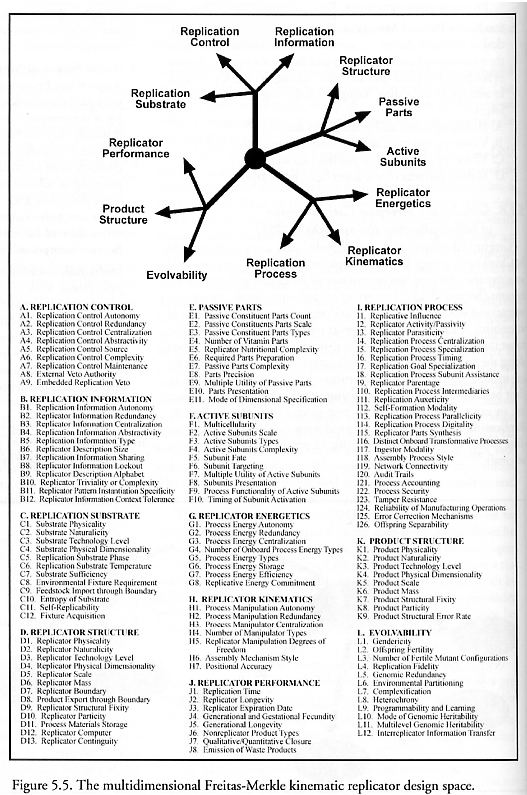
The design space for replicators is large but we have an at least two stage process needed to set it up. This complicates the solution space even more as we can take lots of routes from the currently vailable replicators (biological systems + social manufactoring systems) thru intermediate systems to any of the target design spaces systems.
An overview of the classes gives wikipedia: http://en.wikipedia.org/wiki/Self-replication#Classes_of_self-replication
More interesting than the specific replication system is the bootstrapping process (which is really a transformation of one replicating system into another one). The design dimensions for this boot straping seem to be less studied (obviously this is what you are primariy looking at). I will try a rough sketch:
Number of humans needed (possibly 0)
Intelligence and qualification of humans needed (limiting initial distribution)
Additional machinery needed (dito)
Amount of 'standard' infrastructure needed (which could be shut down to prevent spread)
Connection to the initially affected host system (whole internet)
I see the following rough replication classes for the OPs purpose:
Solutions involving nano-scale (like the DNA lab based example).
Solutions involving macroscopic replicators (clanking replicators). NASA estimates that the effort to build these is comparable to a Pentium IV. Thus I wonder why nobody did it yet.
Solutions involving higher biological systems (e.g. humans, but also animals) in the replication cycle (most of the proposals in the comments fall into this category).
Combinations of the above.
Stories not yet seen in the comments:
AI connected to internet posts designs for fighting robots - somebody assembles them and lets them fight. Instead together they use their 'weapons' to collectively mine resources and build copies of themselves...
Boxed AI proposed a Lego toy for the researchers child: Mindstrom/Tinkerbot plus some building manual for the child to build the toy accompanied with the few lines/pages program to run. The 'toy' searches keyboard orders more parts, opens door, unpacks delivery, assembles more of itself...
I'd like to see a plausible story involving 3D-printers as these initially lack an energy source.
Any scenario where advanced AI takes over the world requires some mechanism for an AI to leverage its position as ethereal resident of a computer somewhere into command over a lot of physical resources.
One classic story of how this could happen, from Eliezer:
You can do a lot of reasoning about AI takeover without any particular picture of how the world gets taken over. Nonetheless it would be nice to have an understanding of these possible routes. For preparation purposes, and also because a concrete, plausible pictures of doom are probably more motivating grounds for concern than abstract arguments.
So MIRI is interested in making a better list of possible concrete routes to AI taking over the world. And for this, we ask your assistance.
What are some other concrete AI takeover mechanisms? If an AI did not have a solution to the protein folding problem, and a DNA synthesis lab to write off to, what else might it do?
We would like suggestions that take an AI from being on an internet-connected computer to controlling substantial physical resources, or having substantial manufacturing ability.
We would especially like suggestions which are plausible given technology that normal scientists would expect in the next 15 years. So limited involvement of advanced nanotechnology and quantum computers would be appreciated.
We welcome partial suggestions, e.g. 'you can take control of a self-driving car from the internet - probably that could be useful in some schemes'.
Thank you!