Dawes' argument, as promised.
The context is: Dawes is explaining von Neumann and Morgenstern's axioms.
Aside: I don't know how familiar you are with the VNM utility theorem, but just in case, here's a brief primer.
The VNM utility theorem presents a set of axioms, and then says that if an agent's preferences satisfy these axioms, then we can assign any outcome a number, called its utility, written as U(x); and it will then be the case that given any two alternatives X and Y, the agent will prefer X to Y if and only if E(U(X)) > E(U(Y)). (The notation E(x) is read as "the expected value of x".) That is to say, the agent's preferences can be understood as assigning utility values to outcomes, and then preferring to have more (expected) utility rather than less (that is, preferring those alternatives which are expected to result in greater utility).
In other words, if you are an agent whose preferences adhere to the VNM axioms, then maximizing your utility will always, without exception, result in satisfying your preferences. And in yet other words, if you are such an agent, then your preferences can be understood to boil down to wanting more utility; you assign various utility values to various outcomes, and your goal is to have as much utility as possible. (Of course this need not be anything like a conscious goal; the theorem only says that a VNM-satisfying agent's preferences are equivalent to, or able to be represented as, such a utility formulation, not that the agent consciously thinks of things in terms of utility.)
(Dawes presents the axioms in terms alternatives or gambles; a formulation of the axioms directly in terms of the consequences is exactly equivalent, but not quite as elegant.)
N.B.: "Alternatives" in this usage are gambles, of the form ApB: you receive outcome A with probability p, and otherwise (i.e. with probability 1–p) you receive outcome B. (For example, your choice might be between two alternatives X and Y, where in X, with p = 0.3 you get consequence A and with p = 0.7 you get consequence B, and in Y, with p = 0.4 you get consequence A and with p = 0.6 you get consequence B.) Alternatives, by the way, can also be thought of as actions; if you take action X, the probability distribution over the outcomes is so-and-so; but if you take action Y, the probability distribution over the outcomes is different.
(If all of this is old hat to you, apologies; I didn't want to assume.)
The question is: do our preferences satisfy VNM? And: should our preferences satisfy VNM?
It is commonly said (although this is in no way entailed by the theorem!) that if your preferences don't adhere to the axioms, then they are irrational. Dawes examines each axiom, with an eye toward determining whether it's mandatory for a rational agent to satisfy that axiom.
Dawes presents seven axioms (which, as I understand it, are equivalent to the set of four listed in the wikipedia article, just with a difference in emphasis), of which the fifth is Independence.
The independence axiom says that A ≥ B (i.e., A is preferred to B) if and only if ApC ≥ BpC. In other words, if you prefer receiving cake to receiving pie, you also prefer receiving (cake with probability p and death with probability 1–p) to receiving (pie with probability p and death with probability 1–p).
Dawes examines one possible justification for violating this axiom — framing effects, or pseudocertainty — and concludes that it is irrational. (Framing is the usual explanation given for why the expressed or revealed preferences of actual humans often violate the independence axiom.) Dawes then suggests another possibility:
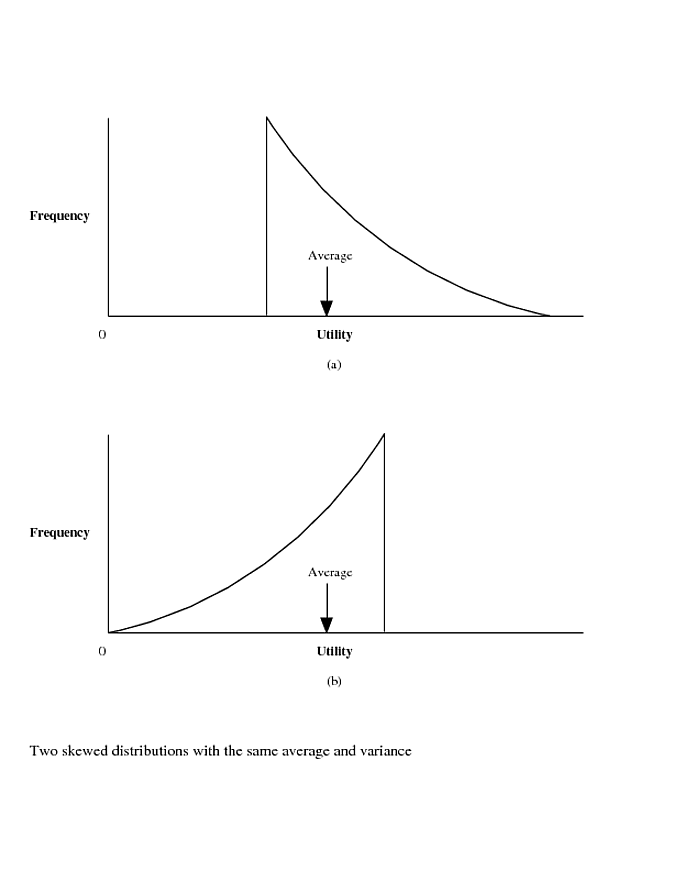
Is such irrationality the only reason for violating the independence axiom? I believe there is another reason. Axiom 5 [Independence] implies that the decision maker cannot be affected by the skewness of the consequences, which can be conceptualized as a probability distribution over personal values. Figure 8.1 shows (Note: This is my reproduction of the figure. I've tried to make it as exact as possible.) the skewed distributions of two different alternatives. Both distributions have the same average, hence the same expected personal value, which is a criterion of choice implied by the axioms. These distributions also have the same variance.
If the distributions in Figure 8.1 were those of wealth in a society, I have a definite preference for distribution a; its positive skewness means that income can be increased from any point — an incentive for productive work. Moreover, those people lowest in the distribution are not as distant from the average as in distribution b. In contrast, in distribution b, a large number of people are already earning a maximal amount of money, and there is a "tail" of people in the negatively skewed part of this distribution who are quite distant from the average income.[5] If I have such concerns about the distribution of outcomes in society, why not of the consequences for choosing alternatives in my own life? In fact, I believe that I do. Counter to the implications of prospect theory, I do not like alternatives with large negative skews, especially when the consequences in the negatively skewed part of the distribution have negative personal value.
[5] This is Dawes' footnote; it talks about an objection to "Reaganomics" on similar grounds.
Essentially, Dawes is asking us to imagine two possible actions. Both have the same expected utility; that is, the "degree of goal satisfaction" which will result from each action, averaged appropriately across all possible outcomes of that action (weighted by probability of each outcome), is exactly equal.
But the actual probability distribution over outcomes (the form of the distrbution) is different. If you do action A, then you're quite likely to do alright, there's a reasonable chance of doing pretty well, and a small chance of doing really great. If you do action B, then you're quite likely to do pretty well, there's a reasonable chance to do ok, and a small chance of doing disastrously, ruinously badly. On average, you'll do equally well either way.
The Independence axiom dictates that we have no preference between those two actions. To prefer action A, with its attendant distribution of outcomes, to action B with its distribution, is to violate the axiom. Is this irrational? Dawes says no. I agree with him. Why shouldn't I prefer to avoid the chance of disaster and ruin? Consider what happens when the choice is repeated, over the course of a lifetime. Should I really not care whether I occasionally suffer horrible tragedy or not, as long as it all averages out?
But if it's really a preference — if I'm not totally indifferent — then I should also prefer less "risky" (i.e. less negatively skewed) distributions even when the expectation is lower than that of distributions with more risk (i.e. more negative skew) — so long as the difference in expectation is not too large, of course. And indeed we see such a preference not only expressed and revealed in actual humans, but enshrined in our society: it's called insurance. Purchasing insurance is an expression of exactly the preference to reduce the negative skew in the probability distribution over outcomes (and thus in the distributions of outcomes over your lifetime), at the cost of a lower expectation.
This sounds like regular risk aversion, which is normally easy to model by transforming utility by some concave function. How do you show that there's an actual violation of the independence axiom from this example? Note that the axioms require that there exist a utility function u :: outcome -> real such that you maximise expected utility, not that some particular function (such as the two graphs you've drawn) actually represents your utility.
In other words, you haven't really shown that "to prefer action A, with its attendant distribution of outc...
It's been claimed that increasing rationality increases effective altruism. I think that this is true, but the effect size is unclear to me, so it seems worth exploring how strong the evidence for it is. I've offered some general considerations below, followed by a description of my own experience. I'd very much welcome thoughts on the effect that rationality has had on your own altruistic activities (and any other relevant thoughts).
The 2013 LW Survey found that 28.6% of respondents identified as effective altruists. This rate is much higher than the rate in the general population (even after controlling for intelligence), and because LW is distinguished by virtue of being a community focused on rationality, one might be led to the conclusion that increasing rationality increases effective altruism. But there are a number of possible confounding factors:
So it's helpful to look beyond the observed correlation and think about the hypothetical causal pathways between increased rationality and increased effective altruism.
The above claim can be broken into several subclaims (any or all of which may be intended):
Claim 1: When people are more rational, they're more likely to pick their altruistic endeavors that they engage in with a view toward maximizing utilitarian expected value.
Claim 2: When people are more rational, they're more likely to succeed in their altruistic endeavors.
Claim 3: Being more rational strengthens people's altruistic motivation.
Claim 1: "When people are more rational, they're more likely to pick their altruistic endeavors that they engage in with a view toward maximizing utilitarian expected value."
Some elements of effective altruism thinking are:
Claim 2: "When people are more rational, they're more likely to succeed in their altruistic endeavors."
If "rationality" is taken to be "instrumental rationality" then this is tautologically true, so the relevant sense of "rationality" here is "epistemic."
Claim 3: "Being more rational strengthens people's altruistic motivation."
Putting it all together
The considerations above point in the direction of increased rationality of a population only slightly (if at all?) increasing the effective altruism at the 50th percentile of the population, but increasing the effective altruism at higher percentiles more, with the skewing becoming more and more extreme the further up one goes. This is in parallel with, e.g. the effect of height on income.
My own experience
In A personal history of involvement with effective altruism I give some relevant autobiographical information. Summarizing and elaborating a bit:
How about you?