Is there anything else you would recommend be discussed before I make that initial payment and set the ball in motion?
Sure, the fact that Ben Best experimented on a patient, ruining his perfusion (Emphasis mine):
...My dear friend and mentor Curtis Henderson was little more than straight frozen because CI President Ben Best had this idea that adding polyethylene glycol to the CPA solution would inhibit edema. Now the thing is, Ben had been told by his own researchers that PEG was incompatible with DMSO containing solutions, and resulted in gel formation.
This would be a useful inclusion in a will. For example, add provisions and funds to transport you to another facility should the one you are in fail, and to another if the second is not available, ad infinitum until permafrost interment.
Eric DeMar did something similar in his will, to ensure his parents (Who'd been cryopreserved by Trans Time in the seventies) would be transported to the CI facilities. A very good choice, considering Trans Time's policies.
A separate decision tree may be included to cover alternatives to cryonics, if the entire cryonics de...
As long as you recognize that clotting is a different process. =)
Of course.
It's been a few years since I studied this, but as far as I know, the physiological significance of rouleaux (including whether they block blood vessels) is unknown - don't forget that they're in equilibrium with the non-rouleaux form.
I wouldn't know, but Mike Darwin says they are harmful:
[...] irregular aggregation of RBCs rouleaux formation has a profound negative impact on perfusion.
I've never heard of rouleaux having a role in blood clotting
They block blood vessels and prevent perfusion, which is why it's equivalent to clotting.
Blood clotting is not caused by red blood cells but by platelets.
I thought ischemic tissue caused RBCs to form Rouleaux complexes. Even without RBC's, ischemia causes plenty of changes that have effects functionally equivalent to clotting: Swelling of myocytes and the endothelium, subsarcolemmal and endothelial blebs, et cetera.
I suppose another option would be to suggest that the patient to start taking anticoagulants before death. I'm not sure whether that would have legal implications though.
This is certainly helpful and doesn't seem to have been...
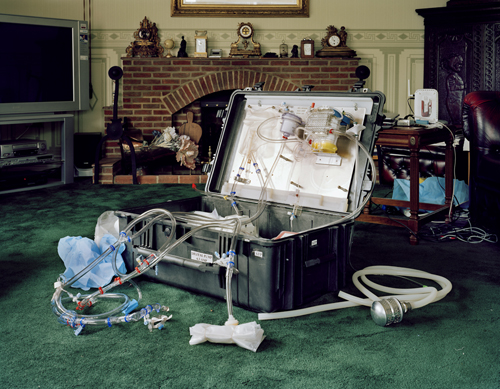
I don't know if you can make a perfusion pump fit into a shoebox, especially not without very good funding. I do remember a case where a standby team (With a slightly-more-than-briefcase-sized perfusion pump, I think it was this) was working on one of those resusci-anne dolls and they mishandled the pump, causing a whole mess:
...I will add one thing that the reporter didn‟t because he had left the room to photograph some of the other CUK members before he lost his light to the setting sun. And that is that the venous blood reservoir bag in the circuit of th
What about a fracture that severs the brain in several pieces?
Hooking up the nerves is still tricky, but we could probably figure it out.
Wouldn't this be tantamount to regrowing a transected spine? I'm not up-to-date on that area, but I don't think we can do that yet.
substantially better neuroscience
We have plenty of models of neurons and some of them imitate neurons very well.
Eugene Izhikevich simulated an entire human brain equivalent with his model and he saw some pretty interesting emergent behaviour (Granted, the anatomy had to be generated randomly at every iteration, so we still need better computers).
super duper nanotech
MNT isn't strictly necessary. Anabolocytes, and other speculative genetically engineered cells. They are a little more likely than Freitas' nanomedicine because, well, cells exist; which is not an argument that works for MNT.
Physical and biological aspects of renal vitrification.
Cryopreservation of organs by vitrification: perspectives and recent advances (PDF).
EDIT: I should clarify, the kidney was cooled with liquid nitrogen vapor and the lowest temperature it was exposed to was still fifty degrees above that of Liquid Nitrogen. This is important because LN2 temperature is far below the vitrification point of M22, and cooling even a little below T_g causes fracturing.
To the best of my knowledge, doctors don't experiment on patients without their consent, drill burr holes without circulation, or generally just do anything they want without fear of prosecution (Since cryonics is considered a form of interment, whether the person was completely turned into a glass sculpture or straight-frozen like so many people were does not affect the organizations). Doctors may forget rectal plugs or leave patients if funds are unavailable, though.
What do you define as 'very recently'?
Thank goodness CI and Alcor have standards.
Well, I have this theory that CI stores its neuropatients in the dewar with the dead cats in it.
Alcor: Improperly trained personnel, unkempt and ill-equipped facilities.
...[...] Saul Kent invited me over to his home in Woodcrest, California to view videotapes of two Alcor cases which troubled him – but he couldn’t quite put his finger on why this was so.[...] Patients were being stabilized at a nearby hospice, transported to Alcor (~20 min away) and then CPS was discontinued, the patients were placed on the OR table and, without any ice on their heads, they were allowed to sit there at temperatures a little below normal body temperature for 1 to 1.5 h
As soon as the first upload is successful then patient zero will realize he's got unimaginable (brain)power, will start talking in ALL CAPS, and go FOOM on the world, bad end.
Now, I have to admit I'm not too familiar with the local discourse re:uploading, but if a functional upload requires emulation down to individual ion channels (PSICS-level) and the chemical environment, I find it hard to believe we'll have the computer power to do that, a million times faster, and in a volume of space small enough that we don't have to put it under a constant water...
Narrow AI and machine learning?
Are you saying Mike Darwin is a religious nut? Because I'm not the one making up stories about on-patient experimentation, shit-covered neck stumps, unkempt and ill-equipped operating rooms, and boiling brains by drilling a burr hole without irrigation.
I'm not sure about the scalability of mechanosynthesis, either (Massive parallelism gets thrown around a lot, but there may be something to convergent assembly) , but I was just talking about the basic tip chemistry.
Zyvex has a similar process called Patterned Atomic Layer Epitaxy which seems more promising as a large-scale manufacturing technology, but I have not seen designs for nanofactories of megadalton-scale products made using PALE.
It was the first to freeze somebody, but the first to be formed was the Cryonics Society of New York in 1965. CSC was founded a year later.
(If you want to nit pick, technically the first organization to freeze somebody was CryoCare Equipment Corporation who froze a still unidentified woman in 1966).
I cannot believe nobody has recommended David Zindell yet! His work is a masterpiece of transhumanist fiction.
His Requiem for Homo Sapiens series is preceded by a short story Shanidar, you should read it first to get a taste of what's next. If you want more, then the next four books are:
I'll second After Life, it's very short but definitely one of my favorite pieces of h+ fiction. The work of Cordwainer Smith (He on... (read more)