jwdink comments on Open Thread: July 2009 - Less Wrong
You are viewing a comment permalink. View the original post to see all comments and the full post content.
Comments (235)
I'm pretty sure that just can't be right. (His argument, that is. I think your interpretation of it is dead on.) We are not limited to imagining the sorts of things our brain is causally determined by. And the way you just put it seems completely backwards. Even if everything reduces to quarks, it's only in principle-- our brains are hard wired to create multiple levels of models, and could never conceive of an explanation of a 747 in terms of quarks.
Look at it this way. Can a painting have a subject? Can it be "about" something? Of course. Certainly there's nothing supernatural about this, but there's also nothing legitimate on the level of quarks that could be used to differentiate between a painting that has a subject and a painting that is just random blobs. I can imagine, after all, two paintings, almost identical in their coordinate-positioning of quarks, which have completely different subjects. I can also imagine two paintings, very different in terms of coordinates of quarks (perhaps painted with two different materials) which have the same subject. So while everything reduces down to quarks, it's the easiest thing in the world to explain a painting's about-ness on a separate level from quarks, and completely impossible to envision an explanation for this about-ness in terms of quarks.
I'm just not sure what about a "black ball" misses the mark of conceivability.
You want to be very careful every time you find yourself saying that.
And that too.
Eliezer, in Excluding the Supernatural, you wrote:
"Fundamentally complicated" does sound like an oxymoron to me, but I'm not sure I could say why. Could you?
I'm having the same difficulty. Aren't quarks (or whatever is the most elemental bit of matter) fundamentally complicated? What's meant by "complicated"?
(Sorry for being so chatty.)
Are you actually implying that quantum mechanics is remotely comparable in complexity to paintings and artistic "subjects"? Please direct me to the t-shirt that summarizes all of artistic critique.
This is probably wrong. The important point is that physics isn't a mind, and less so human mind or your mind, so it doesn't care about your high-level concepts, which makes their materialization in reality impossible. Even though the territory computes much more data than people, it's data not structured in a way human concepts are.
To loqi and Nesov:
Again, both of your responses seem to hinge on the fact that my challenge below is easily answerable, and has already been answered:
To loqi: Where do we draw the line? Where is an entity too complex to be considered fundamental, whereas another is somewhat less complex and can therefore be considered simple? What would be a priori illogical about every entity in the universe being explainable in terms of quarks, except for one type of entity, which simply followed different laws? (Maybe these laws wouldn't even be deterministic, but that's apparently not a knockdown criticism of them, right? From what I understand, QM isn't deterministic, by some interpretations.)
To Nesov: Again, you're presupposing that you know what's part of the territory, and what's part of the map, and then saying "obviously, the territory isn't affected by the map." Sure. But this presupposes the territory doesn't have any irreducible entities. It doesn't demonstrate it.
Don't get me wrong: Occam's razor will indeed (and rightly) push us to suspect that there are no irreducible entities. But it will do this based on some previous success with reduction-- it is an inference, not an a priori necessity.
I don't know. I wasn't supporting the main thread of argument, I was responding specifically to your implicit comparison of the complexity of quarks and "about-ness", and pointing out that the complexity of the latter (assuming it's well-defined) is orders of magnitude higher than that of the former. "About-ness" may seem simpler to you if you think about it in terms that hide the complexity, but it's there. A similar trick is possible with QM... everything is just waves. QM possesses some fundamental level of complexity, but I wouldn't agree in this context that it's "fundamentally complicated".
I see what you mean. It's certainly a good distinction to make, even if it's difficult to articulate. Again, though, I think it's Occam's Razor and induction that makes us prefer the simpler entities-- they aren't the sole inhabitants of the territory by default.
I would assert that, by definition, a meaningful concept is reducible to some other set of concepts. If this chain of meaning can be extended to unambiguous physics, then their "materialization in reality" is certainly possible, it's just a complicated boundary in Thingspace.
Certainly-- that was somewhat sloppy of me. In my defense, however, a priori and conceivability/imaginability are pretty inextricably tied. Additionally, you yourself used the word "envision."
It would perhaps be helpful if you could clarify what you meant when you said:
Your usage doesn't seem to fit into the Kantian sense of the term-- the unity of my experience of the world is not conditioned by everything being reducible. What do you mean when you say irreducibility is a priori logically incoherent?
See blog post links in Priors. A priori incoherent means that you don't need data about the world to come to a conclusion (i.e. in this case the statement is logically false).
This doesn't really answer the question, though. I know that a priori means "prior to experience", but what does this consist of? Originally, for something to be "a priori illogical", it was supposed to mean that it couldn't be thought without contradicting oneself, because of pre-experiential rules of thought. An example would be two straight lines on a flat surface forming a bounded figure-- it's not just wrong, but inconceivable. As far as I can tell, an irreducible entity doesn't possess this inconceivability, so I'm trying to figure out what Eliezer meant.
(He mentions some stuff about being unable to make testable predictions to confirm irreducibility, but as I've already said, this seems to presuppose that reducibility is the default position, not prove it.)
Some comic relief, with a serious point:
The famous cartoon of two mathematicians going over a proof, the middle step of which is "then a miracle occurs".
If reductionism is false in the way you've described, then it seems that we can start at the level of quarks and work our way back up to the highest level, but that at some point there must be a "magical stuff happens here" step where level N+1 cannot be reduced to level N.
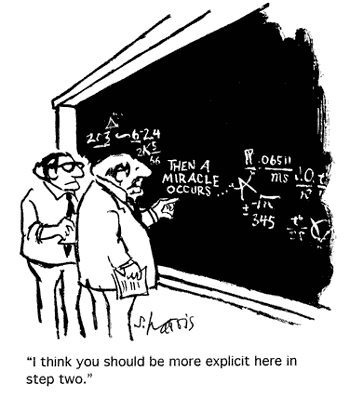
Indeed, an irreducible entity (albeit with describable, predictable, behavior) is not much better than a miracle. This is why Occam's Razor, insisting that our model of the world should not postulate needless entities, insists that everything should be reduced to one type of stuff if possible. But the "if possible" is key: we verify through inference and induction whether or not it's reasonable to think we'll be able to reduce everything, not through a priori logic.
This is a good example of how the "natural" concepts are actually quite elaborate, paying utmost attention to tiny details that are almost invisible in other representations. But these details are in fact there, in the territory. The fact that they are small in one representation doesn't belittle their significance in another representation. And the fact that one object is placed in one high-level category and a "slightly" different object is placed in another category results from exactly these "tiny" differences. You can't visualize these differences in terms of quarks directly, but in terms of other high-level categories it is exactly what you are doing: keeping track of the tiny distinctions that are important to you for some reason.
That sounds right, but that sounds like I am (or at least could) visualize these levels as separate, since to keep track of the tiny differences that end up being important is impossible for my mind to do. This seems to necessitate that imagining irreducibility is not only possible, but natural (and perhaps unavoidable?).
This is not to say that irreducibility is logical, and our reason may insist to us that the painting is indeed reducible to quarks, whether or not we can imagine this reduction. But collapsing the levels is not the default position, a priori logically neccessary.
I'm not entirely clear on what you are saying above. Your mind keeps many overlapping concepts that build on each other. It's also incapable of introspecting on this process in detail, or of representing one concept explicitly in terms of an arbitrary other concept, even if the model in the mind supports a lawful dependence between them. You can only visualize some concepts in the context of some other closely related concepts. Notice that we are only talking about the algorithm of human mind and its limitations.
Perhaps it would help (since I think I've lost you as well) to relate this all back to the original question: is all levels reducing down to a common lowest level a priori logically necessary? My contention is that it's possible to reduce the levels, but not logically necessary-- and I support this contention with the fact that we don't necessarily collapse the levels in our reasoning, and we can't collapse the levels in our imagination. If you weren't disagreeing with this, then I've just misunderstood you, and I apologize.
There are at least 3 ways for anti-reductionism to be not only clearly consistent, but with some plausibility, true - in the sense that there is empirical as well as conceptual evidence for every position (This is connected to a quote I posted yesterday):
Ontological monism: The whole universe is prior to its parts (see this paper)
No fundamental level: The descent of levels is infinite (see that paper)
"Causation" is an inconsistent concept (I'm one free afternoon and two karma points away from a top-level post on this ;)
I have not been able to imagine a pair of (painting+context with a subject)s which have two completely different subjects but are almost identical in their coordinate-positioning of quarks.
You can, though? Can you give an example?
Well, wouldn't a painting of the Mona Lisa, and a computer screen depicting said painting, have very different quarks, and quark patterns? While two computer screens depicting some completely different subject would be much more similar to each other? This is what I was trying to get at.
The two computer screens depicting completely different subjects have almost everything in common, in that they are of the same material. However, where they differ -- namely, the color of each pixel -- is where all the information about the painting is contained. So the screens have enough different information (at the quark level) to distinguish what the paintings are about.
So I don't think you are getting at why "about-ness" isn't related to the quarks of the painting. I think a better example is a stick figure. A child's stick figure can be anybody. What the painting is about is in her head, or your head, or in the head of anyone thinking about what the painting is about.
So it's not in the quarks of the painting at all. "About-ness" is in the quarks of the thoughts of the person looking at the painting, right? (And according to reductionism, completely determined by the quarks in the painting, the quarks of the observer, and the quarks of their mutual environment.)
Above, you wrote:
Thus I agree with this statement as it is written, because I think the difference in the subjects of the paintings are found instead in the thoughts of the beholder. Would you agree that there is a legitimate difference at the level of quarks between the thought that a painting has a subject and the thought that a painting is just random blobs?
But the two screens with two different subjects are probably more similar than a screen and a painting with the same subject, in terms of coordinates of quarks. Additionally, it's not clear to me that there's a one-to-one correspondence between color and quarks. Even establishing a correspondence between color and chemical make up is extremely difficult, due to the influence of natural selection in how we see color (I remember Dennett having a cool chapter on this in CE.)
I don't want to make our disagreement sound more stark than it actually is. I agree that the about-ness is in the mind of the beholder, and the stick figure is a good example as well... but I think this just emphasizes my point. Let me put it this way: Given the data for the point-coordinates of the three entities, could a mind choose which one had which subject? No, even though the criteria is buried abstrusely somewhere in there. The point being that the models are inextricably separate in the imagination, and its therefore not clear to me why its a priori logically necessary that they all collapse into the same territory (though I agree that they do, ultimately).
Maybe I've misunderstood you and you're not talking about what "about" means. Are you talking about how it seems impossible that we can decode the quarks into our perception of reality? And thus that while you agree everything is quarks, there's some intermediate scale helping us interpret that would be better identified as 'fundamental'? (If I'm wrong just downvote once, and I'll delete, I don't want to make this thread more confusing.
Haha if I just downvoted it, then I wouldn't be able to explain what I do mean.
I'm simply attempting to disagree with the logical necessity of reductionism. I said this earlier, I thought it was pretty clear:
So, the fact that a painting has a subject is a good example of this: I can't imagine the specific differences between a) the quark-configuration that would lead to me believing its "about a subject", versus b) the quark-configuration that would lead to me believing its just a blob. I can believe that quarks are ultimately responsible, but I'm not obligated to do so by a priori logical necessity.
So I'm not contending anything about what the most fundamental level is. I'm just saying that non-reductionism isn't inconceivable.
This is a slippery concept. With some tiny probability anything is possible, even that 2+2=3. When philosophers argue for what is logically possible and what isn't, they implicitly apply an anthropomorphic threshold. Think of that picture with almost-the-same atoms but completely different message.
The extent to which something is a priori impossible is also probabilistic. You say "impossible", but mean "overwhelmingly improbable". Of course it's technically possible that the territory will play a game of supernatural and support a fundamental object behaving according to a high-level concept in your mind. But this is improbable to an extent of being impossible, a priori, without need for further experiments to drive the certainty to absolute.
Not quite sure what you're saying here. If you're saying:
1)"Entities in the map will not magically jump into the territory," Then I never disagreed with this. What I disagreed with is your labeling certain things as obviously in the map and others obviously in the territory. We can use whatever labels you like: I still don't know why irreducible entities in the territory are "incredibly improbable prior to any empirical evidence."
2)"The territory can't support irreducible entities," you still haven't asserted why this is "incredibly improbable prior to any empirical evidence."
I feel that someone should point out how difficult this discussion might be in light of the overwhelming empirical evidence for reductionism. Non-reductionist theories tend to get... reduced. In other words, reductionism's logical status is a fairly fine distinction in practice.
That said, I wonder if the claim can't be near-equivalently rephrased "it's impossible to imagine a non-reductionist scenario without populating it with your own arbitrary fictions". Your use of the term "conceivable" seems to mean (or include) something like "choose an arbitrary state space of possible worlds and an observation relation over that space". Clearly anything goes.
You're simply expanding your definition of "everything" to include arbitrary chunks of state space you bolted on, some of which are underdetermined by their interactions with every previous part of "everything". I don't have a fully fleshed-out logical theory of everything on hand, so I'll give you the benefit of the doubt that what you're saying isn't logically invalid. Either way, it's pointless. If there's no link between levels, there's no way to distinguish between states in the extended space except by some additional a priori process. Good luck acquiring or communicating evidence for such processes.
Ah, that's very interesting. Now we're getting somewhere.
I don't think it has to be arbitrary. Couldn't the following scenario be the case?:
The universe is full of entities that experiments show reducible to fundamental elements with laws (say, quarks), or entities that induction + parsimony tells us ought to be reducible to fundamental elements (since these entities are made of quarks, we just haven't quite figured out the reduction of their emergent properties yet)... BUT there is one exception in this universe, a certain type of stuff whose behavior is quantifiable, yet not reducible to quarks. In fact, we have no reason to believe this certain type of stuff is even made of the fundamental stuff everything else seems to be. Every experiment would defy reducing this entity down to quarks, to the point that it would actually be against Occam's Razor to try and reduce this entity to quarks! It would be a type of dualism, I suppose. It's not a priori logically excluded, and it's not arbitrary.
I think we might separate the ideas that there's only one type of particle and that the world is reductionist. It is an open question as to whether everything can be reduced to a single fundamental thing (like strings) and it wouldn't be a logical impossibility to discover that there were two or three kinds of things interacting. (Or would it?)
Reductionism, as I understand it, is the idea that the higher levels are completely explained by (are completely determined by) the lower levels. Any fundamentally new type of particle found would just be added to what we consider "lower level".
So what does it say about the world that it is reductionist? I propose the following two things are being asserted:
(1) There's no rule that operates at an intermediate level that doesn't also operate on the lower levels. This means that you can't start adding new rules when a certain level of organization is reached. For example, if you have a law that objects with mass behave a certain way, you can't apply it to everything that has mass but not quarks. This is a consistency rule.
(2) Any rule that applies to an intermediate level is reducible to rules that can be expressed with and applied at the lower level. For example, we have the rule that two competing organisms cannot coexist in the same niche. Even though it would be very difficult to demonstrate, a reductionist worldview argues that in principle this rule can be derived from the rules we already apply to quarks.
When people argue about reductionism, they are usually arguing about (2). They have some idea that at a certain level of organization, new rules can come into play that simply aren't expressible in the lower levels -- they're totally new rules.
Here's a thought experiment about an apple that helped me sort through these ideas:
Suppose that I have two objects, one in my right hand and one in my left hand. The one in my left hand is an apple. The one in my right hand has exactly the same quarks in exactly the same states. But somehow, for some reason, they're different. This implies that there is some degree of freedom between the lower level and the higher level. Now it follows that this free state is determined in some way; to determine an apple in my left hand and a non-apple in my right, either by some kind of rule or randomly, or both. In any case, we would observe this rule. Call it X. So the higher level, the object being an apple or non-apple, depends upon the lower levels and X.
(a) Was X there all along ? If so, X is part of the lower level and we just discovered it, we need to add it in to our lower level theory.
(b) What if X wasn't "there" all along? What if for some reason, X only applies at intermediate levels? ...either because
The case (a) doesn't assert anything about the universe, it just illustrates a confusion that can result from not understanding what "lower level" means. I don't think (b) in either part is logically impossible because you can run a simulation with these rules.
Until you require (and obviously you want to) that the universe is a closed system. Then I don't think you can have b(i) or b(ii). A rule (Rule 1) that is inconsistently applied (bi) requires another rule (Rule 2) determining when to apply it. Rule 1 being inconsistent in a system means that Rule 2 is outside the system. If a phenomenon cannot be described by the states of the system (the lower level) (bii) then it depends on something else outside the system. So I think I've deduced that the logical impossibility of reductionism depends upon the universe being a closed system.
If the physical universe isn't closed -- if we allow the metaphysical -- then non-reductionism is not logically impossible.
Where does randomness come in? Is the universe necessarily deterministic because of (bii) being impossible, so that the higher levels must depend deterministically on the lower levels? (I'm talking about whether a truly stochastic component is possible in Brownian motion or the creation of particles in a vacuum, etc).
Another thing to think about is how these ideas affect our theories about gravity. We have no direct evidence that gravity satisfies consistency or that it is expressible in terms of lowest level physics. Does anyone know if any well-considered theories are ever proposed for gravity that don't satisfy these rules?
Yes, and it does.
Could you explain? If I were presented with a data sheet full of numbers, and told "these are the point coordinates of the fundamental building blocks of three entities. Please tell me what these entities are, and if applicable, what they are about" I would be unable to do so. Would you?
Given a computer that can handle the representation and convert it into form acceptable by the interface of your mind, this data can be converted into a high-level description. The data determines its high-level properties, even if you are unable to extract them, just like a given number determines which prime factors it has, even if you are unable to factor it.
I happen to agree. However, the claim of reductionism is that what you've described is the case for ALL entities. I'm trying to figure out why this claim is logically necessary, and any disagreement is a confusion.
The claim is about the absence of high-level concepts in the territory. These appear only the mind, as computational abstractions in processing low-level data. The logical incoherence comes from the disagreement between the definition of high-level concepts as classes of states of the territory, which their role in the mind's algorithm entails, and assumption that the very same concepts obey laws of physics. It's virtually impossible for the convenience of computational abstraction to correspond exactly to the reality of physical laws, and even more impossible for this correspondence to persist. High-level concepts ever change in the minds according to chance and choice, while fundamental laws are a given, not subservient to telepathic teleological necessity.
Edit: changed "classes of low-level concepts" to "classes of states of the territory".
But surely there's something in the painting that is causing the observer to have different thoughts for different subjects. But that something in the painting is not anything discernible on the level of quarks. This is why I brought the example up, after all. It was in response to:
I believe (I could be wrong, since I started this thread asking for a clarification) that the implication of this statement (derived from the context) was that "brains made of quarks can't think about things as if they're irreducibly not made of quarks."
First of all, saying "brains made of quarks can't think [blank] because quarks themselves aren't [blank]," seems to me equivalent to saying that paintings can't be about something because quarks can't be about something. It's confusing the abilities and properties of one level for those of another. I know this is a stretch, but be generous, because I think the parallelism is important.
Second of all, we think about things as if they're not quarks all the time. We can "predict" or "envision" the subject of the painting without thinking about the quark coordinates at all (and such coordinates would not help us envision or predict anything to do with the subject).
So I clearly need some help understanding what Eliezer actually meant. I find no reason to believe that brains made of quarks can't think about things as if they're not made of quarks. (Or rather, Eliezer only seems to allow this if it's a "confusion." I don't understand what he means by this.)