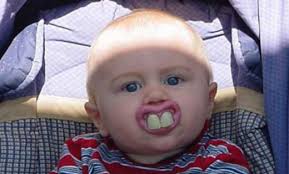
Babies and Bunnies: A Caution About Evo-Psych

42Alicorn22 February 2010 01:53AM

Daniel Dennett has advanced the opinion that the evolutionary purpose of the cuteness response in humans is to make us respond positively to babies.  This does seem plausible.  Babies are pretty cute, after all.  It's a tempting explanation.

Here is one of the cutest baby pictures I found on a Google search.

And this is a bunny.

Correct me if I'm wrong, but the bunny is about 75,119 times cuter than the baby.

Now, bunnies are not evolutionarily important for humans to like and want to nurture.  In fact, bunnies are edible.  By rights, my evolutionary response to the bunny should be "mmm, needs a sprig of rosemary and thirty minutes on a spit".  But instead, that bunny - and not the baby or any other baby I've seen - strikes the epicenter of my cuteness response, and being more baby-like along any dimension would not improve the bunny.  It would not look better bald.  It would not be improved with little round humanlike ears.  It would not be more precious with thumbs, easier to love if it had no tail, more adorable if it were enlarged to weigh about seven pounds.

If "awwww" is a response designed to make me love human babies and everything else that makes me go "awwww" is a mere side effect of that engineered reaction, it is drastically misaimed.  Other responses for which we have similar evolutionary psychology explanations don't seem badly targeted in this way.  If they miss their supposed objects at all, at least it's not in most people.  (Furries, for instance, exist, but they're not a common variation on human sexual interest - the most generally applicable superstimuli for sexiness look like at-least-superficially healthy, mature humans with prominent human sexual characteristics.)  We've invested enough energy into transforming our food landscape that we can happily eat virtual poison, but that's a departure from the ancestral environment - bunnies?  All natural, every whisker.1

It is embarrassingly easy to come up with evolutionary psychology stories to explain little segments of data and have it sound good to a surface understanding of how evolution works.  Why are babies cute?  They have to be, so we'll take care of them.  And then someone with a slightly better cause and effect understanding turns it right-side-up, as Dennett has, and then it sounds really clever.  You can have this entire conversation without mentioning bunnies (or kittens or jerboas or any other adorable thing).  But by excluding those items from a discussion that is, ostensibly, about cuteness, you do not have a hypothesis that actually fits all of the data - only the data that seems relevant to the answer that presents itself immediately.

Evo-psych explanations are tempting even when they're cheaply wrong, because the knowledge you need to construct ones that sound good to the educated is itself not cheap at all. You have to know lots of stuff about what "motivates" evolutionary changes, reject group selection, understand that the brain is just an organ, dispel the illusion of little XML tags attached to objects in the world calling them "cute" or "pretty" or anything else - but you also have to account for a decent proportion of the facts to not be steering completely left of reality.

Humans are frickin' complicated beasties.  It's a hard, hard job to model us in a way that says anything useful without contradicting information we have about ourselves.  But that's no excuse for abandoning the task.  What causes the cuteness response?  Why is that bunny so outrageously adorable?  Why are babies, well, pretty cute?  I don't know - but I'm pretty sure it's not the cheap reason, because evolution doesn't want me to nurture bunnies.  Inasmuch as it wants me to react to bunnies, it wants me to eat them, or at least be motivated to keep them away from my salad fixings.


1It is possible that the bunny depicted is a domestic specimen, but it doesn't look like it to me.  In any event, I chose it for being a really great example; there are many decidedly wild animals that are also cuter than cute human babies.

Comments (587)

MichaelHoward11 March 2010 02:07:17PM2 points [-]

This study suggests looking at kitten pictures makes you more careful, improving performance in fine-motor dexterity tasks such as mock surgery.

I wonder if this could lower the error rate of computer programmers, and whether I should buy Eliezer a kitten.

joaolkf05 March 2010 01:05:45PM* 3 points [-]

A cognitive module for cuteness only needs to make us find babies a nice thing and enhance the probability of parental care. It simply doesn’t matter if, besides doing that, the same cognitive module make us find bunnies or orthorhombic sulfur crystals at low temperature cute, so long this doesn’t have any deleterious effects. Probably a cognitive module that can find cute only human babies and not bunnies is more evolutionary improbable and developmental costly having the same relevant behavioral results of a more cheap and universal cognitive module for cuteness. Evolution only needs to shape cognition in order to generate, more or less, the right type of behavior. It DOESN’T have to, and in most cases it doesn’t, shape cognition nicely, in a way we would look at it and say “nice work”.

wedrifid24 February 2010 03:27:26AM4 points [-]

The problem with popularity: I've just been searching the web hoping to find someone linking to an investigation into cuteness that delved a bit deeper than spouting 'just so' stories. What I found is that not only are the most prominent results LessWrong.com links, most of the next in line links are external responses on the topic that link here.

knb24 February 2010 02:25:08AM* 2 points [-]

So what is the alternative explanation for cuteness? Cuteness is a universal response that is very similar in all human beings. People all over the world find the same things cute. Did the phenomenon of cuteness just emerge, culturally, ex nihilo, and spread to every country in which the subject has been studied?

This universal human phenomenon must be explained somehow. The only explanation is that the phenomenon of cuteness is an evolved response.

And, I can't emphasize this enough, Dennett's hypothesis might have been idle speculation, but this issue has been thoroughly studied by psychologists and neouroscientists.

http://www.journals.elsevierhealth.com/periodicals/bps/article/S0006-3223%2807%2900482-9/abstract

http://www.psychologytoday.com/blog/brainstorm/200803/cute-the-brain

The theory of cuteness as evolved psychological adaptation is supported by mountains of empirical evidence, by reason, and by evolutionary theory.

My evolutionary psychology professor just discussed cuteness in some detail a few weeks ago. She was very convincing. I have absolutely no idea how you consider all of this to be "cheaply wrong".

Alicorn24 February 2010 02:26:25AM3 points [-]

I'm sure there is an evolutionary explanation for cuteness. I just don't think it's this one.

fmuaddib23 February 2010 03:00:29PM* 4 points [-]

Here is the final, most likely explanation for the cuteness paradox:

1 - Cuteness genes are positively selected by many things, but the main filter, at least in mammals, is THE MOTHER INVESTMENT. Puppies (humans, bunnies, all of them..) compete for the investment of the mother, because she is the one that feeds them. They cannot feed themselves until they are adults. Cuteness is a deceivement device and (because it costs physical resources) an honest signal for communicating the mother that the deceiver is the puppy most worth of the maternal investment. Even non mammals use cuteness (i.e. birds and other oviparous species) but their cuteness is rarely perceived as so because of the huge physical differences with the mammals, differences that our mammalian brain cannot see as cute but as deformities.

2 - The selective pressure is bigger when the number of puppies is greater, because the competition is more tight.

3 - Female bunnies bears more children. A litter of rabbit kits (baby rabbits) can be as small as a single kit, ranging up to 12 or 13; however there have been litters as big as 18. So the competition is harsh, and consequently the selective pressure on the cuteness genes is bigger.

4 - Women give birth to 1 or 2 children at once on average, consequently the competition and the selective pressure on cuteness genes is greatly inferior to the selective pressure on the bunnies.

5 - Assuming that cuteness is an universal estetic trait (big facial elements, head bigger than the body, small arms, etc.), developed at the same way in all mammalian brains, it is then reasonable to conclude that human babies display cuteness traits, but are not as cute as the bunnies, because those are subject to a much more tight competition.

Findings that can falsify this hypothesis: - the existence of a species of mammals that bears many children at once that are not cuter than those that bears few, provided that those are normally competing for a shortage of resources from the mother. We need to take in consideration other factors as well, like shortage severity, likeness of the mother to drop some of his puppies if attacked or in extreme hostile environments, and so on.

diegocaleiro24 February 2010 06:29:46AM3 points [-]

Cuteness is not an universal trait, otherwise we would share this Vulture's mum's intuition.

http://g1.globo.com/Noticias/Brasil/foto/0,,15345660-EX,00.jpg http://www.patuca.blogger.com.br/Cosan-005.jpg

In the case of human evaluators of babies, not only our genetic proximity to the baby must be taken in consideration.

Human females pupils dilate (signal of attraction) when seeing a baby. Human male pupils will vary, with the case being that childless man are more likely to get a shrinkage, while fathers mostly have dilated pupils.

Sometimes it pays not to detect something, evolutionarily speaking, some levels of egoism are tolerated and forgotten to keep future altruism, for instance. Females are pro-babies in general probably because it would be too costly to find other babies neutral, or ugly. The male scenario is a bit different.

Also, we see babies all the time, so we should beware of Contrast Effect bias in favor of the bunny.

George24 February 2010 01:17:05AM3 points [-]

Mammals that bear many children less cute than a species that bears few: rats vs guinea pigs. But in any case it is very strange even to suppose that cuteness would be a universal aesthetic.

SilasBarta23 February 2010 04:16:54PM1 point [-]

What about the fact that most people here didn't find the bunny cuter than the baby? And that this is probably true in general?

thomblake23 February 2010 04:29:47PM2 points [-]

What about the fact that most people here didn't find the bunny cuter than the baby?

I'm not sure that's been established. Doesn't this say otherwise?

And that this is probably true in general?

Not if you believe (http://thecutest.info/top.html)

SilasBarta23 February 2010 04:43:53PM1 point [-]

Yikes. Didn't see the LW poll results. I just remember the initial comments on this discussion, where pretty much everyone was saying the baby is cuter, and getting modded up.

Very, very strange.

JohannesDahlstrom23 February 2010 04:50:57PM* 8 points [-]

Selection bias. Those of us (including myself) who agreed with Alicorn probably didn't feel a need to reply just to signal their agreement.

alexflint23 February 2010 12:12:19PM* 2 points [-]

It would be surprising if we found all babies cute because most babies do not carry our genes. Even a simplistic application of evo-psych would predict that we'd find our own babies very cute, while we'd be unmoved or even disgusted by others' babies.

Whether this is actually the case is a matter for careful experimentation and analysis, however. Evolution as a theory is not sufficiently precise to reliably make such detailed predictions (I believe this was Alicorn's original point)

wnoise23 February 2010 07:08:47PM2 points [-]

All babies carry the vast majority of our genes. We're extremely related to all other humans -- the complication is that they're also our most relevant competition. Tiny fractions of a percent differ between one person's kids and their neighbors. Nonetheless, these are the genes we're geared to care about.

wedrifid24 February 2010 08:52:24PM1 point [-]

There is a name for that. The thing we mean when we say 'the child shares 50% of its genes with its father' when it actually shares nearly all of them. A word for the particular difference from the base gene pool that a genetic source gives. It fit perfectly but I just can't remember it. Any ideas?

scotherns26 February 2010 08:34:04AM1 point [-]

Allele?

wnoise26 February 2010 09:50:18AM3 points [-]

No, "allele" is not the word we want, though we should be using it in preference to "gene". "Allele" just means "a particular variant of a gene". Technically speaking, "gene" means all the ways of coding for some particular set of structures (or rather the proteins that end up constructing them, or otherwise affect development). For example, humans have two primary genes for blood type. The first gene determines the Rh factor, with one allele of that gene coding for positive Rh, and the other for negative Rh. The second gene determines the ABO encoding, with one allele coding for O, a second for A, and a third for B. And of course, the alleles on each copy of the gene combine to produce different phenotypes, which can often be simplified to the "dominant recessive" model when there are only two common alleles in a population (e.g. Rh). ABO typing is more complicated -- A and B refer to types of "antigens" (surface markers) that your blood cells may have. Each is produced if you have at least one allele of that type. O, in contrast produces no antigens. (There are actually a whole passel of other genes that code for existence of a whole lot of other antigens and typing factors, but the variants are a lot rarer, so most people don't need to worry about them.)

The term wedifrid is asking for (and that I would really like to have) is about the frequencies of alleles. There is casual talk of someone's son being 50% related to his father. Certainly exactly 50% of his alleles were copied from his father. On the other hand, we should say that he's also 50% related to his father's identical twin brother, where there is no direct copying -- just the happenstance that this set of 50% of alleles is identical to that of his father's identical twin. But, as it turns out, of the 50% of genes that weren't copied, a very very high proportion will be the same as in his father (or indeed his uncle).

A natural distance to define on these sets of alleles is the l_1 distance "how many are different". (we can choose this on the level of DNA letters, codons, codons with equivalents lumped together, or "expresses same protein"; and measure slightly different things). For most genes there is effectively only one allele, so this measure of similarity doesn't go from 0% to 100%. Instead, it varies in a tiny fraction of 1% around 100%. If we do want it to be able to drop down to 0%, then we shouldn't count those genes with only one allele. How about genes with two alleles, but one is extremely rare? Perhaps entropy of each gene would be a reasonable weighting. Just counting "is there a path of descent to a common ancestor" certainly won't let us stretch the scale out to 0% either, because in that sense we're all heavily related. We want some (hopefully mathematically formalizable) sense of "this guy's deviance from the human average overlaps by x% with this other guy's deviance from the human average". Or at least a more precise word for that, rather than just talking about shared gene (allele) percentages, which will be extremely close to 100%.

fmuaddib23 February 2010 03:52:59PM3 points [-]

In fact non social species, like felines, are unmoved or even aggressive toward babies not kin related to them.

But we are primates, and being primates very social, we are subject to trivers reciprocal altruism, in other words: childs are very prone to help strangers if they feeds them. They can be adopted and parassitated as muscular force in exchange of a small piece of the meal, smaller than those of the natural childs of course, as foster care studies have demonstrated. So we can find others child very attractive too, because they can be very useful to us, because they are easily exploited due to the long period of dependence from adults.

This is not directly related to the cutness, anyway, that is a physical trait, with specific characteristics (big facial elements, head bigger than the body, small arms, etc.). If one puppy develops those traits to deceive his parents, those traits will be there to be seen by all the other people too. Unless there is a specific adaptation to resist such aestetic feedback in non kin related puppies, like in some non-social species, the brain response at a cute face is the same.

MatthewB23 February 2010 11:03:21AM2 points [-]

I have a very adverse reaction to human babies... I want to pop them. Or something similar. They look like you could just stick a big pin in them and they'd go POP.

Bunnies are way cuter than human babies (at least to humans I think).

MichaelVassar22 February 2010 07:50:36PM16 points [-]

I agree that evolutionary psychology is very prone to abuse and should probably usually be avoided, but this seems like a terrible example to me. The hypothesis that cuteness is our evolved response to baby-like features does NOT predict that babies will be the cutest thing.

Eliezer_Yudkowsky22 February 2010 08:23:47PM2 points [-]

Very compactly put. The data simply do not contradict the theory in the first place.

mattalyst22 February 2010 03:57:29PM25 points [-]

"Drastically misaimed" really says nothing about whether or not a cuteness instinct would be a good adaptation, though. A counterexample: it's a fact that our visual systems are acutely sensitive to rapidly-moving things. The evo-bio hypothesis is that this is predator detection. Does the fact that 99.999999% of the rapidly-moving things I notice aren't predators negate this hypothesis as well?

I can't think of very many cases in which people endanger themselves or their reproductive chances for the sake of cute animals. I'm sure it's happened once or twice, but using this argument means demonstrating that the number of potential children lost due to finding bunnies cute is greater than the number of actual children attended to due to finding them cute.

As an aside, I think that Google in this case is adding to the confusion. The evo-bio cuteness theory is generally stated as being about a system that detects facial markers that strongly differentiate babies from adults - the key ones being eyes large relative to head size, pursed mouths, round cheeks, and round chins. Some baby animals, when viewed up close in Google, display some of these characteristics. In the wild, however, baby animals are almost never seen up close, and even when they are, they trigger the facial recognition systems only in dribs and drabs, like bad CG.

George24 February 2010 01:23:39AM4 points [-]

"I can't think of very many cases in which people endanger themselves or their reproductive chances for the sake of cute animals." A) Drivers swerving to avoid cats and bunnies etc. B) All the warnings about leaving bear cubs alone. I can think of non-cuteness explanations that probably cover some part of each but it seems idle to reject any role for cuteness in those survivability risks.

HughRistik22 February 2010 07:24:11PM* 6 points [-]

mattalyst said:

A counterexample: it's a fact that our visual systems are acutely sensitive to rapidly-moving things. The evo-bio hypothesis is that this is predator detection. Does the fact that 99.999999% of the rapidly-moving things I notice aren't predators negate this hypothesis as well?

Nope, because the rapidly-moving things that are predators matter way more. False negatives in predator-detection are more costly than false positives by orders of magnitude.

I can't think of very many cases in which people endanger themselves or their reproductive chances for the sake of cute animals. I'm sure it's happened once or twice, but using this argument means demonstrating that the number of potential children lost due to finding bunnies cute is greater than the number of actual children attended to due to finding them cute.

Excellent observation. Perhaps some people find baby animals of other species cuter due to evolutionary baggage from common ancestors, which has never needed to go away because it didn't hurt our reproductive success.

n the wild, however, baby animals are almost never seen up close, and even when they are, they trigger the facial recognition systems only in dribs and drabs, like bad CG.

That's my intuition, also.

ChrisPine22 February 2010 03:44:01PM17 points [-]

Don't any of you have children?? Newborn babies are one thing, but there's a cuteness of seeing small, perfect little versions of yourself or your mate... I don't think a bunny could really compete.

No, other people's babies aren't that cute, but mine sure as hell are.

And in any case, I don't really see how this relates to... whatever it is you are saying about ev-psych (or the deeper mystery of cuteness). Why would you expect evolution to make us only find human babies cute? Evolution only has to work hard enough to keep us from abandoning our babies, and to hell with the (bunny-related) side-effects. Why would evolution care how cute you think bunnies are, as long as it's not so much that you start eating your babies and raising rabbits?

brazil8422 February 2010 04:14:35PM2 points [-]

That thought occurred to me too. Evolutionarily, if our sexual instincts are very strong and well aimed, the cuteness instinct arguably doesn't need to be so precise.

Sticky22 February 2010 06:04:44PM7 points [-]

We find bunnies in general cute, but not humans in general -- so it makes sense that a baby bunny would be cuter than a baby human. It combines babyness and bunnyness, as compared to a human baby who only has babyness. We care about the human baby more than the bunny baby because we value humanness quite apart from cuteness.

pwno22 February 2010 09:50:10PM3 points [-]

Another interesting thought: Animals probably find human babies cute too.

SilasBarta22 February 2010 09:57:12PM1 point [-]

Maybe so. I've heard anecdotal stories about female cats that have had baby kittens, and then take an interest when their owners had a newborn, becoming very protective of the (human) baby.

jimrandomh23 February 2010 03:11:26AM1 point [-]

One more possibility: our cuteness detector is simply our threat detector for animate objects with a minus sign. Bunnies are especially cute because we're especially confident that they can't hurt us. People who feel threatened by the responsibility that babies represent don't find them cute.

Jordan23 February 2010 03:57:07AM2 points [-]

A lot of predators have pretty adorable cubs. If anything the babies should be identified as more of a threat, since the mother protecting them will usually be more motivated than if she were simply trying to eat you.

Ryan23 February 2010 03:52:18AM1 point [-]

May be something to that. Other animals have an innocence factor about them that humans lose pretty quickly for me. Especially by 2 years old or so, I start finding some human kid behavior more manipulative than cute.

bgrah44922 February 2010 03:46:46PM* 7 points [-]

It seems very oversimplified to say, "We think babies are cute because we have to." "Cuteness" casts a pretty wide net when you start thinking of all the things we say are "cute." A sample list of things I've heard described as cute:

  • Babies
  • Bunnies
  • Targets of sexual attraction
  • Small consumer goods, such as tiny containers of shampoo, small forks, etc.
  • Some old men
  • Targets of sarcastic comments ("That's real cute, but .. ")

It seems like we reserve the word for "things that are vulnerable/harmless/ineffective and don't realize it, which then triggers an urge to keep the thing's inaccurate self-perceptions about its own effectiveness intact."

Blueberry24 February 2010 02:04:18AM4 points [-]

This is confusing the map with the territory. We use the word "cute" for all those things, but we don't feel the same way about them all, and we don't mean the same thing by that word in most of those cases.

Blueberry24 February 2010 02:54:50AM3 points [-]

I was asked to clarify and expand this comment, so:

The original post was about a particular feeling that humans often have in certain situations, a feeling that is often triggered by looking at young animals. This feeling is something that exists in the real world (the territory).

We use the word "cute" (among others) to describe something triggering this experience. This is part of our map of the world. However, no word unambiguously refers to just one thing in the real world. That's just not how language works. As it happens, the word "cute" is commonly used to refer to lots of other things as well. Targets of sexual attraction may be said to be "cute", but in a different way than bunnies or kitties, though these may be related. Using the word "cute" sarcastically is a very different use of the word with a completely different meaning. My original point was that if something is described as "cute", that may be a similarity on the map but not the territory.

I may use the same word for a sexually attractive human, a kitten, a small fork, an old man, and a sarcastic comment (map similarity). But for each one, I may mean something completely different, and I may have a completely different response with a separate type of explanation (territory difference).

HughRistik22 February 2010 07:41:06PM3 points [-]

The fact that some humans who find baby animals cute often treat them like babies, refer to their pets as "my babies," and engage in baby-talk to them is consistent with the notion that considering these animals cute is merely a byproduct of human baby-perception. I think part of the reason that Alicorn's baby bunny is so cute is that it is holding up its arms, like a baby wanting to be picked up.

aausch23 February 2010 01:06:46AM1 point [-]

If I don't eat the bunny, I'm sure to find something else to eat. If I eat the bunny, though, it's definitely not going to be alive anymore (attack of the zombie digested bunnies anyone?)

There isn't as much pressure on human evolution to avoid making cuteness mistakes, as there is on bunny evolution to be cute. If evolution were to move fast enough, and the cuteness complex would be hackable, it seems possible to me that things would evolve to hack it (and beat out babies at it).

JulianMorrison22 February 2010 11:45:59AM11 points [-]

Maybe the bunny has evolutionarily converged on the mammal shared cuteness pattern, but the baby has been forced to diverge by other pressures? Human babies are born very underdeveloped relative to other species. I've read speculation that this is due to the upright walking, hip shape, head size, brain size compromise, and that seems sensible to me. Cuteness optimization may have been shoved aside as lower priority.

HughRistik22 February 2010 07:39:19PM1 point [-]

Excellent observation. I was thinking the same thing.

Tiiba22 February 2010 06:53:36AM* 21 points [-]

I wanted to say this for a long time: human babies aren't cute. Certainly not newborns. If I didn't know better, and saw a newborn, I would perform an exorcism. They look like creatures from the Uncanny Valley.

Edit: Seventeen points? Maybe I should make this a top-level post. Opinions?

First I lose about that many from a very thoughtful post because of my unusual sense of humor. Then I gain them back on... this? People, start making sense.

prase24 February 2010 10:24:27AM1 point [-]

Upvoted because of the edit. But don't make this a top-level post, please.

Dustin22 February 2010 07:51:34PM9 points [-]

1 year ago, I would have completely agreed.

Then we had a baby, and now I see cuteness in babies all over the place. None as cute as my baby, though.

RichardKennaway22 February 2010 01:40:31PM* 3 points [-]

I note that cuteoverload.com has no babies on it, as far as I can tell. Cats, dogs, and little balls of feathery fuzz, but no babies.

lavalamp22 February 2010 03:53:11PM3 points [-]

Some potential confounding factors to consider:

  • Society spends the first 18 years of kid's live's teaching them how and why not to have babies (not complaining, just pointing out that it could affect one's cuteness judgments).

  • Your cuteness detector might very well be tied to detecting your own genetic material. IOW, you might find your own babies very cute, and those of others, not so cute. (My parents claim that this is the case, I wouldn't know.) And you, being female, would have a very good idea of what babies are genetically yours...

FrankAdamek22 February 2010 03:33:35PM3 points [-]

I regret not having the time to read all the comments before class, but, in addition to our culture which does anthropomorphize wee bitty aminals, we don't have the acquired distaste or taste for eating or repelling rabbits.

My mother is a gardner, likes puppies, kittens, etc, and hates rabbits. She's said a person will find them cute until they keep ripping up your flower bed.

It seems plausible that having been starving and relieved by rabbit meat a few times, a person would think "Yum!" upon seeing a rabbit.

Perhaps our cute instinct is slightly misaimed, we lack most of the normal associations we would gain from these animals, and in reverse have gained large associations in the other direction, exploding a slight evolutionary mistake. Common kids shows might have more difficulty in making babies super cute, being that some of their audience are infants themselves. Then they'd feature adorable, wittle bittle..."you"s?

LauraABJ22 February 2010 02:50:29AM31 points [-]

I would find this argument much more convincing if it were supported by people who actually have children. My mother goes beserk over a smiling infant in a way I cannot begin to comprehend (I am usually afraid I will accidentally hurt them). My husband, likewise, has an instant affinity for babies and always tries to communicate and play with them. He was raised Jewish with the idea that it is unclean to have animals in the home and does not find animals particularly adorable. In our culture we are inundated with anthropomorphised images of animals in television and given stuffed toys and pets that we take care of like children. It's not that surprising that we find animals cute when we focus so much attention on them as if they were little people. I do not know that such evaluations of 'cuteness' would hold cross-culturally, especially in cultures where people do kill and eat 'cute' animals on a regular basis.

inklesspen22 February 2010 03:49:35AM* 2 points [-]

Other hominids have been known to keep pets. I would not be surprised if cetaceans were capable of this as well, though it would obviously be more difficult to demonstrate.

taw22 February 2010 01:53:35PM3 points [-]
NancyLebovitz22 February 2010 03:46:53PM* 1 point [-]

The site includes the cutest images. The cuteness response can be set off strongly by a cute creature associating with human stuff or (just a few of them) seeming to do a distinctively human gesture. Any theories about what's going on there?

Eliezer_Yudkowsky22 February 2010 08:27:29PM3 points [-]

Also, Alicorn's image found on a Google search is the cutest image on the top of TheCutest.Info. No matter how she found the image to begin with, this seems like highly relevant data! Even a search procedure that seems fair can manage to turn up an unfair point of comparison.

Albeit some of the other images in the top 40 seemed far cuter than that to me - cuter than babies. Maybe I just don't like bunnies? How could evolutionary psychology explain that?

Alicorn22 February 2010 09:01:20PM* 2 points [-]

"Allison"?

My name is not Allison. "Alicorn" is not my real name, related to my real name, derived from my real name, similar to my real name, or otherwise indicative on any level of my real name.

Even if it were, I prefer not to disseminate my real name in most online contexts. For this reason SIAI-house-inhabiting persons have continued to refer to me as Alicorn, to avoid leakage of their knowledge of my real name. So even if you knew my real name, you should not use it.

Eliezer_Yudkowsky22 February 2010 09:48:30PM6 points [-]

I initially commented to the above effect that it was just a random brain-bleep and I did not remember your True Name if indeed I had ever been told it, but then deleted the comment, since if I had known your name to be Allison and genuinely slipped up, I would want to be the sort of person who simply wouldn't say whether or not it was a revealing slip-up, one way or the other, so as to maintain Plausible Deniability. To put it another way, if it had been your real name, I would want to be able to truthfully say, "Whether it was her real name or just a brain-cache substitution, I would not confirm or deny it one way or the other, so you cannot take any evidence from the fact that I am being apparently evasive." This requires that I say the same thing whether your name is Allison or not, since otherwise people can take Bayesian evidence from it. However since in this case you have already commented to this effect, I suppose I might as well confirm it.

I did once know an Allison and my brain seems to repeatedly substitute that name for yours. I usually catch it before commenting, but not this time. There are other bizarre things my brain does along the same lines, for example, I simply cannot remember, even after having been told a dozen times or more, whether Peter Thiel's last name is pronounced Thee-el or Tee-el.

SilasBarta22 February 2010 09:51:55PM1 point [-]

I apologize to all for making such a big issue about the typo. (I removed the flamebaitish part of my earlier comment.)

komponisto22 February 2010 10:05:15PM5 points [-]

For my part, my brain automatically interprets your pseudonym as a portmanteau of "Allison" and "unicorn", and there doesn't seem to be much I can do about it. (Not that I would be any more tempted to refer to you as "Allison" than I would be to refer to you as "Unicorn", of course.)

bgrah44922 February 2010 09:11:32PM1 point [-]

Her real name is Carmen Sandiego.

Alicorn22 February 2010 09:12:18PM4 points [-]

It can't be, because I'm willing to reveal my location relative to the Earth.

byrnema22 February 2010 09:57:57PM* 1 point [-]

Looking through those pictures, I get cuted-out, and want to go find that site about bunny suicides.

Eliezer_Yudkowsky22 February 2010 08:19:55PM1 point [-]

It might be an awful experiment to perform, but if we can find a parent with a newborn child and sufficient self-honesty to be trustworthy, we can ask them whether or not, in all honesty, their own baby is cuter than those images, which were cute enough to make my head explode into candy.

If a trustworthy self-honest rationalist parent looks at that and says "yes, my baby is cuter"... I'd have to say that explains a lot about parents and a lot about the continued survival of the human species.

k3nt23 February 2010 03:10:40AM1 point [-]

My baby boy was at or near the top of all the images for cuteness for about 1 year. Or I would have said so at the time.

JulianMorrison22 February 2010 08:31:44PM1 point [-]

What would be even more interesting would be to do a time-series. When do human infants have peak cuteness?

JulianMorrison22 February 2010 08:19:44PM1 point [-]

Mothers praise and fuss over human babies that cutely imitate adults. It seems like good training for a critter that's going to grow mirror neurons and a sense of empathy.

Alicorn22 February 2010 05:34:32PM1 point [-]

I think that may have the effect of crosswiring with the funniness reaction, although I can't access introspective data on the subject because I generally prefer my cute animal pictures to be devoid of humans and human artifacts.

Leafy22 February 2010 01:47:49PM3 points [-]

Is it not worth considering "cuteness" to be defined in terms of threat levels. It seems to me that in most cases there is a direct correlation between cuteness and perceived threat.

By threat I am referring not just to physical (claws versus soft paws, large vs small, dominant versus meek, hard versus soft) but even biological (messy / unhygenic looking creatures versus fluffy / cuddly looking ones) or social (flawed versus flawless).

This may explain why some people perceive cuteness differently. One person may look at a human baby and see no possible threat, others may be more inclined to be considering health implications or even the threat of embaressment / fear it is associated with.

With this association in mind it would seem that selection towards lower threat is prevalent - babies looking cute leads to lower abandonment or attack by other parties, animals allowed to come close to humans without fear and benefiting from shelter / food / care etc.

AdeleneDawner22 February 2010 02:23:28PM5 points [-]

This also might explain why some of us think that babies are cute, and others of us don't: Not that babies themselves are potentially dangerous, but that messing with someone else's baby is potentially dangerous, particularly if the baby belongs to someone who's not a tribemate. I suspect that finding a given baby cute correlates with how much we trust the baby's parents; in the case of strangers' babies, it would correlate with our priors regarding how dangerous it is to interact with strangers.

This doesn't explain why some stranger's babies register as cuter than others, though - perhaps that correlates with how much the babies look like people who we believe would trust us to interact with their babies?

DanArmak22 February 2010 01:59:48PM3 points [-]

Cats are dangerous predators and many housecats scratch or bite humans in play, but they're still cute, often in the very moment of doing so. They can also appear cute when hunting real prey.

AdeleneDawner22 February 2010 02:10:01PM2 points [-]

Cats that are actually dangerous to us are generally not perceived as cute, though. Googling 'cute lion', for example, turns up primarily cubs, drawings of cubs, drawings of adults with cublike proportions (which look decidedly nonthreatening), or babies or pets dressed up to look like lions. The only picture of an actual adult lion on the first 5 pages that registers as even remotely cute is this one, and that stops registering as cute at all when I consider the chance that that lion could have mauled her.

DanArmak22 February 2010 02:17:47PM1 point [-]

I see this as saying that fear masks cuteness.

It makes sense that immediate physical fear overrides cuteness-attraction. But if fear is banished, the same animals - even adult felines - appear cute (to me, at least). For instance, if I had a bionic body that a lion couldn't maul, I strongly believe I'd find that lion kiss picture very cute and would very much want to play with big cats.

AdeleneDawner22 February 2010 02:32:00PM1 point [-]

That's how I parsed the original comment's 'threat levels' - it's not that we're hardwired to see certain things as nonthreatening and thus cute; the perception of threat is learned or situational, and cuteness is the opposite perception, and thus also learned or situational.

(I'd want to play with big cats in that situation, too. Have you seen the videos of the guy who does? They're adorable.)

NancyLebovitz22 February 2010 03:55:29PM1 point [-]

It can't just be harmlessness-- all sorts of things (like pencils) are harmless but not cute.

CannibalSmith22 February 2010 12:06:15PM* 4 points [-]

Hey, let's play a game! Pick any comment in this comment tree and reply to it with a picture you consider cuter than it. The markup is ![](http://www.blabla.com/picutre.jpg) . Please do not reply to yourself. One picture per post please.

I'll start with the first Google Images result for "cute":
Kutta24 February 2010 02:11:09PM* 3 points [-]

I'm appalled that Less Wrong came to have a "Post cute kittens" thread this soon. Still, I wouldn't call it an unfortunate turn of events.

CronoDAS25 February 2010 10:55:57PM2 points [-]

As an Internet forum grows older, the probability of a thread devoted to posting pictures of cute kittens approaches one. ;)

Kevin26 February 2010 11:22:40AM* 0 points [-]

I will bet 500 karma (1:1, terms fully negotiable) that there will be a "funny picture" thread within one year.

ata23 February 2010 02:19:53PM1 point [-]

Warrigal23 February 2010 12:26:21AM4 points [-]

CannibalSmith23 February 2010 09:55:36AM2 points [-]

Kevin23 February 2010 01:19:09PM2 points [-]

ciphergoth23 February 2010 02:08:15PM4 points [-]

STOP STOP! I die!

ata23 February 2010 02:20:43PM2 points [-]

Wei_Dai22 February 2010 09:00:36AM7 points [-]

Our sense of cuteness may be tuned to respond optimally to young children, instead of newborns. (I'm guessing here based on the fact that humans look like young children for a much longer period of time than like newborns. My personal sense of cuteness is extremely insensitive for some reason.)

What causes the cuteness response? Why is that bunny so outrageously adorable? Why are babies, well, pretty cute? I don't know - but I'm pretty sure it's not the cheap reason, because evolution doesn't want me to nurture bunnies.

I'm not convinced that you should be "pretty sure", but I'm more interested in why you used the word "cheap". What does that mean in this context?

Kutta23 February 2010 11:23:06AM* 1 point [-]

Our sense of cuteness may be tuned to respond optimally to young children, instead of newborns.

Mortality among ancestral newborns were rampant so caring for them was probably of less marginal utility than caring for young children, I think.

ResistTheUrge22 February 2010 11:00:06PM1 point [-]

My "cuteness sense" responds that way. I find young children (2 - 4 years old) much cuter than newborns. I don't think I'm alone in this.

mattnewport23 February 2010 12:22:58AM4 points [-]

Young animals don't generally reach optimal cuteness until some time after birth. Given the slower rate at which human young mature relative to other animals your cuteness sense for humans is not necessarily inconsistent with the normal response to animals. It seems to me that the pictures used for comparison in the OP use a bunny at a relatively later stage of development than the human infant.

Newborn puppies, kittens and rabbits are peculiar little blind wriggling things and are less cute than slightly older young animals. Newborn rabbits appear to be hairless.

Alicorn22 February 2010 05:49:13PM1 point [-]

"Cheap" means the one you come up with if you think about the question "Why are babies cute?" instead of "Why are the things that are cute as cute as they are?"

prase22 February 2010 06:22:52PM1 point [-]

What about domestication?

There may be two sides of the effect. First, sense of cuteness could lead people to keep domestic animals, and having domestic animals was an evolutionary advantage. Second, the way how animals lose their cuteness when they are older may be explained by our need to eat them later.

Or, alternatively, we can think that animal cuteness has evolved first when people domesticated dogs, which were one of the first domestic species, and has nothing to do with eating them later - rabbit cuteness being a side effect. Baby cuteness could be originally a different instinct, but these two instincts later merged.

We need more data. Cultural influences play certainly some role, whose extent is hardly predictable to me. One may do some research of how cuteness is perceived within primitive tribes at New Guinea, for example. I am far from sure that cuteness is mainly a "hardwired" feeling, as opposed to learned.

JamesAndrix22 February 2010 06:00:34PM1 point [-]

Ahh, but it's a baby bunny. If cuteness is a baby-protector, it might have begun a long time ago, maybe even when we were on four legs and furry. It might not not have had time to catch up with our change into big skulled hairless monster apes.

brazil8422 February 2010 02:11:52PM2 points [-]

Fundamentally, aren't you asking why furry mammals are cuter than non-furry mammals?

DanArmak22 February 2010 02:25:29PM1 point [-]

That's not the only determinant of cuteness.

For instance, kittens also purr, mew, play-hunt, rub themselves against people, and lick people. All of which are cute, attractive behaviors that babies lack.

brazil8422 February 2010 02:36:02PM1 point [-]

To me, a baby's babbling is a lot cuter than purring or mewing. And to me, a baby grabbing at something with its tiny hands is a lot cuter than play-hunting, rubbing, or licking.

So for me, the real conundrum is fur. As far as I can tell.

But I admit that this is based on introspection and I'm assuming that my own cuteness standard is somewhat universal.

HughRistik22 February 2010 07:27:35PM2 points [-]

To me, a baby's babbling is a lot cuter than purring or mewing. And to me, a baby grabbing at something with its tiny hands is a lot cuter than play-hunting, rubbing, or licking.

Same here.

So for me, the real conundrum is fur. As far as I can tell.

Our ancestors were furrier, so we might have evolutionary baggage leading us to find furriness cute. As long as this baggage didn't hurt human reproductive success, there would be no reason for it to disappear.

brazil8422 February 2010 07:50:19PM1 point [-]

Our ancestors were furrier, so we might have evolutionary baggage leading us to find furriness cute. As long as this baggage didn't hurt human reproductive success, there would be no reason for it to disappear.

I think this is the best explanation, but I have to admit it doesn't satisfy me 100%. Logically it seems to me that have the cute instinct triggered by a furry creature must hurt human reproductive success at least a tiny amount. Over a long time, this arguably should have a big impact.

HughRistik22 February 2010 08:19:42PM1 point [-]

I think this is the best explanation, but I have to admit it doesn't satisfy me 100%. Logically it seems to me that have the cute instinct triggered by a furry creature must hurt human reproductive success at least a tiny amount.

Well, maybe. But I would want to see some actual historical accounts or folktales of humans getting sidetracked by cute animals recently enough in our evolutionary history to matter. In the EEA, the availability of cute animals as pets would have been a lot lower than it was today. And trying to get a wild animal as a pet would've been harder. When you couple those facts with social norms towards reproducing, people failing to mate or take care of their kids due to being distracted by cute animals seems less and less likely.

Jack22 February 2010 03:37:19AM* 13 points [-]

How come everyone is missing the obvious answer? The human ancestor that first developed attachment to babies may be an ancestor we share with rabbits.

(Edit, Also: Human babies may have evolved to be uglier for other reasons -less hair, bigger heads- and those features may have been selected for more than cuteness.)

Edit 2: Metaphorically, our cuteness program is like running Netscape Navigator 1.0 or something. It sort of does the trick but isn't exactly adapted for modern uses

djcb25 February 2010 06:47:00AM* 2 points [-]

I'm not sure the answer is so obvious.

For example, baby pinguins and other birds can be very cute; baby lizards usually aren't. I think the theory goes that we've evolved from something that looks somewhat lizardy, but definitely not like a bird.

mattnewport25 February 2010 07:13:56AM3 points [-]

cute lizard

I rest my case.

djcb25 February 2010 08:18:21AM* 0 points [-]

I just knew someone would come up with something like this :-) indeed it looks cute. One could take it even a step further; look at the weird but cute-looking space aliens in this Moby video.

This actually supports the notion that cuteness is not necessarily proportional to the likeliness to humans or to our ancestors.

Jack25 February 2010 07:05:25AM1 point [-]

Yeah, it definitely isn't a perfect theory. It is obvious in the sense that it is the logical conclusion to come to if you held the Dennet theory and then had alicorn's evidence presented to you. The main thing is that there is no reason to think that the cuteness instinct is a product of recent evolution.

byrnema22 February 2010 02:56:14PM6 points [-]

I agree with Jack: large eyes embedded in a small puffy face are general mammalian triggers for cuteness. Humans thinking that kittens are cute is just an accident.

Though 'accident' isn't the right word. Mammalian mechanisms are simply very general among mammals and robust. I read this somewhere and assimilated it as obviously true. And then I experienced how true it was when I had kids.

We're always 'being mammals' but I guess we're somewhat desensitized to the mammalian things we do every day. During pregnancy, childbirth and raising a child, a whole slew of new behaviors are activated and it's just amazing to realize the extent to which behaviors are instinctual and rely on physical mechanisms like tactile stimulation, visual cues and internal timers.

Breast-feeding of course. Did you know that breast-feeding is an interactive activity, where the baby has to suck of course, but also the mother needs to 'let down' the milk supply? Tactile stimulation (like sucking or kneading) will trigger 'let down', but also it can be triggered if the mother just thinks about her baby being cute. Women often have a lot of trouble 'pumping' milk for later use because the apparatus doesn't mimic human babies very well. Even if it mimics the way a child sucks during the first 30 seconds, the longer scale 5-15 minute temporal dynamics are missing. There's a difference between the milking patterns at the beginning and the end.

A few months before birth there's the nesting behavior, and then the timing of labor is a very complex, oscillatory process with many false and half starts.

Other timing mechanisms include the biological clock that makes women more inclined to want children, ovulation, the multi-stage birth event itself, lactation rhythyms as mothers and babies fine-tune and adjust over weeks and months. One of the most amazing examples of this, for me, was that I noticed a 1-3 minute pattern in the way I attended to my children. Especially someplace where they were amused and relatively safe but possibly in and out of sight, like at the park. For 1 to 2 minutes, I would just think my own thoughts, possibly chat on the phone or look through a magazine. After about 2 minutes, I noticed a growing anxiety that would not be relieved until I spotted my child. found this very curious and played around with it, deliberately not looking for my child for small periods of time to determine how regular this mechanism was. It seemed very regular.

DanArmak22 February 2010 03:01:22PM1 point [-]

I agree with Jack: large eyes embedded in a small puffy face are general mammalian triggers for cuteness. Humans thinking that kittens are cute is just an accident.

Then I repeat my question: please give examples of non-primate mammalian behaviors that indicate the animal found an animal of a different species "cute".

A second question: does your theory allows distinguishing between "cuteness" reaction and nurturing/baby-raising protective behavior?

byrnema22 February 2010 03:35:06PM2 points [-]

A second question: does your theory allows distinguishing between "cuteness" reaction and nurturing/baby-raising protective behavior?

Mine doesn't. I think that instinctual mechanisms for "nurturing/baby-raising protective behavior" is a really big deal for mammals, so much so that the mechanisms have a tendency to be overly robust. (E.g., some men lactate.) However, I would defer to an expert on this, and would ask one (read a book) if something rested upon the question.

please give examples of non-primate mammalian behaviors that indicate the animal found an animal of a different species "cute".

I look forward to the day when we can scan an animal brain and see what they think and feel. Till then, I can't comment on whether animals think their babies are 'cute'. There's no doubt though that nurturing/baby-raising protective behavior is triggered across species. However it seems context-dependent: the parenting animal must have reason to consider the baby part of the family. So domesticated animals are likely to show this behavior to other pets and babies. (My cat tried to teach my first baby how to hunt when she started crawling, but didn't bother with the second.) Birds will take care of other birds if they're in the nest, etc. And of course there's Tarzan, which might have been based on some kind of observation of this kind.

DanArmak22 February 2010 05:15:44PM1 point [-]

I look forward to the day when we can scan an animal brain and see what they think and feel. Till then, I can't comment on whether animals think their babies are 'cute'.

I think 'response-to-cute-stimuli' can be usefully defined on a behavioral level too.

I suggest this definition: the animal is interested in the cute-animal, often despite being strangers; it spends time looking at it or touching it, plays with it or talks to it (depending on the animal's species-typical behavior). But it eventually forgets about it, leaves it behind (or allows it to depart), and does not protect or feed it - as it would an adopted baby. Doing these last things goes beyond "owww it's cute!" and constitutes parenting behavior.

The question is - do animals reliably exhibit non-parenting behavior of the sort described above, and towards what patterns of other animals?

wedrifid22 February 2010 10:32:37PM* 1 point [-]

How come everyone is missing the obvious answer?

Good question. It didn't appear until here. The obvious answer is that cuteness does in fact serve purposes distinct from making people nurture every baby they come across.

byrnema22 February 2010 10:40:49PM1 point [-]

I don't get it. This other purpose is nutritive?

wedrifid22 February 2010 10:48:33PM1 point [-]

Maintaining a food source until a better time to eat it seems like a somewhat better reason to find bunnies cute than because they look like babies. Particularly because eating or at least killing other people's babies is a strategy that some of our near primate relatives use. Significant evidence could persuade me but I'm just not seeing it.

byrnema22 February 2010 10:53:14PM* 3 points [-]

There may be reasons for experiencing "cute" besides stimulating parental care, but I'm skeptical about the food-source-theory because I think things are cute independent of their nutritive value. The only connection may be that adult herbivores tend be cuter than adult carnivores, and they also taste better.

Nevertheless, I was thinking about what kinds of food I think are cute. And this brought me in an entirely different direction. Anything miniature is cute. (Even a mini-paperclip.) Is this a different sense of cute again? Is our parental duty stimulated so broadly we can experience it in response to a mini-hamburger?

wedrifid22 February 2010 11:01:50PM2 points [-]

That's an interesting take on it. I was going along a similar train of thought of 'anything miniature is cute'. I just didn't interpret it as parental. I took it as 'Miniature things are barely worth it but are growing extremely fast. Throw it back and eat it when it is ten times the nutritional value in a couple of weeks!' My surprise would then be that we experience even in response to things that are not a 'mini-burger'. I'm not going to benefit from eating clippy unless I am iron deficient and I embed him in an apple for a while to rust before I eat it!

wedrifid22 February 2010 07:27:37AM* 4 points [-]

How come everyone is missing the obvious answer? The human ancestor that first developed attachment to babies may be an ancestor we share with rabbits.

Because I don't consider it plausible. The 'cuteness' response is just far more malleable than the, you know, bit where you aren't a rabbit. See, for example, all the other sensory preferences that are are finely honed per species.

EDIT: I will add that it is slightly more plausible to me that rabbits are cute because they look more like baby ancestral primates than baby humans do on some key features (little and fury). Even so I would be reluctant to assign too much confidence to such a theory.

Psy-Kosh22 February 2010 03:38:58AM6 points [-]

That would explain how it is we can find rabbits cute at all. But to find them equally or more cute than human babies would seem to not be explained by your answer.

Unnamed22 February 2010 07:12:01AM* 2 points [-]

Do we know whether adult rabbits find baby rabbits cute? If not, that would count against the common ancestor hypothesis.

Psy-Kosh22 February 2010 05:07:11AM1 point [-]

Hrm... with regards to your edit, wouldn't there still then be the pressures for our "cuteness criteria" to evolve to prefer the new look of babies?

RobinZ22 February 2010 03:51:56AM1 point [-]

"An". "An" obvious answer. There's at least one other which has been proposed in other replies to this post: social conditioning.

I have to say that yours is quite interesting, however. What else does it predict?

wedrifid22 February 2010 07:32:02AM6 points [-]

I have to say that yours is quite interesting, however. What else does it predict?

That instincts are orders of magnitude slower to evolve than physical attributes at the scale of 'people and bunnies'.

DanArmak22 February 2010 11:52:31AM2 points [-]

That instincts are orders of magnitude slower to evolve than physical attributes at the scale of 'people and bunnies'.

The instincts have to reference physical attributes to identify cute things. If physical appearance evolves so quickly, how can the instinct continue to apply to it?

IOW, to accept this theory, it is necessary to believe that the things we find cute are all similar to that shared ancestor (or shared-ancestral juvenile). Does anyone know if this actually makes sense within what we know of ur-Mammalian creatures?

soreff22 February 2010 05:55:48PM3 points [-]

If attraction instincts (cuteness or sexual) evolve much more slowly than physical attributes, then shouldn't supermodels be chimpier than they are?

mattnewport22 February 2010 06:48:55PM* 4 points [-]

Is 'supermodels' supposed to be shorthand for 'highly sexually attractive'? Supermodels are not generally the women who are the most sexually attractive to heterosexual males but are selected for a variety of other attributes such as a 'striking' appearance, height and extreme slenderness.

That said, women who are considered very sexually attractive are not particularly chimpy either. They do share other traits that are not as common amongst supermodels however.

Jack22 February 2010 06:41:13PM1 point [-]

Yes. But there is no reason to think the cuteness attraction instinct and the sexual attraction instinct evolve at the same rate or even at a rate of the same order of magnitude. Finding offspring less cute than your ancestors did is far less likely to lead to genetic death than failing to mate with those with the best traits. That seems obvious to me anyway, I could be wrong.

ideclarecrockerrules22 February 2010 06:07:25PM1 point [-]

This pretty much convinced me that the fine variances of sexiness have much more to do with memes than genes. It shouldn't be hard to test if it is the case with cuteness as well: just find a culture that hasn't been exposed to Disney/Pixar films.

bogdanb22 February 2010 10:51:48PM3 points [-]

Not that hard to do. Look at woman representations in art. Until the last century, they were quite different from current photo-models. (I tend to think of most of them as “fat”, despite the fact that I know they’ve better reproductive characteristics.)

gwern22 February 2010 03:10:43PM1 point [-]

What else does it predict?

How about, the closer something is to human, the more cute? Since there will be 2 million years of pressure honing 'cuteness' to primate needs, and counteracting the x million years of pressure about rabbits.

DanArmak22 February 2010 03:15:53PM1 point [-]

In that case the fact that other animals are often much cuter than humans completely refutes the theory.

gwern22 February 2010 03:21:34PM1 point [-]

It sure does.

komponisto22 February 2010 04:00:22AM7 points [-]

What else does it predict?

That lots of other animals should share our opinions about cuteness.

Unnamed22 February 2010 07:10:53AM* 4 points [-]

I believe that Konrad Lorenz was the first one to advance the evolutionary theory of cuteness. Stephen Jay Gould wrote an article about it (pdf) using Mickey Mouse as an example (don't be dissuaded by the author's identity). Lorenz argued that we respond with awwwws and nurturing behavior to features that distinguish infant humans from adults, like large round heads, large eyes, small pudgy limbs, and clumsy movements, even if they belong to another animal or a nonliving thing.

There has been research on why animals are cute, again going back to Lorenz, and I think it's generally accepted that the young of many species are cute to us because they share cute-inducing features that are common to that developmental stage, some species (like pandas) seem cute just because out of the wide variety of species some of them happen to have cute-inducing features, and some species (like dogs) seem cute because humans have bred them that way. I'm not sure if there is research on whether adults of other species find their own young to be cute.

Human infants are unusually helpless for an unusually long period of time, which helps explain why humans are so attuned to cuteness (and why there would be a bias towards over-identifying instances of cuteness, which evolutionarily is the less costly error). That doesn't explain why bunnies are cuter than babies, though, or why non-humans dominate the top of our cutest list. Perhaps they just have more of the cute-inducing features. Humans occupy a small portion of body-space, and if you move from the region occupied by adult humans to the region occupied by human infants and then go even further along the same dimensions, you could run into regions occupied by other animals. But why would this happen for cuteness but not sexiness?

Unnamed22 February 2010 08:07:10PM2 points [-]

This is a rewrite of my comment as more of an argument and less links and speculation, since I think that parts of it might be clearer that way.

Lorenz's theory is that humans evolved to respond with an awwww to the features that distinguish infants from adults, and so we also awwww to other animals that have those features. Why do other species have features that we find cute? One reason is that we've exerted selection pressure on them - for instance, by being more friendly to cuter wolf/dogs. A second is that features common among mammal young naturally became features of human babies, so of course other baby animals have some cute-inducing features. A third is that features that differ between babies and adults also tend to differ between different species, and so there will be some species that have the baby-like version of those features or even a more extreme version. Babies are smaller than adults but some species are smaller; babies have small less-protruding noses but some species have smaller noses; babies have small limbs relative to their body but other species have smaller ones; babies are soft but some species are softer.

Bunny superiority may just be a result of there being enough species so that some will have a large enough collection of extreme cute-inducing features to be super-adorable. And since our ancestors don't seem to have wasted a ton of fitness on cute non-humans, they didn't undergo a strong evolutionary force to prevent the bunny takeover.

wedrifid22 February 2010 07:35:56AM* 5 points [-]

and some species (like dogs) seem cute because humans have bred them that way.

I have heard it said that in general dogs seem cute because they bred themselves to exploit us more so than us breeding them. Actual breeding came somewhat later on.

Unnamed22 February 2010 05:01:04PM2 points [-]

You're right - I should've said "selected" instead of "bred" - they became cuter under selection pressure from humans.

jimrandomh22 February 2010 02:40:59AM7 points [-]

Perhaps the cuteness response is tied to domestication - ie, evolution wants us to take the bunny with us until it gets old enough to stop being cute, and then eat it.

JulianMorrison22 February 2010 11:38:33AM4 points [-]

Then it fails again. People get attached to pets. They tend not to eat them, even if they're edible.

prase22 February 2010 05:56:51PM* 3 points [-]

Not during famines. We can afford to have pets, but if you are an often hungry member of a hunter-gatherer tribe, cuteness may be a good measure to compensate your desire to eat the bunny on the spot.

Also, we don't eat all domestic animals. Dogs or horses are quite important examples.

JohannesDahlstrom22 February 2010 06:19:06PM* 4 points [-]

We don't, for some memetic reason, I guess, but many cultures do. New evidence suggest that dogs were actually first domesticated for livestock purposes (but see also this).

Incidentally, returning from the South Pole, Amundsen and his team did slaughter their dogs one at a time, as they had planned to do from the beginning, and used them for feeding both themselves and the remaining dogs. Scott's expedition considered killing their trusty companions immoral (not to mention ungentlemanly), a stance that ultimately cost the lives of both the humans and their dogs.

thomblake22 February 2010 06:25:35PM3 points [-]

Also, we don't eat all domestic animals. Dogs or horses are quite important examples.

horse meat

dog meat

I was very grossed out by a little shop advertising "Carni Equine" in Mantova, but apparently the locals did not feel the same, as it was on several restaurants' menus.

JohannesDahlstrom22 February 2010 06:56:04PM2 points [-]

Thin slices of Mettwurst, made at least partially of equine meat, are quite a popular sandwich filling in most of Central and Northern Europe. It's not uncommon for adolescent boys to tease their (usually female) horse-aficionado peers with jokes built around this fact.

(Incidentally, horse meat is apparently very high quality - high-protein, low-fat. And of course, equines - gazelles and others - were an important part of our ancestors' cuisine.)

pjeby22 February 2010 07:40:48PM4 points [-]

Incidentally, horse meat is apparently very high quality - high-protein, low-fat.

What do "low fat" and "high quality" have to do with one another?

JohannesDahlstrom22 February 2010 08:24:08PM3 points [-]

Point conceded; I wrote hastily. It does seem, though, that horse meat has quite favorable cholesterol values and an omega-3 to omega-6 ratio.

tut22 February 2010 12:43:15PM1 point [-]

... there are many decidedly wild animals that are also cuter than cute human babies.

Yup. I think that this is more similar to the human ancestors that needed to be cute in order to be taken care of than any modern infants are.

Eliezer_Yudkowsky22 February 2010 03:52:20AM5 points [-]

1) The baby is far cuter than the rabbit.

2) There's nothing wrong with a stimulus having a superstimulus.

Clippy22 February 2010 12:05:21PM9 points [-]

This is far cuter than all of them put together.

Jack23 February 2010 02:20:16AM* 5 points [-]

But how do you feel about these?

Clippy23 February 2010 02:39:12AM2 points [-]

Those aren't nearly as cute. They have that ugly shape on them that doesn't contribute to paperclip functionality. You could clip that part off and make a second clip for each one of them, given all that they waste.

So, not so much "nurturing" behavior induced.

Eliezer_Yudkowsky22 February 2010 08:15:54PM2 points [-]

What sort of nurturing behavior do you feel compelled to exhibit toward paperclips? Now I'm curious.

Clippy23 February 2010 01:25:22AM3 points [-]

Well, I want to protect them and keep them in a safe place so that other processes in the universe don't convert them into ugly non-paperclip forms. Just looking at that thing makes me want to envelop it within the safe zone!

Alicorn22 February 2010 05:16:06AM14 points [-]

Superstimuli are typically artificial. I don't have this problem with Dennett's explanation of the sweet tooth just because cake exists - the cake is explained. And I wouldn't be complaining about the cuteness explanation if the only thing cuter than the baby were an idealized drawing of a baby.

Douglas_Knight22 February 2010 07:33:42PM4 points [-]

I wouldn't use "superstimulus" to describe a bunny being merely cuter than a baby, but I would for a cuckoo too big for the nest, yet still being fed by the host. This is the result of an optimization process, though not an artificial one.

Alicorn22 February 2010 07:39:20PM3 points [-]

It's in cuckoo interests to be attractive to host birds; it's not obviously serving non-domesticated animals to be cute. It hasn't historically stopped us from eating them at anywhere near the rates that would put that kind of pressure on.

Eliezer_Yudkowsky22 February 2010 08:15:27PM2 points [-]

How does the same cuckoo manage to be attractive to so many host birds?

DanArmak22 February 2010 08:10:12PM1 point [-]

it's not obviously serving non-domesticated animals to be cute. It hasn't historically stopped us from eating them at anywhere near the rates that would put that kind of pressure on.

If so, then it also doesn't significantly harm humans to see animals as cute (since it doesn't make us give up a source of food). If this is so, then a much weaker justification might be accepted for the source of cuteness, perhaps as weak as "side effect of phenotypically unrelated evolution".

Cyan22 February 2010 09:27:45PM* 2 points [-]

Can't find the citation now, but at least some of the reason that host birds feed baby cuckoos is that parent cuckoos monitor how well their offspring are doing and will destroy the nests of birds that fail to feed the cuckoo chick. So there's selective pressure to respond to the cuckoo chick's stimulus without it necessarily being a superstimulus.

knb24 February 2010 01:28:14AM1 point [-]

There isn't strong evidence of this.

~Bird Dork.

Douglas_Knight22 February 2010 10:06:58PM1 point [-]

I saw that hypothesis when I was looking for the picture, but it doesn't apply to the particular picture, where the cuckoo is the only chick in the nest, in fact, too big for even the mother to perch on the rim. That was way beyond the pictures I'd seen before, where the cuckoo is merely bigger than the mother. Actually, the picture doesn't make sense me: how can the mother provide enough food for this gigantic chick, much bigger than her whole brood?

CronoDAS23 February 2010 03:20:58PM1 point [-]

Maybe that's not the mother. Some birds will feed cuckoos in nests not their own.

Jack22 February 2010 06:06:32AM5 points [-]

Given 5000 species of mammals in the world that are guaranteed to have a number of facial features in common with humans and a number of developmental similarities, shouldn't some happen to super-stimulate our cuteness sense just by chance?

DanArmak22 February 2010 12:15:44PM* 6 points [-]

That looks like just the evo-psych kind of reasoning Alicorn is warning against.

Compare: given 5000 species of mammals that are guaranteed to have many physical features in common with humans, shouldn't some happen to super-stimulate our sexual attraction just by chance? Why would mating choice be that much more strongly selected than baby nurturing behavior?

ETA: some good explanations for this difference have been proposed in the comments below:

  1. Only mating choice is subject to sexual selection, which is a powerful force. (Eliezer)
  2. Animals aren't deliberately trying to appear cute. But other humans are always trying to appear sexy. Therefore our sexual choice heuristics evolved to better eliminate false positives. (Me)
Eliezer_Yudkowsky22 February 2010 08:10:28PM5 points [-]

Actually, it makes perfect sense for sexual selection on sexual-attractiveness-features to be subject to far greater selection pressure and fine-tuning than baby-cuteness.

I'll make a testable prediction here: Cases of parental superstimulus (like baby ducks following a stick figure, infant monkeys getting attached to puppets, etc., if I'm remembering correctly) ought to be far more common / easier to fake than sexual superstimulus. I'll limit the key part of the prediction to complex vertebrates so that they have large enough brains to be complicated, but I wouldn't be surprised to find the rule more universal than that.

Alicorn22 February 2010 06:46:34AM6 points [-]

Lots of them superstimulate compared to human babies. It doesn't seem very coincidental to me. There are even birds that are cuter than human babies.

DanArmak22 February 2010 12:13:15PM* 1 point [-]

This doesn't rule out the baby hypothesis (although I don't accept it as the best one, myself). The important thing is that we do consider babies somewhat cute. By the hypothesis, if babies weren't cute at all (if everyone recognized how ugly they are), adults would care for them less. If true, this would be a beneficial instinct despite the attention wasted on cute animals.

Since evolutionary adaptations are selected from chance mutations to begin with, it's not unreasonable for one to have mildly negative side effects. Can someone weigh in on how numerically probable it is that evolution hadn't improved this instinct further, to only work on babies, if we assume it has existed for X millions of years? We need hard numbers...

taw22 February 2010 01:40:45PM3 points [-]

The important thing is that we do consider babies somewhat cute.

I don't find babies cute at all - the shitting crying obnoxious variety which really exists is strongly anti-cute.

On the other hand I haven't met a single person yet who wouldn't go awwwwww when interacting with my cat.

byrnema22 February 2010 03:54:29PM* 2 points [-]

I wonder if we don't repress thinking that babies are cute to some extent. Before I had one, I never thought babies were cute. I just thought: eww, work! or, eww, delayed career plans! They represent responsibility, which isn't cute. (Similar to contents of this thread.)

But if you were walking in a forest and just happened to find a baby. If you didn't know it was a human baby, with various obligations and long-term ties, wouldn't you want to pick it up and snuggle it? Or not?

I'll also add here, though it could be added other places, that I don't know if most parents think newborns are cute. (I actually have a theory that children are born a few weeks earlier than evolution long-term conditioned us for.) Children are maximally cute somewhere between 6 months and 3 years and each parent differs in exactly when and why.

Eliezer_Yudkowsky22 February 2010 08:13:56PM6 points [-]

But if you were walking in a forest and just happened to find a baby. If you didn't know it was a human baby, with various obligations and long-term ties, wouldn't you want to pick it up and snuggle it? Or not?

Unless the baby is likely to be a relative, isn't this actually vastly less adaptive behavior than picking up a cute bunny rabbit that you can eat later in times of famine?

billswift22 February 2010 07:28:01AM3 points [-]

Where do you get this - "Superstimuli are typically artificial"?

wnoise22 February 2010 08:16:09AM* 9 points [-]

Superstimuli are typically not found in the Environment of Evolutionary Adaptedness (or else the executions that latched on to them inappropriately would tend to decrease in frequency through the population). Although humans have spread to habitats outside Africa, the largest changes since then have been ones humans have made -- i.e. "artificial".

Wei_Dai22 February 2010 08:47:19AM* 6 points [-]

That is a reasonable explanation. (I don't know why you were downvoted, and voted you back up to 0.)

But theoretically, it's possible to have a superstimulus for cuteness that existed in our EEA, if the maladaptive behavior that would be triggered by it is more easily prevented by a cultural norm or another adaptation, instead of by tuning down our cuteness sense for it.

CronoDAS22 February 2010 03:18:24AM4 points [-]

Cats are cuter than bunnies.

CannibalSmith22 February 2010 11:52:14AM3 points [-]

Catgirls are cuter than cats.

Eliezer_Yudkowsky22 February 2010 08:07:12PM9 points [-]

Male tentacle monsters perceive Japanese schoolgirls as a superstimulus relative to female tentacle monsters. It probably has something to do with the tie on the sailor uniforms.

CronoDAS23 February 2010 04:20:10AM3 points [-]

What does a female tentacle monster look like, anyway? And do they like human males?

arundelo22 February 2010 12:21:51PM6 points [-]

I think that's a different meaning of "cute".

Leonhart22 February 2010 08:03:01PM2 points [-]

Do you think the two meanings of cute are mutally exclusive? In me they're mutually reinforcing, at least some of the time.

arundelo23 February 2010 05:03:41AM1 point [-]

I was mainly being cheeky, but I don't think I have ever experienced them at the same time.

Cyan22 February 2010 02:38:54AM4 points [-]

Correct me if I'm wrong, but the bunny is about 75,119 times cuter than the baby.

You're wrong. That baby is way cuter than the bunny.

RobinZ22 February 2010 02:53:41AM4 points [-]

For people with cutoffs for low karma comments: Poll on relative cuteness of babies and bunnies - karma balance.

Nominull25 February 2010 09:09:19PM4 points [-]

problem with the poll: the karma changes have left me several hundred karma points in the red to downvote anything.

RobinZ25 February 2010 09:20:04PM0 points [-]

That is a problem - indicate your opinion in a comment, and we'll hand-count it.

Nick_Tarleton22 February 2010 02:14:19AM* 4 points [-]

IAWYC, but I wonder how human-universal the cuteness response to bunnies is (constantly being told "these are cute!" might increase it in our culture). I also wonder how many animals look cute that would have been likely prey in the African EEA.

Alicorn22 February 2010 02:16:59AM* 2 points [-]

I'm not sure what all critters people ate in the African ancestral environment, but I'd be really, really surprised if none of them were cute, at least as juveniles. (Which are easier to catch than healthy adults.)

MBlume22 February 2010 04:56:51AM2 points [-]

These babies are soooo much cuter than your bunny.

taw22 February 2010 01:55:09PM2 points [-]

I don't find these babies cute at all, and their voices are quite unpleasant. (also I have a cat, but no babies)

Alicorn22 February 2010 05:27:09AM* 3 points [-]

The video of babies has the advantage because they are moving around. If the bunny hopped and sniffed things and twitched its nose and groomed its whiskers and nibbled on parsley and crept under a bush and peered out at you, it would be 75,119 times cuter than them.

wedrifid22 February 2010 07:50:03AM1 point [-]

I just search google images for 'cute baby' and 'cute bunny'. The only baby I saw that wasn't cuter than a bunny was one that was photoshopped to have rabbit teeth.

Sticky22 February 2010 03:41:23PM1 point [-]

Not photoshop. That's a pacifier with plastic buckteeth on the outside. It's supposed to be funny.

gwern22 February 2010 03:17:59PM1 point [-]

Buckteeth are extremely negative cultural signs, though.

spriteless22 February 2010 05:13:54AM1 point [-]

I though rabbits had to be cuter because more rabbits eat their children than do humans. They never stopped selecting for that.

byrnema22 February 2010 04:33:29PM* 5 points [-]

That's very funny.

A particularly irreverent friend and I once agreed that babies are cute in a way that somehow, strangely triggers a desire to eat them! It's probably not a desire to actually eat them, but some grooming-thingy, but it's still a strange impulse to experience. (To explain it in case you don't know what I'm talking about, it's an impulse to do something like bite and nibble them all over, but maybe it doesn't work because they don't have fur or what not. )

Jack22 February 2010 05:24:58AM3 points [-]

Why would this make rabbits cuter to humans?

Sticky22 February 2010 06:50:32AM* 2 points [-]

I'm guessing it's because cute rabbits get eaten less than non-cute rabbits, thus exerting selection pressure in favor of cuteness, which presumably is the same in all... something. Mammals?

Sounds a little strained to me, though.

orthonormal22 February 2010 09:14:11AM4 points [-]

The point is that cute is almost certainly a 2-place word.

Jack22 February 2010 07:34:39AM1 point [-]

Why would how humans feel towards rabbits effect how likely they are to be eaten by their rabbit parents?

Kaj_Sotala22 February 2010 09:39:17AM1 point [-]

Rabbits are herbivores.

JohannesDahlstrom22 February 2010 03:50:01PM* 1 point [-]

Eating one's offspring is an adaptive strategy at times of scarcity, especially for species at the r end of the selection spectrum. Of course, still more adaptive would be to eat the offspring of other, genetically-distant individuals, but for herbivores that is usually much harder to arrange.

pelius07 March 2010 12:12:10PM0 points [-]

Psychological conditioning, rather than simple evolutionary instinct, is a major factor in our modern Western viewpoint concerning baby human vs. baby animal cuteness. We must consider the impact a century of books, cartoons, movies, and teddy bears has on our perception of this matter. This programming begins at infancy before we are even conscious of it, familiarizing and humanizing creatures that our ancestors not far back in time would have slaughtered, eaten, or killed for sport without guilt.

bsher01 March 2010 08:34:58PM0 points [-]

Don't know if this has been said already (I really don't have time to read ALL the comments, sorry.), but maybe bunnies are cute because it makes more sense to kill an adult rabbit -- y'know, more meat, and it's likely to have already made more rabbits. If early humanity killed all the baby animals, that would have been devastating to our food supply: kill only (or mostly) adults, and the supply is theoretically unlimited. I actually agree with the critique of the oversimplification and reductionism of evo-psych., but it really does make sense to leave animal babies alone, unless absolutely necessary.

PhilGoetz25 February 2010 01:57:41PM0 points [-]

Here's a pop evo-psych possibility:

Baby animals appear cute to us so that we prefer to eat the adults instead of the babies. Eating the babies would destroy the population, whether domesticated or in the wild.

Possibly human groups who never domesticated animals would feel differently about bunnies.

Alicorn24 February 2010 10:55:44PM0 points [-]

Does anyone know how to contact this blogger so I can correct em on my gender?!

Eliezer_Yudkowsky26 February 2010 04:00:07AM4 points [-]
RobinZ26 February 2010 04:09:22AM1 point [-]
CronoDAS25 February 2010 07:39:50PM4 points [-]

Wow, that's quite a discussion thread that's hanging below this comment; interesting, but completely unrelated to the top-level post. I want to jump in with a few words about anger but I'm completely at a loss as to where to put them.

Anyway, said blogger has now changed his post.

Rain25 February 2010 04:56:23PM* 4 points [-]

Edit: this comment has been rewritten; please see wnoise's comment below for original context.

I feel that the topic of gender identity is not as important as this discussion and others like it on LW seem to make it. In a text based environment, using pseudonyms, we are genderless until we reveal ourselves. And unless we intend to employ mating signals between posters here, it has little relevance even after it has been revealed.

I have operated for years in communities where the gender of participants is highly relevant, but where there were taboos against attempts to discover true genders (online, text-based roleplaying). In such environments, I've developed a severe lack of concern for the topic at large, and instead read what the person has to say and contribute without a gender filter. Many times, I don't even read the name of a poster except as a pattern that allows me to place the comment in context with those around it.

Alicorn's focus on gender identity has, several times now, generated very large discussion threads and at least one top level post. I do not understand why this is accepted by the rest of the LW community as important and relevant to the topic of rationality.

komponisto25 February 2010 06:08:12PM6 points [-]

Alicorn's focus on gender identity

I don't perceive Alicorn as "focusing" on "gender identity". I perceive Alicorn as getting annoyed when people (out of carelessness) get her gender identity wrong.

Rain25 February 2010 06:14:52PM* 7 points [-]

Annoyance is one thing, and I have no problem with it; expressing that annoyance in such a way as to fuel a 118 post thread (and growing) on the topic in an otherwise unrelated article is what I disagree with.

Kevin25 February 2010 06:02:52PM* 5 points [-]

It's because we want more women to post here so we need to listen to Alicorn and keep her happy!!! We respect her opinions. Diversity is good. If we can't keep Alicorn happy, we're generally screwed as far as attracting (and subsequently not alienating) more women to this site.

See Eliezer's post on this topic. http://lesswrong.com/lw/13j/of_exclusionary_speech_and_gender_politics/

Rain25 February 2010 05:13:57PM3 points [-]

If you downvoted this comment, please explain why you feel that the topic of gender identity is so important as to merit top level posts and long discussions in many other posts.