This leads to the unfortunate consequence that the likely error of N=10 is 0.017<x<0.64956 while for N=1,000,000 it is the similar range 0.017<x<0.33433
I'm trying to follow the argument in footnote 1, but I got stuck on the above sentence -- where did these values (especially the 0.017) come from?
IIRC, they're the 'plus' and the 'minus' range of the equation Jaynes gave using ±.
From pg812-1020 of Chapter 8 “Sufficiency, Ancillarity, And All That” of Probability Theory: The Logic of Science by E.T. Jaynes:
Or pg1019-1020 Chapter 10 “Physics of ‘Random Experiments’”:
I excerpted & typed up these quotes for use in my DNB FAQ appendix on systematic problems; the applicability of Jaynes’s observations to things like publication bias is obvious. See also http://lesswrong.com/lw/g13/against_nhst/
If I am understanding this right, Jaynes’s point here is that the random error shrinks towards zero as N increases, but this error is added onto the “common systematic error” S, so the total error approaches S no matter how many observations you make and this can force the total error up as well as down (variability, in this case, actually being helpful for once). So for example,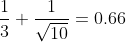 ; with N=100, it’s 0.43; with N=1,000,000 it’s 0.334; and with N=1,000,000 it equals 0.333365 etc, and never going below the original systematic error of
  . This leads to the unfortunate consequence that the likely error of N=10 is 0.017<x<0.64956 while for N=1,000,000 it is the similar range 0.017<x<0.33433 - so it is possible that the estimate could be exactly as good (or bad) for the tiny sample as compared with the enormous sample, since neither can do better than 0.017!↩
Possibly this is what Lord Rutherford meant when he said, “If your experiment needs statistics you ought to have done a better experiment”.↩