Interesting. I did not know that medicine currently mostly does a good job of having well powered studies.
It would actually be pretty interesting, to go through many fields and determine how important systematic vs random error is.
Here's some guesses based on nothing more than my intuition:
What would you need to do this better? A sample of studies from prestigious journals for each field with N, size of random error, lower bound on effect size considered interesting.
Engineering - 10:1
Does engineering use these sorts of statistics? I read so few engineering papers I'm not really sure what statistics I would expect them to look like or how systematic vs random error would play out there.
A sample of studies from prestigious journals for each field with N, size of random error, lower bound on effect size considered interesting.
That would be an interesting approach; typically power studies just look at estimating beta, not beta and bounds on effect size.
From pg812-1020 of Chapter 8 “Sufficiency, Ancillarity, And All That” of Probability Theory: The Logic of Science by E.T. Jaynes:
Or pg1019-1020 Chapter 10 “Physics of ‘Random Experiments’”:
I excerpted & typed up these quotes for use in my DNB FAQ appendix on systematic problems; the applicability of Jaynes’s observations to things like publication bias is obvious. See also http://lesswrong.com/lw/g13/against_nhst/
If I am understanding this right, Jaynes’s point here is that the random error shrinks towards zero as N increases, but this error is added onto the “common systematic error” S, so the total error approaches S no matter how many observations you make and this can force the total error up as well as down (variability, in this case, actually being helpful for once). So for example,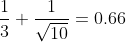 ; with N=100, it’s 0.43; with N=1,000,000 it’s 0.334; and with N=1,000,000 it equals 0.333365 etc, and never going below the original systematic error of
  . This leads to the unfortunate consequence that the likely error of N=10 is 0.017<x<0.64956 while for N=1,000,000 it is the similar range 0.017<x<0.33433 - so it is possible that the estimate could be exactly as good (or bad) for the tiny sample as compared with the enormous sample, since neither can do better than 0.017!↩
Possibly this is what Lord Rutherford meant when he said, “If your experiment needs statistics you ought to have done a better experiment”.↩