Hofstadter on the necessary strangeness of scientific explanations:
...It is no accident, I would maintain, that quantum mechanics is so wildly counterintuitive. Part of the nature of explanation is that it must eventually hit some point where further probing only increases opacity rather than decreasing it. Consider the problem of understanding the nature of solids. You might wonder where solidity comes form. What if someone said to you, "The ultimate basis of this brick's solidity is that it is composed of a stupendous number of eensy weensy bricklike objects that themselves are rock-solid"? You might be interested to learn that bricks are composed of micro-bricks, but the initial question - "What accounts for solidity?" - has been thoroughly begged. What we ultimately want is for solidity to vanish, to dissolve, to disintegrate into some totally different kind of phenomenon with which we have no experience. Only then, when we have reached some completely novel, alien level will we feel that we have really made progress in explaining the top-level phenomenon.
[...]
I first saw this thought expressed in the stimulating book Patterns of Discovery by Norwood Russell
Why Opium produces sleep: ... Because there is in it a dormitive power.
Moliere, Le Malade Imaginere (1673), Act III, sc. iii.
A lesson here is that if you ask "Why X?" then any answer of the form "Because " is not actually progress toward understanding.
Why is there that knee-jerk rejection of any effort to "overthink" pop culture? Why would you ever be afraid that looking too hard at something will ruin it? If the government built a huge, mysterious device in the middle of your town and immediately surrounded it with a fence that said, "NOTHING TO SEE HERE!" I'm pretty damned sure you wouldn't rest until you knew what the hell that was -- the fact that they don't want you to know means it can't be good.
Well, when any idea in your brain defends itself with "Just relax! Don't look too close!" you should immediately be just as suspicious. It usually means something ugly is hiding there.
Ah, David Wong. A few movies in the post-9/11 era begin using terrorism and asymmetric warfare as a plot point? Proof that Hollywood no longer favors the underdog. Meanwhile he ignores... Daredevil, Elektra, V for Vendetta, X-Men, Kickass, Punisher, and Captain America, just to name the superhero movies I've seen which buck the trend he references, and within the movies he himself mentions, he intentionally glosses over 90% of the plots in order to make his point "stick." In some cases (James Bond, Sherlock Holmes) he treats the fact that the protagonists win as the proof that they weren't the underdog at all (something which would hold in reality but not in fiction, and a standard which he -doesn't- apply when it suits his purpose, a la his comments about the first three Die Hard movies being about an underdog whereas the most recent movie isn't).
Yeah. Not all that impressed with David Wong. His articles always come across as propaganda, carefully and deliberately choosing what evidence to showcase. And in this case he's deliberately treating the MST3K Mantra as some kind of propaganda-hiding tool? Really?
These movies don't get made because Hollywood billionaires...
Not that this directly relates to your quote, but I find David Wong to be consistently so deliberate about producing propaganda out of nothing that I cannot take him seriously as a champion of rationality.
It is worth pointing out that this page is about quotes, not people, or even articles. I thought the quote was worth upvoting for:
Well, when any idea in your brain defends itself with "Just relax! Don't look too close!" you should immediately be just as suspicious. It usually means something ugly is hiding there.
Why is there that knee-jerk rejection of any effort to "overthink" pop culture? Why would you ever be afraid that looking too hard at something will ruin it?
I think it's because enjoying fiction involves being in a trance, and analyzing the fiction breaks the trance. I suspect that analysis is also a trance, but it's a different sort of trance.
Your what?
No, I'm not letting it go this time. I've heard people talking about internal monologues before, but I've never been quite sure what those are - I'm pretty sure I don't have one. Could you try to define the term?
Gosh. New item added to my list of "Not everyone does that."
...I have difficulty imagining what it would be to be like someone who isn't the little voice in their own head, though. Seriously, who's posting that comment?
I may be in a somewhat unique position to address this question, as one of the many many many weird transient neurological things that happened to me after my stroke was a period I can best describe as my internal monologue going away.
So I know what it's like to be the voice in my head, and what it's like not to be.
And it's still godawful difficult to describe the difference in words.
One way I can try is this: have you ever experienced the difference between "I know what I'm going to say, and here I am saying it" and "words are coming out of my mouth, and I'm kind of surprised by what I'm hearing myself say"?
If so, I think I can say that losing my "little voice" is similar to that difference.
If not, I suspect the explanation will be just as inaccessible as the phenomenon it purported to explain, but I can try again.
...what? Wow!
I'm dying to know whether we're stumbling on a difference in the way we think or the way we describe what we think, here. To me, the first state sounds like rehearsing what I'm going to say in my head before I say it, which I only do when I'm racking my brains on eg how to put something tactfully, where the latter sounds like what I do in conversation all the time, which is simply to let the words fall out of my mouth and find out what I've said.
Learn to recognize that the parts of your brain that handle text generation and output are no more "you" than the parts of your brain that handle motor reflex control.
No! The parts of my brain that handle text generation are the only parts that... *slap*... Ow. Nevermind. It seems we have reached an 'understanding'.
Right!
I mean, I do realize you're being funny, but pretty much exactly this.
I don't recommend aphasia as a way of shock-treating this presumption, but I will admit it's effective. At some point I had the epiphany that my language-generating systems were offline but I was still there; I was still thinking the way I always did, I just wasn't using language to do it.
Which sounds almost reasonable expressed that way, but it was just about as creepy as the experience of moving my arm around normally while the flesh and bone of my arm lay immobile on the bed.
When you're playing a sport... wait, maybe you don't... okay, when you're playing an instrum—hm. Surely there is a kinesthetic skill you occasionally perform, during which your locus of identity is not in your articulatory loop? (If not, fixing that might be high value?) And you can imagine being in states similar to that much of the time? I would imagine intense computer programming sessions would be more kinesthetic than verbal. Comment linked to hints at what my default thinking process is like.
Didn't think this was going to be my first contribution to LessWrong, but here goes (hi, everybody, I'm Phil!)
I came to what I like to think was a realisation useful to my psychological health a few months ago when I was invited to realise that there is more to me than my inner monologue. That is, I came to understand that identifying myself as only the little voice in my head was not good for me in any sense. For one thing, my body is not part of my inner monologue, ergo I was a fat guy, because I didn't identify with it and therefore didn't care what I fed it on. For another, one of the things I explicitly excluded from my identity was the subprocess that talks to people. I had (and still have) an internal monologue, but it was at best only advisory to the talking process, so you can count me as one of the people for whom conversation is not something I'm consciously acting on. Result: I didn't consider the person people meet and talk to to be "me", but (as I came to understand), nevertheless I am held responsible for everything he says and does.
My approach to this was somewhat luminous avant (ma lecture de) la lettre: I now construe my identity as consisting of at...
Richard Feynman tells the story of how he learned that thinking isn't only internal monologue.
Akin's Laws of Spacecraft Design are full of amazing quotes. My personal favourite:
6) (Mar's Law) Everything is linear if plotted log-log with a fat magic marker.
(See also an interesting note from HN's btilly on this law)
http://scienceblogs.com/insolence/2013/06/04/stanislaw-burzynski-versus-the-bbc/#comment-262541
The movie “Apollo 13″ does a fair job of showing how rapidly the engineers in Houston devised the kludge and documented it, but because of time contraints of course they can’t show you everything. NASA is a stickler for details. (Believe me, I’ve worked with them!) They don’t just rapid prototype something that people’s lives will depend upon. Overnight, they not only devised the scrubber adapter built from stuff in the launch manifest, they also tested it, documented it, and sent up stepwise instructions for constructing it. In a high-maturity organization, once you get into the habit of doing that, it doesn’t really take that long. Something that always puzzles me when I meet cowboy engineers who insist that process will just slow them down unacceptably. I tell them that hey, if NASA engineers could design, build, test, and document a CO2 scrubber adapter made from common household items overnight, you can damn well put in a comment when you check in your code changes.
you can't wait around for someone else to act. I had been looking for leaders, but I realised that leadership is about being the first to act.
Edward Snowden, the NSA surveillance whistle-blower.
Imagine you are sitting on this plane now. The top of the craft is gone and you can see the sky above you. Columns of flame are growing. Holes in the sides of the airliner lead to freedom. How would you react?
You probably think you would leap to your feet and yell, "Let's get the hell out of here!" If not this, then you might assume you would coil into a fetal position and freak out. Statistically, neither of these is likely. What you would probably do is far weirder......
In any perilous event, like a sinking ship or towering inferno, a shooting rampage or a tornado, there is a chance you will become so overwhelmed by the perilous overflow of ambiguous information that you will do nothing at all...
about 75 percent of people find it impossible to reason during a catastrophic event or impending doom.
You Are Not So Smart by David McRaney p 55,56, and 58.
Interestingly enough there is some evidence--or at least assertions by people who've studied this sort of thing--that doing this sort of problem solving ahead of time tends to reduce the paralysis.
When you get on a plane, go into a restaurant, when you're wandering down the street or when you go someplace new think about a few common emergencies and just think about how you might respond to them.
"When two planes collided just above a runway in Tenerife in 1977, a man was stuck, with his wife, in a plane that was slowly being engulfed in flames. He remembered making a special note of the exits, grabbed his wife's hand, and ran towards one of them. As it happened, he didn't need to use it, since a portion of the plane had been sheared away. He jumped out, along with his wife and the few people who survived. Many more people should have made it out. Fleeing survivors ran past living, uninjured people who sat in seats literally watching for the minute it took for the flames to reach them." - http://io9.com/the-frozen-calm-of-normalcy-bias-486764924
As I stated earlier, I don't mind this.
As things one could not mind go, literally dying in a fire seems unlikely to be a good choice.
No. Please, just no. This is the worst possible form of fighting the hypothetical. If you're going to just say "it's all hypothetical, who cares!" then please do everyone a favor and just don't even bother to respond. It's a waste of everyone's time, and incredibly rude to everyone else who was trying to have a serious discussion with you. If you make a claim, an your reasoning is shown to be inconsistent, the correct response is never to pretend it was all just a big joke the whole time. Either own up to having made a mistake (note: having made a mistake in the past is way higher status than making a mistake now. Saying "I was wrong" is just another way to say "but now I'm right". You will gain extra respect on this site from noticing your own mistakes as well.) or refute the arguments against your claim (or ask for clarification or things along those lines). If you can't handle doing either of those then tap out of the conversation. But seriously, taking up everyone's time with a counter-intuitive claim and then laughing it off when people try to engage you seriously is extremely rude and a waste of everyone's time, including yours.
Sorry? Of course he was sorry. People were always sorry. Sorry they had done what they had done, sorry they were doing what they were doing, sorry they were going to do what they were going to do; but they still did whatever it was. The sorrow never stopped them; it just made them feel better. And so the sorrow never stopped. ...
Sorrow be damned, and all your plans. Fuck the faithful, fuck the committed, the dedicated, the true believers; fuck all the sure and certain people prepared to maim and kill whoever got in their way; fuck every cause that ended in murder and a child screaming.
Against a Dark Background by Iain M. Banks.
...The word gentleman originally meant something recognisable: one who had a coat of arms and some landed property. When you called someone 'a gentleman' you were not paying him a compliment, but merely stating a fact. If you said he was not 'a gentleman' you were not insulting him, but giving information. There was no contradiction in saying that John was a liar and a gentleman; any more than there now is in saying that James is a fool and an M.A. But then there came people who said- so rightly, charitably, spiritually, sensitively, so anything but usefully- 'Ah, but surely the important thing about a gentleman is not the coat of arms and the land, but the behaviour? Surely he is the true gentleman who behaves as a gentleman should? Surely in that sense Edward is far more truly a gentleman than John?' They meant well. To be honourable and courteous and brave is of course a far better thing than to have a coat of arms. But it is not the same thing. Worse still, it is not a thing everyone will agree about. To call a man 'a gentleman' in this new, refined sense, becomes, in fact, not a way of giving information about him, but a way of praising him: to deny that he is 'a gentleman' beco
When a word ceases to be a term of description and becomes merely a term of praise, it no longer tells you facts about the object; it only tells you about the speaker's attitude to that object.
This is because a speaker's attitude towards an object is not formed by the speaker's perception of the object; it is entirely arbitrary. Wait, no, that's not right.
And anyway, the previous use of the term "gentleman" was, in some sense, worse. Because while it had a neutral denotation ("A gentleman is any person who possesses these two qualities"), it had a non-neutral connotation.
Baroque Cycle by Neal Stphenson proves to be a very good, intelligent book series.
“Why does the tide rush out to sea?”
“The influence of the sun and the moon.”
“Yet you and I cannot see the sun or the moon. The water does not have senses to see, or a will to follow them. How then do the sun and moon, so far away, affect the water?”
“Gravity,” responded Colonel Barnes, lowering his voice like a priest intoning the name of God, and glancing about to see whether Sir Isaac Newton were in earshot.
“That’s what everyone says now. ’Twas not so when I was a lad. We used to parrot Aristotle and say it was in the nature of water to be drawn up by the moon. Now, thanks to our fellow-passenger, we say ‘gravity.’ It seems a great improvement. But is it really? Do you understand the tides, Colonel Barnes, simply because you know to say ‘gravity’?”
Daniel Waterhouse and Colonel Barnes in Solomon’s Gold
Does Colonel Barnes? If not, he is just repeating a word he has learned to say. Rather like some people today who have learned to say "entanglement", or "signalling", or "evolution", or...
I will gladly post the rest of the conversation because it reminds me of question I pondered for a while.
"Do you understand the tides, Colonel Barnes, simply because you know to say ‘gravity’?”
“I’ve never claimed to understand them.”
“Ah, that is very wise practice.”
“All that matters is, he does,” Barnes continued, glancing down, as if he could see through the deck-planks.
“Does he then?”
“That’s what you lot have been telling everyone. <> Sir Isaac’s working on Volume the Third, isn’t he, and that’s going to settle the lunar problem. Wrap it all up.”
“He is working out equations that ought to agree with Mr. Flamsteed’s observations.”
“From which it would follow that Gravity’s a solved problem; and if Gravity predicts what the moon does, why, it should apply as well to the sloshing back and forth of the water in the oceans.”
“But is to describe something to understand it?”
“I should think it were a good first step.”
“Yes. And it is a step that Sir Isaac has taken. The question now becomes, who shall take the second step?”
After that they started to discuss differences between Newton's and Leibniz theories. Newton is unable to explain why gravity can go through the earth, like...
Stanislaw Lem wrote a short story about this. (I don't remember its name.)
In the story, English detectives are trying to solve a series of cases where bodies are stolen from morgues and are later discovered abandoned at some distance. There are no further useful clues.
They bring in a scientist, who determines that there is a simple mathematical relationship that relates the times and locations of these incidents. He can predict the next incident. And he says, therefore, that he has "solved" or "explained" the mystery. When asked what actually happens - how the bodies are moved, and why - he simply doesn't care: perhaps, he suggests, the dead bodies move by themselves - but the important thing, the original question, has been answered. If someone doesn't understand that a simple equation that makes predictions is a complete answer to a question, that someone simply doesn't understand science!
Lem does not, of course, intend to give this as his own opinion. The story never answers the "real" mystery of how or why the bodies move; the equation happens to predict that the sequence will soon end anyway.
Amusingly, I read this story, but completely forgot about it. The example here is perfect. Probably I should re-read it.
For those interested: http://en.wikipedia.org/wiki/The_Investigation
The reason Newton's laws are an improvement over Aristotelian "the nature of water is etc." is that Newton lets you make predictions, while Aristotle does not. You could ask "but WHY does gravity work like so-and-so?", but that doesn't change the fact that Newton's laws let you predict orbits of celestial objects, etc., in advance of seeing them.
That's certainly the conventional wisdom, but I think the conventional wisdom sells Aristotle and his contemporaries a little short. Sure, speaking in terms of water and air and fire and dirt might look a little silly to us now, but that's rather superficial: when you get down to the experiments available at the time, Aristotelian physics ran on properties that genuinely were pretty well correlated, and you could in fact use them to make reasonably accurate predictions about behavior you hadn't seen from the known properties of an object. All kosher from a scientific perspective so far.
There are two big differences I see, though neither implies that Aristotle was telling just-so stories. The first is that Aristotelian physics was mainly a qualitative undertaking, not a quantitative one -- the Greeks knew that the properties of objects varied in a mathematically regular way (witness Erastothenes' clever method of calculating Earth's circumference), but this wasn't integrated closely into physical theory. The other has to do with generality: science since Galileo has applied as universally as possible, though some branches reduced faster than others, but the Greeks and their medieval followers were much more willing to ascribe irreducible properties to narrow categories of object. Both end up placing limits on the kinds of inferences you'll end up making.
Bad things don't happen to you because you're unlucky. Bad things happen to you because you're a dumbass.
Single bad things happen to you at random. Iterated bad things happen to you because you're a dumbass. Related: "You are the only common denominator in all of your failed relationships."
Corollaries: The more of a dumbass you are, the less well you can recognize common features in iterated bad things. So dumbasses are, subjectively speaking, just unlucky.
The corollary is more useful than the theorem:-) If I wish to be less of a dumbass, it helps to know what it looks like from the inside. It looks like bad luck, so my first job is to learn to distinguish bad luck from enemy action. In Eliezer's specific example that is going to be hard because I need to include myself in my list of potential enemies.
What we want to find is the denominator common to all of your failed relationships, but absent from the successful relationships that other people have (the presumed question being "why do all my relationships fail, but Alice, Bob, Carol, etc. have successful ones?"). Oxygen doesn't fit the bill.
Of course, "bad things", and even more so "iterated bad things", have to be viewed relative to expectations, and at the proper level of abstraction. Explanation:
Right level of abstraction
"I punched myself in the face six times in a row, and each time, it hurt. But this is not mere bad luck! I conclude that I am bad at self-face-punching! I must work on my technique, such that I may be able to punch myself in the face without ill effect." This is the wrong conclusion. The right conclusion is "abstain from self-face-punching".
Substitute any of the following for "punching self in face":
Right expectations
"I've tried five brands of water, and none of them tasted like chocolate candy! My water-brand-selection algorithm must be flawed. I will have to be even more careful about picking only the fanciest brands of water." Again this is the wrong conclusion. The right conclusion is "This water is just fine and there was nothing wrong with my choice of brand. I simply shouldn't have such ridiculous expectations."
Substitute any of the following for "brands of water&qu...
...Stepan Arkadyevitch subscribed to a liberal paper, and read it. It was not extreme in those views, but advocated those principles the majority held. And though he was not really interested in science or art or politics, he strongly adhered to such views on all those subjects as the majority, including his paper, advocated, and he changed them only when the majority changed them; or more correctly, he did not change them, but they themselves imperceptibly changed in him.
Stepan Arkadyevitch never chose principles or opinions, but these principles and opinions came to him, just as he never chose the shape of a hat or coat, but took those that others wore. And, living as he did in fashionable society, through the necessity of some mental activity, developing generally in a man's best years, it was as indispensable for him to have views as to have a hat. If there was any reason why he preferred liberal views rather than the conservative direction which many of his circle followed, it was not because he found a liberal tendency more rational, but because he found it better suited to his mode of life.
The liberal party declared that everything in Russia was wretched; and the fact was that
Stepan is a smart chap. He has realized (perhaps unconsciously)
and so has outsourced them to a liberal paper.
One might compare it to hiring a fashion consultant... except it's cheap to boot!
"Oh, you could do it all by magic, you certainly could. You could wave a wand and get twinkly stars and a fresh-baked loaf. You could make fish jump out of the sea already cooked. And then, somewhere, somehow, magic would present its bill, which was always more than you could afford.
That’s why it was left to wizards, who knew how to handle it safely. Not doing any magic at all was the chief task of wizards - not “not doing magic” because they couldn’t do magic, but not doing magic when they could do and didn’t. Any ignorant fool can fail to turn someone else into a frog. You have to be clever to refrain from doing it when you knew how easy it was.
There were places in the world commemorating those times when wizards hadn’t been quite as clever as that, and on many of them the grass would never grow again."
-- Terry Prachett, Going Postal
It is said, for example, that a man ten times regrets having spoken, for the once he regrets his silence. And why? Because the fact of having spoken is an external fact, which may involve one in annoyances, since it is an actuality. But the fact of having kept silent! Yet this is the most dangerous thing of all. For by keeping silent one is relegated solely to oneself, no actuality comes to a man's aid by punishing him, by bringing down upon him the consequences of his speech. No, in this respect, to be silent is the easy way. But he who knows what the dreadful is, must for this very reason be most fearful of every fault, of every sin, which takes an inward direction and leaves no outward trace. So it is too that in the eyes of the world it is dangerous to venture. And why? Because one may lose. But not to venture is shrewd. And yet, by not venturing, it is so dreadfully easy to lose that which it would be difficult to lose in even the most venturesome venture, and in any case never so easily, so completely as if it were nothing...one's self. For if I have ventured amiss--very well, then life helps me by its punishment. But if I have not ventured at all--who then helps me?
--Soren Kierkegaard, The Sickness Unto Death
...the machines will do what we ask them to do and not what we ought to ask them to do. In the discussion of the relation between man and powerful agencies controlled by man, the gnomic wisdom of the folk tales has a value far beyond the books of our sociologists.
you would be foolish to accept what people believed for “thousands of years” in many domains of natural science. When it comes to the ancients or the moderns in science always listen to the moderns. They are not always right, but overall they are surely more right, and less prone to miss the mark. In fact, you may have to be careful about paying too much attention to science which is a generation old, so fast does the “state of the art” in terms of knowledge shift.
Similar thought:
16) The previous people who did a similar analysis did not have a direct pipeline to the wisdom of the ages. There is therefore no reason to believe their analysis over yours. There is especially no reason to present their analysis as yours.
"It’s actually hard to see when you’ve fucked up, because you chose all your actions in a good-faith effort and if you were to run through it again you’ll just get the same results. I mean, errors-of-fact you can see when you learn more facts, but errors-of-judgement are judged using the same brain that made the judgement in the first place." - Collin Street
"I call that 'the falling problem'. You encounter it when you first study physics. You realize that, if you were ever dropped from a plane without a parachute, you could calculate with a high degree of accuracy how long it's take to hit the ground, your speed, how much energy you'll deposit into the earth. And yet, you would still be just as dead as a particularly stupid gorilla dropped the same distance. Mastery of the nature of reality grants you no mastery over the behavior of reality. I could tell you your grandpa is very sick. I could tell you what each cell is doing wrong, why it's doing wrong, and roughly when it started doing wrong. But I can't tell them to stop."
"Why can't you make a machine to fix it?"
"Same reason you can't make a parachute when you fall from the plane."
"Because it's too hard?"
"Nothing is too hard. Many things are too fast."
(beat)
"I think I could solve the falling problem with a jetpack. Can you try to get me the parts?"
"That's all I do, kiddo."
--SMBC
I wouldn't call it a punchline, exactly... I mean, it's not a joke. But in the comic it's likely a parent and child talking, and the subtext I infer is that parenting is a process of giving one's children the tools with which to construct superior solutions to life problems.
Th[e] strategy [of preferring less knowledge and intelligence due to their high cognitive costs] is exemplified by the sea squirt larva, which swims about until it finds a suitable rock, to which it then permanently affixes itself. Cemented in place, the larva has less need for complex information processing, whence it proceeds to digest part of its own brain (its cerebral ganglion). Academics can sometimes observe a similar phenomenon in colleagues who are granted tenure.
Nick Bostrom
It is perhaps worth noting that a similar comment was made by Dennett:
“The juvenile sea squirt wanders through the sea searching for a suitable rock or hunk of coral to cling to and make its home for life. For this task, it has a rudimentary nervous system. When it finds its spot and takes root, it doesn't need its brain anymore, so it eats it! It's rather like getting tenure.”
...in 1991 or so.
Apparently it does... a few minutes of googling turned up a cite to Rodolfo Llinas (1987), who referred to it as "a process paralleled by some human academics upon obtaining university tenure."
Has the life cycle of the sea squirt ever been notably used to describe something other than the reaction of an academic to tenure?
Hah! Um... hm. A quick perusal of Google results for "sea squirt -tenure" gets me some moderately interesting stuff about their role as high-sensitivity harbingers for certain pollutants, and something about invasive sea-squirt species in harbors. But nothing about their life-cycle per se. I give a tentative "no."
From the remarkable opening chapter of Consciousness Explained:
One should be leery of these possibilities in principle. It is also possible in principle to build a stainless-steel ladder to the moon, and to write out, in alphabetical order, all intelligible English conversations consisting of less than a thousand words. But neither of these are remotely possible in fact and sometimes an impossibility in fact is theoretically more interesting than a possibility in principle, as we shall see.
--Daniel Dennett
A spherically symmetric shell has no effect on the gravitational field inside. It will not pull the surface of a hollow Earth outwards.
I've had that conversation with a few people over the years, and I conclude that it does for some people and not others. The ones for whom it doesn't generally seem to think of it as a piece of misdirection, in which Dennett answers in great detail a different question than the one that was being asked. (It's not entirely clear to me what question they think he answers instead.)
That said, it's a pretty fun read. If the subject interests you, I'd recommend sitting down and writing out as clearly as you can what it is you find mysterious about subjective experience, and then reading the book and seeing if it answers, or at least addresses, that question.
Consider the following dialog:
A: "Why do containers contain their contents?"
B: "Well, because they are made out of impermeable materials arranged in such a fashion that there is no path between their contents and the rest of the universe."
A: "Yes, of course, I know that, but why does that lead to containment?"
B: "I don't quite understand. Are you asking what properties of materials make them impermeable, or what properties of shapes preclude paths between inside and outside? That can get a little technical, but basically it works like this --"
A: "No, no, I understand that stuff. I've been studying containment for years; I understand the simple problem of containment quite well. I'm asking about the hard problem of containment: how does containment arise from those merely mechanical things?"
B: "Huh? Those 'merely mechanical things' are just what containment is. If there's no path X can take from inside Y to outside Y, X is contained by Y. What is left to explain?"
A: "That's an admirable formulation of the hard problem of containment, but it doesn't solve it."
How would you reply to A?
What I have been calling nefarious rhetoric recurs in a rudimentary form also in impromptu discussions. Someone harbors a prejudice or an article of faith or a vested interest, and marshals ever more desperate and threadbare arguments in defense of his position rather than be swayed by reason or face the facts. Even more often, perhaps, the deterrent is just stubbon pride: reluctance to acknowledge error. Unscientific man is beset by a deplorable desire to have been right. The scientist is distinguished by a desire to be right.
— W. V. Quine, An Intermittently Philosophical Dictionary (a whimsical and fun read)
Not having all the information you need is never a satisfactory excuse for not starting the analysis.
My sense of the proper way to determine what is ethical is to make a distinction between a smuggler of influence and a detective of influence. The smuggler knows these six principles and then counterfeits them, brings them into situations where they don’t naturally reside.
The opposite is the sleuth’s approach, the detective’s approach to influence. The detective also knows what the principles are, and goes into every situation aware of them looking for the natural presence of one or another of these principles.
Graffiti on the wall of an Austrian public housing block:
White walls — high rent.
(German original: "Weiße Wände — hohe Mieten". I'm not actually sure it's true, but my understanding is that rent in public housing does vary somewhat with quality and it seems plausible that graffiti could enter into it. And to make the implicit explicit, the reason it seems worth posting here is how it challenges the tenants' — and my — preconceptions: You may think that from a purely selfish POV you should not want graffiti on your house, but it's quite possible that the benefits to you are higher than the costs.)
It’s hard to tell the difference between "Nobody ever complains about this car because it’s reliable" and “Nobody complains about this car because nobody buys this car."
-- Shamus Young
Thanks for the link.
Here's another good quote:
But if your solution to a problem is “don’t make mistakes”, then it’s not a solution. If you’re worried about falling off a cliff, the solution isn’t to walk along the edge very carefully, it’s to get away from the edge.
The hidden thought embedded in most discussions of conspiracy theories is this: The world is being controlled by evil people; so, if we can get rid of them, the world can revert to control by good people, and things will be great again. This thought is false. The world is not controlled by any group of people – evil or good – and it will not be. The world is a large, chaotic mess. Those groups which do exert some control are merely larger pieces in the global mix.
-- Paul Rosenberg
I don't know if there are short words for this, but seems to me that some people generally assume that "things, left alone, naturally improve" and some people assume that "things, left alone, naturally deteriorate".
The first option seems like optimism, and the second option seems like pesimism. But there is a catch! In real life, many things have good aspects and bad aspects. Now the person who is "optimistic about the future of things left alone" must find a reason why things are worse than expected. (And vice versa, the person who is "pessimistic about the future of things left alone" must find a reason why things are better.) In both cases, a typical explanation is human intervention. Which means that this kind of optimism is prone to conspiracy theories. (And this kind of pessimism is prone to overestimate the benefits of human actions.)
For example, in education: For a "pessimist about spontaneous future" things are easy -- people are born stupid, and schools do a decent job at making them smarter; of course, the process is not perfect. For an "optimist about spontaneous future", children should be left alone to become...
Conspiracy theorists of the world, believers in the hidden hands of the Rothschilds and the Masons and the Illuminati, we skeptics owe you an apology. You were right. The players may be a little different, but your basic premise is correct: The world is a rigged game. We found this out in recent months, when a series of related corruption stories spilled out of the financial sector, suggesting the world's largest banks may be fixing the prices of, well, just about everything.
Matt Taibbi opening paragraph in [Everything Is Rigged The Biggest Price-Fixing Scandal Ever] (http://www.rollingstone.com/politics/news/everything-is-rigged-the-biggest-financial-scandal-yet-20130425#ixzz2W8WJ4Vix)
Rosenberg writes:
So, when they say, “No one saw this crisis coming,” they may be telling the truth, at least as far as they know it. Neither they nor anyone in their circles would entertain such thoughts. Likewise, they may not see the next crisis until it hits them.
Plenty of big banks did make money by betting on the crisis. There were a lot of cases where banks sold their clients products the banks knew that the products would go south.
Realising that there are important political things that don't happen in the open is a meaningful conclusion. Matt isn't in a position where he can make claims for which he doesn't have to provide evidence.
In 2011 Julian Assange told the press that the US government has an API with the can use to query the data that they like from facebook. On the skeptics stackexchange website there a question whether their's evidence for Assange claim or whether he makes it up. It doesn't mention the possibility that Assange just refers to nonpublic information. The orthodox skeptic just rejects claims without public proof.
Two years later we know have decent evidence that the US has that capability via PRISM. In 2011 Julian had the knowledge that it happ...
On this site, it's probably worth clarifying that "evidence" here refers to legally admissible evidence, lest we go down an unnecessary rabbit hole.
My dad used to run a business and whenever they needed a temp, he'd always line up 5-10 interviewees, to check out how they looked.
And then hire the ugliest.
Aside from keeping my mother off his back, he reasoned that if the temp had kept good employment, and it wasn't for her looks, she must be ok.
From the comments on the article on the jobs for good-looking.
This is a nice calculation with a fairly simple causal diagram. The basic point is that if you think people are repeatedly hired either for their looks or for being a good worker, then among the pool of people who are repeatedly hired, looks and good work are negatively correlated.
“Those who will not reason, are bigots, those who cannot, are fools, and those who dare not, are slaves.” --Lord Byron.
All too often those who are least rational in their best moments are the greatest supporters of using one's head, if only to avoid too early a demise. I wonder how many years Lord Byron gained from rational thought, and which of the risks he took did he take because he was good at betting...
the designers of a theoretical technology in any but the most predictable of areas should identify its assumptions and claims that have not already been tested in a laboratory. They should design not only the technology but also a map of the uncertainties and edge cases in the design and a series of such experiments and tests that would progressively reduce these uncertainties. A proposal that lacks this admission of uncertainties coupled with designs of experiments that will reduce such uncertainties should not be deemed credible for the purposes of any important decision. We might call this requirement a requirement for a falsifiable design.
--Nick Szabo, Falsifiable design: A methodology for evaluting theoretical technologies
Students are often quite capable of applying economic analysis to emotionally neutral products such as apples or video games, but then fail to apply the same reasoning to emotionally charged goods to which similar analyses would seem to apply. I make a special effort to introduce concepts with the neutral examples, but then to challenge students to ask wonder why emotionally charged goods should be treated differently.
-- R. Hanson
I'm under the impression that all EY / RH quotes are discouraged, as described in this comment tree, which suggests the following rule should be explicitly amended to be broader:
Do not quote from Less Wrong itself, Overcoming Bias, or HPMoR.
An Idiot Plot is any plot that goes away if the characters stop being idiots. A Muggle Plot is any plot which dissolves in the presence of transhumanism and polyamory. That exact form is surprisingly common; e.g. from what I've heard, canon!Twilight has two major sources of conflict, Edward's belief that turning Bella into a vampire will remove her soul, and Bella waffling between Edward and Jacob. I didn't realize it until Baughn pointed it out, but S1 Nanoha - not that I've watched it, but I've read fanfictions - counts as a Muggle Plot because the entire story goes away if Precia accepts the pattern theory of identity.
I also find it odd that polyamory counts but not, for instance, plots that fail when you assume other rare preferences of people. Why isn't a plot that assumes that the main characters are heterosexual considered a Muggle Plot just as much as one which assumes they are monogamous?
I think the idea is not so much "rare preference" as "constrained preference," where that constraint is not relevant / interesting to the reader. Looking at gay fiction, there's lots of works in settings where homosexuality is forbidden, and lots of works in settings where homosexuality is accepted. A plot that disappears if you tried to move it to a setting where homosexuality is accepted seems too local; I've actually mostly grown tired of reading those because I want them to move on and get to something interesting. I imagine that's how it feels for a polyamorist to read Bella's indecision.
To use the ice cream example, imagine trying to read twenty pages on someone in an ice cream shop, agonizing over whether to get chocolate or strawberry. "Just get two scoops already!"
(shrug) My husband and I live in a largely poly-normative social environment, and are monogamous. We don't object, we simply aren't interested. It still makes "oh noes! which lover do I choose! I want them both!" plots seem stupid, though. ("if you want them both, date them both... what's the difficulty here?")
So, no, acknowledging that polyamory is something some people decide is a good idea doesn't force me to "admit" that monogamy is a bad idea.
Admittedly, I'm also not sure why it would be sad if it did.
That's kind of amusing, considering that Lincoln is also famous for destroying his enemies the other way.
He tried the nice way first...
This would seem to further weaken the quote in as much as it is evidence that the tactic doesn't work.
women rarely regret having a child, even one they thought they didn’t want. But as Katie Watson, a bioethicist at Northwestern University’s Feinberg School of Medicine, points out, we tell ourselves certain stories for a reason. “It’s psychologically in our interest to tell a positive story and move forward,” she says. “It’s wonderfully functional for women who have children to be glad they have them and for women who did not have children to enjoy the opportunities that afforded them.”
--Joshua Lang, New York Times, June 12, 2013, What Happens to Women Who Are Denied Abortions?
“Reality provides us with facts so romantic that imagination itself could add nothing to them.” --Jules Verne.
The fellow had a brilliant grasp of how to make scientific discovery interesting, and I think people could learn a thing or two from reading his stuff, still.
The paucity of skepticism in the world of health science is staggering. Those who aren't insufferable skeptical douchebags are doing it wrong.
-Stabby the Raccoon
He [the Inner Game player] reasons that since by definition the commonplace is what is experienced most often, the talent to be able to appreciate it is extremely valuable.
--W. Timothy Gallwey, Inner Tennis: Playing the Game
When you have to shoot, shoot. Don't talk.
Tuco, The Good, The Bad, and the Ugly
I just watched Oz the Great and Powerful, the big-budget fanfic prequel film to The Wizard of Oz. Hardly a rationalist movie, but there was some nice boosting of science and technology where I didn't expect it. So here's the quotation:
I’m not that kind of wizard. Where I come from there aren’t any real wizards, except one, Thomas Edison. He could look into the future and make it real. […] That's the kind of wizard I want to be.
(There's more, but this is all that I could get out of the Internet and my memory.)
Another potential detour on the road to truth is the nature of statistical variation and people’s tendency to misjudge through overgeneralization. Often in the fitness world, someone who appears to have above-average physical characteristics or capabilities is assumed to be a legitimate authority. The problem with granting authority to appearance is that a large part of an individual’s expression of such above-average physical characteristics and capabilities could simply be the result of wild variations across the statistical landscape. For instance, if you look out over a canopy of trees, you will probably notice a lone tree or two rising up above the rest – and it’s completely within human nature to notice things that stand out in such a way. In much the same manner, we take notice of individuals who possess superior physical capabilities, and when we do, there is a strong tendency to identify these people as sources of authority.
To make matters worse, many people who happen to posses such abnormal physical capabilities frequently misidentifies themselves as sources of authority, taking credit for something that nature has, in essence, randomly dropped in their laps. In other words, people are intellectually prepared to overlook the role of statistical variation in attributing authority.
-- Doug McDuff, M.D., and John Little, Body by Science, pp. x-xi
Hindsight is blindsight. The very act of looking back on events once you know their outcome, or even try to imagine their outcome, makes it, by definition, impossible to view such events objectively.
— Mark Salter & Trevor H. Turner, Community Mental Health Care: A practical guide to outdoor psychiatry
Though you can still find subjects who don't know the outcome, ask them for their predictions, and compare those predictions with subjects who are told the outcome to find the size of the hindsight bias.
Linguistic traditions force us to think of body and mind as separate and distinct entities. Everyday notions like free will and moral responsibility contain underlying contradictions. Language also uses definitions and forms of the verb to be in ways that force us to think of classes of things as clearly defined (Is a fetus a human being or not?), when in fact every classification scheme has fuzzy boundaries and continuous gradations.
--Thomas M Georges, Digital Soul, 2004, p. 14
...With machine intelligence and other technologies such as advanced nanotechnology, space colonization should become economical. Such technology would enable us to construct “von Neumann probes” – machines with the capability of traveling to a planet, building a manufacturing base there, and launching multiple new probes to colonize other stars and planets. A space colonization race could ensue. Over time, the resources of the entire accessible universe might be turned into some kind of infrastructure, perhaps an optimal computing substrate (“computronium”)
If you turn on your television and tune it between stations, about 10 percent of that black-and-white speckled static you see is caused by photons left over from the birth of the universe. What grater proof of the reality of the Big Bang–you can watch it on TV.
Jim Holt
Fundamental ideas play the most essential role in forming a physical theory. Books on physics are full of complicated mathematical formulae. But thought and ideas, not formulae, are the beginning of every physical theory. The ideas must later take the mathematical form of a quantitative theory, to make possible the comparison with experiment.
-- Albert Einstein
From David Shields' Reality Hunger:
Once, after running deep into foul territory to make an extraordinary catch to preserve a victory, he was asked, “When did you know you were going to catch the ball?” Ichiro replied, “When I caught it."
The first duty of life is to assume a pose. What the second duty is, no one has yet discovered.
--Oscar Wilde on signalling.
-Thank you, thank you Lord, for preserving my virginity!
- You bloody idiot! Do you think God, to keep you a virgin, will drown the whole city of Florence?
(Architect Melandri to Noemi, the girl he is in love with, who thinks the flood of 1966 was sent as an answer to her prayers)
All my Friend, Act II [roughly translated by me]
This is yet another reason why a God that answers prayers is far, far crueler than an indifferent Azathoth. Imagine the weight of guilt that must settle on a person if they prayed for the wrong thing and God answered!
On another note, that girl must not be very picky, if God has to destroy a whole city to keep her a virgin...(please don't blast me for this!)
[T]here can be no way of justifying the substantive assumption that all forms of altruism, solidarity and sacrifice really are ultra-subtle forms of self-interest, except by the trivializing gambit of arguing that people have concern for others because they want to avoid being distressed by their distress. And even this gambit […] is open to the objection that rational distress-minimizers could often use more efficient means than helping others.
Jon Elster
Even if altruism turns out to be a really subtle form of self-interest, what does it matter? An unwoven rainbow still has all its colors.
Rational distress-minimizers would behave differently from rational atruists. (Real people are somewhere in the middle and seem to tend toward greater altruism and less distress-minimization when taught 'rationality' by altruists.)
Idealism increases in direct proportion to one's distance from the problem.
-- John Galsworthy
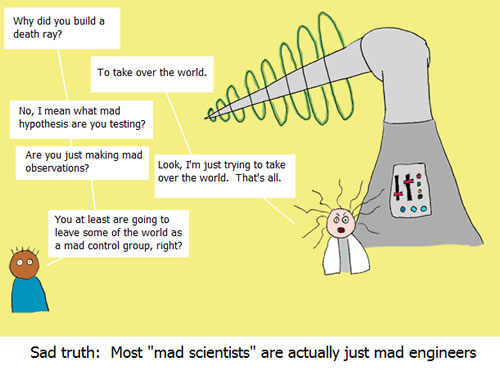
"Why do people worry about mad scientists? It's the mad engineers you have to watch out for." - Lochmon
Considering the "mad scientists" keep building stuff, perhaps the question is "Why do people keep calling mad engineers mad scientists?"
As far as I'm concerned, insight, intuition, and recognition are all synonymous.
As far as I'm concerned, insight, intuition, and recognition are all synonymous.
Calling different but somewhat related things the same when they are not does not warrant "rationality quote" status.
I acknowledge & respect this criticism, but for two reasons I maintain Simon had a worthwhile insight(!) here that bears on rationality:
Insight, intuition & recognition aren't quite the same, but they overlap greatly and are closely related.
Simon's comment, although not literally true, is a fertile hypothesis that not only opens eyeholes into the black boxes of "insight" & "intuition", but produces useful predictions about how minds solve problems.
I should justify those. Chapter 4 of Simon's The Sciences of the Artificial, "Remembering and Learning: Memory as Environment for Thought", is relevant here. It uses chess as a test case:
...[...] one part of the grandmaster's chess skill resides in the 50,000 chunks stored in memory, and in the index (in the form of a structure of feature tests) that allows him to recognize any one of these chunks on the chess board and to access the information in long-term memory that is associated with it. The information associated with familiar patterns may include knowledge about what to do when the pattern is encountered. Thus the experienced chess player who recognizes the feature called an open file
"Never let your sense of morals get in the way of doing what's right." --Isaac Asimov
All too often, an intuition creates mistakes which rationality must remedy, when one is presented with a complex problem in life. No fault of the intuition, of course--it is merely the product of nature.
... from my perspective, this process of “breaking off” answerable parts of unanswerable riddles, then trying to answer those parts, is the closest thing to philosophical progress that there is.
Scott Aaronson in The Ghost in the Quantum Turing Machine.
I think it's entirely wrong for Americans to sympathize with Boston victims while disregarding and in many cases outright denying the existence of victims of drone strikes. It's hypocrisy at its finest and especially rich coming from self-proclaimed Christians.
That is exactly the problem with nationalism.
I suspect you're probably saying that it's understandable for Americans only to feel the reality of this kind of cruelty when it affects "their own", and my response is that it may be understandable, but then so are the mechanisms of cancer.
--...
There is already a word for "don't think about, don't care about, don't act based on, don't know how many there were". That word is "disregarding", which is used in the original quote. It then adds, a fortiori, "and in many cases outright denying the existence of victims of drone strikes". In that context, it cannot mean anything but "explicitly say that there are no victims", and in addition, that this has actually happened in "many" cases.
By "in many cases outright denying the existence of victims of drone strikes", I think that the author meant "in many cases (i.e., many strikes), outright denying that some of the victims are in fact victims."
The author is probably referring to the reported policy of considering all military-age males in a strike-zone to be militants (and hence not innocent victims). I take the author to be claiming that (1) non-militant military-age male victims of drone strikes exist in many cases, and (2) the reported policy amounts to "outright denying the existence" of those victims.
Once we accept that knowledge is tentative, and that we are probably going to improve our knowledge in important ways when we learn more about the world, we are less likely to reject new information that conflicts with our present ideas.
-Dr. Raymond Peat
The secret is to make wanting the truth your entire identity, right. If your persona is completely stripped down to just "All I care about is the facts", then the steps disappear, the obstacles are gone. Tyranosaurus was a scavenger? Okay! And then you walk right up to it without hesitation. The evidence says the killer was someone else? Okay, see you later sir, sorry for the inconvenience, wanna go bowling later now that we're on a first name basis? And so on. Just you and a straight path to the truth. That is how you become perfect.
Sometimes it feels like everyone's / being a dick.
But they're not, / it's just you being a dick to every one.
Some days it seems like nothing / works right.
But its fine, / you're probably using it wrong.You wanna change the world you better / start with yourself.
Charity starts at home in the / skin you're in.
I'm not saying you should go and / change your face.
But if it bothers you that much / you should get a nose job.I'm talking about what lies beneath / the black and white
There's a mass of gray,
it is called your brain.
Since as lukeprog writes one of the methods for becoming happier is to "Develop the habit of gratitude" here is a quote of stuff to be thankful for: "
The taxes I pay because it means that I am employed
The clothes that fit a little too snug because it means I have enough to eat
My shadow who watches me work because it means I am out in the sunshine
A lawn that has to be mowed, windows that have to be washed, and gutters that need fixing because it means I have a home
The spot I find at the far end of the parking lot because it means I
I would still have enough to eat if my clothes fit, I would still have a home if my lawn were self-mowing, I would still be able to hear if she sang more tunefully, I would still be alive if I didn't set my alarm, etc. Taking advantage of these sorts of moments as opportunities to practice gratitude is a fine practice, but it's far better to practice gratitude for the thing I actually want (enough to eat, a home, hearing, life, etc.) than for the indicators of it I'd prefer to be rid of.
I'm fairly certain that's not how you're supposed to develop a habit of gratitude. It's not about doublithinking yourself into believing you like things that you dislike; it's to help you notice more things you like.
I've been doing a gratitude journal. I write three short notes from the last day where I was thankful for something a person did (eg, saving me a brownie or something). Then I take the one that makes me happiest and write a 1 paragraph description of what occurred, how I felt, and such that writing the paragraph makes me relive the moment. Then I write out a note (that is usually later transcribed) to a past person in my gratitude journal.
When I think of that person or think back to that day, I'm immediately able to recall any nice things they did that I wrote down. Also, as I go through my life, I'm constantly looking for things to be thankful for, and notice and remember them more easily.
If you do something like in the quote, it seem more likely that you'll remember negative things (that you pretend to be positive). It goes against the point of the exercise.
We prefer wrong information to no information.
The Art of Thinking Clearly by Rolf Dobelli, p. 33.
I prefer to quantify my lack of information and call it a prior. Then it's even better than wrong information!
What we need is some sort of system in which any proposed complication is viewed as more bothersome than earlier complications.
--Scott Adams, I Want My Cheese
Reading through some AI literature, I stumbled upon a nicely concise statement of the core of decision theory, from Lindley (1985):
......there is essentially only one way to reach a decision sensibly. First, the uncertainties present in the situation must be quantified in terms of values called probabilities. Second, the various consequences of the courses of action must be similarly described in terms of utilities. Third, that decision must be taken which is expected — on the basis of the calculated probabilities — to give the greatest utility. The force o
You could have all the human information in the world about all the human things in it, and a post-Singularity AI able to semantically interpret it all. And yet still not understand why events happen, what a leader should want to happen, or what is actually going to happen next. But the great powers of the modern world–states and civic institutions alike–must always pretend to be on the road to mastering all of that, and they must pretend that mastery will derive from information, analysis and science, not from choices and beliefs and values.
The criminal misuse of time was pointing out the mistakes. Catching them--noticing them--that was essential. If you did not in your own mind distinguish between useful and erroneous information, then you were not learning at all, you were merely replacing ignorance with false belief, which was no improvement.
Orson Scott Card, Ender's Shadow
It was a very ordinary tragedy, she supposed, but no less a cause for regret because it was so common. Like a hint, a foretaste of grief, it was an original, even unique experience for everyone it affected, no matter how often it had happened in the past to others.
And how did you avoid it?
Against a Dark Background by Iain M. Banks. The context differs, but it reminded me of the folks working to eliminate death.
In the exact moment after I'd realized that what Blaine said was true, that I'd cribbed a laugh from someone else's creativity and inspiration, my ego kicked in. And, I mean, my real ego. Not ego's sociopathic cousin, hubris, which would have made me defensive, aggressive and ultimately rationalize the theft. No, the good kind of ego, the kind that wanted success and fame and praise on my own merits, no matter how long it took.
Geulincx, from his own annotations to his Ethics (1665):
......our actions are as it were a mirror of Reason and God's law. If they reflect Reason, and contain in themselves what Reason dictates, then they are virtuous and praiseworthy; but if they distort Reason's reflection in themselves, then they are vicious and blameworthy. This has no effect on Reason, or God's law, which are no more beautiful or more ugly for it. Likewise, a thing represented in a mirror remains the same whether the mirror is true and faithfully represents it, or whether it is fals
...For a few years, I attended a meeting called Animal Behavior Lunch where we discussed new animal behavior articles. All of the meetings consisted of graduate students talking at great length about the flaws of that week’s paper. The professors in attendance knew better but somehow we did not manage to teach this. The students seemed to have a strong bias to criticize. Perhaps they had been told that “critical thinking” is good. They may have never been told that appreciation should come first. I suspect failure to teach graduate students to see clearly th
"Collectability" is something of a self-refuting prophecy.
Collectability might only be self-refuting for mass-produced items.
...It was an ancient calculation: in hard times it paid to sacrifice the vulnerable young, and to keep alive mature individuals who might breed again in an upturn.
But the infant was almost old enough to feed herself. Just a little longer and she would have survived to independence. And this was Ultimate's baby: the first one she had had, and perhaps the only one she would ever be permitted to have. Ancient drives warred. It was a failure of adaptation, this battling of one instinct against another.
It was a primordial calculus, an ancient story told over and
One of the notable things about discussing the interpretation of quantum mechanics with physicists and with philosophers is that it is the physicists who propose philosophically radical ways of interpreting a theory, and the philosophers who propose changing the physics. One might reasonably doubt that the advocates or either strategy are always fully aware of its true difficulty.
David Wallace
......We now live — that is to say, one or two of the most advanced nations of the world now live — in a state in which the law of the strongest seems to be entirely abandoned as the regulating principle of the world's affairs: nobody professes it, and, as regards most of the relations between human beings, nobody is permitted to practise it. When anyone succeeds in doing so, it is under cover of some pretext which gives him the semblance of having some general social interest on his side. This being the ostensible state of things, people flatter themselves
The parts of your brain that generate speech and the part that generate your internal sense-of-self are less integrated than CCC's. An interesting experiment might be to stop ascribing ownership to your words when you find yourself surprised by them - i.e., instead of framing the phenomenon as "I said that", frame it as "my brain generated those words".
Learn to recognize that the parts of your brain that handle text generation and output are no more "you" than the parts of your brain that handle motor reflex control.
EDIT: Is there a problem with this post?
EDIT: Is there a problem with this post?
It's a bit rude to try to change others' definition of themselves unasked.
Another month has passed and here is a new rationality quotes thread. The usual rules are: