We have a baby girl! (we = me + BarbaraB)
Name: Ivana. Date of birth: March 8th. No complications, the baby seems healthy.
She was born in Hainburg in Austria, which is near Bratislava, because frankly we trust Austrian health care more than Slovakian (based on both personal experience and research: tl;dr: health care in Slovakia is typically understaffed and overmedicates, doctors in Austria are typically much more polite and friendly, and what they say seems more compatible with international research, although there are exceptions too). Now we are back in Bratislava.
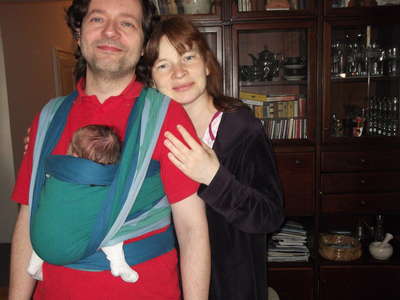
Congratulations!
Out of curiosity: What do you think of Czech healthcare? I got appendicitis while visiting the Czech Republic and had to have my appendix out while there in a hospital that was built in the 1300s.
What do you think of Czech healthcare?
I cannot speak about specific topics, but my general impression based on situation with childbirths is: better than Slovakia, slightly worse (but significantly cheaper) than Austria. Of course in other aspects it may be different.
a hospital that was built in the 1300s
That would be the least of my concerns. I care about the statistics of outcomes, and friendly treatment by doctors. (I see you are from USA. There is a cultural difference: In Europe hundreds of years old buildings are no big deal.)
Haha, thanks. Was just curious. You're right about it being significantly cheaper. 5 days in the hospital, surgery, and all the drugs that go along with that: ~$400 USD.
I've just run my first half-marathon, coming in with an official time of 2h0m44s, close enough to my 2h objective that I'll call it a win.
Also this month, I reached a first milestone in writing video games using FRP (Functional Reactive Programming) in the Elm language, coding a proto-game that reproduces the basic gameplay of "The Company of Myself".
Every week my professor and his students have a journal club, and in the past I would skim through the paper and have nothing substantial to add to the discussion. When it was my turn, my presentations usually lasted only half an hour. For the past few months, however, I have been scrutinizing the papers and actually taking notes.
Two weeks ago, when it was my turn to present, I actually had a 50-slide presentation ready and could answer everyone's questions about the paper. My professor decided to have me present this past week, too, on a closely related paper so we could compare them. I feel slightly less clueless about my field than usual!
Third Flatiron has published my hard SF short story Net War I in their Spring anthology, The Time It Happened. (Also available from amazon for kindle and paper).
This story is deliberately opaque, but I suspect LessWrong members will be more likely than most to figure out what is really going on.
Learned Hangul (just the script, I have no intention of learning Korean ever). Not worth much of bragging, since it is indeed very easy, "a writing you can learn within a morning" - though it took me considerably longer.
My primary motivation was to have a sort of private semi-secret script to write my notes in, and something where syllables will be organized in blocks, which theoretically helps reading (though one has to read a lot to internalize the whole shapes to achieve this).
I have some relevant observations:
- Hangul might fit Korean language perfectly, but is really, really unsuitable for a "random European language". Not only there are many consonants missing, but the syllables cannot have an arbitrary coda, and arbitrary consonant clusters are right out.
- The above point can be remedied somewhat by (re)using historical (obsolete) letters, but:
- Historical letters have almost none computer support.
- Arbitrary consonant clusters have none computer support, since:
- There are standalone "jamo" letters in unicode block U+1100, but most applications cannot deal with them, requiring to use precomposed syllables insted
- Even if I could use standalone jamo, font support does not go beyond initial consonant+vowel+(fixed set of) final consonant cluster, anything else just displays overlapping and utterly unreadable letters.
- Syllables consisting of consonant+vowel are nicely readable, but:
- Syllables witht he structure CVC(C) are less readable, requiring bigger font size, which kind of defeats the point of readability. Especially if one wants to use morphematic writting, as opposed to phonemic one - which was my original intention, to keep the word roots unchanged.
- Thus, Latin script at smallish fontsizes tends to be more readable than Hangul at twice the fontsize.
- Korean input methods under X11 leave a lot to be desired. Especially if you want to type something that does not fit Korean phonology, you are basically out of luck.
Considering all this, I indeed do use Hangul as my private semisecret script, and intent to continue doing so.
Not something I actually did last month, since I wrote the piece two years ago, but it feels like it since that's when the validation arrived. A blog post of mine hit /r/basicincome and then /r/futurism, which are sitting at ~470 (98% positive) and ~1080 (92% positive) votes respectively, and found its way to hacker news. Some of the discussion is pretty good. The relevant quote:
"Let us keep in mind how poorly we treat those who cannot currently contribute to society. Sooner or later we will have to face this question: how do we define personal worth in a world where most people have no economic value?"
The actual accomplishment of the month is a post on Christopher Alexander's Notes on the Synthesis of Form, which won't be as big a hit, and I'm ok with that.
I derived Bayes' Theorem and the basic rule for conditional probabilities today while trying to find the answer to a question.
I had seen Bayes' Theorem before, but never really understood it and certainly had never memorized it. The only relevant knowledge I had was:
- That the syntax for "probability of A given B" is p(A|B)
- That you can multiply independent probabilities to do AND, but aren't allowed to do that if they are dependent
I was surprised at how it followed directly from intuition and the last bullet point above. I put together a toy problem involving the probability that I go outside depending on if it's raining or not and was able to derive Bayes' Theorem essentially from first principles. Not a groundbreaking accomplishment or anything, but I know I'll never forget any of it now!
The line of reasoning was really simple once I was able to distill it:
- I can simulate the probability that I'm outside given that it's raining by first rolling a die to see if it's raining, and if it is, then rolling another die to see if I'm outside, since I already know it's raining.
- These are clearly independent events, so I should be able to multiply their probabilities to get the probability of their conjunction.
- What does the conjunction mean? Intuitively, I'm outside and it's raining exactly when each of those die rolls turned up True, so this multiplication must give the probability that I'm outside and it's raining: p(outside|raining) * p(raining) = p(outside AND raining)
- And if that works, then symmetrically, this same probability p(outside AND raining) should also be equal to the probability that it's raining given that I'm outside times the probability that I'm outside.
- Isolate p(outside|raining) on one side of the equation and Boom: Bayes' Theorem.
p(A|B) p(B) = p(A & B) = p(B|A) p(A)
p(A|B) p(B) = p(B|A) p(A)
p(A|B) = [p(B|A) * p(A)] / p(B)
I passed the AMC 12B with a score of 144/150; that's 24 questions correct out of a total of 25 answered, for those not aware. That may not sound like much, but the problems are fairly difficult (in my opinion), and a major obstacle is the fact that you only get 75 minutes to answer all the questions, which comes out to an average of 3 minutes per question--hardly an easy task. (A stupid mistake on Problem 8 cost me a perfect score.) Overall, though, I feel I did pretty well!
I made a Madoka Magica AMV using a parody someone else made of Do You Want to Build a Snowman. Major spoilers for anyone not familiar with the show. Also, you'll have no idea what's going on.
I also finished rereading Homestuck and finished reading the archive of To The Stars (a rational Madoka fanfic), both of which are long enough that I consider reading it to be impressive. I can't imagine the people that wrote these.
Your job, should you choose to accept it, is to comment on this thread explaining the most awesome thing you've done this month. You may be as blatantly proud of yourself as you feel. You may unabashedly consider yourself the coolest freaking person ever because of that awesome thing you're dying to tell everyone about. This is the place to do just that.
Remember, however, that this isn't any kind of progress thread. Nor is it any kind of proposal thread. This thread is solely for people to talk about the awesome things they have done. Not "will do". Not "are working on". Have already done. This is to cultivate an environment of object level productivity rather than meta-productivity methods.
So, what's the coolest thing you've done this month?
(Previous Bragging Thread)