The absurdity of the conclusion tells us rather forcefully that the rule is not always valid, even when the separate data values are causally independent; it requires them to be logically independent. In this case, we know that the vast majority of the inhabitants of China have never seen the Emperor; yet they have been discussing the Emperor among themselves and some kind of mental image of him has evolved as folklore. Then knowledge of the answer given by one does tell us something about the answer likely to be given by another, so they are not logically independent
Maybe it's just that it's late, but what he's saying in this quote isn't making sense to me.
To demonstrate the validity of the italicized comment, he should give an example where the data values are causally independent, but not logically independent. But the example he gives, of shared conversations and folklore, strike me as not causally independent at all, so while it supports the basic point about systematic error, it doesn't support this particular comment.
What's more, that's not even the problem. Let's say you ask the Chinese people to estimate the height of the king of Samoa. Here they've never talked of him, and know nothing about him other than that he's human. You still can't magic the information out of repeated estimation.
From pg812-1020 of Chapter 8 “Sufficiency, Ancillarity, And All That” of Probability Theory: The Logic of Science by E.T. Jaynes:
Or pg1019-1020 Chapter 10 “Physics of ‘Random Experiments’”:
I excerpted & typed up these quotes for use in my DNB FAQ appendix on systematic problems; the applicability of Jaynes’s observations to things like publication bias is obvious. See also http://lesswrong.com/lw/g13/against_nhst/
If I am understanding this right, Jaynes’s point here is that the random error shrinks towards zero as N increases, but this error is added onto the “common systematic error” S, so the total error approaches S no matter how many observations you make and this can force the total error up as well as down (variability, in this case, actually being helpful for once). So for example,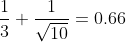 ; with N=100, it’s 0.43; with N=1,000,000 it’s 0.334; and with N=1,000,000 it equals 0.333365 etc, and never going below the original systematic error of
  . This leads to the unfortunate consequence that the likely error of N=10 is 0.017<x<0.64956 while for N=1,000,000 it is the similar range 0.017<x<0.33433 - so it is possible that the estimate could be exactly as good (or bad) for the tiny sample as compared with the enormous sample, since neither can do better than 0.017!↩
Possibly this is what Lord Rutherford meant when he said, “If your experiment needs statistics you ought to have done a better experiment”.↩