If you read any narrow/weak/specific/whatever AI papers, then I'd say you do read engineering papers --- that's how I mostly think of my field, computational linguistics, anyway.
The "experiments" I'm doing at the moment are attempts to engineer a better statistical parser of English. We have some human annotated data, and we divide it up into a training section, a development section, and an evaluation section. I write my system and use the training portion for learning, and evaluate my ideas on the development section. When I'm ready to publish, I produce a final score on the evaluation section.
In this case, my experimental error is the extent to which the accuracy figures I produce do not correlate with the accuracy that someone really using my system will see.
Both systematic and random error abounds in these "experiments". I'd say a really common source of systematic error comes from the linguistic annotation we're trying to replicate. We evaluate on data annotated by the same people according to the same standards as we trained on, and the scientific standards of the linguistics behind that are poor. If some aspects of the annotation are suboptimal for applications of the system, that won't be reflected in my results.
From pg812-1020 of Chapter 8 “Sufficiency, Ancillarity, And All That” of Probability Theory: The Logic of Science by E.T. Jaynes:
Or pg1019-1020 Chapter 10 “Physics of ‘Random Experiments’”:
I excerpted & typed up these quotes for use in my DNB FAQ appendix on systematic problems; the applicability of Jaynes’s observations to things like publication bias is obvious. See also http://lesswrong.com/lw/g13/against_nhst/
If I am understanding this right, Jaynes’s point here is that the random error shrinks towards zero as N increases, but this error is added onto the “common systematic error” S, so the total error approaches S no matter how many observations you make and this can force the total error up as well as down (variability, in this case, actually being helpful for once). So for example,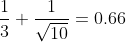 ; with N=100, it’s 0.43; with N=1,000,000 it’s 0.334; and with N=1,000,000 it equals 0.333365 etc, and never going below the original systematic error of
  . This leads to the unfortunate consequence that the likely error of N=10 is 0.017<x<0.64956 while for N=1,000,000 it is the similar range 0.017<x<0.33433 - so it is possible that the estimate could be exactly as good (or bad) for the tiny sample as compared with the enormous sample, since neither can do better than 0.017!↩
Possibly this is what Lord Rutherford meant when he said, “If your experiment needs statistics you ought to have done a better experiment”.↩