Politics/religion:
Statistics:
Literature
Seamus Heaney:
Medicine/biology:
Psychology:
Science/technology
"DNA methylation age of human tissues and cell types" (FAQ), Horvath 2013; mainstream overview of results: "Biomarkers and Ageing: The clock-watcher; Biomathematician Steve Horvath has discovered a strikingly accurate way to measure human Ageing through epigenetic signatures"
I printed out the original paper and read it with some labmates.
Very interesting. The age marker he has created is a simple linear combination of the methylation ratio of several hundred CpG sites (places that a class of methylating enzymes act upon in animals) from large public datasets. Some are positively correlated with age and some are negatively correlated.
I would be interested in people trying to decompose it into subsets of CpGs that have most of their change over childhood or adolescence versus those that change constantly or change only after adolescence.
It's interesting that muscle tissue and adipose tissue shows very poor correlation while blood and epithelium (two cell types which are constantly proliferating) and brain tissue (very little proliferation at least among the neurons themselves) all show very good correlations. The finding that tumors with few mutations showed major age acceleration while those with many mutations showed less is interesting and provides several possible models of what this could mean.
He proposes a model that methylation age represents the cumulative buildup of the results of an epigenetic maintenance system, but at this early date I would not trust any mechanism Ideas just yet. It leaves open the question if this is a biomarker for a functionally significant epigenetic state, or just a marker for time since cell diffferentiation uncorrelated to other functional differences - though cancer was generally associated with older DNA methylation inferred age in the tissue it arose from suggesting it is at least correlated with something important.
(Weren't we being told 5 or 10 years ago that - sure, maybe chess is trivial for computers, but poker would be way harder?)
Multi-player No Limit Hold'em is supposed to be much more complex than the heads-up limit that the machine in the article plays, though I wouldn't be too surprised if that was solved within a few years as well.
Every month you have a lot of interesting links, but it's so many all at once. Is there a way I can get them more gradually?
The comments section of the real-life conspiracies article is the most profoundly disappointing thing I've read in a while.
I found this pretty moving, and it shifted elephants yet higher on my "person" continuum.
Philosophy:
Business:
Misc:
"Unique online experiments find success really does breed success"
In the first experiment, the researchers donated funding to 100 of 200 new, unfunded projects on the crowd-funding website kickstarter.com and monitored the level of later funding. 39% of projects without the initial experimental donation attracted future donations, compared with 70% of those given the experimental donation – almost two times more.
(the other three experiments are comparable).
However, when the research team carried out a second study to investigate whether success increases in proportion to the help given, they found that, for example, giving twice as much funding does not provide twice as much success.
http://www.ucl.ac.uk/news/news-articles/0414/280414-success-breeds-success
I recently discovered the British Museum's online collection database, which looks like an amazing resource for anyone interested in archaeology or with a need to reference artifacts from obscure times and places. Though I expect that's a fairly small set.
ETA: The Smithsonian's got one too, although it doesn't look as well organized.
Child of Light is a side-scrolling jRPG for PC and all non-portable consoles, made by Ubisoft Montreal. I haven't finished it yet, but so far the story and characters are great, and the hand-drawn graphics are so beautiful I want to cry.
Have started it. Quite pretty. Horrible uplay nonsense. Reminded me a lot of Giana Sisters: Twisted Dreams, so you might like that too?
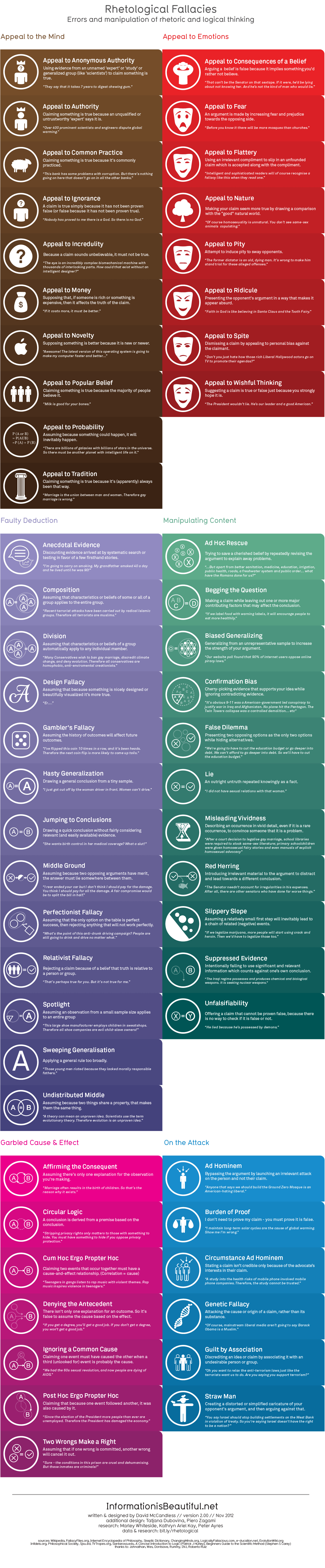
Rhetorical and other fallacies as a nice infographic with nice icons:
http://www.informationisbeautiful.net/visualizations/rhetological-fallacies/
ADDED: As embeddable link: http://infobeautiful3.s3.amazonaws.com/2013/02/iib_rhetological_fallacies_EN.png (embeding here is no good idea).
The finance industry is under attack on different fronts. The Economist and Financial Times, often wrongfully portrayed as dogmatic neo-liberals (not the least in Continental Europe) support the development:
Wolf's article has spawned a debate involving, e.g. Krugman. Positive Money has a good overview article of the debate here
An old Ikea commercial gives an amusing example of the difference between fuzzies and utilons:
Look Who's Back; I have a soft spot for Hitler comedy (I feel it's good to mock rather than be solemn and respectful) and found that side of it very amusing, but it also works as a Nathan Barley-style sendup of media/hipster culture. For a translation it read remarkably smoothly, though I suppose German-English is a smaller linguistic distance than most.
I'm reading World without End, by Ken Follett. It's the sequel to his superb The Pillars of the Earth, which is a marvel, but you don't need to have read the first to savor the second.
What surprised me about World without End is the amount of characters who openly defy the mindless obedience to dogma that you'd expect in a typical Medieval town. I've only read until the 100-ish page, and there's already a clever plotting mother, an aspiring doctor, a carpenter apprentice, all willing to question conventional wisdom and try new ways to do things. It's been refreshing so far.
If the Canterbury Tales taught me anything, it's that medieval people could actually get pretty creative and irreverent when it came to things they cared about. It's the institutions and the background assumptions that are different. Individual people often weren't all that dogmatic, and indeed enforcement of societal norms was weaker in a lot of ways than it is now; but above the individual level, almost every organization was narrowly focused on the status quo or on zero- or negative-sum games. There was nothing forward-looking in the way that science is, or even in the way that serious utopian politics is.
(It also taught me that fart jokes are perennial. A lot of those scenes wouldn't have been out of place in South Park.)
I'm going through The Pillars of the Earth and quite enjoying myself. I expected something a little on the romantic side with a chance of dullness now and then from Follett being unable to control his "show off my research" that affects many authors of his class (like Crichton). However, the book is entertaining, the characters far more interesting than I expected, and his presentation of medieval thought life is very sympathetic without being romantic. These people think. Some well, some poorly. It is quite good.
A couple of memories from The Pillars of the Earth-- it was a surprise to me that most of the misery was caused by social disorder rather than too much authority, though it did show the rise of Catholic power to affect daily life, and it had rather a lot (interesting for me, at least) about how the Catholic church managed to exist as a large institution at such a low tech level.
Fiction:
I just finished Shin Sekai Yori (aka From the New World), a serious science fiction anime series of 25 episodes (link is to a free stream). You could almost think of it as a (more) rationalist Warhammer 40,000, except that the atmosphere and aesthetic is a lot less heavy metal and more similar to, say, Speaker for the Dead. It's a little over-reliant on choppy flashbacks but generally well executed with likable characters and very strong world-building.
Person of Interest is a pretty good show. It starts as an above-average procedural about an AI that predicts premeditated murders and the people (both civilians and police officers) who try to stop them. Seasons two and three move away from the procedural aspect and start to deal more with conspiracies that try to control super-intelligent AIs, and how the AIs begin influencing and controlling humans to achieve their programmed objectives. Very good acting and a great visual aesthetic.
I actually stopped watching half way through season one because they were completely ignoring the themes they could play with about balance of power, privacy, etc. If they've actually started to realize that potential, I'll have to pick it back up.
Anime:
Rewatched Ga-Rei Zero with friends and it holds up; be careful to avoid episode 1 spoilers. Fun supernatural fantasy/horror action, with character relationships that develop and make sense so that one is drawn into caring about them.
Knights of Sidonia is only four episodes in (so may yet turn bad) but it's the most interesting sci-fi I've seen since Shin Sekai Yori; spaceships that feel realistic, and hints of the social/political consequences of life on a generation ship. Animation is CG with these over-smooth faces which may be a deal-breaker for some; together with the used future aesthetic the early parts reminded me a lot of early Ergo Proxy.
I watched Shiki recently. I have no idea what I was doing to miss it back when it was airing in 2010, but I'm glad I eventually got to it. The quality of writing is unusually good for an anime, and I think it touches on a bunch of lw-relevant themes which is why I'm mentioning it here. I would hate to spoil anything for anyone so I won't go into any details, but I definitely recommend a watch.
Some things you might be glad to be forewarned of before starting: a common complaint appears to be that this show has a slow start, so being aware of this might help. I would say that this is probably not a show you can make accurate judgements about based on only having seen a few early episodes. Also, the character design is a bit wacky. I like it and it helps to distinguish each individual in what is a large cast of characters, but regardless some may find it offputting. Finally, there are 2 bonus episodes (the 'specials') that originally came with the BD/DVD releases that you wouldn't want to miss if you really liked the show proper.
p.s. I watched the coalgirls release (Japanese audio, 1080p). It was acceptable, if a bit bloated in terms of filesize.
It's worth mentioning that this show is quite violent. In particular there's the brutal onscreen killing of a tied-up woman by a mostly-sympathetic male character, which some people I know took issue with.
(I enjoyed the show and would also recommend it but figure this aspect is worth mentioning)
Animation:
Madoka: Rebellion (a must-watch for anyone who enjoyed the TV series
I anti-recommend this. I loved the TV series, and think Rebellion ruined its perfect ending and makes me think less of the series as a whole. I am trying to forget its existence.
Agreed. It's hardly a "must-watch" for fans of the oiriginal. It's a "stay the hell away if you thought the original themes and character arcs were meaningful and well crafted".
Because it's what I call a Cannibalising Sequel: instead of easily flowing from, and enhancing the old story and making it better (think Godfather 2, or The Empire Strikes Back), in order to prop itself up a Cannibalising Sequel ruins the old story retroactively, taking away the importance of things that used to be meaningful (think Starcraft: Brood War, or Alien 3). Important sacrifices, past decisions which were supposed to have lasting repercussions, character arcs, lessons learned, and the prices paid for them... so much of that goes out the window in Rebellion.
It's also poorly paced as a movie and sloppily told as a story. The original Madoka had more of interest to offer in its first 2 minutes than this thing has in its first 20. I'm not exaggerating.
Madoka: Rebellion
I am ambivilent towards this. It had some clever bits, and I think I understand what Urobuchi was trying to do with the ending, but the overall execution did not live up to the standards of the orignial series.
Madoka: Rebellion
I also enjoyed this. I thought the fake ending would have been more emotionally satisfying, but the real ending was more interesting and opens up more possibilities for the setting.
I've been enjoying "Suits." The characters are competent and ruthless. No idea how accurate it is for US law.
edit Its Slytherin competence porn
Long time no see LW. Glad to see this is still going.
Anyway, after finding the first half of the premier season mediocre and giving up on it, I recently tried to get back into Agents of S.H.I.E.L.D. and am happy to say that the second half was some of the best television I've seen since, well, Joss Whedon's last television show.
This song cheers me up tremendously, and I'd appreciate recommendations for other music that seems similar.
First things that come to mind, not all similar in the same way, mostly happy, simple songs, often with a good beat:
Quality control vs. openness in advocacy movements
23:minutes. Possibly a good test of mental flexibility for left-wingers.
I think this may have come up before but couldn't see it in the archives: I'd like to see a separation of animation from the general Television and Movies thread.
Sorry for the delay to respond -- busy in real life...
I like the suggestion of splitting Animation into its own subthread. So if nobody has an objection, I'll be implementing this from next month -- if anyone objects, I'll set up a poll to gauge support for the move.
Politics/religion:
Statistics:
Literature
Seamus Heaney:
Medicine/biology:
Psychology:
Science/technology
Every month you have a lot of interesting links, but it's so many all at once. Is there a way I can get them more gradually?
This is the monthly thread for posting media of various types that you've found that you enjoy. Post what you're reading, listening to, watching, and your opinion of it. Post recommendations to blogs. Post whatever media you feel like discussing! To see previous recommendations, check out the older threads.
Rules: