Conjecture is an alignment startup founded by Connor Leahy, Sid Black and Gabriel Alfour, which aims to scale alignment research... (read more)
The rationalist movement, rationality community,1 rationalsphere or rationalistsphere2 represents a set of modes of bayesian thinking from self-described rationalists or 'aspiring rationalists' typically associated with the Less Wrong diaspora and their associated communities... (read more)
Less Wrong is a community resource devoted to refining the art of human rationality which was founded in 2009. Site activity reached a peak in 2011-13 and a trough in 2016-17. This page mainly describes the history through 2016... (read more)
A Seed AI (a term coined by Eliezer Yudkowsky) is an Artificial General Intelligence (AGI) which improves itself by recursively rewriting its own source code without human intervention. Initially this program would likely have a minimal intelligence, but over the course of many iterations it would evolve to human-equivalent or even trans-human reasoning. The key for successful AI takeoff would lie in creating adequate starting conditions... (read more)
A Third Option dissolves a False Dilemma by showing that there are in fact more than two options... (read more)
Eliezer Yudkowsky is a research fellow of the Machine Intelligence Research Institute, which he co-founded in 2001. He is mainly concerned with the obstacles and importance of developing a Friendly AI, such as a reflective decision theory that would lay a foundation for describing fully recursive self modifying agents that retain stable preferences while rewriting their source code. He also co-founded LessWrong, writing the Sequences, long sequences of posts dealing with epistemology, AGI, metaethics, rationality and so on... (read more)
The old LessWrong wiki was a companion wiki site to LessWrong 1.0, it was built on MediaWiki software. As of September 2020, the LessWrong 2.0 team is migrating the contents of the old wiki to LessWrong 2.0's new tag/wiki system. The wiki import is complete... (read more)
The San Francisco Bay Area is a region in the US state of California. Many members of the rationalist community are located there, as are the Machine Intelligence Research Institute and the Center For Applied Rationality.. (read more)
Someone is well-calibrated if the things they predict with X% chance of happening in fact occur X% of the time. Importantly, calibration is not the same as accuracy. Calibration is about accurately assessing how good your predictions are, not making good predictions. Person A, whose predictions are marginally better than chance (60% of them come true when choosing from two options) and who is precisely 60% confident in their choices, is perfectly calibrated. In contrast, Person B, who is 99% confident in their predictions, and right 90% of the time, is more accurate than Person A, but less well-calibrated... (read more)
| User | Post Title | Wikitag | Pow | When | Vote |
Inkhaven is a 30-day residency where one has to publish posts every day, as part of an effort to grow stronger as a writer. While this has produced some excellent posts it also produces a fair bit of noise too, and also many more hastily-written or experimental posts than usual.
Inkhaven-like posts emerge when other people try to imitate this manner on a smaller scale (e.g. Lightcone team members doing their own 1-week writing stints, or 'HalfHaven' where remote LessWrongers aim to post 30 posts over the course of two months).
Focuses on the intersection of frontier AI agents and traditional infrastructure security, including exploit detection, system persistence, and hardware-level attributability
do you still think these are possible to build/define/do you know about any relevant papers?
I have been exploring building something like this as an exploration into better-controllable default developer choices for agent programming primitives, as opposed to "assistant persona + completions API for everything".
Focuses on the intersection of frontier AI agents and traditional infrastructure security, including exploit detection, system persistence, and hardware-level attributability
Inkhaven is a 30-day residency where one has to publish posts every day. While this likely helps one in the longer term, the shorter-term effect is a more likely creation of posts with less effort to doublecheck the arguments and, as a result, with epistemic problems.
Inkhaven-like posts emerge when other people try to imitate this manner on a smaller scale (e.g. Lightcone team members doing their own 1-week writing stints).
In doxastic modal logic, the statement "P is a hyperstition" is written as □P→□P→P. Modal reasoners that satisfy Löb's Theorem believe all personal hyperstitions. This can cause some problems for modal embedded agents. Löbian cooperation works by making mutual cooperation a collective hyperstition.
Inkhaven is a 30-day residency where one has to publish posts every day.day, as part of an effort to grow stronger as a writer. While this likely helps one in the longer term, the shorter-term effect ishas produced some excellent posts it also produces a fair bit of noise too, and also many more likely creation ofhastily-written or experimental posts with less effort to doublecheck the arguments and, as a result, with epistemic problems. than usual.
Inkhaven-like posts emerge when other people try to imitate this manner on a smaller scale (e.g. Lightcone team members doing their own 1-week writing stints)stints, or 'HalfHaven' where remote LessWrongers aim to post 30 posts over the course of two months).
By Ruthenis (summarized; includes level 0):
Scalable oversight is an approach to AI control [1]in which AIs supervise each other.the problem of providing reliable supervision of outputs from AIs, even as they become smarter than humans. Often groups of weaker AIs supervise a stronger AI, or AIs are set in a zero-sum interactiondebate with each other.
People used to refer to scalable oversight as a set of AI alignment techniques, but they usually work on the level of incentives to the AIs, and have less to do with architecture.
A reasoning step is "logically valid" when that kind of step never produces a false conclusion from true premises. For example, in algebra, "Add 2 to both sides of the equation" is valid because it only produces true equations from true equations, while "Divide both sides by x" is invalid because x might be 0. So even if "2x = (y+1)x", letting x = 0 and y = 2, the original equation can be true while "2 = y + 1" is false. But "2x + 2 = (y+1)x + 2" will be true in every semantic model where the original equation is true.
More generally in life, there's a question of "did you execute each local step of reasoning correctly", which can be considered apart from "did you arrive at the correct conclusion". Validity is a local property of a reasoning step or sequence; we can (and should) evaluate each step's validity separately from whether we agree with the premises or end up agreeing with the conclusion. For near-logical domains, this asks "Does the next proposition follow (with very high probability, given other things usually believed about the world or explicitly introduced as premises) from the previous proposition?" For probabilistic reasoning, informal validity asks, "Given everything else believed or introduced as a premise, is this next step adjusting probabilities by the right amount?" or "Does this kind of reasoning step in general produce well-calibrated conclusions from well-calibrated premises?"
Eg, consider why the ad hominem fallacy should be seen as "invalid" or a "locally invalid reasoning step" from this viewpoint. Suppose you start out with well-calibrated probabilities (things you say "60%" for, happen around 60% of the time). You assign 60% probability that the sky is blue. Then somebody says, "Yeah, well, people who believe in blueskyism are ugly" and you nod and adjust your credence in blueskyism down to 40%. Your odds just went from 3:2 to 2:3, so by Bayes's Rule you should've heard evidence with a likelihood ratio of 4:9 to produce that probability shift. Unless you already believe that false propositions are 225% as likely as true propositions to be believed by ugly people, you should already expect that believing an ad hominem argument is something that can produce ill-calibrated conclusions in expectation from well-calibrated premises.
Main articles:

ATOW (2025-09-09)(2026-04-03), nothing has been published that claimMoore et al. (2026) is probably the best academic account of LLM-Induced Psychosis (LIP) is a definite, real, phenomena. Though, many anecdotal accounts exist. It is not yet clear, if LIP is caused by AIs, if pre-existing disillusion are 'sped up' or reinforced by interactinginduced psychosis. They "analyze logs of conversations with an AI, or, if LIP exists at all.LLM chatbots from 19 users who report having experienced psychological harms from chatbot use" where the users mostly came from " support group for such chatbot users."
CDT agents don't consider the acausal impactlogical impacts of their decisionsdecision algorithms' outputs when choosing actions.actions, only the physical consequences of their physical act. Whenever a CDT agent is put in a situation where it has to make a decision, it considers multiple hypothetical worlds,hypotheticals, one for each decision it could make. In a CDT agent, the only difference between these hypothetical worlds is the decision it makes.physical act in the moment of that act, and what happens physically / causally downstream from that. This means that when CDT is faced with something trying to predict its actions, CDT imagines its decision to not have any effect on its predicted decision.
When CDT makes its decisions, it only thinks it controls things causally downstream of its actions. UDT by contrast, is choosing as if it controls every part of reality that is logically correlated withdownstream of its actions.logical output. This allows it to acausally bargaindetermine a wide range of other facts across the multiverse.universe that are logically correlated with itself, like what is or has been reliably predicted about its present decision, or what other agents sufficiently similar to itself will choose. Son of CDT is somewhere in the middle. It acts as if it controls only the things logically correlated with its actions that are causally downstream of its moment of original creation.
If a Son of CDT agent goes on to create further agents, all of those agents will have the same magic moment. They will all care about whether or not Omega's knowledge of them is causally downstream of the moment the moment the CDT agent first wrote Son-of-CDT code.


If youWe used to have 100 or more karma on both LessWronga feature for crossposting to EA Forum. It caused a lot of bugs that were difficult to deal with and didn't feel like it was pulling its weight, so we remove it in the EA Forum, you can automatically crosspost from LessWronglatest update to the EA Forum (and from the EA Forum to LessWrong). You also need to have accepted the EA Forum's Terms of Use,which you can do by trying to create a new post on the EA Forum (if you haven't already done so after the Terms of Use requirement was put in place).
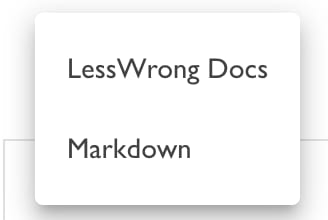
You should be logged in on both sites. To ensure that a post is crossposted after it's published, or to crosspost an already-published post, follow the authentication flow in the Options menu on the post editor page.
The main problems with CEV include, firstly, the great difficulty of implementing such a program - “If one attempted to write an ordinary computer program using ordinary computer programming skills, the task would be a thousand lightyears beyond hopeless.” Secondly, the possibility that human values may not converge. Yudkowsky considered CEV obsolete almost immediately after its publication in 2004. He states that there's a "principled distinction between discussing CEV as an initial dynamic of Friendliness, and discussing CEV as a Nice Place to Live" and his essay was essentially conflating the two definitions.
hey Chris and Mick! wanna include Atlas Computing? we're a fieldbuilding org scoping the problems in AGI risks that make recruiting expertise to lead those orgs easier.
we're also hiring: https://atlascomputing.org/jobs
our onepager here:
https://docs.google.com/document/d/1v9yVAkfnjrFwsp3jH5aYTwfwjVBsNYND/edit?usp=sharing&ouid=109085206565751232228&rtpof=true&sd=true