Postmodernism for STEM Types: A Clear-Language Guide to Conflict Theory
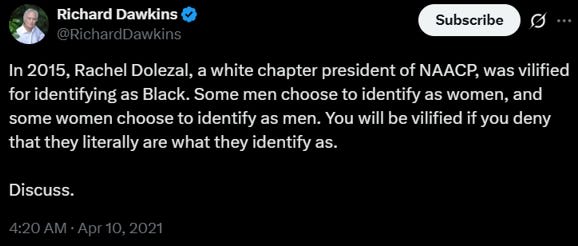
Crossposted from Susbstack Section I : Opening In 2021, Richard Dawkins tweeted: The fallout was immediate. The American Humanist Association revoked an award they’d given him 25 years earlier. A significant controversy erupted, splitting roughly into two camps. One camp defended Dawkins. They saw him raising a legitimate question about logical consistency. If we accept self-identification for gender, what’s the principled distinction with race? This seemed like straightforward philosophical inquiry - the kind of question that deserves engagement rather than punishment. The other camp saw the tweet as harmful. To them, Dawkins was lending intellectual credibility to attacks on trans people. The “just asking questions” frame was either naive or disingenuous. Whether he intended harm or not, the effect was to legitimize transphobia. These camps weren’t arguing about the answer to Dawkins’ question. They were operating in different epistemologies - incompatible frameworks for what makes a good argument and how discourse works. Why Read This Post If you’ve ever been confused about why: * Stating true facts sometimes makes people angrier rather than updating their beliefs * “Just asking questions” gets you accused of bad faith even when you’re genuinely curious * Postmodernists seem obsessed with language and categories in ways that feel disconnected from reality * Public discourse feels dishonest even when no one is technically lying * Smart people with good intentions talk past each other completely on politically charged topics * Why Postmodernists tend to be sceptical of the idea of objective truth ...then this post might help. I’m going to explain two fundamentally incompatible ways of evaluating truth and discourse, show you when each applies, and help you recognize which game you’re actually playing. This is a long post, but if you want to understand why public discourse works the way it does - and how to navigate it without being naive - it’s w

Selective focus is the biggest issue and isn't tackled directly by them.