On the error of failing to appreciate your opponents' three-dimensionality:
They had cliche answers but only to their self-created straw-men. To exaggerate only slightly, they had never talked to anyone who really believed, and had thought deeply about, views drastically different from their own. As a result, when they heard real arguments instead of caricatures, they had no answers, only amazement that such views could be expressed by someone who had the external characteristics of being a member of the intellectual community, and that such views could be defended with apparent cogency. Never have I been more impressed with the advice I once received: "You cannot be sure that you are right unless you understand the arguments against your views better than your opponents do."
Source: Milton Friedman, "Schools at Chicago," from The Indispensable Milton Friedman
H/T David Henderson at EconLog
Note: The final sentence of the passage, as presented by Henderson, is missing closing quotation marks. I have added them.
If any idiot ever tells you that life would be meaningless without death, Hyperion corporation recommends killing them.
--Borderlands 2
If you don't think your life is more important than someone else's, sign your organ donor card and kill yourself.
(House, MD deals with moral grandstanding)
I checked the numbers on this recently. An average heart transplant costs about 1.1 million dollars, and has a mean survival time of about five years (at a very poor QoL). I think there's a pretty strong case that they shouldn't be done at all.
Kidney transplants have a much better RoI, but they don't require the death of the donor.
The benefit is doubled in the second case, but the investment is much larger (obviously), so RoI is not doubled. In fact, the investment is more than doubled (you have to pay for two transplants instead of one, as well as killing someone), so the RoI plummets.
Does it means "8 people saved (for unspecified time)" or "the saved people gain 8 times as much QALYs as the donor lost"?
AFAIK, the there are some problems with transplanted organs which require repeated medical attention and sometimes a lot of painkillers, so we convert X years of a healthy person to Y years of people with bad health.
On the other hand, a person willing to follow this advice and kill themselves probably suffers from depression, so we should reduce their remaining years estimate by a probability of suicide (other than the specific one recommended in this thread).
You mean by calculation, right?
I mean, if every suicidal person saves the lives of up to eight people who want to live, it might be worth outright encouraging this approach, rather than having suicidal people kill themselves in ways that damage their bodies for this purpose, and then spend effort and money trying to bring them back.
Once a certain number of people is reached, though, there might be a degree of overabundance of organs compared to the needs, and unless you want to make the jurisdiction that allows this some sort of exporter of literal human resources, you should probably stop there.
In which Winnie-the-Pooh tests a hypothesis about the animal tracks that he is following through the woods:
“Wait a moment,” said Winnie-the-Pooh, holding up his paw.
He sat down and thought, in the most thoughtful way he could think. Then he fitted his paw into one of the Tracks…and then he scratched his nose twice, and stood up.
“Yes,” said Winnie-the Pooh.
“I see now,” said Winnie-the-Pooh.
“I have been Foolish and Deluded,” said he, “and I am a Bear of No Brain at All.”
The real irony of the story is a historical context I think most readers these days miss: that when the real Plato paid court to a 'king' - Dionysius II, tyrant of Syracuse - it went very poorly. Plato was arrested, and barely managed to arrange his freedom & return to Athens.
Twice.
And supposedly Plato was sold into slavery by the previous tyrant.
Another from the same site — on free will:
"It's my fate to steal," pleaded the man who had been caught red-handed by Diogenes.
"Then it is also your fate to be beaten," said Diogenes, hitting him across the head with his staff.
Let me differentiate between scientific method and the neurology of the individual scientist. Scientific method has always depended on feedback [or flip-flopping as the Tsarists call it]; I therefore consider it the highest form of group intelligence thus far evolved on this backward planet. The individual scientist seems a different animal entirely. The ones I've met seem as passionate, and hence as egotistic and prejudiced, as painters, ballerinas or even, God save the mark, novelists. My hope lies in the feedback system itself, not in any alleged saintliness of the individuals in the system.
Therefore, the first and most important duty of philosophy is to test impressions, choosing between them and only deploying those that have passed the test. You know how, with money--an area where we believe our interest to be at stake--we have developed the art of assaying, and considerable ingenuity has gone into developing a way to test if coins are counterfeit, involving our senses of sight, smell, hearing, and touch. The assayer will let the denarius drop and listen intently to its ring; and he is not satisfied to listen just once: after repeated listenings he practically acquires a musician's subtle ear. It is a measure of the effort we are prepared to expend to guard against deception when accuracy is at a premium.
When it comes to our poor mind, however, we can't be bothered; we are satisfied accepting any and all impressions, because here the loss we suffer is not obvious. If you want to know just how little concerned you are about things good and bad, and how serious about things indifferent, compare your attitude to going blind with your attitude about being mentally in the dark. You will realize, I think, how inappropriate your values really are.
Epictetus, Discourses I.2...
It is somewhat amazing to me that there are people who much less concerned about their ability to recognize false reasoning than their ability to recognize counterfeit currency. It seems pathetically obvious to me that sloppiness in the former, meta level would tend to be expensive at the latter, object level - for example, you end up with people placing their trust in tools like iodine pens to detect counterfeit notes when almost no evidence exists that such a measure is effective.
...Often a person uses some folk proverb to explain a behavioral event even though, on an earlier occasion, this same person used a directly contradictory folk proverb to explain the same type of event. For example, most of us have heard or said, “look before you leap.” Now there’s a useful, straightforward bit of behavioral advice—except that I vaguely remember admonishing on occasion, “he who hesitates is lost.” And “absence makes the heart grow fonder” is a pretty clear prediction of an emotional reaction to environmental events. But then what about “out of sight, out of mind”? And if “haste makes waste,” why do we sometimes hear that “time waits for no man”? How could the saying “two heads are better than one” not be true? Except that “too many cooks spoil the broth.” If I think “it’s better to be safe than sorry,” why do I also believe “nothing ventured, nothing gained”? And if “opposites attract,” why do “birds of a feather flock together”? I have counseled many students to “never to put off until tomorrow what you can do today.” But I hope my last advisee has never heard me say this, because I just told him, “cross that bridge when you come to it.”
The enormous appeal of cliché
After all, the essential point in running a risk is that the returns justify it.
-Sennett Forell, Foundation and Empire
A sound banker, alas, is not one who foresees danger and avoids it, but one who, when he is ruined, is ruined in a conventional way along with his fellows, so that no one can really blame him.
-John Maynard Keynes
Traditional pundits are intimidated and frightened by Nate Silver's quantitative analysis. They see their comfy job pandering to the beliefs-as-attire market, with no expectation of accuracy, disappearing if pundits who can actually predict things take over.
edit: This comment, further down the page, explains well.
Exactly. Here is an excellent article elaborating further. (Only quibble is that is was not just Silver; other data-based analysts like Sam Wang and Josh Putnam made essentially the same predictions):
...When we talk about the epistemology of journalism, it all eventually ties into objectivity. The journalistic norm of objectivity is more than just a careful neutrality or attempt to appear unbiased; for journalists, it’s the grounds on which they claim the authority to describe reality to us. And the authority of objectivity is rooted in a particular process.
That process is very roughly this: Journalists get access to privileged information from official sources, then evaluate, filter, and order it through the rather ineffable quality alternatively known as “news judgment,” “news sense,” or “savvy.” This norm of objectivity is how political journalists say to the public (and to themselves), “This is why you can trust what we say we know — because we found it out through this process.” (This is far from a new observation – there are decades of sociological research on this.)
Silver’s process — his epistemology — is almost exactly the opposite of this:
Where political journalists’ inform
other data-based analysts like Sam Wang and Josh Putnam made essentially the same predictions
A dataset including Wang & Putnam, with scoring of accuracy:
I assume he is referring to the tendency of the media to call a persistent but small lead "too close to call." It's confusing the margin of lead with the likelihood of winning.
Either that, or the tendency of partisan commentators to make predictions for their side that were totally unconnected to state-by-state polling results.
You can't distinguish your group by doing things that are rational and believing things that are true. If you want to set yourself apart from other people you have to do things that are arbitrary and believe things that are false.
False.
I mean, grain of truth, yes, literally true, no. You can shock the hell out of people and distinguish yourselves quite well by doing rational things.
Paul Krugman says something similar
(ii) Adopt the stance of rebel: There is nothing that plays worse in our culture than seeming to be the stodgy defender of old ideas, no matter how true those ideas may be. Luckily, at this point the orthodoxy of the academic economists is very much a minority position among intellectuals in general; one can seem to be a courageous maverick, boldly challenging the powers that be, by reciting the contents of a standard textbook. It has worked for me!
(Very close to the end of Ricardo's Difficult Idea] )
You can shock many people by doing some rational things - those preselected for not being done by most people already, and also those that are explicitly counter to important irrational things that many people do. And these specific rational actions have an availability bias. Conversely, once something is "normal", it's not a highly available mental example of "especially rational".
But can you really shock many people by doing a randomly selected rational thing? By giving the right answer on a test? By choosing the deal that gains you the most money? By choosing a profession, a friend, a place to live, based on expectations of happiness? By choosing medical treatment based on scientific evidence? By doing something because it's fun?
It might shock people that the choice is in fact rational; they may disagree that the deal you chose will earn you the most money. But when people agree about predictions, why would they be shocked by most rational choices? I think a random (but doable) irrational act is much more shocking than a random rational one.
The inhabitants of Florence in 1494 or Athens in 404 BCE could be forgiven for concluding that optimism just isn't factually true. For they knew nothing of such things as the reach of explanations or the power of science or even laws of nature as we understand them, let alone the moral and technological progress that was to follow when the Enlightenment got under way. At the moment of defeat, it must have seemed at least plausible to the formerly optimistic Athenians that the Spartans might be right, and to the formerly optimistic Florentines that Savonarola might be. Like every other destruction of optimism, whether in a whole civilization or in a single individual, these must have been unspeakable catastrophes for those who had dared to expect progress. But we should feel more than sympathy for those people. We should take it personally. For if any of those earlier experiments in optimism had succeeded, our species would be exploring the stars by now, and you and I would be immortal.
David Deutsch, The Beginning of Infinity
If I have a Grand Unified Theory Of Everything, it's this: I believe that people always do things that make sense to them. Hard as it is to believe with all the hurting out there, almost nobody hurts others just to be a jerk. So if you want to change human behavior on a grand scale, you can't tell people "stop being a jerk." You have to dissect and then recreate their models of the world until being a jerk doesn't make sense.
While I think there's some truth to this, it's easy for me to come up with examples of things I've done that never made sense to myself.
..."Because they were hypocrites," Finkle-McGraw said, after igniting his calabash and shooting a few tremendous fountains of smoke into the air, "the Victorians were despised in the late twentieth century. Many of the persons who held such opinions were, of course, guilty of the most nefandous conduct themselves, and yet saw no paradox in holding such views because they were not hypocrites themselves-they took no moral stances and lived by none."
"So they were morally superior to the Victorians-" Major Napier said, still a bit snowed under. "-even though-in fact, because-they had no morals at all." There was a moment of silent, bewildered head-shaking around the copper table.
"We take a somewhat different view of hypocrisy," Finkle-McGraw continued. "In the late-twentieth-century Weltanschauung, a hypocrite was someone who espoused high moral views as part of a planned campaign of deception-he never held these beliefs sincerely and routinely violated them in privacy. Of course, most hypocrites are not like that. Most of the time it's a spirit-is-willing, flesh-is-weak sort of thing."
&q
In a man whose reasoning powers are good, fallacious arguments are evidence of bias.
--Bertrand Russell, "Philosophy's Ulterior Motives". (The context is Descartes' philosophy and the obviously fallacious proofs he offers of the existence of God and the external world.)
As the philosopher David Schmidtz says, if your main goal is to show that your heart is in the right place, then your heart is not in the right place.
Jason Brennan, Libertarianism: What Everyone Needs to Know
"Oh, sorry, I have this condition where I don't see or hear anything I disagree with."
"I had no idea that being human was a disease."
"A bad one! Everyone who contracts it eventually dies!"
"Look,” [Deutsch] went on, “I can’t stop you from writing an article about a weird English guy who thinks there are parallel universes. But I think that style of thinking is kind of a put-down to the reader. It’s almost like saying, If you’re not weird in these ways, you’ve got no hope as a creative thinker. That’s not true. The weirdness is only superficial."
New Yorker article on David Deutsch
(I saw this on Scott Aaronson's blog)
And then she said, "Ha ha ha, I figured out how to remove the closing quotation mark! From now on, the whole future is my story!
-Aristosophy. I like to think this is about the Robot's Rebellion.
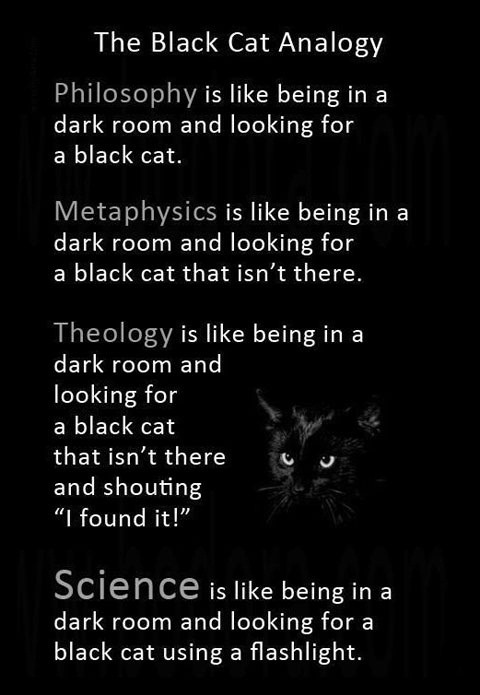
Philosophy is like being in a dark room and looking for a black cat. Metaphysics is like being in a dark room and looking for a black cat that isn't there. Theology is like being in a dark room and looking for a black cat that isn't there and shouting "I found it!" Science is like being in a dark room and looking for a black cat using a flashlight.
Recognizing the startling resurgence in realism, Don Philahue (of The Don Philahue Show) invited a member of Realists Anonymous to bare his soul on television. After a brief introduction documenting the spread of realism, Philahue turned to his guest:
DP: What kinds of realism were you into, Hilary?
H: The whole bag, Don. I was a realist about logical terms, abstract entities, theoretical postulates - you name it.
DP: And causality, what about causality?
H: That too, Don. (Audience gasps.)
DP: I'm going to press you here, Hilary. Did you at any time accept moral realism?
H: (staring at feet): Yes.
DP: What effect did all this realism have on your life?
H: I would spend hours aimlessly wandering the streets, kicking large stones and shouting, "I refute you thus!" It's embarrassing to recall.
DP: There was worse, wasn't there Hilary?
H: I can't deny it, don. (Audience gasps.) Instead of going to work I would sit at home fondling ashtrays and reading voraciously about converging scientific theories. I kept a copy of "Hitler: A Study in Tyranny" hidden in the icebox, and when no one was around I would take it our and chant "The Nazis were bad. The Nazis were really bad."
-- A dialogue by Philip Gasper
I've never heard more different explanations for anything parents tell kids than why they shouldn't swear. Every parent I know forbids their children to swear, and yet no two of them have the same justification. It's clear most start with not wanting kids to swear, then make up the reason afterward.
-Paul Graham in The Lies We Tell Kids
I like to be around people who don't constantly emphasize their every word, making it hard to tell when something is actually important. Since swearing is a verbal marker of importance, its casual overuse is like shouting all the time; it's very wearying. And, lest I be accused of rationalising, I do not only apply this to children, but have also asked my wife to cut back on swearing.
As a side note, Americans are very loud, both in the literal sense of putting more decibels behind their voices, and in their over-reliance on swearing. I think you've fallen into the bad equilibrium that comes about when everyone has an incentive to be a little louder than the next guy, and there's no cost to being so.
Slogans like “practice random acts of kindness” feel good and are easy to put into practice. But if we don’t take our activism more seriously than that, our motive is probably a desire to feel good about ourselves, to help ourselves or those close to us, or to act out our self-identity. The endpoint of authentic compassion is a desire to do the most good that one can, to be as effective as possible in creating a world with less suffering and destruction and more joy. Figuring out how we can do the most good takes careful thought over a long period of time, and it means moving into new and possibly uncomfortable areas of advocacy. But the importance of taking our activism seriously and approaching it from this utilitarian perspective cannot be overstated. It will mean a difference between life and death, between happiness and suffering, for thousands of people, for thousands of acres of the ecosystem, and for tens of thousands of animals.
Nick Cooney, Change of Heart
"The boundary between these 2 classes [the Eloi & Morlocks] is more porous than I've made it sound. I'm always running into regular dudes - construction workers, auto mechanics, taxi drivers, galoots in general - who were largely aliterate until something made it necessary for them to become readers and start actually thinking about things. Perhaps they had to come to grips with alcoholism, perhaps they got sent to jail, or came down with a disease, or suffered a crisis in religious faith, or simply got bored. Such people can get up to speed on particular subjects quite rapidly. Sometimes their lack of a broad education makes them over-apt to go off on intellectual wild goose chases, but, hey, at least a wild goose chase gives you some exercise."
--Neal Stephenson, In the Beginning Was... the Commandline
...The last project that I worked on with [Richard Feynman] was in simulated evolution. I had written a program that simulated the evolution of populations of sexually reproducing creatures over hundreds of thousands of generations. The results were surprising in that the fitness of the population made progress in sudden leaps rather than by the expected steady improv
I would like to upvote the Feynman quote. I am not interested in upvoting the Stephenson quote. I think it would be better if these quotes were in separate comments, as recommended in the post.
I would like to upvote the Feynman quote. I am not interested in upvoting the Stephenson quote.
I would like to upvote the Stephenson quote, and not the Feynman quote.
You two talk between yourselves so that only one of you upvote the entire comment.
In the way that skepticism is sometimes applied to issues of public concern, there is a tendency to belittle, to condescend, to ignore the fact that, deluded or not, supporters of superstition and pseudoscience are human beings with real feelings, who, like the skeptics, are trying to figure out how the world works and what our role in it might be. Their motives are in many ways consonant with science. If their culture has not given them all the tools they need to pursue this great quest, let us temper our criticism with kindness. None of us comes fully equipped.
--Carl Sagan
It is neither desirable nor any longer effective to try bullying people into accepting the authority of science. Instead, all members of the educated public can be invited to participate in science, in order to experience the true nature and value of scientific inquiry. This does not mean listening to professional scientists tell condescending stories about how they have discovered wonderful things, which you should believe for reasons that are too difficult for you to understand in real depth and detail. Doing science ought to mean asking your own questions, making your own investigations, and drawing your own conclusions for your own reasons. Of course it will not be feasible to advance the "cutting edge" or "frontier" of modern science without first acquiring years of specialist training. However, the cutting edge is not all there is to science, nor is it necessarily the most valuable part of science. Questions that have been answered are still worth asking again, so you can understand for yourself how to arrive at the standard answers, and possibly discover new answers or recover forgotten answers that are valuable.
Hasok Chang, Inventing Temperature: Measurement and Scientific Progress
I am too much of a sceptic to deny the possibility of anything... but I don't see my way to your conclusion.
Thomas Huxley
Remember, kids, the only difference between screwing around and science is writing it down.
-- Adam Savage
“It was, of course, a grand and impressive thing to do, to mistrust the obvious, and to pin one’s faith in things which could not be seen!”
-Galen, a Roman doctor/philosopher, on Asclepiades's unwillingness to admit that the kidneys processed urine - despite Galen demonstrating the function of the kidneys to Asclepiades by, well, cutting open a live animal and pointing to the urine flowing from its kidneys to its bladder (search the page for "ligatures" to find Galen's experiment described), among other things.
To say that the Greeks didn't have correct scientific theories is obviously true. To say that they had a methodology that departs from ours is somewhat true. To say that they were merely making stuff up without reference to any observation is to merely make stuff up without reference to any observation.
I could do someone significant bodily harm by hitting them with Aristotle's collected empirical works on the anatomies, reproductive systems, social habits, and forms of locomotion of animals. And I'm not a huge dude.
How would we compare these hypotheses?
9. Scientific advancement requires that in each generation, your culture acquires more knowledge about the world than it loses — and there are a lot of ways for a culture to lose knowledge; among them mortality, library fires, Alzheimer's, censorship, tech bubbles, faddish beliefs or cults, pareidolia, political propaganda, shame, anti-epistemology, language change, revolt of the masses, economic collapse rendering high-tech/high-knowledge trades untenable, superstitiogenesis¹, the madness of crowds, and other noise. In the absence of really good schooling, literacy, anti-censorship memes, skepticism memes, and economic resilience, the noise is likely to dominate the signal, driving cultures back towards subsistence and ignorant superstition — a condition in which beliefs are no more correlated with reality than is needed to keep you alive from day to day. However, the difference is basically quantitative (how much is preserved?) rather than qualitative (some cultures Have It and others Don't).
10. It's just too hard to maintain the technology base for scientific advancement with 1% literacy; there's just too much chance of losing it due to correlated death of the literate class — plagues; king decides to kill all the scribes and burn the books; barbarians invade and do the same; etc.
¹ any process by which new superstitions are created
"Virtue" has a specific meaning in the ancient Greek world which doesn't seem like it's all that relevant here.
The way I would put it is that a clever Greek interested in the natural world became an engineer, and a clever Greek interested in the social world became an active citizen, which is a sort of combination of landlord, lawyer, and philosopher. Archimedes made his living by basically being the iron-punk hero of Syracuse; Plato and Aristotle made their living by teaching young rich folks how to be effective rich adults. A broad-minded citizen should be curious about the natural world, but curiosity is just a hobby, not a calling.
Yep. If nothing of what Archimedes did counts as ‘science’, you're using an overly narrow definition IMO.
Naturalism came after science, not before it. Most if not all of the key figures of the Scientific Revolution were devout theists.
Many scientists today are also theists. The actors of the Scientific Revolution successfully compartmentalized their theism. If they had really thought God was likely to modify the results of their experiments to differ from established physical law just to mess around, or that there weren't any regular physical laws, they wouldn't have bothered with science.
'At my funeral, I don't want people to wear bright colors and smile and laugh fondly at the wonderful memories of the precious time we spent together on Earth. Tell them to wear black and cover their faces with ash. Tell them to weep bitter tears and rail angrily against the cruel God who took me at so young an age. Do this for me, my beloved.'
http://www.theonion.com/articles/loved-ones-recall-local-mans-cowardly-battle-with,772/
I find both the ironic and straightforward meaning of this quote to be meaningful.
If any man pretend to me that God hath spoken to him … immediately, and I make doubt of it, I cannot easily perceive what argument he can produce to oblige me to believe it .. For to say that God … hath spoken to him in a dream is no more than to say he dreamed that God spoke to him.
Thomas Hobbes, Leviathan, Chapter 13
But if my (not a mathematician) friend says that god spoke to him in a dream, and gave him a proof of the Goldbach conjecture, and he has the proof and it's valid, then I would think something more interesting than a typical dream was going on.
The great thing about reality is that eventually you hit it.
Source: Andrew Sullivan in an otherwise fairly bland political post
On confirmation bias
If a man objects to truths that are all too evident, it is no easy task finding arguments that will change his mind. This is proof neither of his own strength nor of his teacher's weakness. When someone caught in an argument hardens to stone, there is just no more reasoning with them.
Epictetus, Discourses I.5.1-2 (page 15 of this edition) (original Greek, with alternate translations at the link)
Chris Cillizza says that [...] the surge in the quantity of public polling available creates a confusing fog of numbers in which "partisans, who already live in a choose-your-own-political-reality world, can select the numbers that comply with their view of the race and pooh-pooh the data that suggest anything different."
That's true. But if you actually want to know what's happening in the race the increased poll volume makes it clearer not less clear. The sense that the polls are "all over the map" is the mistake. You need to think of each datapoint as having an associated probability distribution and then look at where they overlap. [...] The fact that we now have tons of polling that averages out to [a] conclusion means the scope for "sampling error" to throw us off is, at this point, tiny. One poll showing a lead of the current magnitude would leave us with a ton of uncertainty, but a bunch of polls makes the picture pretty clear.
By the time one is consciously aware of something, the brain has already done the work.
--Michael Gazzaniga
Girl 1: Because distance is infinitely divisible, if you assign number pairs to each letter of the alphabet, you can specify any string of letters just by pointing to a very specific place on this centimeter and getting its decimal output. In fact, that sentence I just said is at a particular point on the centimeter, as was this one, and whatever you or I say in the future. The centimeter has read every book there will ever be and knows every scientific fact that can be. It knows the future of our friendship. It knows how we'll die. It knows how the universe ends and how it began.
Girl 2: What's the point of doing anything then?
Girl 1: Well, the centimeter also "knows" a bunch of crazy stuff.
Centimeter callouts: "2+2=3" "Up is down, rotated 90 degrees" "Ponies aren't awesome"
Girl 2: So I know infinity less than the centimeter, but have infinity better discretion.
Girl 1: Yeah, that's basically your life. You know relatively no information, but you're relatively great at using it.
Girl 2: I bet if I tell Bobby about this, he'll like me.
Girl 1: Well, you're okay at using it.
The folly of mistaking a paradox for a discovery, a metaphor for a proof, a torrent of verbiage for a spring of capital truths, and oneself for an oracle, is inborn in us.
Paul Valéry
An astronomer, a physicist and a mathematician are on a train in Scotland. The astronomer looks out of the window, sees a black sheep standing in a field, and remarks, "How odd. Scottish sheep are black." "No, no, no!" says the physicist. "Only some Scottish sheep are black." The mathematician rolls his eyes at his companions' muddled thinking and says, "In Scotland, there is at least one sheep, at least one side of which appears to be black from here."
(This version is from Wikipedia.)
Previously approximated here.
I still habitually complete this joke with:
"Actually," says the stage magician, "we merely know that there exists something in Scotland which appears to be a sheep which is black on at least one side when viewed from this spot."
Though I'm now tempted to add:
"Hmph," snorts the cognitive psychologist. "Such presumption. An event occurred that we experienced as the perception of a black sheep, only one side of which was visible, standing on what we believed to be a field in Scotland."
I've heard a version in which after the mathematician speaks, the shepherd yells “Snowy White [the name of the sheep]! Stop rolling in the mud!”
"Bah", says the thermodynamicist. "All I know is that your brain is in a configuration that makes you say you saw a black sheep a minute ago."
"Meh", says the trivialist. "Scottish sheep are black. Scottish sheep are white. Scottish sheep are black and white. Scottish sheep are purple octopuses. And I don't even need to look out the window."
...If we see in each generation the conflict of the future against the past, the fight of what might be called progressive versus reactionary, we shall find ourselves organizing the historical story upon what is really an unfolding principle of progress, and our eyes will be fixed upon certain people who appear as the special agencies of that progress. [...] But if we see in each generation a clash of wills out of which there emerges something that probably no man ever willed, our minds become concentrated upon the process that produced such an unpredictable issue, and we are more open for an intensive study of the motions and interactions that underlie historical change. [...] The process of the historical transition will then be recognized to be unlike what the whig historian seems to assume – much less like the procedure of a logical argument and perhaps much more like the method by which a man can be imagined to work his way out of a "complex". It is a process which moves by mediations and those mediations may be provided by anything in the world – by men’s sins or misapprehensions or by what we can only call fortunate conjunctures. Very strange bridges are used to make
Besides being fascinating in its own right, such exotic finds are a good test of astronomers’ theories about how planets form. In PH1’s case, its four stars are actually a pair of binaries. Conventional planetary-formation theory holds that worlds condense out of a disc of dust and rubble early in a star’s life. But in this case, “the second binary would sit right at the edge of the protoplanetary disc,” notes Dr Lintott. Computer models suggest that the gravitational influence of the second pair of stars ought to disrupt the disc and prevent the formation of planets. Reality, in this case, disagrees with the models—and that is how science advances.
Source: The Economist's "Babbage" blog, in a post on exoplanets
(Of course, science advances when reality agrees with models too.)
Edited to remove "emphasis added" from the quotation, which I had added originally but have since decided against.
As we learn more and more about the solar system, the reality-check that our theories have to pass becomes more and more stringent. This is one reason why scientists have a habit of opening up old questions that everybody assumed were settled long ago, and deciding that they weren’t. It doesn’t mean the scientists are incompetent: it demonstrates their willingness to contemplate new evidence and re-examine old conclusion in its light. Science certainly does not claim to get things right, but it has a good record of ruling out ways to get things wrong.
-- The Science of Discworld, Terry Pratchett, Ian Stewart and Jack Cohen
...What does Magritte mean when he says "This is not a pipe"? It sure looks like a pipe. But step back for a moment: what is the definition of the thing you are looking at? The thing you are looking at is not a pipe. The thing you are looking at is a picture. ... You see, if it were actually a pipe, you could stuff tobacco in it, smoke it, etc. But you cannot do anything like that with it. This is not a pipe. It's a picture.
We generally figure this out when we're growing up. You have a Teddy Bear. When you're a child, perhaps you very adorably treat Rupert as if he were "Bear: Subtype Stuffed". But that isn't really true! Rupert is not any kind of a bear at all, and has no actual connection to Ursus. In reality, the amusing childhood mistake is an inversion of the true state of affairs... Rupert is really a "Stuffed Toy: Subtype Bear".
Likewise, Magritte's treacherous pipe is not a "Pipe: Subtype Picture". Rather, it is a "Picture: Subtype Pipe".
Here's another fine example: consider trips to Rome. You can have an expensive trip to Rome, a long trip to Rome, a pious trip to Rome, etc. Some trips to Rome can be several of these at once. There are all sorts of trips to Rome: religious tr
Quote from Peter Watts' Blindsight.
About the prospects of a fight against a superintelligence:
Still, I could tell that Bates' presence was a comfort, to the Human members of the crew at least. If you have to go up unarmed against an angry T-rex with a four-digit IQ, it can't hurt to have a trained combat specialist at your side.
At the very least, she might be able to fashion a pointy stick from the branch of some convenient tree.
The ideas of economists and political philosophers, both when they are right and when they are wrong, are more powerful than is commonly understood. Indeed the world is ruled by little else. Practical men, who believe themselves to be quite exempt from any intellectual influence, are usually the slaves of some defunct economist. Madmen in authority, who hear voices in the air, are distilling their frenzy from some academic scribbler of a few years back.
Previously quoted on LW, but not in a quotes thread. I was reminded of it by this e...
"His mother had often said, When you choose an action, you choose the consequences of that action. She had emphasized the corollary of this axiom even more vehemently: when you desired a consequence you had damned well better take the action that would create it." - Lois McMaster Bujold, writer (b. 1949)
Death does not concern us, because as long as we exist, death is not here. And when it does come, we no longer exist.
-Epicurus
I need help on this: I'm torn between finding this argument to be preposterous, and being unable to deny the premises or call the argument invalid.
It's linguistic trickery, like saying prisoners can't escape because if they escape they're not really prisoners now are they?
I can think of two possible things Epicurus could have meant, one correct and the other incorrect. We don't need to fear the experience of being dead, because there's no experience of being dead. But if we care about saving wild geese, then we should avoid dying, because our dying leads to fewer saved geese.
The most astonishingly incredible coincidence imaginable would be the complete absence of all coincidences.
-- John Allen Paulos(from Beyond Numeracy)
Men, it has been well said, think in herds; it will be seen that they go mad in herds, while they only recover their senses slowly, and one by one.
Charles Mackay from "Extraordinary Popular Delusions and the Madness of Crowds"
...Three years ago...I learned that people to whom I defer, and whose authority over my actions is hardly less than that of my own reason over my thoughts, had disapproved of a hypothesis in the field of physics that had been proposed somewhat earlier by another person. I do not want to say that I had accepted that hypothesis...This occurrence was enough to make me change my resolution to publish the treatise...
(Knowledge of "bodies" in the sense of matter) would not only be desirable in bringing about the invention of an infinity of devices to ena
Romana: You mean you didn't believe his story?
The Doctor: No.
Romana: But he had such an honest face.
The Doctor: Romana, you can't be a successful crook with a dishonest face, can you?
Doctor Who
...In fact, we come to associate having to expend effort and do things with our work, and associate relaxing and not doing anything with leisure time. So, because many of us don't like our jobs, we tend to associate having to do things with being unhappy, while happiness, as far as we ever know it, means... not doing anything. We never act for ourselves, because we spend our whole days acting for other people, and we think that acting and working hard always leads to unhappiness; our idea of happiness is not having to act, being on permanent vacation.
And th
The question I pose to you is simple. Who is to be the master, you or the bits of talented meat that secrete hormones for you? Your glands are the product of aeons of evolution, and they are not to be scorned, but neither are they to be obeyed blindly.
--Prime Function Aki Zeta-Five, Sid Meier's Alpha Centauri
He who would do good to another must do it in Minute Particulars: General Good is the plea of the scoundrel, hypocrite and flatterer.
William Blake
When I am speaking to people about rationality or AI, and they ask something incomprehensibly bizarre and incoherent, I am often tempted to give the reply that Charles Babbage gave to those who asked him whether a machine that was given bad data would produce the right answers anyway:
I am not able rightly to apprehend the kind of confusion of ideas that could provoke such a question.
But instead I say, "Yes, that's an important question..." and then I steel-man their question, or I replace it with a question on an entirely different subject that happens to share some of the words from their original question, and I answer that question instead.
...Over a half century ago, while I was still a child, I recall hearing a number of old people offer the following explanation for the great disasters that had befallen Russia: "Men have forgotten God; that's why all this has happened." Since then I have spent well-nigh 50 years working on the history of our revolution; in the process I have read hundreds of books, collected hundreds of personal testimonies, and have already contributed eight volumes of my own toward the effort of clearing away the rubble left by that upheaval. But if I were asked
"Men have forgotten God" -> "Men have lost certain beliefs and practices that strengthened social stability, and thus provided (despite their actual falsehood or even ridiculousness) a certain local optimum." ?
I have as much authority as the Pope, I just don't have as many people who believe it. -George Carlin
"I have the same height as the Empire State Building, I just don't tower as many feet from the ground."
I think analogies are really only useful for explaining the unfamiliar in terms of the familiar. This kind of bizzare analogy, explaining the familiar in terms of the unfamiliar, is only useful for amusement purposes.
-- George Weinberg commenting on Mencius Moldbug, “The magic of symmetric sovereignty”
(Not that I think that's a valid general principle, but I do feel that way about many of the thought experiments I see proposed on LW.)
The Last Psychiatrist bats another one out of the park:
...So start with an interesting hypothetical: does everybody need to work anymore? I understand work from an ethical/character perspective, this is not here my point. Since we no longer need e.g. manufacturing jobs-- cheaper elsewhere or with robots-- since those labor costs have evaporated, could that surplus go towards paying people simply to stay out of trouble? [...] Let me be explicit: my question is not should we do this, my question is that since this is precisely what's happening already, is i
...And knock it off the with "buts", as in, "Thank you for clarifying, but it's not good enough..." You can say that without the "but": "Thank you for clarifying. That's very helpful. Now that I have basis to discuss your plans, I want to let you know how much I hate that..." It's not a "but" statement -- it doesn't sit in contradiction of the "thank you" -- it's an "and" statement: "Thank you for fixing problem #1 and problems #2 through #46 still exist."
The only place that
So the first lesson about trusting your senses is: don't. Just because you believe something to be true, just because you know it's true, that doesn't mean it is true. The most important maxim for fighter pilots is "Trust your instruments."
--David Eagleman
...Two, you can use this corpus to conduct a very interesting exercise: you can triangulate. This is an essential skill in defensive historiography. If you like UR, you like defensive historiography.
Historiographic triangulation is the art of taking two or more opposing positions from the past, and using hindsight to decide who was right and who was wrong. The simplest way to play the game is to imagine that the opponents in the debate were reanimated in 2008, informed of present conditions, and reunited for a friendly panel discussion. I'm afraid often the
From moment to moment, different modules or systems compete for attention and the winner serves as the neural system underlying that moment of conscious experience.
--Michael Gazzaniga
Regarding brain architecture.
As soon as an Analytical Engine exists, it will necessarily guide the future course of the science.
Charles Babbage
It was a fairly audacious prediction, that turns out to have been true. I think it's fair to allow Babbage to describe as an analytical engine what we would nowadays call a "computer".
The man who never alters his opinion is like standing water, and breeds reptiles of the mind.
William Blake
Freeman? That's one of my favorite lines from Blake's "Proverbs of Hell"...
My friend the Angel climb'd up from his station into the mill; I remain'd alone, & then this appearance was no more, but I found myself sitting on a pleasant bank beside a river by moonlight hearing a harper who sung to the harp, & his theme was, The man who never alters his opinion is like standing water, & breeds reptiles of the mind.
...What do I mean by “generally correct but overly simple”? Imagine a physicist who says, if he drops a sheet of paper and a bag of bricks from the top of a high tower, they'll both hit the ground at the same time. When the local villagers tell him he must be mad, he scoffs, and declares they must not understand gravity, for which (as Galileo proved) the rate of an object's downward acceleration is independent of its mass. When the villagers continue to doubt him, he writes angry pamphlets expressing his disappointment that everyone is too foolish to accept
“Must a name mean something?" Alice asked doubtfully.
Of course it must," Humpty Dumpty said with a short laugh; "my name means the shape I am - and a good handsome shape it is, too. With a name like yours, you might be any shape, almost.”
Lewis Carroll, Through the Looking Glass
...King Kai: It’s…. It’s over.
Yamcha: What?
King Kai: Goku could not escape the explosion. Namek is gone, and so is he.
Yamcha: No. Goku no. NOOOOOOOOO! [Cries]
Tien: Why do you care?
Yamcha: Ah, wha?
Tien: Why do any of you care? Are you forgetting the whole reason they went to Namek in the first place? Now we have two sets of Dragon Balls.
Yamcha: Well…. yeah but you make it sound like death has no consequence.
Tien: It really doesn’t. We’re literally waiting to go back. Hell, this is Chiaotzu’s second time.
Chiaotzu: Next time I get a free sundae!
Yamcha: Huh.
King
There is always an easy solution to every human problem — neat, plausible, and wrong.
H.L. Mencken
On [the bottom line(http://lesswrong.com/lw/js/the_bottom_line/)/[politics as a mindkiller](http://wiki.lesswrong.com/wiki/Politics_is_the_Mind-Killer):
This is a practical country. We have ideals; we have philosophies. But the problem with any ideology is, it gives the answer before you look at the evidence. [Stewart: Right.] So you have to mold the evidence to get the answer that you've already decided you've got to have. It doesn't work that way.
Source: Bill Clinton, in an appearance on The Daily Show with Jon Stewart (episode date: September 20, 201...
Transitional species, Winston Rowntree
I couldn't just quote a part of this, as any one good quote would drag half the comic with it. It deserves reading, though.
"Tell me," the great twentieth-century philosopher Ludwig Wittgenstein once asked a friend, "why do people always say it was natural for man to assume that the sun went around the Earth rather than that the Earth was rotating?"
His friend replied, "Well, obviously because it just looks as though the Sun is going around the Earth."
Wittgenstein responded, "Well, what would it have looked like if it had looked as though the Earth was rotating?"
-related by Richard Dawkins in The God Delusion
We do not belong to those who only get their thoughts from books, or at the prompting of books, it is our custom to think in the open air, walking, leaping, climbing, or dancing on lonesome mountains by preference, or close to the sea, where even the paths become thoughtful. Our first question concerning the value of a book, a man, or a piece of music is: Can it walk? or still better: Can it dance?
Nietzsche, The Gay Science
My view is that if your philosophy is not unsettled daily then you are blind to all the universe has to offer.
Neil deGrasse Tyson
Each morning I go through all my beliefs and randomly flip their truth values, guaranteeing maximal surprise
There is no objective "world around us." There are only attempts to represent that world, whose attributes and flaws vary. I am a writer. I believe in being "on the ground." I believe in "seeing things." But part of "seeing things" is that if you actually are seeing as much as possible, you understand the limitations of your eyes.
Bokonon: One day the enhanced humans of the future will dig through their code, until they come to the core of their own minds. And there they will find a mass of what appears to be the most poorly written mess of spaghetti code ever devised, its flaws patched over by a massive series of hacks.
Koheleth: And then they will attempt to rewrite that code, destroying the last of their humanity in the process.
"There are these two young fish swimming along and they happen to meet an older fish swimming the other way, who nods at them and says "Morning, boys. How's the water?" And the two young fish swim on for a bit, and then eventually one of them looks over at the other and goes "What the hell is water?"
"The real value of an education has almost nothing to do with knowledge, and everything to do with simple awareness; awareness of what is so real and essential, so hidden in plain sight all around us, all the time, that we have to ...
We run the risk of going extinct, and the irony is, we did it to ourselves. The ‘smarty pants’ brain that created advanced weapons, complex global economics [and more] is routinely bossed around by the brain that shoots from the hip, makes often terrible decisions, and reacts more to fear and greed than to reason....
No one in their right mind would deliberately create the means of their own extinction, but that’s what we seem to be doing. The only conclusion is that we’re not in our right minds...
I dislike this quote because it obscures the true nature of the dilemma, namely the tension between individual and collective action. Being "not in one's right mind" is a red herring in this context. Each individual action can be perfectly sensible for the individual, while still leading to a socially terrible outcome.
The real problem is not that some genius invents nuclear weapons and then idiotically decides to incite global nuclear war, "shooting from the hip" to his own detriment. The real problem is that incentives can be aligned so that it is in everyone's interest every step along the way, to do their part in their own ultimate destruction.
Of course, if "right mind" was defined to mean "socially optimal mind," fine, we aren't in our right mind. But I don't think that's the default interpretation.
I would call “moral progress” the process whereby a society's behaviours and their CEV get closer to each other than they used to be.
Is this a possible use of 'CEV?' So far as I understand CEV, it's not possible that it could change: our CEV is what we would want given all the correct moral arguments and all the information. Assuming that 'all the information' and 'all the correct moral arguments' are constants, how could the CEV of one society differ from that of another?
The only way I can think of is if the two societies are composed of fundamentally different kinds of beings. But the idea of moral progress you describe assumes that this is not the case.
The only way I can think of is if the two societies are composed of fundamentally different kinds of beings.
None of the people alive in Homer's times is alive today. Dunno about how “fundamentally” different we are -- I'd guess the difference between CEV and CEV is very small but not exactly zero.
Here's the new thread for posting quotes, with the usual rules: