Lifestyle interventions to increase longevity
There is a lot of bad science and controversy in the realm of how to have a healthy lifestyle. Every week we are bombarded with new studies conflicting older studies telling us X is good or Y is bad. Eventually we reach our psychological limit, throw up our hands, and give up. I used to do this a lot. I knew exercise was good, I knew flossing was good, and I wanted to eat better. But I never acted on any of that knowledge. I would feel guilty when I thought about this stuff and go back to what I was doing. Unsurprisingly, this didn't really cause me to make any positive lifestyle changes.
Instead of vaguely guilt-tripping you with potentially unreliable science news, this post aims to provide an overview of lifestyle interventions that have very strong evidence behind them and concrete ways to implement them.
A quick FAQ before we get started
Why should I care about longevity-promoting habits at a young age?
First, many longevity-promoting lifestyle changes will increase your quality of life in the short term. In doing this research, I found a few interventions that had shockingly large impacts on my subjective day-to-day wellness. Second, the choices you make have larger downstream effects the earlier you get started. Trying to undo years of damage and ingrained habits at an advanced age really isn’t a position you want to find yourself in. Third, extending your life matters more the more you believe in the proximity of transformative tech. If the pace of technological improvement is increasing, then adding a decade to your life may in fact be the decade that counts. Missing out on life extension tech by a few years would really suck.
Isn’t longevity mostly just genetics?
That's what I believed for a long time, but a quick trip to wikipedia tells us that only 20-30% of the variance in longevity is heritable.
What sort of benefits can I expect?
The life satisfaction of people who remain independent and active actually increases significantly with age. Mental and physical performance are strongly correlated, meaning maintaining your body will help maintain your mind. The qualitative benefits for life satisfaction of many of these interventions can be so dramatic that it is hard to estimate them. The gulf in quality of life between people maintaining good habits and those who do not widens with age.
How were these recommendations generated?/Why should I believe you?
This post summarizes studies at the intersection of having large effects, large sample sizes, and being well-designed in terms of methodology. The cutoff for an intervention being “worth it” is somewhat subjective given that there is often only a rough estimate of the overall effect sizes of various interventions in comparison to one another. CDC mortality statistics were used to determine the most likely causes of death in various age brackets. The list of things that kill people balloons significantly as you get towards the less common causes of death and I have limited research time. Individuals who face unusual health circumstances should of course be doing their own research and consulting health professionals.
This brings me to my disclaimer:
This post is not intended to diagnose, treat, cure, or prevent any disease. No claim or opinion on these pages is intended to be, nor should be construed as medical advice. Please consult with a healthcare professional before starting any diet or exercise program. None of these claims have been evaluated by the Food and Drug Administration. Suggestions herein are intended for normal healthy adults and should not be used if you are under the age of 18 or have any known medical condition.
Alright, let’s dive in.
Things that will eventually kill you
CVD
At the top of our list is cardiovascular disease, or CVD, causing the plurality of all deaths by far. We will break down the controllable components of CVD in terms of lifestyle interventions.
Smoking
This doesn’t need much of an explanation. Responsible for the majority of lung cancers, respiratory diseases, and a huge contributing factor to CVD. Buying an e-cig for yourself or people you know who smoke are possibly the single cheapest intervention for adding years to life. E-cigs have very high success rates in getting people to quit smoking and are absurdly cheap. You can spend under $10 and add 14 years to someone’s life. I buy them just to give away. Recommended products: 1, 2.
Alcohol
Some controversy over possible benefits of small amounts, but large amounts definitely bad. Avoiding alcoholism is a whole subject I won’t tackle here.
Blood Pressure
Second to tobacco in effect size. Blood pressure is one of the things most people ignore. It is extremely cheap and easy to start monitoring your blood pressure, and there are things you can do if you find it to be high. You want your blood pressure to be about 120/70. If you are higher than this there are some simple things you can do. The first is to exercise and eat fish every week, especially salmon. There are also a few supplements that have been found to be helpful.
A quick note about my criteria for inclusion for supplements: I am extremely dubious as to the benefit of most supplements. Study after study shows that most of them are a waste of time and money. The fish example given above is a good illustration. You might ask why you can’t just take fish oil pills. Well it turns out that fish oil pills suck, and you’d need to take approximately 9 times as much to have the same effect as eating fish, at which point they’d have dangerous blood thinning effects. So when I recommend a supplement it has to meet a pretty stringent list of requirements.
1. Large effect seen in multiple randomized controlled trials.
2. Therapeutic dose is a tiny fraction of the toxic dose, or no toxic dose able to be identified because it is so high.
3. Side effects comparable to placebo.
4. Dose size is commensurate with an amount it would be reasonable to ingest in natural form.
So basically I weight any downside risk very heavily given the spotty track record of the general reference class of supplements.
So what passes these criteria for blood pressure?
1. CoQ10, large effect size in multiple studies
http://www.ncbi.nlm.nih.gov/pubmed/14695924
2. Flavonoids/anthocyanins, these compounds are present in things like dark chocolate, fruits, and teas.
http://ajcn.nutrition.org/content/88/1/38.short
3. Garlic
http://www.biomedcentral.com/1471-2261/8/13/
I have personally had success lowering my blood pressure from the 140’s to the 120’s with these supplements keeping my exercise levels constant.
Blood lipids (cholesterol)
Here the conventional recommendations appear to be wrong, or at least somewhat misguided. First, some theory. Blood lipids are composed of a variety of substances, but for our purposes we will stick to the ones tested for in blood panels and how to interpret these numbers. A typical blood panel will report LDL, HDL, and Triglycerides. The simple story of “high LDL bad” does not accurately reflect risk of CVD. The most powerful predictor of CVD in terms of blood lipids is the Triglycerides to HDL ratio.[1][2][3][4][5] The higher the triglycerides and the lower the HDL, the greater the risk. This relationship holds independent of LDL levels, which are usually the focus of cholesterol discussions with health practitioners. As it turns out, there are actually two types of LDL, and distinguishing between them is something not usually performed on a blood test. The reason for the prolonged confusion arises from the correlation between a poor HDL:Triglyceride ratio and prevalence of the unhealthy type of LDL. As a result, potent cholesterol lowering drugs are over prescribed. For people with a healthy ratio of triglycerides:HDL, a total cholesterol between 200-220 (traditionally considered “high”) is actually correlated with lower mortality,[6] and aggressive lowering with drugs resulted in worse health outcomes. This is not to say that statins (cholesterol lowering drugs) are not useful. On the contrary they seem to be highly helpful for patients recovering from a cardiovascular event, but they have shown no benefit for people with no history of problems.[7] Statins have serious side effects[8] and should not be taken lightly. Be skeptical.[9]
So how does one go about lowering their triglycerides and raising their HDL? Again, exercise and eating fish are awesome here. Excessive fructose intake raises triglycerides, and this relationship is worsened by high BMI. Fiber and resistant starch from fruits, vegetables, and tubers has a positive effect. Intermittent fasting has also shown promising effects here.
BMI/Obesity
There are some controversies here I don’t really want to get into the details of as it is a complex subject. I do want to mention that health interventions should not have an excessive focus on whether one is losing weight. Many of the interventions discussed here have significant effects (for example on insulin sensitivity, c-reactive protein, and fasting blood glucose) even when body composition does not change. Getting BMI below ~27 should be a priority however, as it has wide ranging effects across all other interventions.
Nutrition
This is a big subject, and we’re not even going to attempt to go into detail. This section will focus on the largest high level features of a diet that have positive or negative impact. Processed meat consumption has the single largest negative effect on health. It is shockingly bad, even if you already suspected as such.[1] In contrast, a bit of red meat has actually been found to be positive. It seems to be that many earlier studies claiming harm from red meat did not adequately separate out the huge effect size of processed meat. Fish and nut consumption appear to be a grand slam for CVD in particular and also just for overall health.[2][3] Eggs and whole milk are very nutrient-dense and have some of the highest bioavailability of any food. Pescetarians live significantly longer than vegans,[4] lending support to fish consumption. Outside of specific foods, common micronutrient deficiencies have been indicated in everything from cancer, to immune system suppression, to poorer physical and mental performance, to sleep problems, greater inflammation, and even depression. Really there’s too much material there to cover, there are just pages and pages of studies.
There’s also the bad news that multivitamins mostly don’t do anything. There has not been found an alternative to eating a variety of nutrient-dense whole foods. Though vitamin D supplementation appears to be quite beneficial. Another LW user, John_Maxwell_IV, and I are trying to make this easy with our startup MealSquares.
Blood donation
The studies related to this have some methodological issues but overall the effect size is so large, and the cost and risks so low, that it is worth inclusion. Several studies have indicated that, for men, regular blood donation results in a massive reduction in heart attack.[1][2][3] Other studies have found no such relation.[4] There are also additional health benefits to blood donation.[5] These are just some of the studies on this subject, but on balance after reviewing the evidence, I can say that donating blood once a year is almost certainly worth it if you're a man. Donating too often is probably bad for you though.
Exercise
This topic is large enough that I am separating out my actual recommendations into another post and purely discussing the health benefits here. Exercise is probably the single most important lifestyle intervention. Even minimal amounts of exercise have very large impacts on longevity and health. We’re talking even 15 minutes a week causing people to live longer. Even ignoring quality of life you are looking at a 3-7 fold return on every minute you spend exercising in extended life,[1] perhaps even exceeding that if you are making optimal use of your time. Exercise has a positive impact on pretty much everything that contributes to mortality. I don’t really know how to convince you, the reader, that the future actually exists and that future you will be incredibly angry or sad that you didn’t put in a small effort now for a better life later. But everyone has already told you this your whole life. So I’m going to contrast it with the inverse. Most of the activities that we associate with fun and leisure involve some aspect of physicality, even if it’s just walking around with friends. Losing access to these activities as can and does happen to people represents a massive decrease in quality of life. If you are reading this and you are young, you are able to simultaneously ignore your body’s need for exercise, and demand performance of it when necessary to enjoy yourself. This will not remain true forever. Exercise has a protective effect against exactly the sorts of degenerative injuries that deprive people of their freedom of movement and activity.[2] I don’t care if you start with an exercise habit of one pushup a week, but you must do something.
Let’s move on to some relevant considerations assuming you want to exercise. What sort of exercise should I be doing? Several studies have indicated that endurance athletes enjoy the greatest improvements in longevity. I would agree with this but caution that often the groups in such studies with the best health outcomes are those that do engage in resistance training as well. Soccer and other team sport players, for example, often perform resistance training as part of their overall conditioning. This seems to be overlooked because they do not perform it at the same level of intensity as athletes in the power sports. Long distance skiers and bikers also generally train lower body strength moves at an impressive level compared to the general public, even if it is a level significantly below that of power athletes (e.g. here is an example of a training regime for a competitive skier). My point is simply that you shouldn’t read a study that says “endurance athletes live longer” and assume that all you need to do is run. Strength training also has significant effects on insulin resistance, resting metabolic rate, glucose metabolism, blood pressure, hormone balance, joint health, organ reserve, depression, increases in HDL, reduction in back injuries, sleep quality, and a variety of harder-to-quantify quality of life improvements.[4][5][6][7][8] I go to the trouble to cite resistance training so heavily because I feel that the benefits of cardio are generally well-understood, but I regularly encounter the idea that resistance training is only for people who want to look like a gross bodybuilder.
Hopefully I have established that one should do both endurance and resistance training. Program specifics will be included in the other post as well as info on when benefits taper off.
Edit: Exercise post is up here.
Stress
Stress affects almost every system in your body. It increases disease risk by acting as an immunosuppressant. It directly impacts blood pressure, sleep problems, skin conditions, anxiety, depression, and even heart problems. Chronic untreated stress is often considered a causal factor in many other ailments people are medically treated for. Stress often goes untreated because alleviating it is seen as low priority. Whatever we are doing right now is worth a little stress. This can be true, but over a longer time horizon failing to learn better ways of managing stress really harms us. To confront stressors you must confront ugh fields. Non-productive coping mechanisms are the norm here: procrastination, abuse of substances including food, sleeping too much, blame as a curiosity-stopper etc. Simple strategies for dealing with low level stressors include things such as meditation, gratitude journaling, reflecting on and updating goals, or even just paying other people to deal with a recurring source of stress. Two previous LW posts have excellent advice in this area: How to Be Happy and Be Happier.
If you are depressed and don't know where to start on getting help please take a look at Things that sometimes help if you're depresed.
Supplements that impact stress include
1. Rhodiola Rosea: http://www.sciencedirect.com/science/article/pii/S0944711310002680
2. Ashwaghanda root, which shows promise for chronic anxiety: http://www.ncbi.nlm.nih.gov/pmc/articles/PMC3573577/
Sleep
Chronic insomnia is a massive source of stress for many people and poses a huge mortality risk. In one study, people who got chronically less sleep had 3 times the mortality risk as people who slept well![1] You cannot afford to not start optimizing your sleep. It is important that your sleeping place be a quiet, dark, cool environment. You can use simple methods to improve each of these parameters. Forehead cooling has shown great promise in clinical trials.[2] You can accomplish this with a gel pack that is cool (not ice). Even small LED lights in your room impact sleep quality because the melatonin production system is very fragile and sensitive to light.[3] Get tape and cover lights. Try orange glasses to prevent blue light from destroying your endogenous melatonin production after 10pm. Regularize your sleeping and eating schedules. Expose yourself to bright lights in the morning to calibrate your circadian rhythms. Afternoon/early evening exercise is beneficial in making you sleepy. Melatonin pills work for many, but make sure you start with 75mcg (cut these into fourths), rather than the 3mg most pills come in. A teaspoon of raw honey before bed helps prevent some people from waking multiple times throughout the night.
Consider reading this excellent info from Yvain on sleep apnea, especially if you snore excessively or feel very tired even after a full night's sleep.
Cancer
Almost all of the risk factors for cancer have some overlap with CVD, meaning most of the advice above works for cancer too, but there are a few additional considerations worth discussing.
Cancer and UV exposure
One of the surprising results of my research was that conventional wisdom appears to be wrong here. There is not a simple relationship between UV exposure and increased cancers. Specifically, while increased sunlight exposure is correlated with higher incidence of skin cancer, it appears that it is also correlated with a decreased risk of 5 other cancers that are far less survivable.[1] This is a straightforward trade off, getting sun exposure wins by quite a lot. Shade your face to avoid photodamage to your skin and macular degeneration of your eyes.
Breast cancer and testicular cancer
Redacted, see Vaniver's comment here.
Floss
No, seriously. Not flossing is way more lethal than you think.[1] You should also see a dentist regularly, even if you have to pay for your own insurance. (It's surprisingly cheap, e.g. Delta Dental offers plans for under $100/yr; lots of people don't make use of their plan and subsidize the treatment of those who do use theirs). Losing teeth greatly increases your chances of infections over time.
Things that will kill you right now
Avoidable medical errors
Avoidable medical errors might be the second leading cause of death after CVD.[1] This makes a hospital visit possibly the most dangerous thing you can do, especially if you are young. In general, you should not assume that medical staff are competent. Triple check dangerous prescriptions. If you don’t know whether a prescription is dangerous, assume it is. Ask medical staff if they’ve washed their hands (yes, this is actually still a major problem). Sharpie on yourself which side of your body a surgery is supposed to happen on, along with your name and what the surgery is for (seriously). Keep your own records, especially if you have serious medical issues; error rates in medical documentation are ridiculous. Medical equipment is generally cleaned by custodial staff with no medical training who often don't know how a particular device works. Have someone you can call in an emergency who knows about all of this.
While we're discussing medicine, I'll throw in a couple low cost recommendations that give me peace of mind, even if an emergency situation is unlikely. The first is that the Red Cross has created an android/iphone app covering first aid with extensive pictures and videos helping you through the situation. The second is quickclot which can stop severe bleeding much faster than traditional techniques.
Unintentional poisoning
This is mostly acetaminophen poisoning resulting from their mandatory inclusion in pain killers to prevent abuse. Also people misdosing themselves with legal and illegal drugs. Be careful, this outweighs traffic accidents in accidental deaths. Adding the 24 hour emergency poison control line number (1-800-222-1222) to your phone is something you can do right now.
Traffic accidents
Michael Curzi has a great post on this I won’t attempt to reproduce here: How to avoid dying in a car crash.
Summary of interventions
-
If you know people who smoke, getting them to vape is the single largest impact you can have on their lifespan.
-
Pay attention when in your car.
-
CONSTANT VIGILANCE when dealing with the medical profession and drugs.
-
Exercise: very high return on first few units of effort, some cardio and some resistance training is best.
-
Blood donation every 12-24 months for men.
-
Buy a blood pressure monitor and do blood pressure reduction interventions if needed.
-
Eat fish, nuts, eggs, fruit, dark chocolate. Supplement Vitamin D3.
-
Work towards a healthy weight.
-
If you are losing sleep/are stressed, try one small intervention at a time, and don’t get discouraged. These interventions are the hardest but potentially the most rewarding. Supplements for stress, anxiety, and sleep are somewhat subjective and vary more in reported efficacy than others; self-experimentation is recommended.
-
Floss (and see a dentist).
Closing
Don’t worry too much. Don’t get down on yourself about health. This creates an ugh field making you less likely to take action. The process of becoming healthier is going to make you feel stupid sometimes. This is a marathon and not a sprint; standard habit forming rules apply. Trying to fix 10 things at once is highly stressful! Do not do this! Discuss things that worked for you and didn’t work for you in the past with yourself and with others and come up with a plan. Don’t publicly commit to your plan in the comments, this makes you less likely to do it. Oh, and feel free to argue with me or request more sources.
Loading…
Subscribe to RSS Feed
= f037147d6e6c911a85753b9abdedda8d)
Comments (363)
I wondered what "processed meat" means exactly and looked it up in one of the studies:
I also looked up "resistance training" but it is not clear exactly what is meant. I have to assume that it is streangth training.
I recommend adding this post to the boring advice repository
So is ground beef that is wrapped in a package like this usually processed or unprocessed meat?
Where I've heard the term used, it'd be unprocessed. As someone who can't eat the usual meat preservatives at all for health reasons, I can tell you for sure that typical plastic wrapped hamburger meat isn't preserved with anything (which, based on the examples, would probably be the reason why processed meat is bad for you).
Judging from the votes and quality couldn't this go to Main? At least with minimum further streamlining?
And if not why not?
Now that it's in Main, I'm wondering why it hasn't yet been promoted? The current situation is low-visibility, given LW reading trends.
Over the last year I have become dramatically better at instilling habits in myself. I posit two main reasons for this. The first is understanding the habit formation process, as summarized by Kaj Sotala here. The second is learning to create plans that are more robust against random failure. I used to model myself as a coherent agent with some set amount of willpower to expend on the various things I found unpleasant. More recently, I model myself as a bunch of sub-agents with different goals. The subagent that tends to make plans for what I’m going to do this week is NOT the same sub-agent that will actually have to do these things. So now I make plans that can take into account a low motivation sub-agent being in charge. Sometimes this is as simple as a part of your plan that says “IF you don’t want to go to the gym THEN you will go to the gym anyway.” Yes, seriously. Sometimes it is making the activation costs of a particular action easier by removing friction from your process. Sometimes it is modeling my future self as an idiot who can’t stop eating cookies and doing things like preemptively throwing cookies away.
How would I actually go about forming a new habit? Let’s use flossing as an example. Trying to remember to floss after I brushed didn’t work. At all. So I had to start strategizing. My sub-agents didn’t have sufficient motivation to care. So I started reading up on the benefits of flossing and looking at images of flossed vs unflossed surfaces in a mouth. This created enough of an emotional connection that I started feeling like I really needed to floss. But I still forgot. Remembering to floss after I brushed was still not working, so I changed it. I put the floss in my room. That way it was available over a much longer period of time in the evening. IF I forgot to floss THEN I would floss in the morning. I thought about positive things while flossing, longevity and building effective habits and having clean teeth. After a few weeks, flossing was finally a habit. I didn’t have to think about it anymore and was able to start working on a new habit.
I had the same experience for years. Every six months or so I would read an article like this one reminding how important it is to floss, visit a dentist or something similar. Then I promised to myself that from now on, I'd floss daily. And then I'd forget to actually do it.
After reading The Power of Habit (the book Kaj Sotala summarised in his article linked above) I realised that just trying to remember would never work. Instead, I needed to create a cue. I did this by placing the floss in front of my facial cleanser. Then, every evening when I reached for the cleanser (this already was a habit for me), my hand would hit the floss. That reminded me to floss and only after flossing I would clean my face. And it worked. I don't have to think about flossing anymore: after a month it had become a habit and now, after six months or so it's starting to feel weird that there was a time I didn't floss every day.
Link?
Can you talk more about this? How do you think about sub agents? How do you make plans for them? I mean, do you write plans down, visualize doing something in a particular setting, etc.? What are your planning sessions like?
I used IFS frameworks at the beginning. http://en.wikipedia.org/wiki/Internal_Family_Systems_Model
Now that I am used to doing it regularly and have built up some internal trust, I can often just ask around internally about how different parts feel about an action and get coherent answers.
Thanks, that looks interesting. How did you learn specific IFS techiniques? Did you attend a workshop, work with a therapist, read books, extensively google stuff, etc.?
Sessions with friends, reading stuff online mostly. I refer to it as psychotherapy lite because it is pretty hard to do wrong. The goal is to explore and see if anything surprising pops up. I might be missing some useful stuff from not having read any of the books yet. But part of the reason I haven't is because even with the basics I found tons of low hanging fruit.
This is good stuff!
One addition I would make to your "sleep" section: between 5% and 10% of Americans have moderate or severe sleep apnea, mostly undiagnosed. Untreated sleep apnea more than doubles mortality through a combination of cardiac problems, stroke, and maybe a cancer-promoting effect as well. There are well-known effective treatments for sleep apnea and it is kind of dumb not to get them.
The main symptoms of sleep apnea are excessive snoring, and feeling very tired during the day even if you slept a normal amount the night before. It is most common in obese and older people but sometimes happens in normal-weight and younger people as well. If you think you might have this condition, probably your highest-priority longevity intervention (after quitting smoking, if you do that) is to go to your doctor and get it checked out.
Crap. Alright, I sleep alone so I don't know if I snore or not, but I can test this with an iPhone app. Thanks for giving me the push I need to do this (I had briefly considered the possibility of sleep apnea before but didn't see any easy next actions).
Update: I had some trouble with the app the first two nights (it stops recording if you exit it in any way), but I have audio evidence that I snore now (I don't know what counts as excessive). Time to go see a doctor about a diagnosis.
CPAP (auto-adjusting pressure) didn't work on me. What else is there?
Complicated. I think I'm seeing you tomorrow night, I'll talk to you then rather than demand your medical history on a public forum.
Buteyko breathing [1] and high-intensity interval training [2]. YMMV, etc.
[1] http://store.breathingcenter.com/books---in-english/buteyko-breathing-manual-download
[2] e.g. "sprinting" on an elliptical
Sleep apnea is caused by low CO2 tolerance which causes you to breath off too much CO2, and low CO2 levels relax smooth muscle, including the smooth muscle of your throat (which otherwise should actively maintains your airway at all times). The above two practices increase CO2 tolerance.
(Low CO2 tolerance can be caused by many things (e.g. too much mouth breathing from allergies, jobs which require lots of talking or singing or instrument playing, lots and lots of sitting without exercising, chronic anxiety, etc.)
Evidence:
Did you go to a Sleeplap? They are supposed to fit it, have a pile of different masks to choose from. As far as I know cpap is the way to go with APNEA.
I have two relatives that had apnea - one got rid of it by losing weight, the other by having her tonsils removed.
I've got it :-) Actually I read about it before, but delayed going to the doctors for a few years. Afterwards it took about 6month of preliminary testing till I got the appointment in the sleep lab - since it is not an emergency situation. But afterwards the CPAP helped me right away. Its ridiculously effective. (Around the same time I started using f.lux to dim the brigtness of the monitor which is a good idea anyway (redshift for linux), and later got an eye mask to keep lights out.) From the self help group I got some material for the practical questions. And read many sad stories of those who need decades to figure it out. Not all doctors know about sleep apnea. But numbers are rising. One danger ignored is professional drivers who cause accidents by being tired. Might account for 7% of the total traffic accidents. But eitherway if you have it treatment is there. The published papers I read (mostly metastudies) usually deal with compliance rates in combination with some other factor. Medical compliance is stupidly low, many people don't use their CPAP even if it works. But I saw no other treatment options that were seriously explored. A nice feature is that CPAP is purely external, so no changes in your body, no operations and no big problems if you forget it occasionally.
To correct the symptom list above: snoring is a common signal, but not all snoring is from APNEA. You can have it checked out, if its a problem. The mean part is the daytime fatigue, which others will usually assume is due to a lazy lifestyle, partying to long or such. It takes a while to make the leap from daytime fatigue - despite extensive sleeping to an actual problem in the sleep.
And one plus point: you look and sound a bit like Darth Vader while sleeping :-)
I snore when I'm very tired and sleeping on my back (when my jaw relaxes down in that position it's harder to breathe even through nostrils). Any cheap advice for that (besides don't do it)?
Are there harmless allergy meds that would be worth taking for better sleep when I have mild nasal congestion from seasonal pollen etc?
Thanks! I believe it was you who pointed out that longevity is only 20-30% genetics that sent me down this rabbit hole to begin with.
If I remember correctly, Yvain argued for a salt intake lower than 1500mg / day, whereas on your meal squares page, you made an argument for having 3000mg / day. Wy do you think you disagree on that one?
Differing takes on which evidence is more valid. Many studies say reducing salt is healthy. A few studies say it is unhealthy, and point to the fact that all the other studies actually say "salt reduces blood pressure" and that it turns out that in this particular case the reduction was not correlated to overall mortality. It would seem that reducing salt has detrimental effects that outweigh the blood pressure effect.
Sunlight leads to less cardiovascular disease. (nitric oxide)
Sunlight leads to less cardiovascular disease Vitamin D.
And see if you can have someone in your life who can advocate for you in medical matters if you're not in good enough shape to advocate for yourself. (Anyone know if deeply incompetent medical care is as bad a problem in countries which aren't the US?)
Are there any decent vegetarian substitutes for fish?
No. If you are a vegetarian for moral reasons consider how your personal consumption impacts suffering on the margin and maybe consider at least drinking milk.
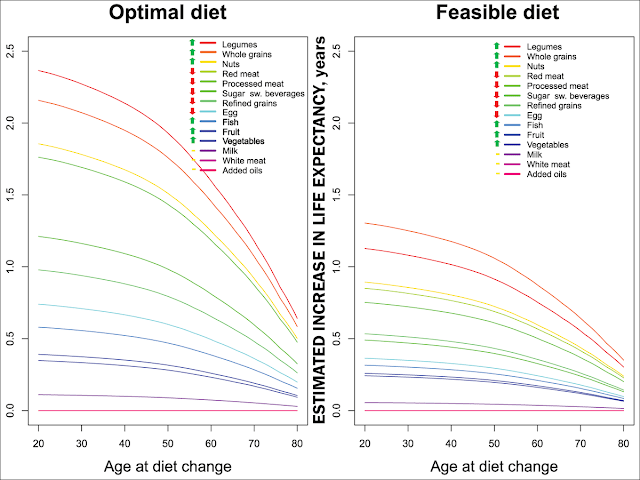
Is it that we don't know what makes fish so effective, or we do know and can't get it any other way?
The main benefits of fish are high protein content and most of the fats are essential omega-3 fatty acids, including the protective EPA and DHA which are mostly unavailable in plant form. The omega-3 fatty acid ALA, which is available in many plans, only gets converted at a rate of 2-10%. If you wanted to get 2g/day of EPA+DHA, you'd need to consume 20-100g of ALA, or 37-186g of flaxseed oil.
What about algae oil?
I'm also looking at krill oil. My vegetarianism is approximately Peter-Singer-When-He-Still-Ate-Mussels (http://www.wesleyan.edu/wsa/warn/singer_fish.htm), and I'm pretty sure Krill are simple enough that there's no disutility in consuming them, but I'm having trouble finding anything definitive.
I have a general heuristic in my diet of "if you need to process ten thousand of something to get the amount you want to eat, don't do that."
What about yeast? This seems like a silly heuristic.
On this topic, I'm a bit concerned about the argued support for fish eating. RS writes,
'Pescetarians live significantly longer than vegans,[4] lending support to fish consumption.'
But this doesn't follow. Does fish consumption make a difference vs. lacto/ovo vegetarianism? If not, there's no support for fish consumption (but perhaps milk/eggs).
The cited study (from the abstract) seems to rate longevity between each group equally, at least from ischemic heart disease, indicating no effect:
'mortality from ischemic heart disease was 20% lower in occasional meat eaters, 34% lower in people who ate fish but not meat, 34% lower in lactoovovegetarians...'
Briefly checking wikipedia and other sites, I can't find significant support for fish-eating vs lacto/ovo vegetarianism, but I'd be interested to hear if I'm missing something.
In addition to pure health issues, I'm also concerned that eating fish will have a high disutility, for you get less kg of meat per death. Brian Tomasik has had a stab at crunching the numbers here: http://reducing-suffering.org/how-much-direct-suffering-is-caused-by-various-animal-foods/.
That treats all animal pain as equal, and finds that farmed salmon results in estimated 200x more suffering than beef per kg. You may want to factor in sentience complexity, indirect effects, pain responsiveness, etc. But the intuitive problem is that it would have to be massively less bad to eat fish vs most mammals to conclude that it's better to eat them, for their relatively lower mass will mean killing many more to achieve the same amount of meat.
Of course, the moral disutility of fish-eating is distinct from its health effects. I only raise it in case people want to consider balancing disutility of production with utility gained from health benefits, if any, from consumption.
For which respect? Tempeh is a great source of vegetarian protein and micronutrients, as fermentation removes all the nasty stuff from soy. Algae supplements have a good bit of the n-3 fatty acid DHA and EPA, but are extremely expensive with average prices being $60/mo for the recommended 2g EPA/DHA per day. Contrast this with $8/month for fish oil of the same power.
(edited to add sources) (edited to add music-nerdery)
Reviewing my notes from Wiseman, I can add the following recommendations for stress:
*Listen to classical music. Actually, if you check the study, only major, baroque music was helpful. I recommend the Brandenburg concerti.
*Spend at least 30 minutes outside on warm, sunny days.
*Laugh at least 15 minutes a day.
*Source: Music can facilitate blood pressure recovery from stress.
*Source: A warm heart and a clear head. The contingent effects of weather on mood and cognition.
*Source A correlational study of the relationship between sense of humor and positive psychological capacities
*Source The Effect of Mirthful Laughter on the Human Cardiovascular System
<music nerdery>
(background: I've trained in classical cello for 11 years. What follows has an inferential distance of 1 for me, and an inferential distance of quite a lot for a layperson. You should probably move along)
If you check out the music study, you'll notice that it talks about "classical" music, while I'm specifying "major, baroque". Here's why.
Classical and baroque music are different. Colloquially, "classical" refers to old music that typically gets played by violins and pianos and flutes and stuff. If you're versed in music history, "classical" refers to music from the classical period, which has certain defining characteristics that make it quite distinct from other periods, like the baroque period, much like heavy metal and blues quite distinct genres with their own defining characteristics.
The original study used Spring by Vivaldi and Canon in D by Pachelbel as "classical" music. If you're a layperson, these are perfectly representative pieces of classical music. If you're a music nerd, these pieces will tell you a lot about the effect of major, baroque music on blood pressure, but generalized to classical music is analogous to saying something like "all vertices of a square form right angles, thus the vertices of all quadrilaterals form right angles."
Baroque music is different from classical is different from jazz. We know (major, baroque) works and jazz doesn't; everything else is different enough I'm sketched out about generalizing from baroque to that. Here's why I'm fine with generalizing from (Vivaldi, Pachelbel) to (major, baroque), but not to the rest of classical.
Baroque music is noticeably lighter than more contemporary music because of (the bows, lack of endpins, use of harpsichord instead of piano, gut instead of metal strings, smaller ensembles, different wind instruments, fewer types of brass instruments, less overpowering brass instruments).
Also, baroque music tends to use just intonation, whereas more contemporary music tends to use equal temperament, and the music tested. This may be important because JI sounds better, even if it's less flexible. (Physically, JI sound waves a low-reducing integer ratios of each other, whereas ET sound waves form ratios of powers of the twelfth root of 2 of each other, so instead of having 3:2, you have 1:2^(7/12))
I specify major because it's more consonant (physically, in major and minor JI, sound waves reduce to low integer multiples of each other; in major, they tend to reduce more, so instead of having 5:4, you have 6:5).
So, until somebody goes out and tests Mozart Symphony no. 40, you're overstating your case if you claim the study I cited extends to anything beyond major, baroque music. Fortunately, all of the Brandenburg concerti are major and written by Bach, the preeminent baroque composer.
</music nerdery>
Does it matter which kind of laughter? Is laughing with others a lot better than doing it alone? Is schadenfreude laughter as good as any other kind of laughter?
That's a good question. What if it turned out that laughing maniacally after committing an act of villainy was the healthiest of all? Would that change people's views about altruism?
I don't know if it's healthy, but I find maniacal laughter quite satisfying. Fortunately, I do enough theatre and similar performance that I have many opportunities for it.
Hmmm. It would be sufficient for the maniacal laughter to take place; technically, the villainy is unnecessary, as long as the necessary parts of the brain can be fooled.
One way to do this would be with a computer game; playing civilisation (for example), betraying your computer-player allies, and then laughing maniacally about it.
Alternatively, for more of a challenge (in case overcoming difficult opposition turns out to be a necessary element), one could play a game against human players (Diplomacy might work well here) and laugh maniacally if one achieves victory. (Since the game is structured in such a way that at least one player must eventually achieve victory, someone will have the opportunity to gain the health benefits of the maniacal laughter; one may have additional opportunities during the game to laugh maniacally as well).
Obligatory.
Are you referring to the "Mozart Effect" studies? That's what I found in the book (or at least the parts of the preview that were accessible), but Mozart is actually classical, not baroque. The effect seems to be small and specific to one particular type of task, according to this Nature meta-analysis:
As a side note, if you're going to cite studies it would be great to continue Romeo's trend of actually linking to the relevant studies, since there's not enough info in your comment to find the ones you're referring to and I don't own Wiseman. I don't really trust Wiseman (or pop-sci books in general) to interpret findings with anything remotely resembling rigor.
See edit.
Thanks for suggesting I put in sources. It didn't occur to me, but it really should have.
I generally don't trust pop-sci either, but Luke recommended Wiseman repeatedly, and since I trust Luke, I see Wiseman as a way of getting useful results without the work of reading all the science myself, much the same way I just give to Givewell's recommended charities rather than evaluate them myself. I could, but they have a comparative advantage, and I'm guessing you'll agree doing the verification is expensive. If there's a flaw in this reasoning, I'd appreciate a head-ups. Thanks!
For clarity, I don't trust Wiseman since I've never read anything and my prior for pop-sci is low. Luke's endorsement is a positive update to his credibility.
Fully verifying is expensive, but spot-checking is cheap (this post took me about 10 minutes, e.g.). Similarly, most people barely check GiveWell's research at all, but it still matters a lot that it's so transparent, because it's a hard-to-fake signal, and facilitates spot-checking.
Re: music--it looks like you were referring to a different study on the benefits of listening to music than the one I found in Amazon's preview of Wiseman. "Listen to classical music <to reduce blood pressure when stressed>" would have been another high-VoI addition to the OP.
Further studies indicate that "self-selected relaxing music" has the same effect, and that it's probably mediated by general reduction of SNS arousal. This suggests that (a) if you're doing an SNS-heavy task, like difficult math, you may not want to listen to music at the same time; (b) anything else you would expect to move you around the autonomic spectrum should work the same way (e.g. meditation). On the other hand, neither of the studies asked subjects to do anything while listening to music, so it's unclear whether the effect would stay visible. A possibly interesting meta-analysis is here. If doing anything while listening to music makes the effect go away, then I would guess that meditation or the autonomic-spectrum navigation that CFAR teaches is a more efficient way to reduce blood pressure.
I don't know if Wiseman went into any of those in his book, but my take-away is to do some research before installing any new habit.
Anecdote: My mom once tried to invoke the Mozart effect by putting on his music while me and my sister were doing schoolwork, hoping that it would make us more productive. It had just the opposite effect - we sat there and enjoyed the music, rather than doing our math assignments.
On eating more fish: How worried should I be about mercury poisoning? Is it worthwhile to carefully select fish for low mercury content?
For instance, one guy on /r/fitness reports that 2 cans of chunk light tuna a day gave him mercury poisoning; while you're not recommending that much fish, I'd expect that health detriments appear long before full-blown mercury poisoning.
(I'm not expecting you in particular to tell me this, I just want to know if someone on LW has already done this research.)
For pregnant women, these days they're recommending oily, low-mercury fish like salmon, herring, and sardines. Chart
Oh yeah, salmon is easily the best for health benefits AFAIK. I should include this in the post.
Must be wild salmon, not farmed salmon. The difference in Omega 3/6 ratio is immense.
I would recommend against eating canned food to limit your exposure to Bisphenol A.
I would also not eat tuna every single day for such an extended period of time!
The health benefits of fish outweight the health detriments of mercury until way beyond the level of consumption you're likely to get to.
Just eat fish.
Supporting data..?
I notice that I am confused about what makes a post worthy of being Promoted. This post is well-researched and has an incredibly high score and lots of interesting comments. Is it that MIRI/CFAR/et al are afraid that someone might implement these and later sue if they don't get results, or somerthing?
As it is, Main but not Promoted is currently the least visible location on the site.
Honestly, I'm surprised that there aren't more posts tagged 'longevity' on this site. Cryonics is wildly popular here, as a way to continue one's existence in the future, after one's physical body gives out; however, simply surviving long enough for someone to invent a cure for aging seems to be another way to solve the same problem and, moreover, one which can be worked concurrently with cryonics.
Also, nobody knows whether people currently being cryonically preserved by current methods can ever be thawed and healed or uploaded into an emulator. It would suck to die and get frozen a year before they realise they were doing it all wrong.
Well, I was surprised by the flossing claim, looked it up and found a correlational study with control variables. Give me my choice of control variables in a correlational study and I will prove that smoking cigarettes prevents lung cancer. And I was a bit worried about other items listed even before then. So I decided not to promote.
Beeminder Beeminder Beeminder. Having an email reminder to exercise, and a penalty for not doing so, has been tremendously helpful for me- I now actually lift weights three times a week, as compared to just when I remembered to do so on my own.
Counterpoint: Beeminder does not play nice with certain types of motivation structures. I advocated it in the past; I do not anymore. It's probably not true for you, the reader (you should still go and use it, the upside is way bigger than the downside), but be aware that it's possible it won't work for you.
Yeah. Beeminder doesn't work for me either - nor do most online punishment-based motivators.
My problem with it is that it doesn't punish you for failing to do the thing you need to do. It punishes you for failing to record the fact that you did the thing you need to do.
So if you're time-poor (like me) and still managed to do the thing... but didn't have time to go online and tell beeminder that you did the thing... you still get punished. :(
Yeah, I have the same problem with it. When my productivity went up, I actually went off the road because I couldn't be bothered to record it all.
The beeminder team sends "legitimacy check" emails if you've derailed on your goal which explicitly asks if it was a case of forgetting to enter the data. I've written in once or twice when I've derailed on account of not entering the data on time and have had quick responses from them, and haven't been punished. Were you unaware you could do this?
Kind of. I was aware you could appeal the decision, but I felt that would be an imposition on some poor moderator... and given I'm pretty sure this would occur on a regular basis, decided I didn't want to do that.
What would work for me, would be for a short "grace period" in which we could update the decision ourselves. Like I said - fitocracy gives you a week or so to back-date your past workouts. Of course fitocracy doesn't run with a monetary punishment so it's not as bad for you to backdate...
Basically - I conclude that beeminder's mechanic doesn't fit well enough to my likely usage patterns to be worth it.
My workplace has a gym. I generally scarf my lunch at my desk and use my actual lunch hour at the gym. This pretty much guarantees that I will go work out at a more-or-less set time every weekday. Between this and a weekly judo class, I typically exercise 6 days a week, without really having to remember anything. (Downside/tradeoff -- less socialization, which, like exercise, reduces stress)
Great article. Lots of really good information. A few questions:
Does anyone have a link to this full study? I'd like to see the full data. The abstract is confusing. It says you would need " two- and ninefold higher doses of EPA and DHA, respectively, if administered with capsules rather than salmon," but it's not clear which numbers you need to multiply by those factors... The amounts in the 100g of salmon or the amounts in the 1 or 3 fish oil caps? If it's the amount in the 3 caps, then that comes out to 900mg EPA and about 2700mg DHA, which is about 3 and a half grams. That's achievable in 6 high-quality caps and doesn't seem like it's at a level where you'd be in any danger of blood thinning... Do you have a good resource I can read to get more information on the blood thinning effects and when they might be dangerous?
I noticed you didn't really include anything on the fat content of a diet and its effects on CHD and Lipid Profile. As I understand it, omega-6 fatty acids are harmful in the amounts that most people in Western countries eat, even when not oxidized. On the face of it, this study appears to suggest that in CHD patients, bringing the omega-6 to omega-3 ratio down to 4:1 was associated with a 70% decrease in total mortality. I think it's likely that the omega-6 : omega-3 ratio is important and that supplementation of omega-3 likely achieves many of its benefits by bringing this ratio back into balance (since people typically have very low omega-3 intake). Reducing intake of omega-6 from seed oils like corn oil, soybean oil, and sesame oil seems likely to have similar beneficial effects.
On that note, really the only thing that jumped out to me about your meal squares is the high PUFA content. If you ate 5 servings to reach 2000 calories, you'd be getting 18g of PUFA, most of which is omega-6 and not much is EPA/DHA which are likely the only omega-3s your body can actually use effectively. It not being oxidized is definitely an important factor, but omega-6 is inflammatory and (as far as I can tell) negatively affects blood markers even without being oxidized before you eat it. Besides that though, I'm really impressed with it. Good luck.
We're going to be replacing our current sunflower seeds with high oleic acid versions which will bring us down to under 5% of calories from PUFA.
Do you have a jailbroken version of that study anywhere? That's a really large effect, and the best evidence against PUFA yet if true.
The maximum total energy from PUFA has been a discussion point with DIY Soylent makers as well. The final consensus was that it should definitely be below 10%, and possibly below 4%. The 4% figure comes from The perfect health diet, which uses this as a source:
Angela Liou Y, Innis SM. Dietary linoleic acid has no effect on arachidonic acid, but increases n-6 eicosadienoic acid, and lowers dihomo-gamma-linolenic and eicosapentaenoic acid in plasma of adult men. Prostaglandins, Leukotrienes and Essential Fatty Acids 2009 Apr;80(4):201–6, http://pmid.us/19356914.
I've also got a copy hosted at http://forecast.student.utwente.nl/Lesswrong/ but only download that if your university or company legally gives you access to Elsevier content.
For the discussion and links to other relevant papers, see http://discourse.soylent.me/t/optimal-micronutrient-ratios/5049/52 and further posts
For my Soylent, I ended up getting most fats from macadamia oil (mostly Omega-9 aka MUFA) and MCT oil (Medium-chain saturated fat), since they don't have any negative effects associated with them. Correct me if I'm wrong.
My university has access to the paper. I've got it hosted on my server, but you're only allowed to download it if you have legal access through your university as well. If you have legal access, feel free to click this link:
http://forecast.student.utwente.nl/Lesswrong/The%20importance%20of%20the%20ratio%20of%20omega-6%20omega-3%20essential%20fatty%20acids.pdf
I don't, unfortunately. I thought it looked really high as well. The wording of the abstract seems to indicate that it was an observational/epidemiological study, not an RCT, but you can never really tell from the abstracts.
Regarding driving safety: A couple of years ago I asked my old driving instructor if he knew of a good book on driving safety I could use to increase my skills. He pointed me to some of Fred Mottola's guides at the National Institute for Driver Behavior. I ordered pretty much all of the reading / course material he has available, and I thought they were excellent. There's a lot of little tips for marginally increasing safety, and he focuses a lot on developing good habits so it doesn't require constant vigilance.
In order to get the full benefits of his program you'll probably need to repractice a lot of your driving skills to unlearn your bad habits and replace them with good ones. It's probably a worthwhile investment though given the risks. (I'll also add that mortality rates for car accidents don't include life-altering injuries, which are also extremely high-risk.) But even if you don't do the full program, he has some short guides that focus on the 10 most important habits of good driving.
Note that they mostly sell to drivers ed teachers rather than individuals. I was actually the first person they ever sold to as an individual, and they didn't really know how to deal with me. So they just sent me a couple of copies of everything, and I gave them out to some of my relatives.
Hey [iarwain1] I'm interested in trying out the driving guides. Could you please recommend one of the books to start with before buying the rest? Also, do you happen to know of anyplace where I can take a "simulated accident" course (in the Bay Area, if possible)?
The Ten Habits book is the main one, but there's also the Zone Control system which is mostly a very expanded version. Here's the product list. Don't buy the mirrors.
I have experienced consequences of donating blood too often.The blood donation places check your hemoglobin, but I have experienced iron deficiency symptoms when my hemoglobin was normal and my serum ferritin was low. The symptoms were twitchy legs when I was trying to sleep and insomnia, and iron deficiency was confirmed with a ferritin test. The iron deficiency symptoms went away and ferritin went back to normal when I took iron supplements and stopped donating blood, and I stopped the iron supplements after the normal ferritin test.
The blood donation places will encourage you to donate every 2 months, and according to a research paper I found when I was having this problem essentially everyone will have low serum ferritin if they do that for two years.
I have no reason to disagree with the OP's recommendation of donating blood every year or two.
IIRC, where I am they don't even allow you to donate blood if you've already done so in the past three months or, if you're a fertile woman, in the past six months.
I was pretty surprised about blood donation. My intuition is screaming that it must be one of those correlation/causation things where unhealthy people are discouraged from donating blood, but on the other hand, the researchers are all surely very well aware of this issue and must have taken steps to correct for it.
Anyway, have you thought about typically sub-clinical viruses like cytomegalovirus? I recall reading that a CMV infection cuts a few years from your life expectancy. I don't have research to back it up, but I think it's a good idea to avoid having intimate contact (e.g. casual sex) with lots of people.
Males tend to have iron overload which is bad for you. The easiest way to fix it is to bleed on a regular basis.
Women don't have that problem.
Those of us disqualified from donating blood should probably try to get into some form of exercise that involves a lot of blood loss; like skateboarding over sharp rocks, fencing with un-foiled blades, or taunting apex predators in their natural habitat. A new Ev-psych explanation for why men engage in this sort of activity more than women!
Huh, a plausible longevity argument for Mensur fencing. Never thought I'd see that in the wild.
(Snark aside, I imagine it'd be rather difficult to find a hobby that reliably takes a pint of blood a year and doesn't kill or seriously injure you.)
Pet leeches :-P
Wouldn't necessarily call it iron overload, but definitely higher levels.
Hmmm... as someone who is a carrier for hemochromatosis (thanks 23andme!) perhaps I should consider this more than the average person...
I thought it was a pretty standard term.
Yes it is, but generally for rather more clinically significant levels. The difference between men and women exists but is much much smaller than the difference you get from, say, hereditary hemochromatosis. Ordinarily I hate nomenclature quibbles but labelling the normal state of half the population as a pathology seems out of place.
Well, nobody claims all males suffer from iron overload.
On the other hand, the correlation between blood donation and mortality seems to suggest that there is a nontrivial amount of people (very likely males) with "clinically significant levels" who are probably not aware of that fact.
Hmm. Do the studies account for this?
Also, that would mean women on medication that stops their period also might have this problem.
Indeed; also post-menopausal women.
I suggest you read this article, which suggests that blood donation doesn't decrease mortality.
What do you (or anyone else) think of it?
There is a review floating around where some researchers investigated exactly this claim and concluded that the reverse causation effect only accounted for about 30% of the effect. This is one of those situations where the costs and benefits are a massive enough ratio to make it worth the risk that it isn't doing anything IMO.
I tried to find it but failed. Do you recall it's title or authors?
Sorry I don't. Don't see it with a cursory search in google scholar either.
Oh well. I'll still mention this in Immortality: A Practical Guide if that's okay with you.
Oh if you want to cite it I'll look a little harder.
This review actually seems pretty thorough and reports a negative result (though still positive for people who have already experienced a CHD event): http://circ.ahajournals.org/content/103/1/52.full
They discuss why they think positive results happened in previous studies. I'm updating away from the hypothesis as a result of finding this. Blood donation still has enough other studies showing various benefits and essentially no studies showing harm (except for excessive donation, more than twice a year IIRC) that I think it is worth it, but the mortality effects might not be very high.
Keep in that one of blood donation's supposed mechanisms is to prevent iron overload, but only ~0.5% of the population has iron overload to begin with. See ChrisT's comment.
My post mentions a specific reason -- iron overload -- which is bad for you. Blood donation fixes that problem if it exists.
That particular argument does not rely on correlations at all.
Your post also mentioned that males tend to have iron overload. I find this to be suspect, as if males tended to have iron overload, the study would have probably found that blood donation decreases mortality.
That said, for those who do have iron overload, blood donation likely does fix that.
I don't know how prevalent iron overload is. It might well be rare enough so that its effects are lost in the noise. I wasn't claiming that donating blood is necessarily healthy, my point was rather that mechanisms (not correlations) by which blood donation could be useful for health exist.
If you don't know how prevalent iron overload is, then you can't know that men tend to have it, so I suggest editing you comment to say "some men have iron overload" instead of "men tend to have iron overload."
Iron overload / haemochromatosis occurs in approx 0.5% of the population of Northern European origin (and less in other ethnicities). Undiagnosed and untreated the iron will build up in the liver and other organs and cause a variety of unpleasant side effects. Venesection is the standard treatment, though I suggest that less than 0.5% of the population is not significant enough to explain the other studies.
Source: http://www.haemochromatosis.org.uk/index.html
Usually I'm content to just lurk and read interesting posts, but here there's finally something well enough into my area of expertise that it worth making an account to contribute to!
The e-cig linked as a suggestion is a (low end, generously speaking) clearomizer system. There's nothing wrong with that, they will work as advertised and be less harmful than tobacco and all that good stuff. And if you're buying e-cigs en masse to hand out to smoker friends you can't beat the price. But it's a bit misleading to say one of these alone will add an arbitrary number of years to a persons life. The heating coils in any kind of ecig don't last forever, and low end devices like the one in the OP tend not to be disassemble-able/customizable. At $5, tossing it out and getting a new one is no big deal, really. But still.
A former smoker with disposable income (read: anyone who could afford to sustain their own tobacco habit in the first place) that's just a bit pickier would get more mileage out of a rebuildable atomizer based mechanical mod system, even a lowerish end one. It'll cost more since you'll have to buy parts individually (think building your own computer), but the increased quality of the experience is well worth it. For example, you'll be able to tweak how much power you're getting (based both on what you buy and how you set things up), instead of being stuck with the woeful 650 mAh battery and criminally high 1.8 ohm resistance in the OP's recommendation. I've spoken with many people who didn't fully give up on cigarettes until they found their way to "advanced user" products like these that give them the exact experience they're looking for.
Of course the exact product that's right for any given person will vary, but I'll link a decent midrange atomizer and mod (or battery tube). You'll need A1 kanthal resistance wire for building coils, available in huge quantities for dirt cheap on eBay and such. You'll also need cotton for your wicks, for beginners it's perfectly fine to buy a bag of organic cotton balls at your local drug store (maybe boil them if you don't trust how "organic" they are). The choice of e-liquid (the stuff you'll be smoking, see OP's second link) is highly subjective and up to personal taste, but I find higher VG juices to be more to my liking. Always buy the best, safest batteries you can Sony VTC4s and VTC5s are the current gold standard for 18650 sized batteries. Most battery chargers should be fine, but I'd recommend something like this
Caveat, especially since this is a post about increasing longevity: There have been a few reported cases of people successfully blowing up their e-cigs with systems like these, but this risk is basically nonexistent if the user practices any kind of battery safety. I trust the members of the LW community know enough about ohm's law to not accidentally build a pipe bomb and then stick it in their mouths. If this remote possibility is a dealbreaker for anybody, there exist "regulated mods" which tend to come in the form of a box. These have electronic chips in them which regulate the flow of energy from your battery and guarantee consistency, but come with some limitations as to how you can build your coils, and the electronics take some power for themselves lowering the overall potential output (think manual vs automatic transmission in cars)
It should be noted that the vape industry is an incredibly fast moving space. A lot of the info and forum posts on e-cigs (especially from more than a year or two ago) is already outdated. Back then a system like the one I linked wouldn't have existed, in part because battery technology wasn't in a place to make it cost effective. If some 2016 future-dweller stumbles upon this comment, don't take it at face value. Research the current equivalents and best practices. They're almost guaranteed to be different. If in any doubt, the vaping community is rapidly growing (chances are they're a dedicated vape shop near you if you're in a remotely large city. There are currently three in Monterey, CA and that town is tiny) and generally very helpful (if somewhat "bro"-y, culturally). If there isn't a shop near you to help you out, there are many impartial product reviews that you could find on YouTube.
Vaping is much more complex and personal than someone completely new to it might at first realize, and your individual needs and experience will vary. In any case, I hope this was helpful, and not just incoherent rambling.
Thanks for giving people detailed options! I am liking the mini protank myself. Glass and steel instead of plastic.
I have always been confused about this one part. Seems like this is the place to ask, for once.
Where do these exact o'clock figures always come from when people are talking about sleep optimizing?
I mean, 10pm by which clock? Certainly, the position of arrows on my watches does not influence melatonin production. Is it calibrated by amount of daylight? But in the area I live in, 10pm can be a middle of the night or not-even-sunset, depending on time of the year, and the number given is a constant and doesn't depend on calendar. Is it calibrated by biological 'internal clock'? But it has different settings in different people. I go to sleep at 2am (and feel sleepy and dizzy if I don't) and wake up at exactly 9am with no alarm clock. Does the advice still apply to me? Does it assume some sort of 'normal' internal clock settings? Then what are they and why is it never explicitly mentioned? Please, help me resolve this confusion. Where did the numbers come from?
Interesting that there is not much discussion in the comments about weight loss, which is very hard as we all know. And not much discussion about cholesterol either for some reason.
I would just like to point out that Body Mass Index and cholesterol are not very good predictors of risk and that there is some evidence that waist/hip ratio may be a better metric to track.
https://www.mja.com.au/journal/2003/179/11/waist-hip-ratio-dominant-risk-factor-predicting-cardiovascular-death-australia
Is body mass a good predictor of risk for people who know that they are not in an obvious category where body mass is expected to be a poor predictor? That is, if you exclude the bodybuilders and limit its use to relatively average-appearing people, is body mass then useful?
BMI is a horrible metric that was never intended to be used for evaluations of individuals (it was supposed to be used for evaluation and comparison of whole populations), is known to scale wrongly with height and basically should just be ignored.
While you are technically correct, that shouldn't function as an excuse to let oneself get overweight. My BMI was just measured a couple weeks ago to be 23.7 (between 18 and 25 is "normal"), and even after you account for the fact that I carry some muscle thanks to a year of strength training, I'm still visibly chubby and the nurse told me to lose weight. I agree with her on this.
But what you're doing is exactly ignoring the BMI: the BMI is supposed to be normal, but you think you should lose weight.
Yes, that's my point. However, I'm abnormal: the most common use of ignoring BMI is to let oneself remain overweight against the evidence of its health detriments.
I recall reading that BMI correctly predicts obesity in 95% of men and 99% of women. Do you disagree with this?
The best metrics are body fat percentage or fat-free mass index.
For what it's worth, even vaguely muscular people are going to blow apart the BMI scale. I'm 5'10" and 190lbs at around 13% body fat. My normal weight range according to BMI is 130-173lbs. If I got down to that without losing any muscle mass, I'd be 5% body fat, which is severely underweight. I was completely sedentary before weight training, and I've only been training powerlifting for 1.5 years with moderate results (ie, I'm not quite as strong as most high school football players).
I disagree, it's fairly hard for people to get much above BMI of 28 while lean. You are likely underestimating your BF, have you done a bod pod or other immersion test?
I haven't. I use calipers and visual estimation compared to DEXA confirmed images. Calipers, if taken at face value, report me to be at 8-10% BF which is definitely too low. Visually, I currently look like pictures of guys in the 13-15% range, so I add 5% to the calculated result. Even at 16% BF (the highest estimate I can get), I'd be around 7% BF with a BMI of 24.8. That's underfat yet very close to overweight.
Would you mind posting a self-pic?
Do you have a comparison study which included hip/waist as well as body fat percentage?
I have some doubt that your claim is true because the distribution of the fat seems to be very important eg fat around the hips is far less damaging than fat around the abdomen.
For what it may be worth, I am "vaguely muscular" and my BMI of 23.6 seems about right in terms of assessing my level of overweight.. I do agree that muscularity can foul up the BMI scale but I think it take more than just modest muscularity to do so.
I recall reading that BMI correctly assesses obesity in 99% of women and 95% of men. I can try to dig up a reference for this if you like. So the answer to your question would seem to be "yes."
I agree, but significant permanent weight loss is a very difficult and complex problem. So perhaps it's a matter of what is the low-hanging fruit. Arguably it's a lot easier to get in the habit of flossing or taking vitamin D supplements than it is for a fat person to get thin and stay there.
When people go on health kicks, attempting to lose weight is very frequently the number one priority. Possibly because there is so much stigma associated with obesity. But a good argument can be made that other things, such as exercise, should be a higher priority.
I'm very surprised that there is no mention of a low-dose aspirin regime here. Low dose aspirin can greatly reduce chances of stroke, heart attack, and cancer. The main caveat is that there is increased chance of bleeding or stomach ulcer, the latter of which can be avoided by taking with food.
I looked into the numbers and it's a wash for people under 45. The risks are greater than often presented, likely because the marketing is targeted at people at heightened risk who really do need to be convinced to take it.
Is it worth it to carry around aspirin to take if you even worry you might be having a heart attack, for people under 45?
If you worry about having a heart attack, there are better things than aspirin to carry with you.
This post would be much more helpful if you had listed those things. The only thing I'm seeing suggested besides aspirin is nitrates of some form, which appear to be prescription.
I am not a doctor and I don't want to give medical advice to unknown people over the 'net.
If curiousepic has a medical condition that causes him to have a well-founded fear of a heart attack, he really should ask his doctor -- who, among other things, will know what that condition is and can write prescriptions.
Wouldn't it be better to say something like "ask your doctor, who can give you answers tailored to your medical history," then?
carrying a small first aid kit in your day bag is pretty reasonable.
I can't donate blood where I live. Perhaps I should look into good old-fashioned bloodletting.
Examine.com is much less positive about CoQ10 writing "all the noticeable effects (more vitality) could potentially be placebo. It is very much a faith buy and the costs if you take it in the wrong manner (without a fatty transport) could be quite high financially."
From my own looking around I would recommend adding CoQ10 if you are on statin anti-cholesterol medications. They interfere with its recycling within your body, and while there's a reason that the active part of CoQ10 is called 'ubiquinone' (its in EVERYTHING that was once alive) its plausible that levels might drop enough to mess with higher metabolic levels if you are on these drugs. Source: anecdotal evidence and a recent study that seemed to show that statin drugs cause people to stop getting cardiovascular benefits from aerobic exercise.
mean decrease in systolic pressure over 8 studies of 16mm Hg kicks the crap out of a lot of interventions, including some prescription ones.
Why should we listen to you and not, say, the Harvard School of Public Health ?
That is, why do you think you did a better job of reading and interpreting the literature and publishing guidelines?
For career reasons, I am unable to give a complete answer to this question (see my contact details). I just want to give the general advice that it may be a good idea to beware of people who use the word "science" and the brand name "Harvard" to promote their personal views on questions that are not answerable without long-term randomized trials with perfect adherance (or alternatively strong causal assumptions that are unlikely to hold in these particular settings)
I am not claiming that aspiring rationalists can necessarily do any better, I just want to make the point that it may be better to admit ignorance (or high-variance priors) rather than appealing to the authority of "Harvard"
Noted. To be clear, the question I'm asking is why is OP a more worthy authority than the rest?
Why should we listen to OP and not follow, say, the UK's NHS healthy living guidelines? I hope the answer is better than "because nobody at the NHS is a member of LW"
For political reasons the NHS couldn't write things like
Fair point.
Ditto for these NHS healthy living guidelines. Where do I contradict them? I had thought my main takeaways were pretty uncontroversial WRT mainstream advice.
I am having a hard time finding places I disagree significantly with them. Are you referring to sodium? Here is their article on the salt controversy: http://www.hsph.harvard.edu/nutritionsource/the-new-salt-controversy/
"pointing out that the committee’s conclusions discounted effects of sodium reduction on blood pressure."
“Discounting the especially large blood pressure reduction going from 2,300 to 1,500 mg in prehypertensives, hypertensives, older adults and blacks who are especially vulnerable to the effects of high sodium betrays an unbalanced weighing of the evidence.”
-Dr. Frank Sacks
There are a couple problems with this critique.
It does not seem to me after reading the IoM report that they are discounting BP effects. They are explicitly noting that the BP reducing effects are not resulting in the expected mortality reduction if salt had no positive health effects. BP is a proxy measure for CVD and mortality risk. We shouldn't stick religiously to the proxy if we can gain access to the actual underlying thing we care about.
the "especially large reduction" comment seems inappropriate given that the IoM was NOT asked to establish sodium guidelines for people who display an especially high sodium sensitivity or have medical conditions but for the general populace. It also seems to be disregarding the fact that extreme sodium reduction has resulted in higher hospitalizations even in these "at risk" groups. I agree there is ambiguity about where in the 2g-4g consumption level is ideal. I also agree that the recommendation for certain sub-populations might be different. But the evidence of <2g=harm seems pretty solid. This evidence is not exclusively from mortality statistics as Dr. Sacks implies but also from hospitalizations as mentioned.
I have not been able to figure out why the low sodium is being pushed so aggressively. Much of the language used (in that article for instance) leads me to believe that perhaps the belief is that they need to set a very low target in order to effect any change at all. i.e. if we tell them 1500mg maybe they will only overshoot to 2000mg, because they are currently eating 4-5g a day which is definitely harmful. Heavily pushing the salt=bad narrative with no nuance seems dangerous though because there are also people going in the other direction: eating under a gram a day and passing out or having other serious complications. One of the most common hospitalizations being getting lightheaded and falling.
Anyway, was there some other contradiction between my recommendations and the HSPH rec's that you were concerned about?
Sorry for the confusion. I'm picking authorities at random and asking why I should trust you over them, not vouching for any authority in particular. Perhaps I should have asked more bluntly: who are you and why are you qualified to give us health advice?
No offense. :)
More a curiosity than anything: dairy isn't represented at all on the HSPH's "healthy eating plate" but is specifically highlighted in your section on nutrition. Why the discrepancy?
I'm not. I'm a random person who is investigating the advice of professionals and trying to determine the interventions with the highest reported effect sizes in the literature. I'm not running studies myself or claiming anything in the absence of studies.
Milk and eggs is because of the Adventist health study and others:
"mortality from ischemic heart disease was 20% lower in occasional meat eaters, 34% lower in people who ate fish but not meat, 34% lower in lactoovovegetarians, and 26% lower in vegans. "
http://ajcn.nutrition.org/content/70/3/516s.full
Keep in mind that it is perfectly valid to infer that if I disagree with a mainstream source on healthy advice this is minor evidence I am wrong.
Seconding Anders_H here (will not get into specifics for similar reasons).
Our opinions should not be treated as independent, of course.
Regarding sleep temperature, I've seen contradictory recommendations.
This article references a finding that "finding that facial warming helps send people to sleep". And Wikipedia writes
Though, this guy writes
And this pdf recommends staying cool.
I experimented with gradually reducing my blanket load while sleeping but I found that past a certain point I would wake up chilly in the middle of the night and put blankets on in order to fall asleep again. So empirically that seemed to disrupt my sleep.
It seems like the outlier data point is the Fast Company quote. I sent an email to the company working on SomNeo to see if they could send me the study they based their decision on. I noticed that the study you cite was a pilot study without that many participants, and results on insomniacs don't obviously generalize to the larger population.
On the topic of whether it's useful to worry about longevity when you're young: I just saw this article in the NY Times, which suggests that it is.
Where does it say that the difference is significant? The only mention of this I see in the cited paper is table 7, and the CIs there overlap a great deal. (And it goes on to say that the numbers should be "interpreted with caution because of the uncertainty of the dietary classification of subjects in the Health Food Shoppers Study".)
By the way, it seems to me that we need to think in more detail about the relationship between happiness and stress. For example, I have pretty high-stress job (I am a litigation attorney) but at the same time it's a lot of fun most of the time and I am reasonably happy with it. How many more years could I expect to live if I were a trust fund baby?
A few studies have been done on the relationship between retirement age and longevity. As I recall, the best studies seem to show little or no relationship once you eliminate consideration of individuals who retire early for health reasons. It occurs to me that stress or lack of stress can cut both ways. If you have a sense of purpose in life it can make you feel happy. But once you have a sense of purpose, things will invariably come up which frustrate your objectives in large and small ways. Which is stressful. On the other hand, if you are completely apathetic you will be free from stress. But you won't have any sense of purpose or meaning.
My understanding is that how you respond to stress is a better predictor than total amount of stress.
That raises an interesting question. Just from simple observation, it's clear that a lot of people respond to stress by engaging in unhealthy behaviors like binge eating, excessive alcohol consumption, etc. So if stress is correlated with health problems, perhaps the causation is indirect.
We do have some reasons to expect direct causation such as inflammation and immunosupression.
Also relevant to longevity are supplements for reducing the cognitive decline that comes with aging, such as piracetam.
I clicked through to your recommendation to floss and saw an associational study with a set of control variables. This is such a horribly bad sign that it makes me doubt the rest of your post.
Floss does have the weakest evidence going for it, hence its position last on the list. It stayed above the "worth it" line due to the low cost and risk. I also believe it has an impact on quality of life even if the mortality effect turns out to be small. I do need to add a discussion of this to my post at some point.
Some mouthwashes may be risky
Necroposting, but do you have any more information on mouthwashes as a source of risk? The one I use (Crest pro health) doesn't appear to contain chlorohexadine, but does contain another chlorine compound (cetylpyridinium chloride).
Wikipedia says cetylpyridinium chloride is an antiseptic. Assuming the blood pressure-raising mechanism is, in fact, killing off beneficial microbes, then we would expect cetylpyridinium chloride to have similar effects.
I understand your skepticism about associational studies. Clearly, the likelihood ratio from seeing a positive result in such a study should be tiny in most cases. But just out of curiosity, if you automatically discount all cohort studies, where do you expect evidence on the causal effects of lifestyle interventions to come from?
Nobody questions that doing a randomized controlled trial would provide much stronger evidence, but a RCT with a lifestyle intervention as the exposure and mortality as the outcome would take decades to complete, would require a very large sample size, and would have several potential threats to its validity, including low adherence to treatment assignment and loss to followup. Furthermore, you would need a separate arm for every possible variation of the intervention, and you would need to do one of these trials for every possible lifestyle intervention
In the absence of an RCT, the best we can do is a properly designed and properly analyzed cohort study.
As far as I know, instrumental variables are the only other option that is seriously considered, but there are very few perfect instruments, and in most realistic epidemiologic settings, using a weak instrument is probably worse than doing a cohort study. If you want to go into a further discussion on this, as a starting point, see the article "Instruments for Causal Inference: An Epidemiologist's Dream?" by Miguel Hernan and Jamie Robins, and focus on the section on how minor violations of unverifiable assumptions can blow up the bias.
I am not suggesting that cohort studies are the answer, but rather that we only have four options:
Either (1) Conduct a lot of very expensive randomized controlled trials on every possible lifestyle intervention and wait a couple of decades for the results, or (2) do associational studies, or (3) Postulate that we understand physiology and biochemistry well enough that we can learn about the effects of lifestyle intervention simply by reasoning, or (4) accept that we are unable to learn about the effects on lifestyle interventions on longevity
Personally, I am leaning towards option 4, but I am willing to accept properly conducted cohort studies as weak evidence, at least to give us some idea about what randomized trials would be most promising.
What really confuses me about your comment, is that you doubt the rest of his post simply because he cited a cohort study, when it was obvious from just reading the title of the post that the only evidence he could possibly have on the effect of lifestyle interventions, would necessarily come from associational studies.
What about (2'): "do associational studies, but try to implement assumptions needed for g methods to work via study design." That is, make sure exposures are given only given the observed past, there isn't interference by construction, etc.
Out of curiosity, do we have hard data on the reliability of this vis-a-vis RCTs?
I wonder if farmed salmon, presumably full of colors and antibiotics, has the same beneficial effect as wild.
A quick google search indicates that salmon farming has become much better in recent years, and might surpass wild salmon soon. Most of the information on fatty acid profiles that I can find is from 2008, before these advances. The chart on this page indicates that farmed salmon has much more fat with a smaller proportion of omega-3. The total n-3 is close (1.8g farmed vs 1.7g wild), but if most of the extra fat is n-6, then you're not doing much for fixing the 3:6 ratio.
How good is the case for eating garlic when one looks at more than just blood pressure?
Not sure. It also might help with blood lipid profile: http://www.ncbi.nlm.nih.gov/pubmed/22234974
no other effects that I'm aware of (of sufficient size).
Very nice article! Regarding the benefits of alcohol: for those curious, it is well established at this point that alcohol is actually protective against arterial plaque; it just has all sorts of other problems. This is just for kicks mostly, but I read a publication that said that for people who have ALL the following criteria:
Male (No women because alcohol increases risk of breast cancer)
They said it is likely tat 1-2 drinks per day, no more than 2 per day, and no more than 10 per week, will actually increase life expectancy.
Additionally, it's just alcohol in general that helps. Red Wine had no significant impact over other alcohols.
It looks like there is a new meta-analysis that concludes that alcohol is bad for your heart (original paper). (I haven't read it.)
How much have you looked into potential confounders for these things? With the processed meat thing in particular, I've wondered what could be so bad about processing meat, and if this could be one of those things where education and wealth are correlated with health, so if wealthy, well-educated people start doing something, it becomes correlated with health too. In that particular case, it would be a case of processed meat being cheap, and therefore eaten by poor people more, while steak tends to be expensive.
(This may be totally wrong, but it seems like an important concern to have investigated.)
My process is to collect a list of confounders by looking at things controlled for in different studies, and then downgrading my estimation of evidence strength if I see obvious ones from the list not mentioned in a study. This is probably not the best way to do this but I haven't come up with anything better yet.
Ok, so basically, I need to floss more and drive less recklessly (when I drive at all, which is rarely). But other than that, I'm doing good at targeting longevity.
steeples fingers
Eeeeexcellent. Everyone who claims to aim for immortality or personal happiness but doesn't exercise, turn in your rationality card right now.
I can't claim any super-insightful techniques for actually building good habits and making good decisions, personally. My main technique is just to make a decision by putting myself in the shoes of future-me and asking what he's going to care about more.
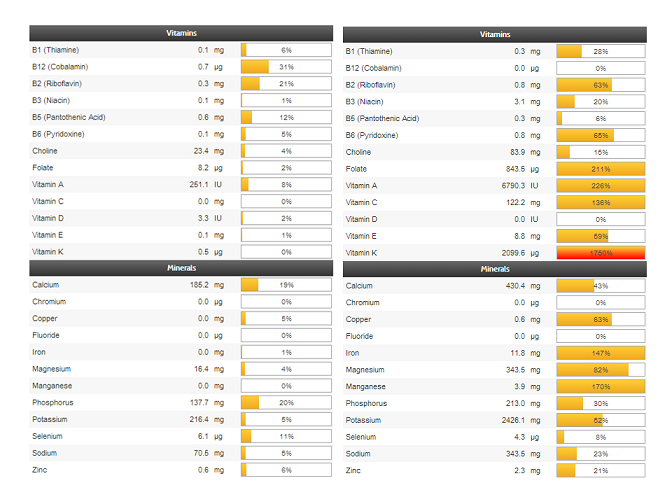
This is a useful post. Thank you for writing it.
You claim that "Eggs and whole milk are very nutrient dense." I think that's quite a controversial statement. Here are the nutrition facts for 100 Calories of whole milk and spinach:
I've downvoted your post due to use of a misleading graphic (EDIT: Downvote retracted after your reply). The graphic is comparing low fat milk, not whole milk, while whole milk has much more nutrition than low fat milk. Additionally, nutrient density can refer to both nutrients/calorie, nutrients/volume, and nutrients/price. All are important measures. Spinach wins on nutrients/calorie, but the other two, not so much.
Whole milk, for example, has 124IU of Vitamin D while the chart only lists 2.4 IU, which approximates the 1% fat figure from Google's nutrition information.
This is what 200 calories of whole milk looks like. This is 200 calories of eggs. This is 100 calories of spinach.
Spinach has little protein (0.9g/serving), while eggs and milk both contain 8g and 7g per serving. This extremely important number is missing from the chart. A cup (30g) of spinach (standard serving size) contains 7 calories, so you'd need to multiply your numbers in the charts by 0.07 to get the expected nutrition per serving of spinach. A serving of whole milk (8oz/244g) is around 148 calories, so we'd need to multipy by 1.48 for a serving:serving comparison. Doing this, the differences in nutrient content are much smaller for most nutrients, and milk 'winning' several of them.
A gallon of whole milk (16 servings) costs ~$3 in my town, and a 10oz bag of spinach (roughly 9 servings) costs ~$2. The price per calorie, per gram protein, and for most micronutrients is smaller for milk than spinach.
Spinach is, of course, great to eat and very healthy. But so are milk and eggs. That they compare so favorably to your chosen food when using more realistic comparisons supports "milk and eggs are nutrient dense."
I originally used whole milk in my graph, but later removed it because the data was for fortified milk. (Clearly, in assessing the nutrient density of a food, one should exclude whatever nutrients are added in supplement form by manufacturers.) I have now found data for unfortified whole milk, and have updated my original comment with a graph displaying nutrition data for that type of milk.
Whole milk does not contain significantly more vitamin D than low fat milk does. The figure you quote corresponds to fortified whole milk, which for the reasons mentioned in the preceding bullet point should not be used in this context. And even if we used both fortified whole milk and fortified low fat milk, it would also be false to say that former contains significantly more vitamin D than the latter does.
Nor is the nutrient content of whole milk higher than that of low fat milk; if anything, the opposite is the case. Here's an isocaloric (100 Cal.) comparison of the nutrient content of whole milk and low fat milk:
According to Wikipedia, "Most commonly, nutrient density is defined as a ratio of nutrient content to the total energy content." That source also provides other definitions, while noting that they are less commonly used. But none of those definitions include the two alternative definitions you provide yourself. Nor have I seen those definitions used in journals or respectable discussion groups, like the Calorie Restriction Society mailing list. I think it's unfair to claim that my graph is misleading--and downvote me accordingly--for relying on the most commonly accepted definition of that expression, instead of using definitions which are rarely if ever used by knowledgeable authorities.
Everything else you write might support your argument if price or volume were relevant metrics for assessing the nutritional density of foods. It doesn't support your argument under adequate definitions, and sometimes provides extra support for my own position (for instance, 100 Calories of spinach contain (much) more, not less, protein than 100 Calories of whole milk).
Most of the milk I see for sale is fortified with vitamins A and D. I would want studies regarding milk's health effects to report on the same sort of milk that I can buy in a store.
Two points that came up in my research:
1. whole milk and eggs are associated with significantly lower mortality for vegetarians, and somewhat lower mortality for the general populace.
2. fruit has twice the effect of vegetables on mortality risk per serving.
I am basically highly dubious of the proposition that we are supposed to munch on leaves all the time. Past and extant hunter gatherer groups eat tubers, fruit, and nuts as their plant material. We simply don't see these groups pursuing leafy greens as a significant calorie source.
Huh?
I rather suspect fruit here is working a proxy for something else (maybe wealth).
Nutritionally, the major difference between fruits and vegetables is that fruits have MUCH more sugar. In particular, fructose which doesn't have a sterling reputation, to put it mildly.
http://jn.nutrition.org/content/136/10/2588.short
http://www.neurology.org/content/65/8/1193.short
Yup. Surprised me a bit too when I first saw it. Fructose effects are not linear. The liver has some ability to process a certain amount of fructose every day, it is going well beyond this limit that is harmful. 5 servings of fruit is probably going to be 30-50g of fructose, which has been proposed as the approximate amount we can process.
Yes, I understand there are studies. That doesn't make me trust their conclusion. I don't have time to dig into these papers right now, but I wonder how well they controlled for e.g. socioeconomic status and latitude.
Wealth doesn't look likely to me -- vegetables aren't a lot cheaper than fruit where I live, unless we're talking potatoes and such, and those usually aren't counted as vegetables in these analyses.
I would be interested in what fruits and vegetables are respectively displacing in the diet. If a lot of these people are eating fruit for dessert instead of e.g. cake, or for breakfast in place of Pop Tarts, then dramatic longevity effects wouldn't surprise me but also wouldn't be an unqualified endorsement of more fruit for everyone.
Carrots, cabbage, onions, squash -- not cheaper than fruit?
But yes, I don't think it's purely a matter of money but may be a matter of culture as well.
Yep, a very good point.
I just looked these up on Safeway's online store for my area, and found carrots at about 80 cents a pound, cabbage at a buck a pound, onions at about 56 cents and squash at about a dollar. (You can squeeze a bit more out of some of these if you're buying in 10-pound increments, but I consider that impractical for individuals or small families.) Compare to cheap apples at $1.09 a pound, grapefruit at $0.66, or bananas at about $0.85.
Fruit does go a lot higher -- if you're buying berries or tropical fruit, you can easily be spending five or six bucks a pound. But if you're mainly looking for frugality, you have plenty of options in each category. I expect this to be skewed a bit by season, too -- there aren't many cold-season fruits.
Do we have data on the eating habits of hunter gatherers to draw such detailed conclusions about the nutritional composition of their diets? Personally, I think we should rely primarily on prospective epidemiological studies about the health effects of various types of foods on different cohorts, rather than on speculative historical studies about our Pleistocene ancestors.
I don't think anyone is claiming that people should regard "leafy greens as a significant calorie source". Rather, the claim is that people should eat lots of vegetables (not just leafy greens, by the way), where "lots" is something like the NHS "five [portions] per day" recommendation--which only 10% of young Britons comply with. That's maybe 500 grams of vegetables per day. Even if you eat that many veggies, the calories derived from vegetables would only constitute 5-10% of your total daily calories.
The shape of the human teeth and the specifics of the human digestive tract are pretty good indicators of what we evolved to eat. It is rather obvious that humans did not evolve eating only plants.
What do you think of the health effects of too much sitting? That seems to be a hot topic recently. http://www.mayoclinic.org/sitting/expert-answers/faq-20058005
Breaking up long sitting periods with stretching and walking around is a safe bet, but the studies are actually less clear than the editorials on them would lead you to believe.
Could you use the standard font and fontsize please?
I standardized a bunch of the formatting. Will try to do more visual polish in the next few days.
I am considering writing a program that will launch this page in my web browser every few hours.
(While most of these interventions are things with a surprisingly high cost in terms of stress, the one I like the least but am least stressed about is the recommendation to eat more fish. I am not a fan (nor much of an enemy) of fish. I will gladly save any recommended recipes that manage to include fish and all its benefits without making it overly obvious that I'm eating fish. I could always try and self-modify so that I no longer treat fish as pretty far down the preferred meat hierarchy, but using it in something more desirable in general sounds way more fun. Bonus points if it's something well balanced.)
Have you had a seared tuna steak? Cooked properly, it's one of the tastiest things I've ever eaten.
Here is a very simple recipe for fish that doesn't feel like fish. I made it yesterday :). In addition to being simple, it is easily tweak able/optimizable for your tastes and dietary needs. All quantities are rough approximations:
Throw in a pot 1 onion (chopped), 4 celery sticks (chopped), 1 potato (diced), 2 cod fillets, and 2-3 cups of watered tomato sauce. (The one I use is a super-simple homemade one: 2 tablespoons tomato paste, 2 tablespoons olive oil, 2 cups water, 1 tablespoon sugar, and salt and pepper to the taste). Bring to the boil and simmer until cooked. (I do it in a pressure cooker, where it takes 20-25 minutes. In a normal pot it would take longer and you probably need to use more water). And there you have it. The defining taste is the celery in tomato sauce; the fish (which breaks down) and the potato are just white chunks in it giving the feelings of protein and starch without changing the taste. Makes 3-4 servings.
You can get sashimi delivered to your house frozen for around $25 a pound.
That seems really expensive.
I praise your for the effort.
But I have one problem: how do I explain it to others? People might ask me one day "why are you doing/concerned with that?" and what my reply be? "Some guy on Lesswrong told me, but don't worry it's a rational site!"
That's silly. Instead of spreading one-dimensional awareness, you should instead spread academically correct information and let it do it's course. That way, if someone ever asks me why, I can give them a link, or at least the bottom line. Depending on how curious they are they might even read it and spread it further and who knows.
If anybody's interested about nutrition, I'll vouch for bodyrecomposition, Lyle McDonald's site. The text-to-shit ratio to there is simply great (1:0). If anyone else can share some more "make your life better" advice, sites, or whatever, go ahead!
Here's something that happened to me lately: I couldn't stomach fish. No matter what happened I couldn't take it. Then I just realized it was cooked half-made, and I should've let it burn good and get some real color. The trick was to basically cook it until the significant water content in it is basically out and it gets a lot more bitey, rather than slimy mess that melts in your mouth and leaves your fingers with a nasty unclean feeling. Get a fillet and cut it into several pieces just to make sure you're not putting a big piece so it'll cook evenly, rather than "sushi inside" or whatever you call that when you take a bite and feel it wasn't cooked properly.
I would refer to the original research rather than my efforts to collect and synthesize it. I linked some of the best research I could find for each point, but it is by no means exhaustive.
This paper and this one (I haven't read either) make me wonder if living in a consistently warm climate is beneficial, especially as one grows older.
From paper 1:
It looks like it's relatively easy to control the amount you're temperature-shocked, and they talk some about cold adaptation but I didn't see it quantitatively linked to the other parts of the paper.
In general, cold is more dangerous than heat, and while hot climates have historically had worse diseases and bugs than cold climates, it's not obvious to me that's still the case. There probably is something to retiring to Florida.
I have bought such an e-cig and gave it to a friend. It was received positively. It also prompted a discussion about the (unknown?) effects of e-cigs. Even though this was only cited as an often given counter-argument I nontheless wonder what the research behind e-cigs shows? Can you provide references that back your claim of getting people to quit?
Effect in people not intending to quit: http://www.biomedcentral.com/1471-2458/11/786
Are you planning to do a post on nutrition later?
Are waterpiks as good as flossing?
I'll discuss some more nutrition stuff in the exercise post. But nutrition is a giant can of worms I don't want to get too deep into.
I've heard conflicting things about waterpiks. Here is a small study indicating that it is effective. I do need to expand the oral hygiene section to discuss both waterpiks, oil rinsing, and alcohol mouthwashes.
My dentist told me that waterpicks are not effective, but I don't know what he based that on. If the data proves otherwise I'd love it, since I find regular flossing to be really annoying.
I really don't like flossing. Can I substitute antiseptic mouthwash instead?
I used to hate flossing too:
The bleeding gums go away after flossing regularly for a while. After trying several other flossing tools, I found one that solves the other two problems: the Reach Access Flosser. Its sole downside is that you have to periodically replenish your supply of disposable heads, but this is not very expensive, and the reward is healthier teeth.
I started using this maybe something like five years ago, and it turned me into a flosser after decades of being a non-flosser, so I'm an evangelist for it now.
I mostly have problems with #1.
I lost some manual dexterity in one of my hands, and my dentist recommended a water flosser. I think waterpik is the brand, seems to work well.
You can sort of substitute oil rinsing, but I'm not positive they have exactly the same disease prevention effects. It's certainly better than nothing.
Listerine and similar antiseptic mouthwashes are supposed to be effective against gingivitis and tooth decay, which is why I asked.
Listerine doesn't work vs gingivitis for me.