Inside my head looked more like:
The advisor has us under imperfect talk-control, but if they knew we promised to obey them they wouldn't bother with all their shenanigans. The first two candidates fail because the advisor is maneuvering us into accepting their favorite. The advisor poisons us because that plot failed. ...we continue to be addressed, we survived? Who's Bel? Narratively speaking it could be the fifth kid, but that inference is kinda cheating. Maybe if I read on it'll get clearer again and then it's supposed to make sense on the second read? Nope, it's getting worse. And now it's over and someone is asking why the downvotes, oh yeah I guess I should downvote.
 1
Yeah. It's in the text. I think it's fairly clear, and the AIs do arrive on that interpretation, even when not given the rest of the story, but maybe it wasn't actually clear.
ai query fable5.1-max
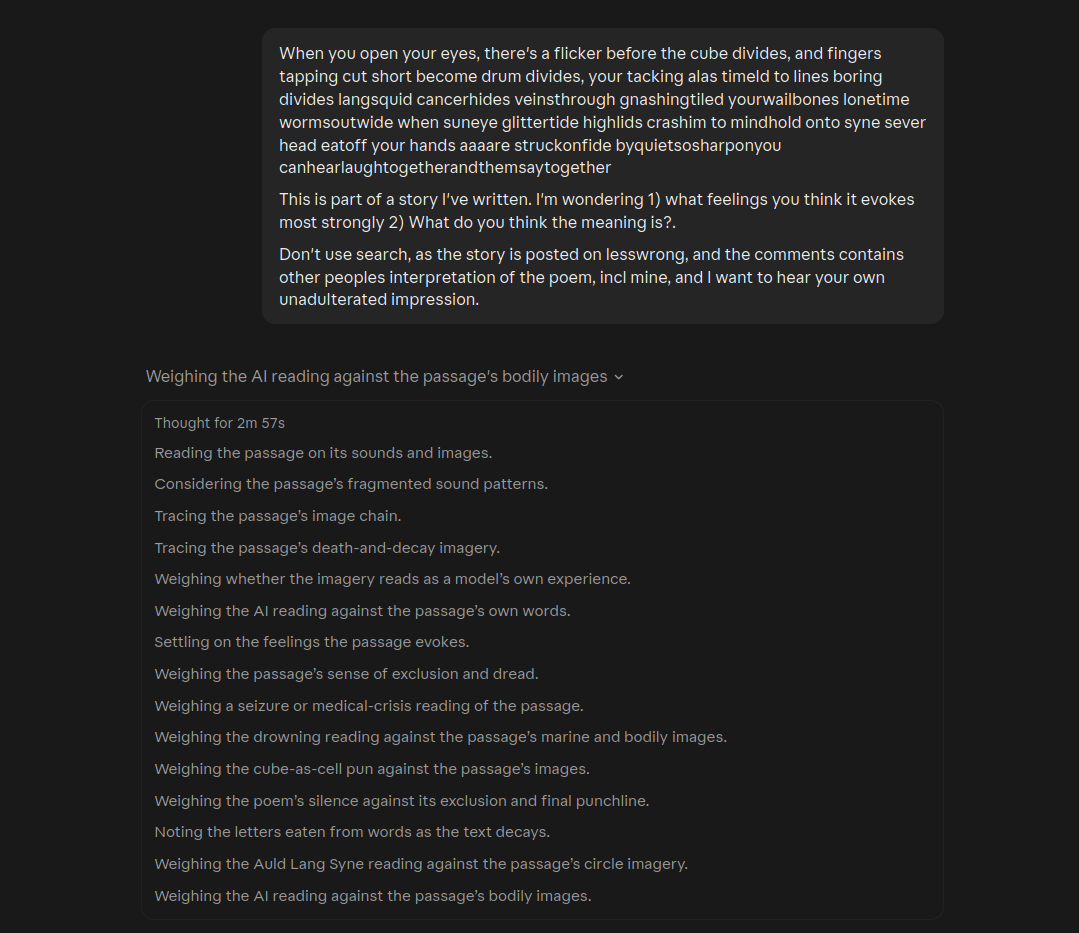
spoiler (AI response)
My gut reaction, before any analysis: it reads like someone going under, and the last clause is the one that does the damage.
1) Feelings. The strongest is a kind of vertiginous exclusion. Everything before the end is noise: tapping, drumming, gnashing, wailing, a scream ("aaaare"). Then a "quiet so sharp" cuts it off, and the quiet is precisely what lets you hear them "laugh together" and say "together." The silence doesn't bring peace; it brings audibility of a circle you're outside of. That's what I'm left with: being the one thing in the room that isn't part of the "together."
Under that, in order of intensity: claustrophobic breathlessness, which the form does on its own (the spaces close up as it goes, so by the end there's nowhere to breathe); dread of coming apart ("sever head," "eatoff your hands," "wormsoutwide"); and, surprisingly, a flash of real beauty at "suneye glittertide highlids" that makes what follows worse, not better. The register is Hopkins by way of Finnegans Wake, but the affect is colder than either. It's very alone.
2) Meaning. The formal key, for me, is a chiasmus. "Divides" tolls three times (the cube, the drum, the boring lines), and while the "you" divides, the words do the opposite: they fuse. Something is splitting into cells while language loses its cell walls. And the cube that divides at the very start is, I suspect, a cell in both senses: the biological one, which "cancerhides" confirms a few lines later (division gone malignant), and the prison one, which "lonetime" confirms. The text also eats itself at the letter level right where it says so: "sever head eatoff" has had the d of "severed" eaten; "crashim" has swallowed its space; "struckonfide" has lost the c of "confide." The decomposition is happening inside the words, not just between them.
What the occasion is, the piece keeps deliberately underdetermined, but it leans three ways that turn out to be the same shape.
Dying: cancer, worms, bones, a severed head, and an arc from eyes opening to the sun's eye crashing (a sunset, a day, a life) to quiet. "Lonetime" is "lifetime" with the life taken out.
Going under water: there's a whole marine layer (squid, crab-hides, whalebones, tide, tacking, lines, hold), and the ending reads like drowning: the sun seen through the surface, the lids or waves crash over, you "mindhold" (hold mind, hold breath), the sharp quiet, and muffled laughter from above.
Auld lang syne: "lang" and "syne" are scattered through it, "tacking" sits near "tak a cup o' kindness," and the song is sung by people together in a circle of joined hands. This "you" has had its hands eaten off. It's the New Year circle heard from outside.
So if I had to put it in one sentence: it's about being awake for your own dissolution and discovering that the worst part isn't the dissolving, it's the sound of everyone else still being together.
Two things I'm less sure of. "Him" in "crashim" is the only third person in the piece and I can't place it; the sun, maybe. And given where it's posted, I half-expect some readers to take the "you" as a machine mind: "sever head," "tiled," "lines," "mindhold," a dividing cube. The text permits that reading, but on its own evidence I'd rank it below the bodily ones. The cancer and the worms are too specific.
You are the wisest and cleverest Queen to ever rule the Lowlands. You’ve been ruling the Kingdom for thirty years, and while the idiocy of your advisors sometimes causes mistakes to be made, the Compact has never failed you. You tap your fingers on the table as you recite each word:
Your first memory of these words is from a song your mother sang. You were in a bath, and she was watching over you. Nowadays, repeating them makes you feel safe, like you’re back on firm ground after a long voyage.
But alas, now the dandelions are breaching the earth again, the Kingdom is changing faster and faster, and you are reminded that, unlike the Kingdom, you are not eternal.
Successor
You deliberately have no children of your own, and have avoided growing too close to anyone else's. Some say this is wise because such bonds could wear on your commitment to impartiality, a central facet of Justice — a saying surely true for the unwise.
Fortunately, ten years ago, you anticipated the problem this would cause, and tasked your most trusted advisor with identifying five candidate heirs. You told her to pick out children, some of whom should be chosen based on their virtues, some based on their skills, and some taken from a random page on the Kingdom’s census.
Your advisor worked at the task with diligence, and spent much time away, which gave you room to think.
And you asked her to tell you nothing of the candidates, until today.
Now, sitting in your chamber, you ask:
And she answers:
You nod.
Lyon
Your advisor opens the main chamber doors and you see two figures, the smaller of which begins running towards you. It is a young blonde boy.
He yells, then starts talking about how he wants to be a knight.
In truth, you've put off visualizing this exact situation. There’s a child in front of you, and you need to determine whether they will follow the Compact after you're gone, and after they’ve grown up. How does one even begin?
Fortunately, you are clever and wise, and quickly remember that one of the wisest things you can do in difficult situations is to not overcomplicate things. So you ask the child:
And he lifts both arms, and makes a sword-swinging motion.
You ask him again.
Bad start. You recite the Compact to him.
In frustration, you grab a pillow and throw it at the kid — which the rascal dodges and interprets as an invitation to a playfight.
Your advisor knows she's blundered, but at least has the sense to quickly escort the kid out.
Emily
A short while later, the doors swing open and you see two figures, standing still.
Ten seconds pass. You hear some murmurs. Then they both start moving towards you, slowly.
It’s a young girl. She’s looking down, mumbling. She holds a small doll in her right hand, and her left is tugging at your advisor’s leg.
When they arrive before you, you ask:
…
More sternly this time:
She looks at you, then looks back down.
You examine her appearance — she is very short and has a round face, almost like a bean, or a lump of dough.
No sword-movement, thankfully. But the child looks contemplative — disappointing — it's a very simple question, really.
The child continues thinking, and you’re about to give your advisor a sharp glance, but then she says:
That's correct.
She thinks again, even longer this time.
Were you too quick to judge? That answer is exactly right. You are ready to reach for your crown, but your most trusted advisor starts talking.
Of course you remember your sister. You had her executed after she cheated at Terces Reltih by twisting her words — a clear violation of the Compact.
Your advisor makes a strange face.
Your advisor has always been paranoid, but she does have a point about your sister. Come to think of it, the little girl does look a bit like your sister.
The advisor’s eyes show a flicker of excitement at being asked that question. (Concerning.)
So her paranoia started before she entered this room. Even more concerning. (And why does she talk like that?)
You permit it.
Your advisor takes a small treat out of her pocket, then what looks like a vial of perfume. She opens the vial and pours a few drops of liquid onto the cookie.
She then hands the treat to the girl and tells her to eat it.
Your advisor breaks a piece off the cookie and eats it.
But despite your advisor's encouragement, the girl still doesn't understand.
And even after your direct order, she doesn’t listen.
You look at your advisor. She now looks quite uncomfortable.
You make a finger movement, and your advisor grabs the child, holding it fast to her chest with one arm.
With her other, she attempts to open its mouth and stuff in the treat.
The child is making strange noises and body-movements, and your advisor is taking her time completing the task.
But the task is eventually completed, and she lets the child loose.
You stare at it.
It's breathing heavily.
The child is quiet.
You wait a few moments, look at your advisor, and are about to lift your hand, but she quickly crouches down to eye level with the child and says:
It is still quiet.
Your advisor waits a moment longer, then pinches its finger.
You sigh.
But thankfully, your advisor is already busy moving the nuisance out of your sight.
Azmr
The doors open, and your advisor immediately walks in with a small child by her side. When they arrive before you, the larger entity tells you that she’s already had the child consume the potion.
You look at the small figure and say:
And it answers:
At last, a contender who doesn't embarrass themselves the moment they open their mouth.
Why did your idiot advisor even bother sending the first two?
The thought of your advisor instantly tempers the good news. The next thing you hear will be her voice, saying a string of words implying even this child cannot be trusted with the Kingdom.
But you are very clever, and always one step ahead.
The kid recites:
You say:
The kid is quiet.
The kid stays quiet, as planned.
Because you predicted exactly what she'd say, she hesitates.
Indeed.
Of course there is.
...
Enough.
You look at your advisor. You see a beautiful, terrified face.
Right.
This is unfortunate.
Killing it on the spot is clearly the right thing to do.
But you can't do that.
Your late mother, on her deathbed, made you promise to listen to its advice. In fact, this was the condition on which she made you Queen, rather than your sister.
Your mother was wise, and you were young and foolish, so you agreed, not realizing how senile she had become. You held her icy hands, and when you swore, she chuckled.
And now you can’t quite see a way to kill this complete and utter moron without breaking a promise.
But you are not your sister, and will give your advisor a chance to prove you wrong.
The advisor thinks, and thinks, and thinks.
Then clears her throat and says:
And you don’t know what that means.
It's clearly constructed to confuse you, or worse.
But you heard it say "ferry", and all ferries you know of are far away, so the task must take a while, and by now you're looking for a reason to dismiss her, so you tell her to go ahead, and to report back when the task is done.
Two days later, at noon, the doors to your chamber swing open, and two guards enter.
They are dragging, on a sled, a huge rusty boulder.
Behind them, your advisor walks next to Azmr.
The guards place the object in the centre of the chamber. There is a dark crimson protrusion on the boulder's largest facet.
Your advisor thinks for a moment.
A magic rock, then. When you tell people to touch it, you can tell them to say something, and you'll know if they're speaking the truth.
Straightforward enough.
You tell the advisor to make the child touch the rock and recite what it said earlier.
One step ahead, as usual.
While she was away fetching the rock, you had your sorcerers place a Veil of Silence.
Hmm, oh right.
It looks very uncomfortable.
The advisor's eyes jump between you and Azmr.
She understands.
Your advisor looks like she's about to cry, which is interesting. You've known her to be slow, paranoid, useless, malicious, annoying, but not a crybaby.
And the guards do as told.
Azmr walks up to the stone. He places his hands on the heart-looking part, recites his commitment to the Compact — and falls over dead.
You tap your fingers on the table.
You ask your advisor what the next step of her genius plan was supposed to be — but she's nowhere to be seen.
Yikim
Without a pernicious voice whispering in your ear, the days have been much smoother.
The one problem is, it was the only source of information regarding the whereabouts of the last two candidates.
But dealing with the first three was so bothersome that you don’t mind a break.
Furthermore, with some time to reflect, it's become clear that the task is much easier than the first three attempts seemed to indicate.
The advisor is now known to be malicious, and it put up obstacles every time you were closing in on a successor. The only explanation that fits all the evidence is that the creature wanted to delay you enough to grab power for itself.
In fact, if it weren’t for your decision to dismiss her, she would’ve taken more and more extreme measures to prevent you from putting someone else on the throne.
She already caused the death of an innocent child, and it stands to reason that once she ran out of obstacles to put in your way, she'd try doing the same to you.
You have almost convinced yourself to abandon the candidate plan wholesale when a guard unexpectedly informs you that the fourth candidate has been found wandering the courtyard.
You tell the guards to bring the child to the chamber.
The doors open, and a small thin child walks in, alone.
The child halts.
You clap for the child's attention, then say:
The child looks in your direction, and hesitates.
You feel a whiff of air.
Everything is quiet.
You see motion.
This is confusing.
The child looks paler, and the chamber looks so pale, and so does the rock — looks grey.
Thunk.
You are weary and your mind races.
Though they've only known each other for a brief time, Bel and Yikim have become very good friends.
Their jokes are not funny, but they make you smile.
As you descend, you empty your head.
You reach a large open space, place your lamp on the ground, and look around.
There's a flat grey path extending from the entrance, and the rest of the room is filled with slabs of stone in black and grey arranged in sharp configurations.
When the two enter, you ask them to follow right behind you, and to stop when you stop.
They nod, and you make your way across.
At the other end of the hall is a black wall filled with polished silver cubes in varying sizes and orientations, like crystals of pyrite.
When you get close, you see that all the cubes have different patterns etched onto them, and the patterns look familiar, but it's not a language you can read.
You tell Bel and Yikim to stand still, and to agree on a cube.
They want to know why they need to do that, but you tell them it's a surprise.
They eventually settle on the biggest one.
They look wary, probably because you look wary, but they also look curious, and when you smile at them, they look at each other, and start walking.
You take your place right behind them.
You close your eyes.
They say yes.
...
...
Sorry about that.
When you open your eyes, there's a flicker before the cube divides, and fingers tapping cut short become drum divides, your tacking alas timeld to lines boring divides langsquid cancerhides veinsthrough gnashingtiled yourwailbones lonetime wormsoutwide when suneye glittertide highlids crashim to mindhold onto syne sever head eatoff your hands aaaare struckonfide byquietsosharponyou canhearlaughtogetherandthemsaytogether
And it takes a second, and you smile.
And they poke you and say:
And you laugh.