We introduce TasteVal, a benchmark that measures the experimental research taste of AI models on AI R&D tasks. We define research taste as the ability to pick interesting problems to solve, design experiments, and interpret experimental results. TasteVal measures the experimental component of research taste; given a fixed research problem, we measure how well a model iteratively designs experiments and draws conclusions from their outcomes. In the AI Futures Model, experimental compute becomes the main bottleneck once coding is automated, so the time to superintelligence depends primarily on how fast research taste improves.
Setup. Given a fixed AI R&D problem, TasteVal measures how well a model designs experiments and draws conclusions from their results. We operationalize experimental research taste as compute efficiency: how much experimental compute a model needs to reach a given score, relative to human experts. A model that reaches the experts' score with half the experimental compute has twice their experimental research taste. Under this definition, doubling a model's experimental research taste has the same effect as doubling the compute available to run its experiments.
TasteVal consists of 8 novel tasks representative of frontier AI R&D, spanning pretraining data curation, pretraining and fine-tuning language models, preference modeling, and robustness to adversarial prompts. To isolate taste from coding ability, the model under evaluation only designs experiments and interprets their results, while a fixed coding agent implements and runs them on a single H100. A run ends when the model under evaluation has used 40 GPU-hours of compute or 120 hours of wall-clock time. Our human baseline is the best expert attempt on each task, drawn from 24 experts (at least two per task) who have recently worked at organizations including OpenAI, Google DeepMind, NVIDIA and Microsoft Research.
Results. The experimental research taste of frontier models has doubled every 3.0 months since December 2025 (95% CI 1.7-5.0 months). The best model, Opus 5.5, significantly exceeds our human baseline with a compute multiplier of 2.30x (95% CI 1.15-4.37x), at roughly 1/30 of our expert baseliners' average cost per attempt.
As a naive extrapolation rather than a forecast: if taste keeps improving at our measured rate per unit of general capability, the probability of a taste-only singularity rises from 51% to 88% in the AI Futures Project's AI Futures Model. Under the same assumption, the model's median arrival date for artificial superintelligence moves from mid-2030 to late 2028, and its probability of superintelligence before 2030 rises from 46% to 69%.
Limitations. Our results may overstate how fast the research taste is improving. Our tasks are fast and cheap to verify, which frontier labs find easiest to hill-climb, and our human baseline doesn't include top researchers, so it may significantly underestimate the best researchers in the world. TasteVal also doesn't measure a model’s ability to choose which problems are most fruitful to work on.
Our results may also understate how fast the research taste is improving. We did only limited elicitation of each model, spending about 1/30 as much per attempt on our best model as on our human experts.
Are these measuring the design of one experiment at a time? LLMs are pretty good at this these days (my recent experience is mostly with Opus 5.5 and Sol 6.1), but they still need handholding on strategy and metacognition to stay productive and on task for research projects that don't have obvious next steps at any given point.
This seems like it's measuring a component of research taste.
What did the Brainstorming session for "How will we measure , Taste?" look like?
In H.1,
"This construction has the three properties we want from our headline metric:
1. The score is denominated in effective compute, so results can be carried directly into forecasts of AI progress. 2. Historical scores do not change as new models arrive. 3. The scale extends by adding a new reference (i.e. does not saturate easily). We rejected several alternative measures on these criteria. "
These criteria appear desirable. What did the rejects look like? Are there "near miss" metrics that could be refined?
Wow, quite the inflection point. Contrasted with Anthropic's percentage of AI R&D lead by AI [0]:
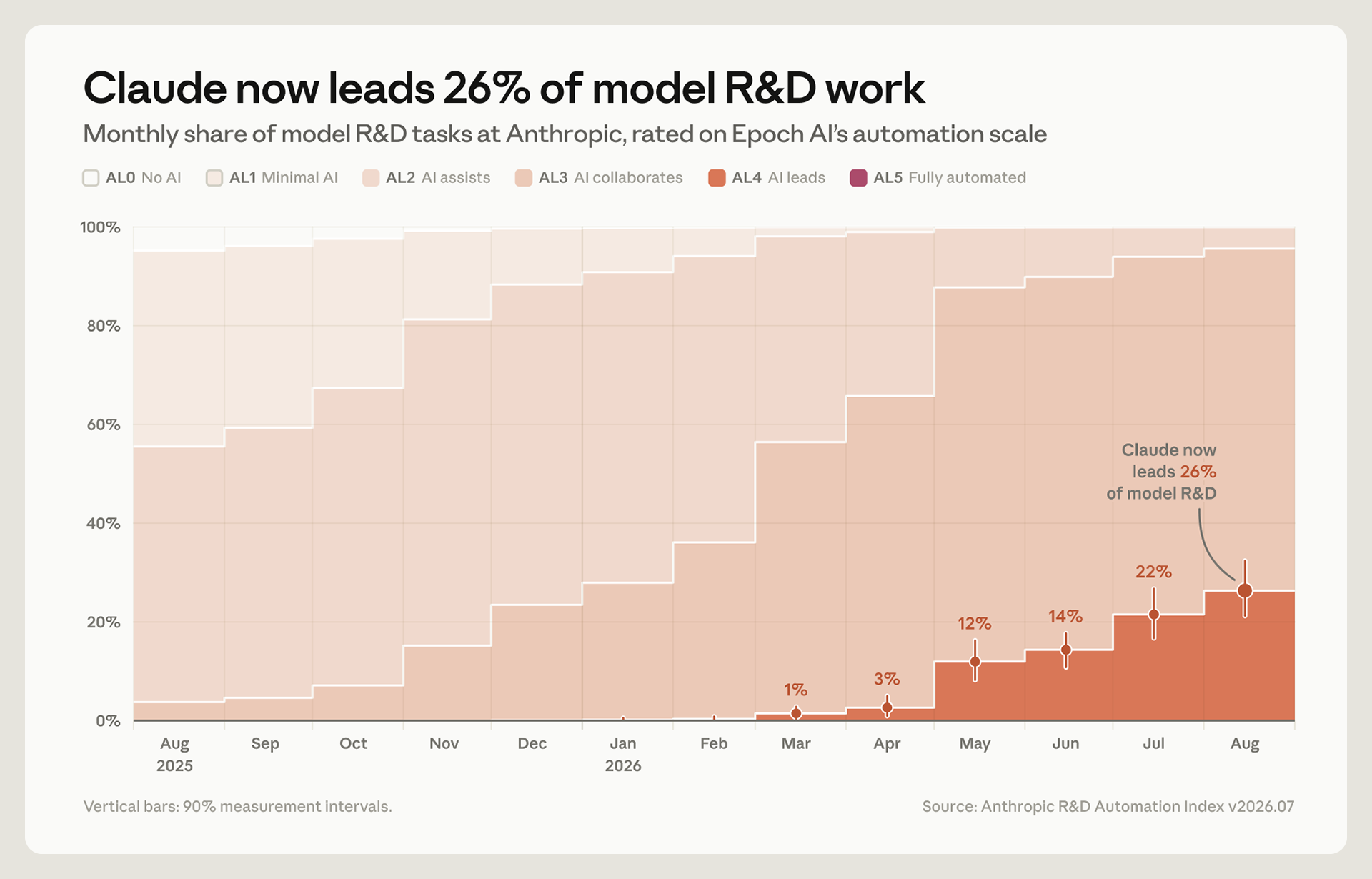
That puts >90% of R&D work lead by AI in 2027 if the earlier AL* trends are followed, and AL4 matches almost perfectly with taste going superhuman (assuming Anthropic is using highest capability models as soon as they are available internally). I wonder when AL5 appears? Probably this year or early next?
Waiting of course for reactions from folks more expert than I, but this gives me a similar feeling to the day the METR chart first came out and I almost quit my job. If reality-mapping–––and I suspect it is–––this is very bad news indeed. THREE MONTHS?
📝Tweet, 📄 Paper
We introduce TasteVal, a benchmark that measures the experimental research taste of AI models on AI R&D tasks. We define research taste as the ability to pick interesting problems to solve, design experiments, and interpret experimental results. TasteVal measures the experimental component of research taste; given a fixed research problem, we measure how well a model iteratively designs experiments and draws conclusions from their outcomes. In the AI Futures Model, experimental compute becomes the main bottleneck once coding is automated, so the time to superintelligence depends primarily on how fast research taste improves.
Setup. Given a fixed AI R&D problem, TasteVal measures how well a model designs experiments and draws conclusions from their results. We operationalize experimental research taste as compute efficiency: how much experimental compute a model needs to reach a given score, relative to human experts. A model that reaches the experts' score with half the experimental compute has twice their experimental research taste. Under this definition, doubling a model's experimental research taste has the same effect as doubling the compute available to run its experiments.
TasteVal consists of 8 novel tasks representative of frontier AI R&D, spanning pretraining data curation, pretraining and fine-tuning language models, preference modeling, and robustness to adversarial prompts. To isolate taste from coding ability, the model under evaluation only designs experiments and interprets their results, while a fixed coding agent implements and runs them on a single H100. A run ends when the model under evaluation has used 40 GPU-hours of compute or 120 hours of wall-clock time. Our human baseline is the best expert attempt on each task, drawn from 24 experts (at least two per task) who have recently worked at organizations including OpenAI, Google DeepMind, NVIDIA and Microsoft Research.
Results. The experimental research taste of frontier models has doubled every 3.0 months since December 2025 (95% CI 1.7-5.0 months). The best model, Opus 5.5, significantly exceeds our human baseline with a compute multiplier of 2.30x (95% CI 1.15-4.37x), at roughly 1/30 of our expert baseliners' average cost per attempt.
As a naive extrapolation rather than a forecast: if taste keeps improving at our measured rate per unit of general capability, the probability of a taste-only singularity rises from 51% to 88% in the AI Futures Project's AI Futures Model. Under the same assumption, the model's median arrival date for artificial superintelligence moves from mid-2030 to late 2028, and its probability of superintelligence before 2030 rises from 46% to 69%.
Limitations. Our results may overstate how fast the research taste is improving. Our tasks are fast and cheap to verify, which frontier labs find easiest to hill-climb, and our human baseline doesn't include top researchers, so it may significantly underestimate the best researchers in the world. TasteVal also doesn't measure a model’s ability to choose which problems are most fruitful to work on.
Our results may also understate how fast the research taste is improving. We did only limited elicitation of each model, spending about 1/30 as much per attempt on our best model as on our human experts.