The thing about China was an update to me. Seems like it's not just a misguided attempt to appeal to DC china hawks.
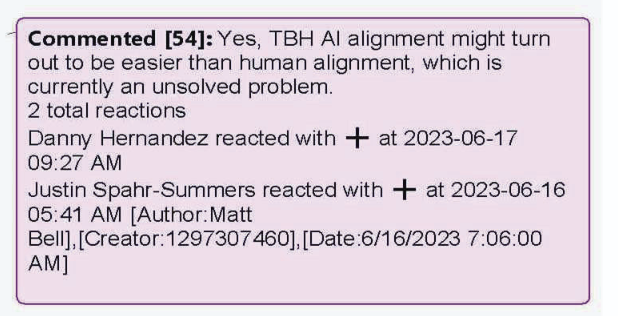
FWIW, as someone who thinks AI alignment is very hard, I do not necessarily disagree with this statement.
Sure, it may be very hard to figure out how to precisely design a mind from scratch. But after you've done so, you get to design a mind from scratch. Whereas with humans you have only incredibly crude tools for controlling their values, and all kinds of practical and ethical restrictions regarding how to wield them.
Or, like: It may be easier to get human alignment to three nines of reliability than AI alignment. But if you want ten nines, AI may be an easier route (hard as it is).
I think this statement makes sense if you don't really believe in ASI. If AI just sort of reaches human level intelligence or slightly above but not more, then yeah I think aligning AI's is easier than aligning humanity with the good.
In general I am never sure how powerful Dario thinks ASI can truly get.
Very valuable share. This makes me interested in setting up some pipeline to find and be warned of more such things in the future, do you have recommendations?
Most of my research was done by asking Opus 5.5 max thinking
look through the anthropic copyright court case stuff on courtlistener, and dig through all of the filings and evidence from Anthropic. can you find any interesting info about Anthropic in them? (i know a lot is redacted, and you'll have to look at a lot of stuff to find the interesting bits)
and then asking a lot of followups. Claude spun up a lot of subagents to sort through all the documents, which took a lot of tokens[1] since there are a lot of boring documents and many filings are PDFs that don't have any selectable text, so Claude had to do a lot of transcribing.
If you setup a pipeline it would probably be good to let Claude buy court filings through PACER.
- ^
I used ~half of my 5-hour limits on the 20x max plan throughout the research process, or about $600 at API prices. (It took more than 5 hours so I'm adding up all the usage across the 5-hour sessions.)
I'm surprised to hear you picked Claude for the task, given obvious company allegiances. I'd be curious to hear if ChatGPT raises qualitatively different highlights!
I mostly went with Claude because I already had a 20x max subscription, and I don't have a ChatGPT sub right now. Also in general I like talking with Claude more, and I think she's better at fulfilling the intent of my requests?
FWIW Claude's initial response to my request wasn't very good. She focused too much on Anthropic's data strategy which I guess sense given that most of the documents are about that, but I had to chat with her more to clarify I was more interested in things like Anthropic's long term plans and approaches to safety (instead of things like the specifics of Anthropic's book-scanning operation).
If you setup a pipeline it would probably be good to let Claude buy court filings through PACER.
I'm currently working on a project to collect information on federal courts and pass it to various AI models to make predictions. I've thought about doing something like this as part of that. I think a good setup would be to have a model "crawl" cases on PACER in a browser with RECAP. My understanding is that would get both you and CourtListener (and therefore everyone) the document.
For token spend, do you have a sense of where those tokens are getting used? As you indicate, cases can have large amounts of long documents. CL also has an API/MCP, so its possible to collect and process documents without the model having to do a lot of the heavy document processing. Not sure about interacting with PACER, but it might help keep costs down to do that outside a chat session without AI and just have the AI reference the processed documents. That's partial the approach I'm taking anyway.
If people are interested in this, I'd be interest in a setting up a "feed" for data and information on "the AI cases".
Thanks!
Anthropic released some documents earlier this year due to the book copyright litigation. I think a few of those documents might be of interest to some people here and haven't gotten much attention. In this post I link to some of those documents, and quote the bits I find interesting.[1] (This expands on my quick take from yesterday.)
These aren't Anthropic's official opinions about anything, and you should probably treat opinions in these documents as "what the author thought at the time", not as a corporate stance.
Concise Research Roadmap
It describes Anthropic's research plans in July 2021:[2]
In the pretraining section:
It predicted the usefulness of RL for tool use pretty early:
Another employee's comments on that document:
Data Hypotheses
It describes hypotheses (the author doesn't "believe any of them with very high probability") about what training data is useful. Among other things, it suggests training on Chinese text to slow down Chinese AI labs:
A comment on the doc:
All Company meeting!
This is a June 2021 slideshow[3] that discusses hiring, office space, the efficiency of training trillion parameter models, RL, sources of training data, and interpretability. It discusses Anthropic's first alignment failure in the "RL Update" section:
Product visions for early 2025 (written in June 2023)
It discusses potential use-cases for Claude 18 months in the future, as of June 2023. At the bottom (in the blue text[4]), various Anthropic employees provide their own takes.
It suggests setting an ambitious goal (transformative AI) and breaking it down into stepping stones that show progress and profit along the way, like SpaceX:
It discusses "three major visions for TAI": "Claude the Virtual Employee" (also called "Claude the Robot"), "Claude the personal assistant" (also "Claude the Cyborg"), and "Claude as intelligent org infrastructure". It says working on Claude the Virtual Employee and Claude as org infrastructure are useful to "reduce TAI risk", and Claude the personal assistant is "Sort of" useful for reducing TAI risk.
Responsible Scaling as a Framework for Anthropic
It is a slideshow that discusses the RSP and why Anthropic scales capabilities.
It has a diagram of Anthropic's business model:
Slack messages
I had Claude make a thingie to read Slack messages from the filings.
Conclusion
Keep in mind that these documents weren't intended to be public, they aren't Anthropic's official position on anything, and were written in the past. I don't want anyone to get the impression that any of these documents represent commitments from Anthropic to do anything; instead you should think of these as information about what some people at Anthropic were thinking about in the past.
Also keep in mind that this isn't a random sample of documents. The documents Anthropic releases due to litigation are strongly tilted towards being about training data because Anthropic gets sued over their training data a lot, and doesn't get a lot of lawsuits related to things like alignment science. You should also consider that Anthropic might try harder to redact information that makes them look bad. Most of the documents I looked at are things like Data Partnerships <> Finance; Monthly Syncs which is heavily redacted and much less interesting.[6]
Thanks to Anthropic and the authors of these documents for creating them; I enjoyed reading them! Also thanks to the Free Law Project for running RECAP/CourtListener, which is where I got these documents from. (Perhaps I should get a PACER account so I can access documents that aren't already in RECAP.)
I'll probably get back to focusing on technical AI safety research now, but reading obscure documents about Anthropic has been a fun hobby!
The PDFs are all images of the documents, so I had Claude Opus 5.5 transcribe the text for me.
I fixed the distortion from the original PDF to make it easier to read. Well actually Claude fixed it but I at least prompted it.
Fixed from the original to be undistorted and have the slides take up the full page.
I think the text is blue because it's a Google Doc, and everyone else added their takes as suggested edits. Not sure though.
Confusingly people in the Slack threads discuss things like "add it to Teal" and a "Teal datamix update", after Claude 3 Opus was publicly released. Maybe this means Anthropic continued training on a descendent of Claude 3 Opus after it was released? Maybe "teal = Claude 3 Opus" is an over-simplification? Anthropic's codename table is pretty weird - e.g. "Santa" is a codename for all Claude models from Claude 1 to Claude 2.1, except Claude Instant 1 and Claude 2. At first I thought it was something like the base model, but that would imply that Claude 2.1 used an older base model than Claude 2?
Also Claude 2 is given a second codename of "Project Hatch", but in 2023 the New York Times said that Project Hatch was a ChatGPT-like interface to Claude (presumably claude.ai), not an LLM?
Some documents are even less interesting! E.g. Copy Fairy Code is entirely redacted.