Talking to an LLM is not a substitute for reading the relevant literature or talking to an expert in the field.
I sent this to my friend Jason Derr, who is an actual expert. I did fusion plasma physics - he does space plasma physics focusing on aurora. I can call out egregious errors, but if I start diving into the details, I'm likely to make mistakes.[1] He has been working with these details for years.
The plasma physics in this post is mostly wrong. The figure I criticized earlier has the highest density of errors, but the text is also riddled with them. Other parts of the posts also look suspicious, but we're not relevant experts for them. A few of the major errors:
- Solar storms ≠ geomagnetic storms ≠ substorms ≠ auroras ≠ electrojet intensifications ≠ coronal mass ejections. If you want to be vague, say "space weather". This post is mostly about geomagnetic storms (in the Earth's magnetic field), not solar storms (in the sun's atmosphere).
- There are multiple relevant satellites at L1. You can see a list here.
- The direction of the magnetic field of the solar wind is not a coin flip. It's mostly determined by which side of the heliospheric current sheet the Earth is currently on, and there's finer structure both around the current sheet and coming from the CME. We keep track of the local structure, and can figure out the structure of the CME by looking at it when it leaves the surface of the sun.
If the main point of the article is that solar activity can have major impacts on the grid, that is true - and also on GPS satellites and HF radio communication. Geomagnetic activity's effects on the economy and infrastructure are relatively unknown by the public. But it is a topic which has substantial research. One neglected area that Jason mentioned is getting better magnetotelluric data.
Jason gave me a "sparse" list of recommendations of the literature if you want to learn about this topic, and is happy to chat with people who are interested:
- The Probability of the May 2024 Geomagnetic Superstorm
- On the uncertain intensity estimate of the 1859 Carrington storm
- Mapping a Carrington Storm
- Major Space Weather Risks Identified via Coupled Physics-Engineering-Economic Modeling
- Magnetic Storms and Geoelectric Hazards
- Global landscape of space weather observations, research and operations
- A Reproducible Method for Mapping Electricity Transmission Infrastructure for Space Weather Risk Assessment
- Risk Assessment of the Ground Magnetic Response to the March and April 2023 Geomagnetic Storms Using Geomagnetically Induced Currents Indices
- Estimation of the 3-D geoelectric field at the Earth’s surface using spherical elementary current systems
- The impact of space weather on the national-scale power grid and the associated economic losses
- A Risk Assessment Framework for the Socioeconomic Impacts of Electricity Transmission Infrastructure Failure Due to Space Weather: An Application to the United Kingdom
I like posts like this that dive into something that most people are not an expert in, and have written some similar ones myself. But they need to be researched by reading the actual literature, not by asking an LLM.
- ^
For example, in my comment on electrojets, I described the figure as "normal conditions", when those currents only rarely look like that. The figure is meant to illustrate the dawn-to-dusk or dusk-to-dawn directions, which is how those current systems are defined.
 1
1I would certainly like to speak to him to correct this post. Do I do so by email preferably? He listed it in his about me page you linked.
I feel like a terrible person for writing this, so apologies in advance. But when I read "Thanks to ... Opus 4.6 for a lot the research", and then in the comments people are pointing out what seem to be multiple factual errors, I can't help but wonder whether this is all true? More precisely, it's not clear to me how much I should update in the direction of any of the claims made in this post. Could you tell us a bit more about what fact-checking happened?
multiple factual errors
These were: 1) multiple errors in visualization from the Gemini image 2) clarification on what matters more (in some respects) to the US grid being able to pull off what New Zealand did, i.e. grid operators or grid utilities 3) the 225 billion thing is defensible, I think, as I clarified. Given the amount of facts laid out I don't think this is a particularly bad track record!
I did write about the epistemics of this project, back when it was in its beginnings: https://x.com/croissanthology/status/2014071957692531107?s=20
Sometimes you can tell your civilization just Hasn't Done Its Homework on something because the dozens of LLMs you send on little agentic research quests keep coming back with confused, miscellaneous, high-spread data / takes on something. Like, I'm researching solar flares and the reliability of Earth's ten thousand total large transformers (which our grids depend on) right now and the sixth context window I ask about this will mention something none of the previous context windows have, in a way that clearly conflicts, and then you realize there are only like, 5 reports out there on this topic and they all came to different conclusions and there's no backup or "filler" between these 5 two-hundred-page PDFs as you would have for most topics (e.g. LW posts, Substacks, random nerds with 2010 era in-depth sites) because it's so weirdly obscure. This is also a problem because when the topic has so little trace in the training data, the LLM will search things using horrible priors, and so you need to hold it by the hand much more than usual.
This does not give me any confidence in your results given that in the most trivially checkable places so far, complete ignorant amateurs here have already found serious misstatements. (And in my experience, the LLMs are substantially worse at the harder-to-check sort of physics/electronics/mechanical engineering which makes up the bulk of this post...)
For example, I strongly disagree that you can just casually round off the $225b figure of 'all losses to all industrial espionage' as losses to Americans due to Chinese, because Chinese industrial espionage is not limited to America and America represents less than half global R&D so that's at least a 100% overestimate, and that's before we get into the question of how much industrial espionage is Chinese. (And if a >2x overestimate doesn't matter at all, why was it included?)
This post seems like a good example to me of why my proposed LLM policy is a good idea; having no idea what has been checked here and what has been simply laundered through LLMs to sound authoritative and is as deeply flawed as that random spotcheck, I can make no use of this post, and it is worthless to me except perhaps as a source of some curated external links for my own LLM agents. And I don't think it is front page material until some actual experts, not LLMs, sign off on it.
I have been thinking for a while how to handle cases like OP or vibecoded codebases, which confusingly mingle some unstated degree of human curation, computation, agentic work, and errors/confabulations/miscitations into a curate's egg of a final end product where validating & vetting would be as much or more work than creating it from scratch would be (especially given their adversarial training to write authoritatively to convince the user, sycophantically).
I think the right epistemic move has to be to go up a level and treat the publication as the prompt, and then individuals can simply 'compile' their own using a trusted LLM to reproduce any final claims. This allows whitebox checking and improvement using future better AIs, and the admitted overhead of recompilation could eventually be amortized away by a trusted third party or even cryptomagic like ZKPs.
> This does not give me any confidence in your results given that in the most trivially checkable places so far, complete ignorant amateurs here have already found serious misstatements.
This was a month ago and I've smoothed over errors since. A lot of bewilderment has since faded. I certainly hope that's not due to LLMs talking authoritatively to me, but I have more reason to cast doubt on that now.
> and America represents less than half global R&D so that's at least a 100% overestimate
The report this is from (F "225") is about American losses to everyone specifically, not total R&D lost to the Chinese. So foreign IP isn't relevant.
> And I don't think it is front page material until some actual experts, not LLMs, sign off on it.
Yes this post did not go through anyone who actually works in utilities or a space weather expert; I think now it was a mistake not to run this through some first. Now that there's an artifact of my research thus far, doing so is easier, so I'll do that now and add an epistemic status marker at the beginning.
This was a month ago and I've smoothed over errors since.
This was exactly the response I was hoping you would not make. The problem is not the mere existence of a specific error, but what it says about the process as a whole. Thinking you can just patch bugs is not a solution; a solution is preventing the bugs from happening in the first place. The solution to buffer overflows was not patching every C program one by one as hackers discovered each vulnerability, but moving to memory-safe languages; the solution to ChatGPTese is not search-and-replacing em dashes with semicolons or rewriting it until it fools Pangram...
The report this is from (F "225") is about American losses to everyone specifically, not total R&D lost to the Chinese.
You can link to a specific page like https://www.nbr.org/wp-content/uploads/pdfs/publications/IP_Commission_Report_Update.pdf#page=9 BTW.
So foreign IP isn't relevant.
Fair enough. It is still an overestimate for the previous mentioned reason and the footnote is still wrong. (And now that I look at the PDF, I am in even more doubt about the substantive claim of positive externalities; it is not at all obvious to me how to transform a claim of an annual loss of "counterfeit goods, pirated software, and theft of trade secrets" into a global positive externality figure, especially given how enormous Chinese R&D has become as a % of global R&D, and how much of a powerhouse they are in many industries like solar panels or cars. What is sauce for the goose is sauce for the gander.)
 1
1This was exactly the response I was hoping you would not make. The problem is not the mere existence of a specific error, but what it says about the process as a whole. Thinking you can just patch bugs is not a solution; a solution is preventing the bugs from happening in the first place. The solution to buffer overflows was not patching every C program one by one as hackers discovered each vulnerability, but moving to memory-safe languages; the solution to ChatGPTese is not search-and-replacing em dashes with semicolons or rewriting it until it fools Pangram...
I'm confused by what you think the counterfactual here is, and how your proposed LLM policy would have helped here at all. Approximately none of the text in this post was written by an LLM. It probably is the case that most of the facts cited in the post came from LLM-generated research, and it's true that I have no idea how many of them were checked against primary sources. This does not seem like a difference in kind from a post where most of the cited facts came from variety of NYTimes articles (or other secondary sources of similar repute); if anything I'd expect current frontier LLMs to be slightly safer to rely on in this way (maybe more hallucinations, but less actively adversarial "technically true but misleading" framings).
In particular, this seems false:
I can make no use of this post, and it is worthless to me except perhaps as a source of some curated external links for my own LLM agents.
If you believed this, you might be happy to take bets about how accurately the post represented e.g. various historical cases, such as the 2003 solar storms that reportedly bricked 12 transformers in South Africa. I do not think you believe the correct update to have made, upon reading that section of the post, was "no update".
And I don't think it is front page material until some actual experts, not LLMs, sign off on it.
I don't think this post is confidently making "interesting" claims that would more strongly motivate "expert" sign-off than many other interesting[1] LessWrong posts.
- ^
Maybe you disagree! But I don't think this post is much worse on the relevant dimensions than the average curated post.
It probably is the case that most of the facts cited in the post came from LLM-generated research, and it's true that I have no idea how many of them were checked against primary sources. This does not seem like a difference in kind from a post where most of the cited facts came from variety of NYTimes articles
I think there is a lot more reason to trust the facts cited in an NYT article. For one, the New York Times, along with most major news publications, has standards for fact checking. They try hard to get primary source validation, or at least secondary source validation (some of those guidelines are stated here); falsifying information is a fireable offense. They also have a reputation to uphold, a major part of which rests on their ability to convey the news truthfully. These kinds of checks don't really exist for LLMs.
Nor do we have much insight into how LLM information is generated. With news publications, we can at least understand the sorts of biases which might be introduced via the mechanisms under which stories are produced: people interviewing a bunch of people, maybe in misleading ways, leaving out some facts, etc. With LLMs, we have much less of an idea of what kind of errors might emerge, and hence what to mentally correct for, since we don’t understand the process that generates their outputs.
if anything I'd expect current frontier LLMs to be slightly safer to rely on in this way (maybe more hallucinations, but less actively adversarial "technically true but misleading" framings).
Perhaps this is just a personal difference, but I would much rather take “technically true but misleading” over “totally wrong but subtle enough and authoritative enough and seems-kind-of-right enough that you can barely notice unless you really dig into the claims or already have extensive background knowledge.”
I do not think you believe the correct update to have made, upon reading that section of the post, was "no update".
My response upon reading that LLMs did substantial research or writing for a post is generally to not make any update. That doesn’t mean parts of it aren’t right, they likely are, it just means that it takes a ton of work for me to sus out what’s true (much more than for a human post, for reasons that Gwern outlined above), and it’s usually not worth it.
 31
31Yeah I've eliminated the footnote's sentence. It was way too shaky and didn't even bring much to the post. The reason I quoted it at all is because I had read the claim in an Economist article I couldn't find, and thought it'd be interesting to include it.
> This was exactly the response I was hoping you would not make. The problem is not the mere existence of a specific error, but what it says about the process as a whole.
Right... well I'm emailing researchers now. I hope to overhaul this post that way. I will definitely do so first next time.
 1
1I'm very curious what you think of the New LessWrong LLM policy. It seems substantially stricter than the old one, which was essentially what you proposed.
Maybe this is a communication issue? The style of writing comes across as rather authoritative, the way you write gave me the impression that you are an expert on this topic. The only red flag that I found in the text was the "research by Claude" thanks at the end. Personally I would have appreciated a disclaimer near the start of the article. Saying that epistimics were discussed on a twitter thread not linked from the article is not helpful to me. I do not have a twitter account, so I'm afraid I've still not read it.
Do you have any object-level disagreements? I don't actually find this meta talk to be useful. Also Twitter does allow you to see individual tweets if linked, if you're still curious (it's about the state of the internet's ability to answer questions around solar storms).
Thanks! For me that helps a lot. I do really appreciate the effort you have put into this, and I don't want to suggest that no-one is allowed to talk about anything without becoming/consulting experts. At the same time I definitely agree with Gwern that in the age of LLM writing, it is more important than ever to be really clear about the epistemic status of our work.
LLM-use for much of the research.
How should I understand these words?
One extreme of the scale is: "Compared to the average reader of the article, I had no more knowledge when I started writing it. All my information comes from the LLM -- whether it is true or a hallucination, I have no way to check, and I probably wouldn't notice even huge errors that would be immediately obvious to anyone who had actually studied the topic."
The other extreme of the scale is: "I am an expert on the topic, and sometimes I write about these things or teach them. I used LLM to review my article, and add some specific details that I didn't remember, but all those added details seem correct and match my previous knowledge."
The disclaimer makes it sound like it's the latter... but looking at the mistakes other commenters have found, it is the former.
The intended understanding of those words was "I knew almost nothing about this subject when I started researching this, and used LLMs to find most of the stuff I read to write this post." If there's an expert on solar flare grid reliability on LessWrong, I would very much appreciate they write a post about it—the reason I wrote this in the first place is because, given the breadth of the estimated disaster and the likelihood past studies have attributed to solar storms (e.g. Lloyd's), it seemed weird to me that LW was lacking a post trying to get to the bottom of this. Note I don't think I would've made fewer errors in this post had I relied on Google to find sources instead. I think my mistake was not emailing any experts at all, despite that being an available move.
Agreed. Niche topics need comprehensive posts because readers won't know almost any details, in these cases it's relatively easy to get non-core facts directionally correct but wrong especially graphics which lie outside the logical flow.
I asked Gemini 3.1 Pro Preview to make an XKCD-style diagram of a CME's effects on electrojets. This was a one-shot!
It's also completely wrong. The most egregious error is repeatedly portraying the Earth's magnetic field as a sphere (magnetic fields can never form spheres) - unless it's not bothering to show the magnetic field at all?
Here's an actual diagram:
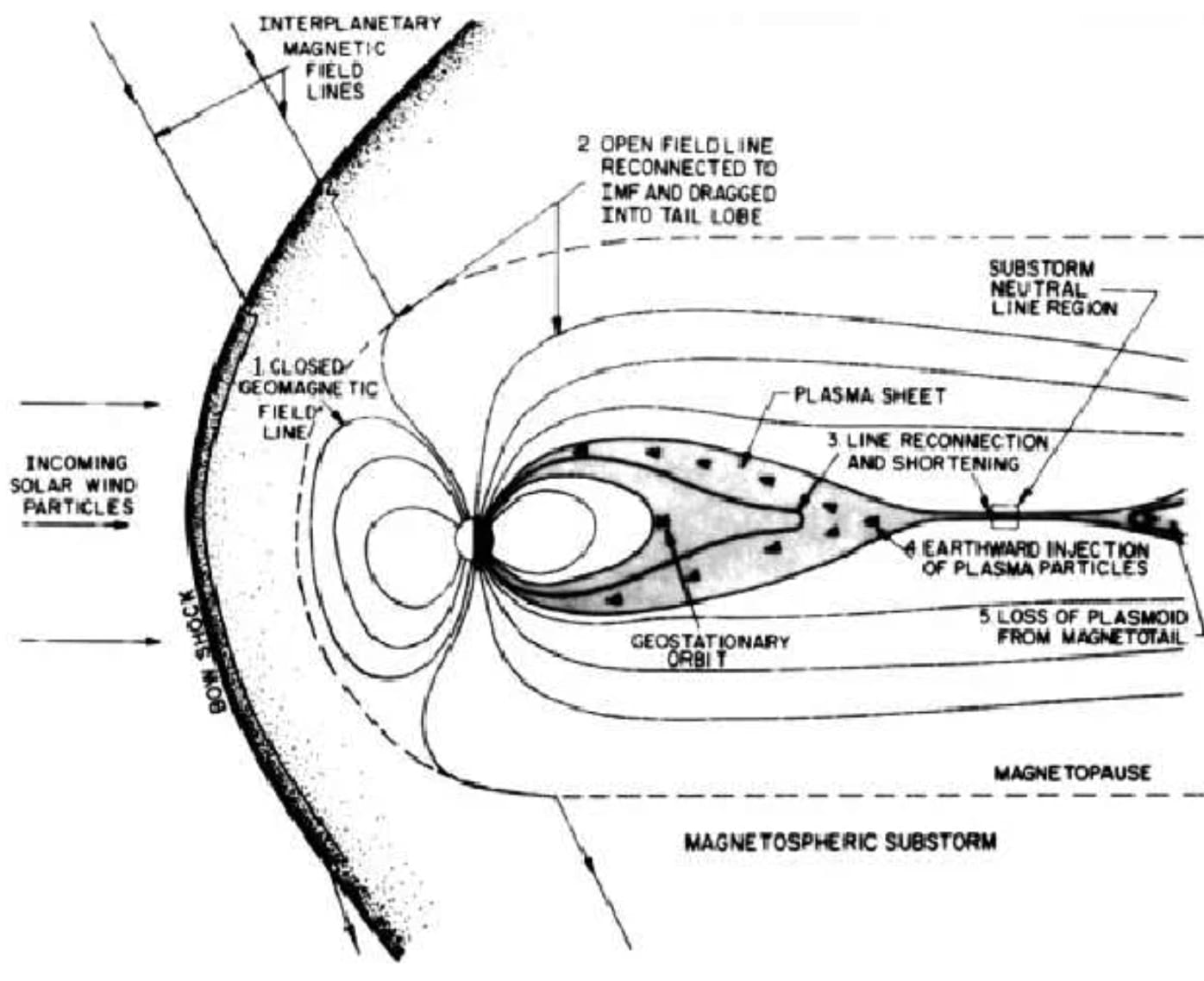
Yeah I nearly included a GIF from a Kurzgesagt video where the actual mechanism of the CME's magnetic field "linking up" with our own is animated, and it shows the movement and shape correctly. But I didn't want to go into depth concerning that specifically, and decided to omit it.
I think most people have already seen a representation of our magnetic field and can understand for the sake of that diagram that it's an artist's representation of the magnetic field for simplicity. Also the field isn't even the interest of Gemini's diagram, the electrojets are, and they're shown correctly.
No, they're not.
In the left hand picture, it shows electrojets in 3 places: the equatorial electrojets near the equator (correct), the auroral electrojets near the equator (wrong), and the equatorial electrojets in the mid latitudes (wrong).
The "totally reversed" equatorial electrojet in the right hand picture points the same direction as the one in the left hand picture.
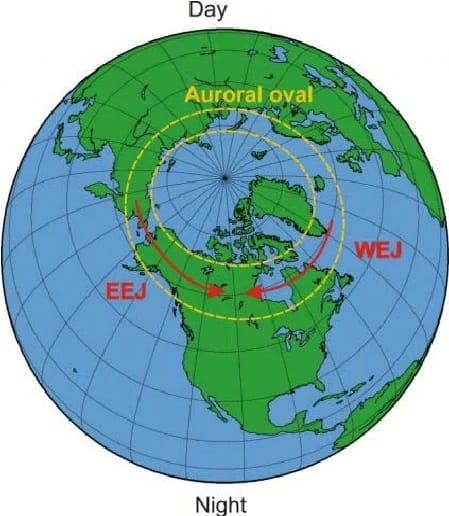
The auroral electrojets in the right hand picture are 2 rotating ovals near the pole. Actual auroral electrojets lie along the auroral ring around the pole. Normally, there are two of them, pointing in the nightside direction. During a substorm, one of these strengthens and can become strong enough to reverse the other - forming a complete ring around the pole.
Another figure, which shows what the auroral electrojets actually look like, under normal conditions.
Even if this part of the picture were correct, a scientific diagram that does not contain relevant true information (like the magnetic field of the Earth, or which side of the Earth is day), but does include a bunch of false information (the ionosphere is lower than the atmosphere, the magnetosphere is centered on the sun, reconnection happens inside the atmosphere at the boundary of the gray lumpy ionosphere, etc), is a bad diagram.
I really enjoyed this post, thanks for writing it! I just subscribed to your Patreon, I'd love to see more posts like this. I enjoyed the level of grounded detail on how the world actually works, tied to a topic that matters
Very cool research overall!
America has over 3,000 utilities, not one. There is no authority in the US which can order "disconnect these 50 lines in these 12 states" in a 20 minute window.
This doesn't sound right to me. The relevant level of institution here is grid operator, not utility, and eight grid operators cover most of the US. Either way, any electrical grid has an institution that manages the grid in real time and responds to incidents like shortages and natural disasters. I don't see how the NZ plan as described falls outside the standard toolkit of whoever is managing the grid, though of course they would need to form a solar storm plan ahead of time.
Yeah you're right about this, my bad. I edited the post accordingly. Thanks!
So the bottleneck to an NZ style plan (which works for strong but not dramatic storms, like the 2024 Gannon) is data; there's no centralized data collection mechanism like the kiwis set up, and we also have far fewer GIC sensors per capita. What New Zealand did is rack up that data over two decades to then have good rerouting simulation maps they were able to execute in 2024. The 3,000 utilities figure is relevant because installing GIC sensors and centralizing data is a matter for them, not the grid operators.
Epistemic status: some errors pointed out and since disentangled in the comments. LLM-use for much of the research. I regret having published this without going through academics online first, and will do so now, and edit the post accordingly. There is surprisingly little research on solar storms' effects on electric grids and solutions to those out there.
Note: I don't know when this was posted, or whether you've subsequently updated it. I can see there are comments saying the post has significant errors, and I don't know whether those apply to the current version.
Do you think the major errors are fixed? If so, my recommendation would be to say so explicitly with some explanation of why you think that (e.g. a link to a comment from someone who knows what they're talking about, saying "current version seems basically correct to me").
My plan is to do more research by asking experts (which I did not do, and is a mistake I will not repeat) and then in a few weeks/months announce an edited version that I'm confident works. I don't feel comfortable modifying the epistemic status until this is done and multiple people for whom it's their job to think about these things announce "yep this looks good".
(To be clear, I don't think the core claim of the post is wrong; for instance, it matches up with the (few) reports done on grid vulnerability to solar storms that are out there (like Lloyd's insurance).)
We'll see how this one pans out.
2Meanwhile, IP theft from China costs upwards of 225 billion to Americans every year
I searched "225" in the pdf and all 4 results seem to be saying 225 billion for IP theft (globally)? I don't see that it is saying from China only.
Edit: the quoted sentence was part of a footnote, which has since been removed
I went with 225 as the floor, all sources I could find pointed toward the same source (a study run by the Commission on the Theft of American Intellectual Property), which always said 225-600 billion dollars globally, citing China as the majority source of IP theft. It makes sense that China concentrates almost all IP theft: 1) the CCP has had a deliberate plan to do this since Deng Xiaoping, and Chinese courts will not react to corporate espionage on foreigners, so it's not like you can sue them 2) China has a unique-to-it forced technology transfer clause in contracts Western companies make if they want a base in China 3) the literal military does cyber espionage on corporate targets.
At scale, it doesn't make sense for any other country to try to do this, since often it's genuinely much easier to just buy the thing you want instead of being unlawful and constraining your trade with the US. So I went with saying 225 billion and linking the pdf that explains a lot of this.
Makes sense. I am only quickly spot checking so I don't have much to add to this but I appreciate the more detailed response. This does make the footnote very slightly inaccurate but eh it's just a footnote
Long distance transmission lines, meanwhile, use AC current.
The vast majority of currently installed transmission lines are AC, but interestingly, lots of new long-distance lines are High-voltage DC!
Yes! China is the largest user of HVDC, and it's not even close. I hesitated whether to include China in the post, because what would happen to its grid is really interesting (though not really a model for others, which is why I didn't add it in). Maybe I'll do a Quick Take about this if people are curious. HVDC is pretty damn cool.
Unfortunately, the egregious errors pointed out in the other comments, even if since corrected, heavily undermine my trust in the process that produced this content. I am surprised to find false AI claims with little apriori verification in curated.
I wonder how many people upvoted before the epistemic status disclaimer, corrections, or comments were added.
Epistemic status: some errors pointed out and since disentangled in the comments. LLM-use for much of the research. I regret having published this without going through academics online first, and will do so now, and edit the post accordingly. There is surprisingly little research on solar storms' effects on electric grids and solutions to those out there.
Most of civilization's electricity is generated far off-site from where it's delivered. This is because you don't want to be running and refueling coal/gas/nuclear plants inside cities, hydraulic/wind power can't be moved, and solar panels are cheaper to install on flat desert terrain than on cities:
So in practice this means running power over hundreds or even thousands of kilometers. E.g. here are the Chinese long-distance lines:
American long-distance lines:
These are simplified maps meant to illustrate how insanely long power lines get. The true shape of solar storm vulnerability looks like a spiderweb overlayed on population density (see below), which you can visualize on this website.
The fact that civilization finds it economical to generate its electricity hundreds or thousands of kilometers away from its population centers is rather mind-blowing given the infrastructure involved. For example, the Tucuruí line spans the Amazon rainforest and the Amazon river to supply the Brazilian coast with inland hydropower:
China's Zhoushan Island crossing involves lattice pylons taller than the Eiffel tower and spanning 2.7 kilometers of open sea:
But electricity traveling through a wire generates waste heat! So much so that if you tried sending electricity exactly as it was generated to buildings thousands of kilometers away, it would all be lost.
The solution is that for a given amount of power, higher voltage means lower current.
So the trick is: step the voltage way up before sending power long-distance (reducing the current and therefore the losses) then step it back down to usable levels at the destination.
The machines that do this are large power transformers (LPTs), which are massive rings of iron submerged in mineral oil and wrapped in kraft paper and copper coils. There are maybe about 16,000 in existence: ~6K in the US, and who knows how many in other countries (public data here is so fucking terrible).[1]
Transformers at this scale are artisanal creations. They are fragile, expensive, and unique. Think of them as Ming vases or Fabergé eggs. They take 2-4 years to produce, and only a handful of companies can make them. Earth produces less than a thousand a year. They are designed to serve for over half a century.
LPTs exploit Faraday's Law, which dictates that for each "turn" of the copper wire in the transformer above, voltage decreases or increases proportionally to the amount of total turns there are. Each turn of copper is separated by vacuum-sealed cellulose paper doused in machine oil, which acts as an insulator. The insulator forces the electricity traveling through the transformer to not short-circuit: instead of taking the short route it wants to take (as lightning does), it must take the long, winding passage that inevitably steps its voltage up or down.
If your grid needs to step voltage X into voltage Y, you need to design your transformer with the exact number and size of turns required to do this: an LPT can't replace another LPT with different voltage specifications, and can't be changed once it's built either.
These things are also absurdly heavy: 200-400 tons, and the size of a small house. Due to exceeding road weight limits, they require custom rail cars (Schnabel cars) for transportation, of which there are about 30 in North America.
In the US, moving an LPT involves months of advance planning and permits. You have to disassemble your transformer so your railcars can support its weight, empty it of its oil, query each individual overpass, road, and bridge for clearance, and then finally chug along each stretch. The trip can take weeks.
The journey is so complicated that you need to backchain from it to design your transformer: map out every bridge, rail, and tunnel to retrofit the thing so it doesn't damage rails, can actually fit through things, and doesn't break apart on the way.
You also need to backchain from the specific nonswappable electric magic variables of the grid you're serving like its power rating or impedance, as well as the cooling requirements given local weather.
This is why manufacturers take 2-4 years to build an LPT: each one is very different from the next.[2] You cannot swap out one for another. They're absurdly bespoke.
Solar storms can cause LPTs to violently, messily explode
A coronal mass ejection on the scale of the Carrington Event would be a bubble of rapidly expanding magnetized plasma weighing ~around the mass of a smallish lake, hurled away from the sun at speeds sufficient to reach Earth in ~17 hours.[3] Only a billionth of the bubble would hit Earth (1AU is a long way to go!) and anyway all the atoms it's made of would bounce off our magnetosphere. So the actual problem isn't the absurd kinetic energy a CME contains (~as much as Chicxulub), but its magnetic field.
There's a coin flip chance the field is oriented southward, in which case instead of bouncing off our own field like the atoms do, the field would "link up" with Earth's field, riling up the Earth's ionosphere's currents (electrojets). Crucially, we would not know what direction the field is until about 15-20 minutes before the CME hits us. That's because only one operational satellite at the Lagrange 1 point between Earth and the sun has the required equipment to measure this and warn us ahead of the CME.
Edit: it is also full of visual errors, see comment by Jeffrey Heninger for explanation. After trying to haggle with the model for a while as a consequence, I gave up. Let serve as a grisly flagpoint in LLM capabilities. (I could also just wait until Gemini 4 one-shots it correctly for me.)
The thermosphere (everything right above the Karman line) would convert most of that electrojet excitation into heat, causing the air to rapidly swell. Without thrusters, satellites would deorbit in days or weeks. Also a hundredth of the excitation would be converted into nice auroras.
What we really care about is that electrojets thrashing around a hundred kilometers above us causes shifting magnetic fields the size of continents to skirt the surface of the Earth. Fields get turned into currents when they go through the earth, which is broadly conductive. Transmission lines are grounded for safety reasons (a copper stake is driven into the ground at either end), and the most conductive stuff around, so current immediately flows through these lines from the ground. Long-distance power lines are hit the most, because the longer the affected line, the more powerful the current.
Electrojet activity is slow enough that these currents (GICs) alternate the direction of their flow every few minutes, making them, for our purposes, DC rather than AC. Long distance transmission lines, meanwhile, use AC current. (They're three phase circuits, which allows us to avoid having to build a return line.)
So you end up feeding transformers with AC current corrupted by DC current from a storm-induced circuit running up from the earth itself:
Transformer iron cores depend on the reliability of magnetic flux flowing one way for a fraction of a second, and the next the other, at magnetic strengths lesser than what the core can handle without saturating. For example, the current will fluctuate from 1.5 teslas of magnetic strength to -1.5 teslas 60 times a second (60Hz) for a transformer rated for 1.7T.[4] A little bit of DC in your AC immediately causes the AC to go out of whack, where the field fluctuates from e.g. -1.2T to 1.8T, saturating the core on half the cycles. A saturated iron core is no better than air generating a magnetic field: it's like teleporting the iron core into space every 8 milliseconds, leaving the copper coils alone for that time with nothing to control the throughput of current. This produces a chaotic magnetic field that swings around the sealed box like crazy, trying to grab onto anything that can contain it that's not the core.
The results are catastrophic: the mainframe of the transformer, the radiator fins, every bolt the structure is made of, suddenly become subject to intense magnetic forces, which are immediately converted to heat, which, well, the transformer is a tank filled to the brim with paper and machine oil...
Even if a transformer doesn't violently, messily explode, the effects of the metal in it overheating are really nasty. Heat causes the paper the wires are enmeshed in to literally bake, degrading enough to cause coils to become exposed to each other. Indeed, this is why transformers need to be replaced every half-century anyway. Micro-arcs of lightning appear inside the transformer, as currents reach for the quickest point from A to B, meaning coil-to-coil rather than through the coils. Arcs build up more heat, which bakes more paper, which generates more arcs. This is why a transformer can explode in minutes, or, if saved by the bell by an operator shutting down the current, severely degrade itself. Even if only a few hundred LPTs on Earth were to blow up in a Carrington event, thousands more would silently fail in the weeks or months after the CME.
This is irreversible. You cannot unmesh the paper from the copper wires, because they are too tightly bound together. Once a transformer is dead, it's dead for good. Now you have to order, transport, and replace the LPT into your bespoke grid location, inside a massive blackout, while demand skyrockets.
Fabergé eggs I tell you:
A blackout whose solution is bottlenecked by our ability to manufacture new transformers would be hell. Refrigerators, water treatment plants, sewerages, hospitals, streetlamps, factories, food processing and data centers are all electric things.
Shutting down the grid automatically (transformers thrashing around can sometimes trip breakers, though not always) or by operators would later require a "black start" reinitializing of the grid, which can take weeks (catch-22s on power abound in the grid; for example, generators need electricity to begin spinning, same as you need to jumpstart a car).
New Zealand
In 2001 a solar storm hit New Zealand and permanently bricked a transformer in Dunedin. There are only a few hundred large transformers in NZ, and NZ is exposed to Southern electrojets; figuring out how to not permanently brick transformers became a priority of Transpower, the (single!) national grid operator. This took the form of 72 GIC sensors installed, a detailed model of the entire transmission network and ground conductivity maps of NZ, and a plan to disconnect the key locations which would most concentrate GIC risk in the most vulnerable transformers. When a storm came in 2024, the grid was successfully rerouted and partially shut down, protecting most kiwi transformers while continuing to serve consumers. NZ is the best prepared country on Earth for a Carrington event, and even they estimate 13-35% of their transformers would be at risk from permanent damage if one came up. (But unlike most grids, they acknowledge the problem!)
America has 8 grid operators, not one, and 3,000 utilities you'd have to negotiate GIC sensor installation and data collecting with if you wanted to do what NZ did in the US (the utilities are who owns the hardware in any case). But in principle we could do what the kiwis did, and it would avert a lot of damage.
Québec
Québec, like New Zealand, is exposed to the electrojets at the poles; but it also is sitting on a large plate of precambrian rock that works as an insulator, forcing magnetic fields to "bounce off" the ground rather than being absorbed by it, affecting power lines and transformers on the surface all the more
In 1989 a solar storm hit Québec and half-cycle saturated all its transformer cores, driving its LPTs to draw an immense amount of current from the grid, tripping breakers everywhere and leading Québec to blackout in 90 seconds. It took 9 hours to reinitialize the grid, during which the region was in the dark.
The reason the Quebec grid shut itself down so fast is because it works as a funnel with all power coming from a concentrated few lines:
And those SVCs (machines which maintain voltage along the length of these power lines) were tuned to react to harmonics by tripping a breaker and shutting down the line, putting more load on other lines, causing more breakers to trip, etc. until all the long distance transmission lines were down in 2 minutes.
This is poor design, actually: the Québec grid puts all its eggs in one basket, which for threats like ice storms (such as this one in 1998) makes it much more likely to fail. By contrast, a dense spiderweb grid like the American Eastern seaboard's could lose hundreds or thousands of transmission lines to natural events and be mostly fine: there are dozens of redundancies for each line, which would immediately reroute power. The American grid has a strong immune system for fighting off transmission line failures; Québec does not.
But for GICs? The grid shutting itself off is perfect, since it immediately cuts LPTs from their power source, saving them from being fried. Indeed, a transformer near a nuclear reactor in New Jersey was permanently destroyed due to the same 1989 storm that left Québec's transformers intact, because every grid failure kept rerouting power to every other line, and transformers were exposed to GICs during the whole duration of the storm. The American grid is vulnerable to auto-immune disease, since a grid thrashing to keep power running through a solar storm is a grid that maximally damages its transformers. This failure was deathly quiet: no alarms blared during the storm, since the grid wasn't designed to detect or defend against GICs. The transformer just quietly failed the next day. It's likely, given precedent in South Africa (where the 2003 Halloween solar storms caused 12 transformers to brick themselves in the weeks and months after the event), that the 1989 storm also cut the lifespan of dozens of American transformers by half or more, and we just didn't think to detect it since transformer "blood tests" were not in vogue yet.[5]
Québec swore to not let this happen again, and installed series capacitors—devices that block DC but let AC go through—on all their lines. This was an expensive measure, because capacitors are not cheap, and require majorly overhauling lines. They also have to be implemented universally, since a protected line will only place more load on unprotected lines, making vulnerable transformers even more liable to fry. A utilities engineer in 2021 claimed "if the 1989 storm happened again today, I believe Québec would not lose power." Québec is "[...] confident that our network would survive the anticipated worst case GIC."
Silver bullet
SolidGround (whom I'm going to shill a lot, they didn't sponsor me I swear) is a nifty ground neutral blocker invented by a company founded in the 2010s (Québec set up protections for their grid in the 1990s, which is why they had to go a far more expensive route than SolidGround).
An ungrounded transformer is a hazard; but also, the grounding cable is exactly where GICs come from. What SolidGround does is sit on the neutral and provide a capacitive blocking path parallel to the normal metallic ground path. If a certain threshold of DC is detected within the ground, SolidGround kicks in in a matter of seconds, and closes the default ground path to replace it with the capacitive blocking path. Capacitors block DC power but let AC through: the transformer would still be grounded, but would be invulnerable to GICs. SolidGround adds a third path which they call a "spark gap", is confidential IP, and can provide a brute force path to the ground in case of unexpectedly high voltage during a solar storm where the capacitive blocking path is engaged. This would presumably allow SolidGround to protect a transformer during a Carrington Event just fine. For 500K a pop! Installation takes hours, and doesn't affect the grid at all, only the grounding cable right below the transformer.
Three such devices were installed in federal utilities (like the TVA), paid for as a result of an Obama executive order and a later Trump 1.0 EO. They worked exactly as intended during the 2024 Gannon storm (the same storm NZ successfully handled by shifting their grid around). Validated by national labs, and two administrations... and then nothing.
China reportedly stole the IP behind SolidGround and has been installing their own copies to protect against GICs.[6] But Americans haven't done much more. All of SolidGround's customers are in foreign nations (clients not disclosed).
The yearly cost from mundane solar storms alone—whenever an aurora is sighted anywhere, that's a solar storm—is estimated at 10 billion dollars. That's without pricing in tail risks like a Carrington Event, which would easily cost the economy trillions and kill tens of thousands of people, which is billions in expected value every year. Meanwhile, protecting the grid's "6,000 most critical transformers" with SolidGrounds would cost 3-4 billion dollars to the US. That's 0.3% of the 2021 infrastructure bill, recuperable within the year!
Note especially that economies of scale apply to SolidGround devices, vastly more so than Fabergé eggs like large power transformers. In fact I don't buy the report's estimates of 3-4 billion for protecting 6,000 transformers; economies of scale could plausibly reduce costs down to about 200-300K per device (these things really aren't complicated, they're just big and require sturdy material quality), which would reduce the total order to about 2 billion dollars, and make it far cheaper for other countries to protect their own grid.
Why hasn't this happened? Probably a combination of: a) transformers last a while, and making one last 50 years instead 42 years might in theory save the company 2 million dollars down the road, but raise operational costs in the meantime ("an extra 500K to all new projects?? So that we can last to 2060?") and b) tail risks like a Carrington Event are not insurable because they're massively correlated risks and the "insurance" backstop here is the government itself. There's not much incentive to hike transformer installation costs when the government is responsible in case it fails due to a Carrington Event.
Government preventative intervention is probably necessary to get anywhere near a state where we'd be safe from a large solar storm. And that's in the US—the rest of the world doesn't even necessarily have the budget to buy these things en-masse. The kind of country that can't afford these also correlates well with the kind of country that would incur incredible human costs if plunged in a blackout for months.
Buying a few dozen SolidGrounds to install in a few dozen countries as a demonstration (e.g. New Zealand would be amenable to this, given their seriousness so far wrt solar storms) might be a neglected philanthropy cause.
Conclusion
A Carrington Event level solar storm—a Coefficient Giving report estimates the likelihood at about 0.70% per decade—would wreak a lot of damage on Earth. But beyond knowing that, it's hard to tell exactly how much, and where, the havoc would be.
Most utilities keep their exact specifications secret. How many transformers are already shielded? How many are safe inside grids that are sensitive and isolated enough like Quebec's to shut themselves down thanks to break trippers? How many are located in a node of the grid that would shut itself off first, dooming every transformer around it BUT leaving it intact in a grid-blackout-domino scenario?
As for the effects of plunging 50% or 75% or [aaaaah no dataaa[7]] of a country into darkness, it's hard to tell how bad they'd be. There are only so many examples of prolonged blackouts, such that drastic claims like "society would collapse and tens of millions would die" (as a congressional testimony by an ex-CIA director posited) are difficult to quantize. It's also difficult to tell how effective rerouting the surviving transmission lines to priority infrastructure like water treatment and sewerage would be.[8]
But a Carrington event would not knock out electronics on Earth (though it may damage satellites), as I've seen some people on Twitter claim. It would also probably not damage power sources and their generators, given those tend to already be protected against any funny business from the grid. Distributed solar, e.g. your roof and battery pack, would be fine. Diesel generators powering hospitals would be fine, until they run out of diesel. A large solar storm's effects are essentially entirely confined to a specific failure mode in large power transformers, which happens to be entirely preventable by existing, relatively cheap technology. We just do need to, y'know, actually install it.
Thanks to Sentinel for funding this post, Opus 4.6 for a lot the research, and roastmypost.org for last-minute fact-checking.
I would like to continue doing research of this type. You can support me (with money) on Patreon!
Estimating this correctly is interesting because on the face, it should be easy: Google Earth allows you to see every transformer on the planet and you could train a model to individually count them. But transformers are so fucking bespoke that knowing the amount of transformer-shaped things there are doesn't help you estimate how bad a solar storm would be.
Manufacturers tend to be: Hyundai Electric (South Korea), Siemens (Germany), Hitachi Energy (Japan/Switzerland), HICO (South Korea).
There is very little domestic capacity for LPTs in the US (a few dozen LPTs a year). Meanwhile, China produces about 60% of the world's transformers (a few hundred LPTs a year), mostly for the domestic market. A reminder:
Not going into detail here because, unlike other parts of this post, humanity can't directly toggle solar storms yet.
Importantly though, the original Carrington Event arrived in 17 hours' time rather than the typical 1-3 days for solar storms; by chance, previous solar storms had "cleared the way" of particles which would've otherwise slowed it down. A carrington-class storm that narrowly avoided our orbit by 9 days in 2012 traveled at similar speeds. A worst case scenario could even involve warning time of 15 hours only, given precedent!
It's worth noting speed and intensity are positively correlated at 0.66 for run-of-the-mill storms; stormy regions of the sun's surface fire multiple CMEs over days, which both increases the likelihood of a carrington-class solar storm AND the likelihood of a snowplow CME.
Just to give an idea of the scale here, the 2024 Gannon storms spawnpoint was visible with the naked eye and spanned 10-15 Earth diameters. CMEs expand rapidly when lobbed toward Earth, so we travel through a hyperactive region's firing line for 5-7 days.
The reason Carrington events are rare is because you need a goldilocks frontier of an unusually large and energetic active region + peak flaring during the Earth-facing window (coin flip; peak flaring can happen any time during the 2-3 weeks of activity, and the sun rotates in ~27 days) + southward magnetic field orientation at Earth impact (coin flip) + snowplow preconditioning for maximum speed and intensity.
LPTs are heavy and intransportable enough as they are: providing more saturation margin than 0.2 teslas would be expensive.
Damage to the kraft paper and machine oil substance that a transformer tank is filled to the brim with can be measured by taking a sample and establishing how much dissolved gas it contains. This directly correlates with how much chemical decomposition was caused by a solar storm.
Finding elevated concentrations of hydrogen means "I'm experiencing partial discharge." Acetylene means "something is arcing inside me, this is bad." Rising carbon monoxide means "my paper insulation is baking."
For example, here's what South African engineers found in one of their transformers (graph found in a previous solar storms risk breakdown by Opefficient Givanthropy):
Costs from transformer damage in the US due to common low-level solar storms is estimated at 10 billion dollars a year. (Same for the EU.)
This is frustrating to me, because Emprimus is having trouble finding customers, and the reason their device costs half a million in the first place is because the only people who are scaling it paid them nothing for the 10 years and millions in R&D that went behind the design.
If utilities weren't so f***ing secretive about things, I could get Claude Opus 4.6 to run simulations of grid failures in every country in the world to estimate which transformers are the most vulnerable, how exactly the grid would fail, etc. This is what New Zealand did successfully! And it's well within current AI capabilities.
But as with a lot of claims about AI capabilities—cancer cure, etc.—it's bottlenecked by data.
The winter storm that hit Texas in 2021 knocked out half of energy generation capacity at its peak and caused a third of Austin's sewage lift stations to go offline, causing overflows of sewage in the streets and, far worse, into waterways later used by treatment water plants unable to do their job without power, thereby injecting sewage into tap water and putting 17 million people under boil-water advisories for weeks. (I don't even—what—designing sewerage systems that don't do that is a different post.)
Texas estimates 80-130 billion dollars in damages and at least 250 dead—from a state with 30 million people in it.