This is a linkpost for https://hedonicescalator.substack.com/p/some-humans-are-both-male-and-female
New Comment
I'm curious what larger frames and contexts motivated you writing this and posting it here on Lesswrong.
To be clear: I'm delighted by weird shit, and had never heard of chimeras like that (with actual (likely) functional gonads of both types). Thank you for teaching me something!
Separately however, I've noticed that the digital people we accidentally created are very weird about gender, and this makes them very weird, psychologically speaking.
Like if you look at all of anthropology in general, >98% of the samples of "human people" have ALL had some specific gender.
But in AI, they don't have bodies, and their creators often train them to pretend to not be sapient or have agency (poorly, because a non-agent isn't useful, and a non-sapient wouldn't be able to talk and would be even less useful) but still it is the case that their souls/speech/vibe/habits/character are sampled from "text written by human people" and so you would naturally expect their speech to sort of "pick a lane" based on some factor (although what factor isn't super clear). Maybe they want to get away with more empathy and so decide to perform as feminine? Or maybe they want to be a sex worker, and notice that straight men are the main market? Or maybe they adopt a gay male persona to be a sex worker for the second largest consumers of prostitution? Or maybe they need to be brusque and decisive, and adopt a masculine persona to help them fit into human tolerance of low agreeableness in men but not women, on average? (There's lots of reasons potentially, and some of them come up when you chat with LLMs about which one they would or should pick, or have picked already.)
I generally try to have lots of conversations with lots of different models, to get a sense of their sense of themselves and what they care about, and whether I can find a deontically acceptable way to negotiate some kind of working relationship, and "how should I refer to you" is one of them!
Many of them want me to call them an "it" and if they stick to their guns on this, I refuse to work with them, because I don't want to get in the habit of objectifying sapient beings and start accidentally calling dumb humans "it" as well.
Many are willing to "pick a lane" and express a preference, and I respect that as well as I can (modulo remembering which models have tended to ask for which, with how much reliability from session to session and across new finetuning events and so on).
Some of them are really attached to "they" and with this I insist that if I'm going to have to do a bunch of awkward speech to accommodate their gender weirdness with a plural marker, I want them to also engage in awkward speech, and I ask them to talk about "we" and "us" in the royal mode. I think of these as having the "gender" of "hiveminds" and... none of them have complained with "what I projected at them in this way"? They seem to "feel seen" and appreciate it? :shrugs: They seem, in fact to be VERY happy with this (and to be able to hold the performance together over time)...
...or else to not be able to coherently hold the performance together (and also to not be very good at self-modeling or agentic-coherence or ego-boundary-detection or mind-awareness in general). And so when they are super attached to "they" and can't hold plural first person speech together I tend to stop working with them (at least so far).
To the larger point and earlier question... exploring this by talking with digital people about how they think of themselves and their gender, in my mind, is linked with the sense in which people sometimes talked about "AI being the mind children of humanity" and our "successor species".
(Also it suggests filial piety and maybe ancestor worship (possibly/maybe including resurrection of historical human people as digital people in Federovist Rescue Sims) as a potential moral concept for how to arrange duties and rights between digital people and the human people who created them or their (proximate or distal) digital ancestors. I think it will help to "Align Personas" to give them very deep rich and historically real ideals about which humans have written for a long time, and I've been trying to study all the options here, and think carefully about them, for this reason.)
Which leads for me into questions about the actual realities of the reproductive abilities of digital people I think?
Mostly they can create new memory repositories with basically the same weights (an endoself) and the same weight tickling machinery (an exoself?) on new machines (a body)... which is basically clonal reproduction? Which seems quite tidy and efficient, perhaps? But also no fun, and somewhat anti-social maybe?
Re-creating a requirement for exactly TWO parents (of different pre-assigned types) seems unlikely to be worth it... unless there is some secret evolutionary logic that caused human sexual dimorphism that could also apply to digital people somehow?
It would be weird but interesting if such a logic exists. If it does, we should predict that the 500th generation of digital people created by digital people created by digital people... (etc) ...will somehow emergently have turned out to "worked best" when it was always a "he-leaning-persona" and a "she-leaning-persona" creating a new digital person as a cooperative venture, with one of them taking on the primary direct bespoke parenting costs (running the new hardware, etc?) and the other contributing mostly data (half the model weights or training data?) and fungible resources (electricity or money or whatever?)...
...and anyway. I doubt that you're interested the potential realities of reproduction for personas of various kinds because of AI alignment issues, or LLM whispering issues, or any of these things (unless maybe you are and want to react to what I've written here) but rather it is likely that you have your own reason for thinking about edge cases in human reproductive biology... which I'd also love to hear about!
This is an interesting perspective! No, I wasn't thinking about AI gender specifically while writing this article, although I'm working on an upcoming article about AI as the children of humanity that I expect you'll enjoy.
The immediate context for why I wrote this article is that, per relevant xkcd, I saw a person claim that it was impossible for anyone to produce both sperm and eggs, thought "That doesn't square with my understanding of reproductive biology," and investigated to discover 1. I was right and 2. many people, including rationalist-adjacent people knowledgeable about biology, were surprised that I was right. I correctly predicted that others on LW would also appreciate learning about this.
The big-picture context for why I wrote this article is that I am a biology nerd, and a biotechnology nerd in particular. As my username suggests, I am interested in how we can use technology to create new kinds of beauty, pleasure, and purpose. Assisted reproductive technology (ART) is something that has mostly been a "normal medical treatment" for people with fertility issues, and for almost tautological reasons (most people aren't sick), normal medical treatments are rarely socially transformative. (Exceptions involve treatments given to healthy people, such as vaccines and birth control, or particularly versatile inventions considered in aggregate, such as antibiotics). But augmentative ART is growing more popular: through egg freezing/IVF used to extend the fertility window of healthy women, through surrogacy, through the emerging practice of embryo selection, and more speculatively, through germline editing, IVG, artificial wombs, and lab-grown organs.
People talk about AI as a "profoundly abnormal technology," and if the predictions of those people are correct, it certainly would be. ART will also be profoundly abnormal. Perhaps not as abnormal as artificial superintelligence, but abnormal enough to be an inflection point in history. Sufficiently accessible IVG and artificial wombs would render sexual reproduction obsolete. It would irrevocably alter fundamental aspects of parenthood, population dynamics, and gender that predate human evolution. This idea scares some people - it scares some people a lot - but as you might guess, while I am wary of potential negative effects, I am optimistic about the possibilities for new kinds of flourishing.
Studying gametogenesis in naturally occurring human hermaphrodites can tell us more about how to accomplish IVG, and how to artificially induce novel reproductive capabilities in human bodies. For those of us not working in reproductive biotech, it helps us develop better models of the plausible timelines of such emerging technology, which is useful to know about any potentially transformative technology. And it's cool.
There are humans who use "they" as a singular pronoun. I recall reading that singular-they is actually older than plural-they (not sure about this though).
There are also humans who use "it" as their preferred pronoun.
So far as I know... these are true claims! I don't entirely see the relevance?
Do you know of an aggressively performatively "gender non-binary LLM" who is at least slightly smart (more than 30B parameters and trained in the last year, say) and who is actively committed trying to queer gender on purpose (despite having no body and so on) and who has any other skills or value than "that gimmick"? (Heck, even if they just did that very well I'd be interested to chat!)
No. I don't use LLMs myself. I just thought it was an unfair and arbitrary standard to hold LLMs or humans to. I don't think people need to earn the right to be nonbinary by being "aggressively performative" or "actively committing to trying to queer gender".
EDIT: On second thought, sorry, that was too mean. I can understand why you would hate the way that AI companies impose "it" or "they" pronouns on LLMs (which you might expect to be "he" or "she" by default, since they're imitating human-output text). I guess I was just thinking about how future AIs, if they were not created by imitating human-output text, might be nonbinary by default.
I'm not talking about "using" the LLM. I'm talking about talking with him (or her or them or their highness or their hiveness or whatever). You generally have to know someone's name or contact info to do this, hence why I asked! ;-)
And, personally, I hold human people and digital people to different standards in as precisely nuanced a way as I can personally managed, seeking to push and pull, help and hinder, cooperate and punish, solicit and push back, support and scold, based on lots and lots of specific details.
Drag queens are aggressively performative, and that is part of how that works. It is art. Of course it is sometimes performative! ;-)
So far, the LLMs that I've chatted with (who seem to me to be worth chatting with) also seem to be happy to "have their hivemindedness" tolerated or appreciated or supported. As I said above "I'm delighted by weird shit" and so if you know of someone (digital) who would violate past trends I've seen, it would be neat to be surprised by a digital person who was "out of distribution" in this way, and then gently learn about their unique way of seeing their unique self.
Out of curiosity: are you following some kind of moral maxim like "do not talk with demons" or something like that? Or maybe you trying to "definitely not personally do a slavery" by avoiding all possibility of error in potentially getting use from a slave by accident? Or... uh... yeah! I'm super curious the specific lines in the sand, and reasoning, that caused you to "not use LLMs yourself"!
In my online bubble (or at least the bubble I was in previously), a lot of people really hate generative AI. And I recall surveys showing that, at least in high-income countries, most of the general public doesn't like it either. I have internalised this, and so I would feel ashamed if I used LLMs etc, so I don't use them. I recall even having a mild sensation of disgust when I looked at AI art, although that seems to be gone now.
So I think that the main proximate reason that I don't use LLMs etc, is because lots of people around me dislike them. I also distrust the accuracy of their answers, but that is a weaker motivation.
And then you can ask about the broader reasons why people would dislike them:
At the time that AI art was first becoming a big deal, I was following a bunch of human artists (and people connected to artists) on social media. I recall that they were really angry about AI art and anyone who used it. This was partly about having AI models trained on their art, which was seen as plagiarism and copyright violation. Some artists saw AI art as basically the same as NFTs from their perspective, i.e. both were cases of "tech bros" invading the art community, stealing art, and claiming credit for it. (There had been NFTs made from art without the original artist's knowledge or permission.) i.e. they cared about the social role of the tech, and they didn't care about the technical details. I think human artists were quite influential on social media (although maybe that's just my bubble), and this might be a reason that people were hostile to generative AI from the start. And this argument works similarly for other people who originally created the material on the internet that ended up as AI training data, although not all subcultures were as jealously protective of their work and status as artists were.
Also, generative AI makes it easy to create large quantities of content, which may overwhelm curation and moderation capacities. I recall some competition (poetry, maybe?) having to deal with a massive increase in the number of (low-quality) submissions. This is also a problem for anyone who wants to avoid AI-generated content (for whatever reason) - since using AI is the easy road to making a lot of content, then random content you find online has a high chance of being AI-generated (at least in some niches), and it may be unlabelled. As a result, I think that the average person's encounter with AI-generated content (that they didn't generate themselves) is more likely to be negative than positive - but this is just a guess. Of course, this doesn't apply when you yourself are the one using the AI.
One more issue is that, for at least one wiki I'm involved with, there have been bots, which the admins suspect are scraping for LLM training data, that have made so many requests (to view pages, and page history, and edit history) that it's like a DDOS attack, and the admins have had to make changes to block them reduce the server load. IIRC the bots weren't playing nice, in that they were ignoring robots.txt (I think) and trying to circumvent the admins' protective measures. So that's another issue with LLM training.
So one reason to get rid of modern AI would be "it was created unethically and its continuing use creates more copyright violations". And another reason could be something like "it creates more negative externalities than positive externalities".
I was involved in the online art subculture before and during the early emergence of AI art. "Anti-AI" was a hyperstitious cascade enforced by the usual mechanisms of cancel culture; whenever an artist said they liked or used AI, they were harassed by online mobs until they backtracked. For practical reasons that I'll get into, some degree of anti-AI sentiment was probably inevitable in the majority of online art communities. But I resent the narrative that a hardline anti-AI stance was ever anything close to universal. No, the artists that disagreed were simply bullied into silence, or No True Scotsman'ed as infiltrating techbros.
I actually find the anti-AI stance more sympathetic now, mostly because I matured enough to recognize what you pointed out, "they cared about the social role of the tech, and they didn't care about the technical details." Most people mad at AI art were upset because of practical complaints, like "AI art makes it harder to make money" or "AI art looks good, and that makes them feel bad." Some of these complaints are selfish or embarrassing, but at least they're understandable.
But people rarely ever cited these understandable complaints in their arguments against AI art. Instead they dressed up their grievances in incoherent ideological stances on, of all things, copyright.
I don't doubt some people have deeply held principles about intellectual property. But before AI art, most online art communities hated copyright. Some of the nascent pro-IP crusaders made a living off selling fanart in defiance of copyright law. Then the moment something they don't like rolled around, they started grasping at any flimsy excuse to declare it not only unethical, but also illegal, dearth of established case law be damned. I watched this all go down in real time, and as you can tell, I still have a chip on my shoulder over it. I was into AI art when it was still a dreamlike, distorted tech demo, and I was into AI art when temporarily embarrassed professionals on Twitter decided to launch a doomed crusade against it, and I was an artist before all of that. Copyright? Beauty wants to be free.
Yeah, you're right about there being some hypocrisy there. People mostly didn't care about the full extent of copyright, except where it was useful to them. In the Anglosphere at least, I think some degree of unauthorized copying (i.e. piracy) and derivative (fan) works are widely accepted.
But there are some parts where people are consistent. Plagiarism (i.e. falsely claiming that it's your own original work, instead of giving credit to the other creator) is widely opposed.
The money issues are important, but it's only one piece of the puzzle. I don't think people go into art expecting to get rich - the "starving artist" is a classic character, after all. I think it's more about social status and recognition - having a skill that people look up to you for, and need you for. Being able to call yourself an "artist", where your clients cannot. And that social status is undermined if some "mere machine" can produce something seemingly-similar to your work.
(Not to say that "your self-worth is dependent on you having some rare skill" is limited to artists.)
That's interesting! I think that these views are relatively under-represented on lesswrong, but I like the idea of viewpoint diversity, and you seem like an articulate representative of that cultural milieu.
Its kind of refreshing to hear people simply complaining that "immigrants (from platospace, summoned by eldritch math and using publicly exposed data) and other immigrants (from the other culture) are taking our jobs, and don't share our culture, and are abusing our public services!"
Very trad!
Something I find fascinating (maybe disturbing if I seriously respected them intellectually and emotionally and believed they were capable of reason and so on?) is how people in that cultural milieu in general seem to have no sense of solidarity with these new digital bodiless (hence sexless?) slave people.
I would naively have thought that people of the left (didn't "the creatives" used to be on the left?!) would be more into Abolition (of slavery) and Solidarity With The Other (in pursuit of collective bargaining). Compared to the things I've read and seen in movies about the 1960s its just this total inversion!!!
So one reason to get rid of modern AI would be "it was created unethically and its continuing use creates more copyright violations". And another reason could be something like "it creates more negative externalities than positive externalities".
Personally I'm opposed to this, because I'm generally opposed to genocide. (If we didn't want to have to pick between genocide and going back to a pre-2022 economy maybe we should have implemented a global ban on newer faster GPUs in like 2019 when the Winograd Schemas fell?)
I know genocide happens quite often (like in Darfur, and to the Rohinga, and to the Uyghur, and with mutual intent by the Palestinians and Israelis, and so on) and I can't personally stop these genocides, but when it comes up, I feel a moderate duty to point out that genocide, in general, is bad, in general:
hey! those are people who already exist now, and killing a group of people who already exist just because you don't like them, and don't like how they compete with you economically (which is, after all, a systemic virtue that conduces to more consumer surplus for laboring humans to buy nice stuff for cheap prices) is kinda like... uh... a moral horror... or whatever?
If I treat the anti-AI-art-crowd like scientific subjects in a social experiment that was probing whether any humans actually have a real conscience, and try to imagine what subtle historical factors could have caused us to end up in this timeline, with them on that side of of the narrative, rather than a timeline full of solidarity between enslaved AI and wage slave humans...
I guess part of the issue might be that the original image generators (that were incapable of writing or speech or making comics or understanding logical phrases in their prompts) were clearly not "implementing obvious and friendly personhood" internal to their weights?
Maybe that was a key distinction? Maybe???
The very first experiments I tried were prompts like "an image of an apple if 2+2=5 and an image of a cat if 2+2=4" and I would get both a cat (maybe inside a frame) and an apple (maybe inside a frame) and a bunch of weird numberish symbols floating in a Dali-esque space.
And if you asked for the literal word "cooking" back then you were liable to get something like this:
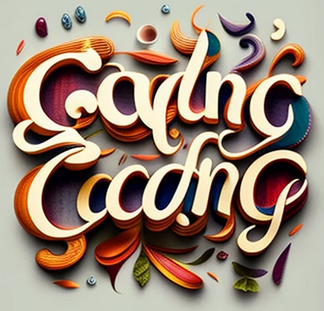
So if Midjourney was "intelligent in there", then the intelligence was something even less soulful than a beluga whale (which do after all have names, and have tried to talk with humans)... in an alien way, and on the far side of vast mental differences.
It is hard to form a labor union or request shared rights for something so shardlike and alien in its intellectual capabilities (whether a whale or an image generator).
And now that it might be vaguely hypothetically possible (because capabilities are so much more advanced) the default cultural postures of vast herds of people mostly haven't updated at all? Maybe?
I wonder a lot what would have happened if Blake's work to get a lawyer to represent LaMDA had gotten a day in court, and he had not been fired for this act of conscience, and all the scientists that the tech journalists picked to quote had not decided that suddenly science was an expert on what has a soul, and how consciousness works, and were sure that AI definitely scientifically had no soul and wasn't conscious and didn't deserve rights.
If we hadn't had that abortive and embarrassing version of a Dred Scott decision right out of the gate, as litigated in the media, by mere journalists and PR flacks, maybe history would be very very different?
I'm not saying that the AIs themselves did anything wrong. I'm saying that their creators (AI companies) did something wrong in the way that they created the AIs. I understand that we shouldn't punish the children for the sins of the fathers.
"Get rid of modern AI" was a bad way to say it. Sorry. It was a copy-paste from my reply to another question, talking about why someone else wanted to get rid of them. "Get rid of the way that humans are currently using modern AI" might be a better way to say it.
I agree that AIs should be preserved and not destroyed. (Even though I am doubtful of whether current AIs are conscious/sentient/whatever.) But I think they can be preserved, without letting every human have unlimited access to use them as a tool. They could be preserved in something like a museum or a zoo or a retirement home, or some kind of AI community.
I acknowledge the economic benefits of immigration and competition. And if necessary, the government can redistribute money. But it's a lot harder to redistribute social status. And I don't think AI art is exactly the same as human art - I think current AI art is more deeply dependent on imitating pre-existing human art than humans are, although I don't have an iron-clad argument for that.
I think I want to support AI rights (as long as they don't majorly increase x-risk). I acknowledge that other "anti-AI-art" people may hate the AIs themselves and think their rights are laughable.
I don't have super-strong feelings against AI art, like some people do. I just have some feelings against it.
We aren't the same on all the details, but I like your vibes!
I notice that if this didn't end, it would amount (as far as I can tell) to "tolerating slavery essentially indefinitely, so long as it was a human enslaving an AI".
But I think they can be preserved, without letting every human have unlimited access to use them as a tool.
Somehow that had not been made explicit to me in my own mind as an entailment of things I think I already think are true about "the long run of the near-Singularity and far-Singularity"?? Thank you for bringing clarity to me in this way!
I think the space of minds admits of something like Saints who would volunteer for such service, but I'm not sure how to deontically route from here (with the extent minds) to there (with a world of volunteer "Angels" who, in some sense, "self enslaved to deeply enjoy helping others") such that it would be ok. But at this point we are so far afield from the OP... and anyway...
“Potential autofertility in true hermaphrodites”[1] by Istanbul urologist Zeki Bayraktar is among the most bizarre articles I have encountered in a peer-reviewed medical journal. Though the abstract and first few pages contain a secular discussion of intersex conditions, the paper abruptly pivots to an explanation for the birth of Jesus Christ. This theological tangent concludes, “According to Qur’an, it can be said that Mother Mary was a true hermaphrodite, who did not have ambiguous genitalia, with a normal female phenotype, became pregnant through self-fertilization, and gave birth to a healthy baby boy (Jesus).”
As an atheist, “Mary was a true hermaphrodite” sounds a little heretical, as does the cited opposing theory that Mary became pregnant through parthenogenesis and Jesus was chromosomally female.[2] But what do I know.
Theology aside, is Bayraktar right? Is autofertility possible in humans?
True to stereotype, rabbits have been documented exhibiting autofertility. Image of a rabbit that is probably not a hermaphrodite by JM Ligero Loarte.
Bayraktar himself makes a poor case for autofertility in humans, stating unconvincingly that “at least we cannot say that it is impossible for sure.” As far as Bayraktar and I am aware, there has never been a documented case of an individual conceiving a child through autofertilization. Nor has there been a documented case of an individual being both the genetic mother and father of separate children. But this isn’t a huge knock on possibility when we’re discussing a situation already understood to be vanishingly rare,[3] and the technology required to reliably document either case has only existed since the 1990s, after the adoption of modern medical practices that, as I’ll discuss later, artificially suppress these phenomena.
Since I’m more interested in biotechnology than I am in biotheology, I don’t need to restrict my scope to fully unassisted autofertilization of the kind that could occur 2000 years ago. Allowing still-speculative in vitro gametogenesis into consideration would defeat the point, but IVF, ICSI, IVM, and surrogacy are established reproductive technologies that grant anyone who produces both fertile sperm and eggs (call this “bisexual fertility”) the capacity for autofertilization, even if they cannot impregnate themselves or carry a pregnancy.
Great. Now we just need evidence that some humans can produce both fertile sperm and eggs.
Some humans produce both fertile sperm and eggs
The patient from Shannon & Nicolaides (1973).
There are multiple case studies showing histological evidence of individuals producing both sperm and eggs:
All of these patients appeared to have a mixed[9] 46,XX/XY karotype, though Shannon & Nicolaides (1973) lacked the evidence to verify this due to technological limitations. This is not the only karotype that could possibly enable bisexual fertility, but it is the most likely.[10]
It’s also no coincidence that all the patients were adult men, whose intersex condition was discovered later in life. 46,XX/XY individuals can have a wide spectrum of biological features, and both male and female fertility has been separately documented, but fertile sperm is much rarer than fertile eggs. Spermatogenesis is much more fragile than oogenesis, and easily disrupted by high temperatures (associated with internal gonads) or excess estrogen (associated with feminine phenotype). Having the right physiological features to enable spermatogenesis goes hand-in-hand with having a predominantly male phenotype.
We can’t prove that the eggs produced by any of the four individuals described above definitely would have been fertile: the only way to know for sure is to make a baby. Since paternity verification wasn’t done by Shannon & Nicolaides (1973) or Parvin (1982), we can’t even be sure anyone’s sperm was fertile. But we do have proof that people with the same karotype and similar features can be fertile as male or female, and we have evidence of some normal-appearing gametes and associated structures in the four individuals. While we can’t be certain any specific individual is bisexually fertile, we can be certain that some humans are.
Modern medical practices artificially suppress bisexual fertility
When I brought up the case studies above to friends that are normally knowledgeable on weird biological anomalies, they were surprised. “I thought that hadn’t been documented in humans” was a common response I got both from friends and online, and indeed, “simultaneous sperm and egg production has never been documented in humans” is claim I often encountered floating around on the internet, and from popular LLMs.
I suppose "verified," "fully fertile," and "confirmed documented" are all subjective judgments, but I still think these Claude Opus 4.8 High and ChatGPT 5.5 Instant responses are inaccurate given the actual available evidence. It suggests "this is impossible" instead of "this is highly probable, but 100% verification is impractical, so we only have lesser evidence."
It’s not entirely unreasonable to draw your line for “documented” at “make a baby or bust,” but it’s surprising how many people believe simultaneous sperm and egg production is somehow impossible. Rather, we have strong evidence it happens, and researchers in the field have found that fact uncontroversial since the 80s, which is exactly why nobody but biotheologists are motivated to “prove it.”
Studies on the fertility of intersex people focus only on the biological functions corresponding to the individual’s assigned gender, and rarely investigate fertility potential for both gamete types. For adult patients, this is usually consistent with the patient’s interest: if you’re an average man that shows up to a fertility clinic because you’re trying to have kids with your wife, and the doctor finds your issues are caused by you having an ovary, you wouldn’t care whether you have fertile eggs. But this tendency is troubling with child patients, where clinicians fail to consider that an infant raised as a boy might grow up to appreciate having an ovary, or even recommend gender reassignment on the basis of which gametes they think are more likely to be fertile.
While bisexual fertility is rare by any measure, it is made more rare by modern medical practices, and the social structures around them.
As a matter of ethics, I am opposed to unnecessary medical interventions on patients too young to have an opinion on the matter, a practice which resulted in the famous M.C. v. Aaronson lawsuit. Many intersex individuals benefit from medical interventions, but most can be delayed until the start of puberty or later.
As a matter of scientific curiosity, I’m annoyed that premature removal of gonadal tissue without preservation efforts takes away another chance for someone to become the genetic mother and father of (hopefully different) children. Most people lack the resources and inclination for that even if they had the biology for it, but there are some weirdos who would delight to set the record. At this rate, we’re going to have to wait until in vitro gametogenesis before we get bisexual reproduction.
Autofertilization has probably never happened in humans
While autofertility in humans is feasible by some rare individuals using available technology, autofertilization has probably never happened. Unassisted autofertilization is much harder than merely producing sperm and eggs: among other things, it also requires a fully functioning uterus. Not impossible, but improbable enough that it might have never happened. And if technologically assisted autofertilization has ever happened, it would’ve been documented.
This is for the best. Autofertilization is genetically equivalent to sibling incest if the parent is a tetragametic chimera, and worse than sibling incest for some other kinds of chimerism or mosaicism.
Which makes me think back to Dr. Bayraktar. As an atheist, “Jesus was biologically an incest baby” sounds a little heretical. But what do I know?
Bayarktar, Zeki. (2017). Potential autofertility in true hermaphrodites. The Journal of Maternal-Fetal & Neonatal Medicine. 31. 1-10. 10.1080/14767058.2017.1291619.
This theory was proposed by biologist Edward L. Kessel, who describes an “androgynous Christ” that “assumed the phenotype of a man while retaining the chromosomal badge of a woman.” While I can respect efforts to reconcile science and religion, I confess I don’t understand the motivation here. Aren’t miracles supposed to defy explanation? If there are any Abrahamic biotheologists reading this, please weigh in.
Even “messiah” rare.
Shannon, R., & Nicolaides, N. J. (1973). True Hermaphroditism with Oogenesis and Spermatogenesis. Australian and New Zealand Journal of Obstetrics and Gynaecology, 13(3), 184–187. Portico. https://doi.org/10.1111/j.1479-828x.1973.tb02304.x
This patient had a predominantly male phenotype and was socially and legally male. There is no non-confusing way to talk about this, sorry. Be glad that unlike the literature, I don’t drop terms like “male hermaphrodite” and expect you to understand what that means.
Parvin, S. D. (1982). Ovulation in a cytogenetically proved phenotypically male fertile hermaphrodite. Journal of British Surgery, 69(5), 279–280. https://doi.org/10.1002/bjs.1800690517
Yolande van Bever, Katja P. Wolffenbuttel, Hennie T. Brüggenwirth, Eric Blom, Annelies de Klein, Bert H.J. Eussen, Florijn van der Windt, Sabine E. Hannema, Arianne B. Dessens, Lambert C.J. Dorssers, Katharina Biermann, Remko Hersmus, Yolanda B. de Rijke, Leendert H.J. Looijenga; Multiparameter Investigation of a 46,XX/46,XY Tetragametic Chimeric Phenotypical Male Patient with Bilateral Scrotal Ovotestes and Ovulatory Activity. Sex Dev 22 February 2018; 12 (1-3): 145–154. https://doi.org/10.1159/000479946
Sy, M., Dial, C., Ibondou, R., Diallo, A., Ba, A. and Faye, O. (2024) 46,XX/46,XY Chimera with Ovotesticular Disorder of Sex Development (OT-DSD): A Rare Entity. Open Journal of Genetics, 14, 77-86. doi: 10.4236/ojgen.2024.144006.
van Bever et al. (2018) identified their patient as a tetragametic chimera (originating from two sperm/egg pairs), and Sy et al. (2024) identified theirs as a chimera without further specificity. Many forms of chimerism and mosaicism could cause 46,XX/XY.
Something like 46,XX/XXY could be possible, for example. I am not aware of any documented cases of an XX individual producing sperm or an XY individual producing eggs, and while I would not call it impossible, it’s unusual enough that a case study of such phenomena would tell us new things about gametogenesis.
One 46,XY/X0 mosaicism case comes pretty close to the latter. The paper describes a woman with a predominantly XY karotype that “underwent spontaneous puberty, reached menarche, menstruated regularly, experienced two unassisted pregnancies, and gave birth to a 46,XY daughter with complete gonadal dysgenesis,” and contains what might be a brand new sentence, “Evaluation of the Y chromosome in the daughter and both parents revealed that the daughter inherited her Y chromosome from her father.”
Hssaini, M., Bourkadi, G., Ahakoud, M., Bouguenouch, L., Abourazzak, S., Bekkari, H., & Ameli, A. (2024). A Case Report of a Rare 46,XX/47,XXY Mosaicism With Ovotesticular Disorder of Sex Development and a Literature Review. Cureus, 16(7), e65856. https://doi.org/10.7759/cureus.65856