aaqofib
22
6
aaqofib has not written any posts yet.

aaqofib has not written any posts yet.
The question of how much more infectious B.1.1.7 is is pretty useless without also referencing a generation time estimate. Different agencies/countries use different values for that, so the numbers for the relative R number R_B.1.1.7 / R_old they give are not directly comparable. I expanded on this in a comment a while ago.
In the meantime, the Danish SSI also published a report in which they also stress that the numbers of how much more infectious B.1.1.7 is can't be compared across countries due to in particular different generation times being used. This report is from January 21., and in it they estimate relative R to be 1.36 as of January 14. A newer report from February 3. mentions that SSI now estimates a relative R for B.1.1.7 of 1.55. The SSI uses a generation time of 4.7 days, the English PHE uses a generation time of 6.57 days.
The quoted conclusion of 37% increase in infectiousness from the original post is unfortunately a mistake, see my comment here.
This is an estimated 37% increase in infectiousness. Compared to 50%, that’s much much better. The difference is enough to give us a puncher’s chance of things not being so bad, both buying us time and reducing how bad it is when the time comes.
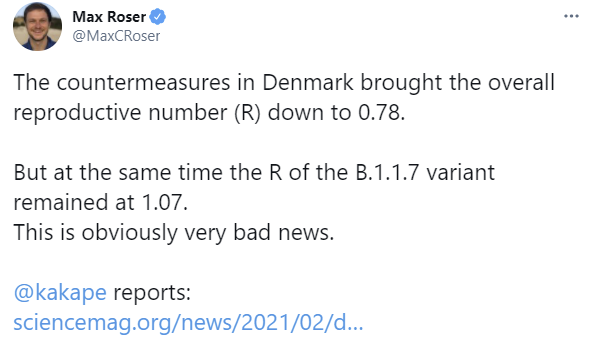
Unfortunately, this is an incorrect conclusion from the data referenced in the tweet. It seems the 37% number was obtained by dividing 1.07 by 0.78, which rounds to 1.37. However, while 1.07 is the R of the B.1.1.7 variant, the 0.78 is not the R of the other variants, but the overall R (it says so right in the tweet!), which includes B.1.1.7. As B.1.1.7 is a sizable... (read more)
SSI (Denmark) published a new report today, that makes some of the things I talked about in the parent comment clearer.
Bilag (=Appendix) B talks about estimating the relative growth rate for B.1.1.7. On page 14 they write:
Det mest interessante er den tidslige udvikling. For hver uge øges log(odds) med 0.077 per dag. Med den nuværende lave andel af cluster B.1.1.7 svarer dette til at hyppigheden af cluster B.1.1.7 blandt de smittede stiger med 71% (95% CI: [33%, 120%]) per uge.
My translation:
... (read more)The most interesting is the temporal evolution. Every week log(odds) increases by 0.077 per day. With the current low share of cluster B.1.1.7, this corresponds to the frequency of cluster B.1.1.7 among the
In the former control group, Sweden is throwing out the extra vaccine doses in Pfizer vials, because we might dislike the FDA but at least we don’t have to deal with the European Medicines Agency, who are totally Delenda Est Club members:
But good news, they could soon give the go ahead to stop throwing away vaccine doses.
Just for additional information / clarification, as it seems to me this could be interpreted to suggest that EU countries, after starting vaccinations on the 2020-12-27, threw away anything left over after taking 5 doses out of a vial until some time after 2021-01-07, whenever EMA approved using the extra doses:
While I am not familiar with... (read more)
Short version: I think it comes down to different generation times used, and the Danish reports, the English reports, as well as what the referenced tweet 1 is saying are consistent with (assuming for the moment cases of the other variants stay constant) B.1.1.7 cases increasing by something like 60% to 80% each week. I would be very happy about corrections from someone who understands this better, I am not an expert at all.
Long version:
(Note: I will think about the change in infectiousness between other, old variants and B.1.1.7 as multiplicative below.)
In interpreting these numbers I think it is highly relevant to understand what is used as a generation time. In the... (read 544 more words →)
Regarding the Danish hospitalization numbers:
The non-omicron variants column in the hospitalization table of the daily Danish omicron reports (which one can found on here, with the most recent one via the big "Download her" button and the older ones under "Arkiv") was changed from the previous one to the last report. Until the report from the December 15, they only reported cases for which a variant PCR test was carried out, i.e. hospitalizations of people who tested positive for coronavirus, but where no variant PCR test result is available was not counted (which makes sense, as it is then not known whether the case is omicron or not!). Starting with the current... (read 759 more words →)