Election results in Central Europe match some pre-WW1 borders
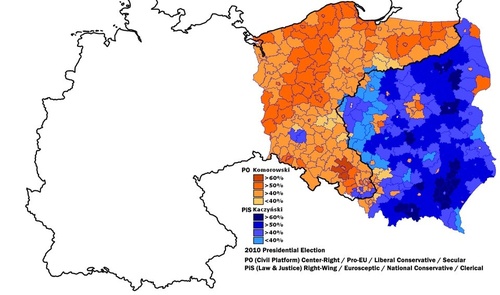
I have seen this image of Quora: Polish presidential election, 2010 Election results are arguably one of the most apparent and easy to measure effect of complicated cultural diffences (provided that the country is sufficiently diverse to make the cultural differences relevant). After reading Albion's seed, I think that I understand much better the origin of some of the cultural differences in the United States. The author of Albion's seed devotes his final chapter to an analysis of the US election results until the XX century. Cultures are different through countless axes, but election results may be seen as a sort of spontaneous principal component analysis: the population spontaneously sorts itself in some political coalitions (which tend to become only two in countries with first-pass-the-post systems, and a few more in countries with proportional systems). This looks a Prussia - Russian Empire split, rather than a city countryside split (though big cities like Warsaw vote with Prussia). Looking at the population density, the orange part does not seem much more urbanized than the blue part. First of all, maybe this particular year is cherry-picked? Kind of: the map of other presidential elections does not correspond so neatly to the former Prussian-Russian border. But the general pattern remains. These two regions of Poland are sometimes called Poland A and Poland B, and the developement gap between the two is widely discussed (much like the gap between northern and southern Italy). This might also be seen as a split across the Hajnal line. But the population that lives Poland A is not the same population that lived in the orange zone when it belonged to Prussia. Following the massive resettlements of the postwar period, the majority of the modern day Polish-speaking inhabitants of the Recovered Territories are not descendents of the (mostly German-speaking) inhabitants of the former Eastern Prussia. As culture is mostly inherited, it is often hard to d
Although impressive, it is worth to notice that Cicero only played blitz games (in which each turn lasts 5 minutes, and players are not usually very invested).
An AI beating 90% of players in blitz chess is less of an achievement than an AI beating 90% of players in 40 min chess; and I expect the same to be true for Diplomacy. Also, backstabbing and elaborate schemes are considerably rarer in blitz.
I would be very curious to see Cicero compete in a Diplomacy game with longer turns.