The Devin mishap is a reminder of how tricky it often is for the general public to gauge what's currently possible and what isn't for AI. A lot of people, including myself, assumed the claimed performance was legitimate. No doubt many AI startups like Devin are waiting for the rising tide of improving foundational models to make their ideas feasible. I wonder how many are engaging in similar deceptive marketing tactics or will do so in the future.
Well over a million in England by 1850. However they were used primarily for agriculture and later transport. Not industry. As such, they played, at most, a supporting role in industrialization. Also, my original question stands, "Why England?", given the Dutch Golden Age had similar conditions.
Also, development of those 3 technologies wasn't limited by available power.
No, but they were limited by technological advancement and production getting cheaper, which by the mid 1800s were very much tied to steam power. They were also limited by the availability of capital for development, capital which would be much harder to come by with less energy to begin with. And of course the steam turbine was developed directly from the steam engine.
All of three technologies you've listed were not ready for broad practical use until well over 150 years after Newcomen's steam engine. By this time, steam power had long since dethroned wind and water as the primary source of energy for industrial production.
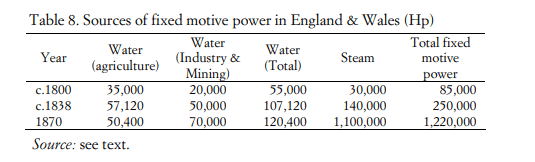
By the mid 1800s, steam was producing as much power for England and Wales as all other sources of fixed motive power combined. That's not even mentioning the world changing impact of inventions such as the train and steamship. Now consider a world without this technology. What leads you to believe that a practical ICE, large steam turbine, and/or hydroelectric power would develop even remotely on schedule in a world with no trains, far lower steel production, and half the motive power? The steam engine's impact on early industrialization is often overstated but its impact by 1850 really can't be exaggerated. It was the diffusion and improvement of the steam engine that bridged the economic gap between the first and second industrial revolution.
One popular conception of the Industrial Revolution is that steam engines were invented, and then an increase in available power led to economic growth.
This doesn't make sense, because water power and horses were much more significant than steam power until well after technological development and economic growth became fast.
While it is true that the first industrial revolution was largely propelled by water, wind, and horsepower rather than the steam engine, the steam engine was instrumental in continuing that momentum into the latter half of the 19th century. The Dutch Golden Age is sometimes characterized as a kind of proto-industrial revolution and likely saw the highest productivity in history prior to the 1800s.... (read more)
Interested in any of the roles. I haven't played chess competitively in close to a decade and my USCF elo was in the 1500s at the time of stopping. So long as I'm given a heads up in advance, I'm free almost all day on Wednesdays, Fridays, and Sundays.
This line leaves me wondering about human isolation on our little planet and what maladaptations humanity is stuck with because we lack neighbors to learn from.
Failing to adopt cheap and plentiful nuclear power comes to mind as a potential example.
I largely agree with the sentiment of your post. However, one nitpick:
The world's largest protest-riot ever, when measured by estimated damage to property.
This claim is questionable. The consensus is that the economic cost of the George Floyd Protests was between one and several billion. Perhaps it was the most expensive riot in US history (though when inflation-adjusted the LA riots may give it a run for its money) and the most expensive to be cleanly accounted for economically, but intuitively I would imagine many of the most violent riots in history, such as the partition riots in India and Pakistan, caused more economic damage.
further progress will not come from making models bigger. “I think we're at the end of the era where it's going to be these, like, giant, giant models,” he told an audience at an event held at MIT late last week. “We'll make them better in other ways.” [...] Altman said there are also physical limits to how many data centers the company can build and how quickly it can build them. [...] At MIT last week, Altman confirmed that his company is not currently developing GPT-5. “An earlier version of the letter claimed OpenAI is training GPT-5 right now,” he said. “We are not, and won't for some time.”
This new rumor about GPT-4's architecture is just that and should be taken with a massive grain of salt...
That said however, it would explain OpenAI's recent comments about difficulty training a model better than GPT-3. IIRC, OA spent a full year unable to substantially improve on GPT-3. Perhaps the scaling laws do not hold? Or they ran out of usable data? And thus this new architecture was deployed as a workaround. If this is true, it supports my suspicion that AI progress is slowing and that a lot of low-hanging fruit has been picked.
"A medieval European painting by Giotto Di Bondone of a hot-air balloon flying above a city as onlookers watch" by Dalle-2
TL;DR
Hot air balloons certainly could have arrived at least decades earlier and there's a high chance they could have arrived centuries, possibly even millennia earlier.
Jason Crawford asks, "Why did it take so long to invent X?" The post is an invitation. It asks the reader to identify low-hanging fruit, inventions that could have been invented far earlier but weren't. Now, most technologies don't fit the bill. Not everything could have been invented long before it was. Many relied on recent advancements. The airplane only became possible once engines became powerful enough to... (read 1578 more words →)
Good post!
Btw, this link appears to be broken