Why does expected utility matter?
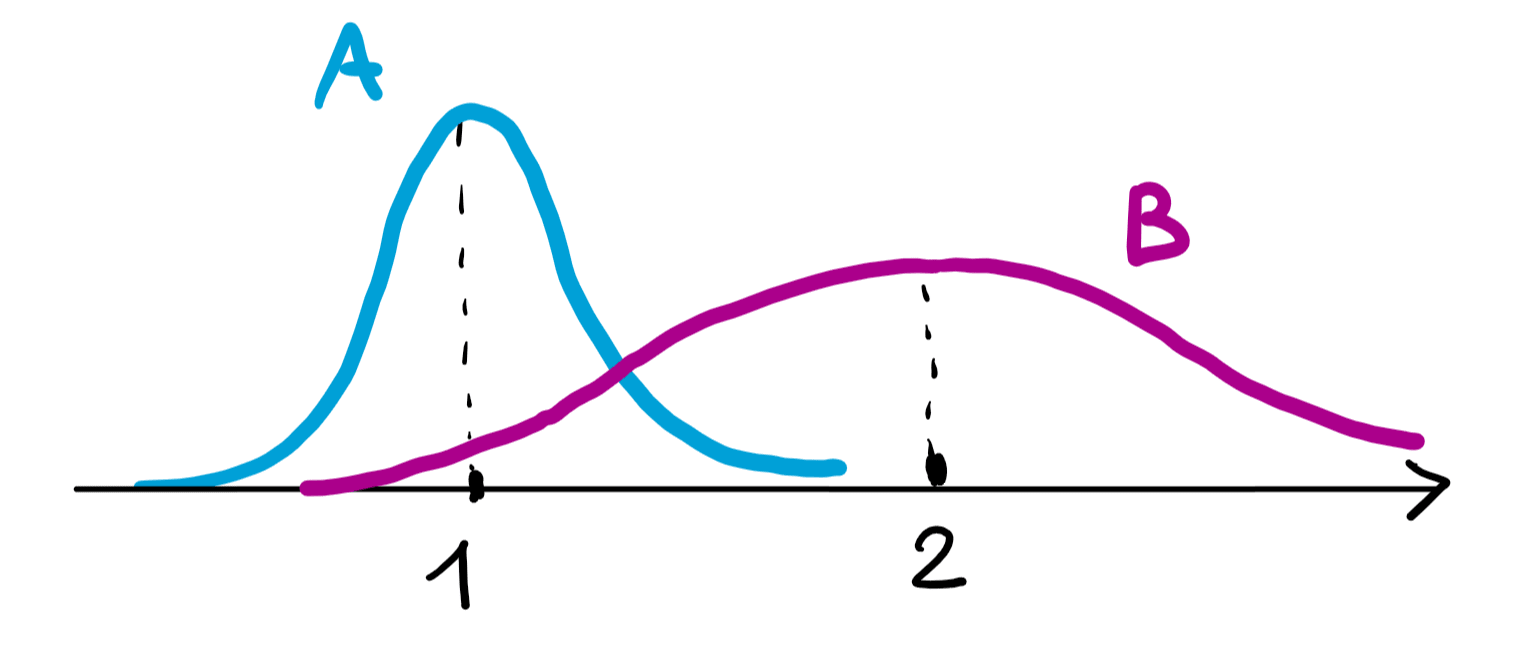
In the context of decision making under uncertainty we consider the strategy of maximizing the expected monetary revenue and expected utility; we provide an argument to show that under certain hypothesis it is rational to maximize expected monetary revenue, then we show that the argument doesn't apply to expected utility. We are left with the question about how do we justify the rationality of the strategy of maximizing expected utility. Expected monetary revenue Suppose you have to choose one of two games A and B with an expected economic return of 1$ and 2$ respectively, which have a certain probability distribution. If you play many times, say N, the law of large numbers and the central limit theorem might become relevant, and your probability distribution for the repetition of A and B will have their masses more and more sharply separated around N and 2N respectively. At this point, it is clear that it is better for you to play B many times than to play A many times. You can predict this in advance by calculating the expected winnings of A and B. So assuming you can make "lots" of choices between A and B, you must prefer the one with the higher expected profit. But what if you can only make one choice? If the distributions of A and B overlap, does the expected profit still matter? Even if you only have to make this particular choice once, it could be one of a long sequence of many different choices, not always between A and B, but between other sets of options. Even if the choices are different, we can still manage to take advantage of the LLN and the central limit theorem. Suppose we have a large number of choices between two games: * time 0: choose between games A0 and B0 * time 1: choose between A1 and B1 * time 2: ... * ... * time N: choose between AN and BN We can hope that again if you always choose the game with the higher expected return the statistical randomness will be increasingly irrelevant over time for large N and you will store a l
Your point is that in the case of the low entropy universe you have much possibilities for the time to consider for its random formation compared to the single brain?