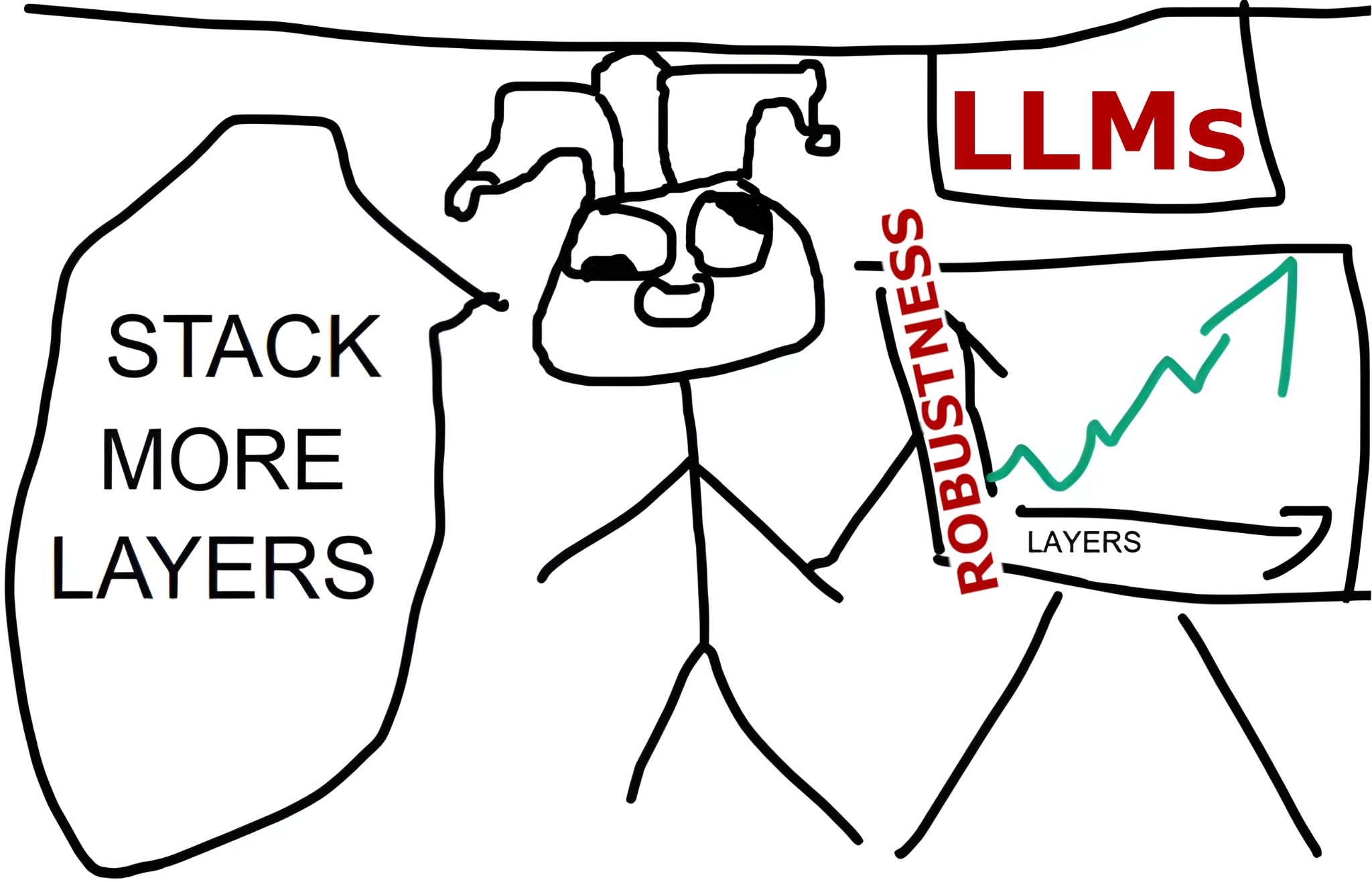
Adversarial vulnerabilities have long been an issue in various ML systems. Large language models (LLMs) are no exception, suffering from issues such as jailbreaks: adversarial prompts that bypass model safeguards. At the same time, scale has led to remarkable advances in the capabilities of LLMs, leading us to ask: to what extent can scale help solve robustness? In this post, we explore this question in the classification setting: predicting the binary label of a text input. We find that scale alone does little to improve model robustness, but that larger models benefit more from defenses such as adversarial training than do smaller models.
We study models in the classification setting as there is... (read 183 more words →)
Based on my understanding from talking with the author, it is the former. The language model is simply used to provide a shaping reward based on the text outputs that the game shows after some actions; it's the RL optimization that learns the weird hallucination strategy, and the reason it's able to do it is because its capabilities in general are improved thanks to the shaping reward.