Rehearsing the Future: Tabletop Exercises for Risks, and Readiness
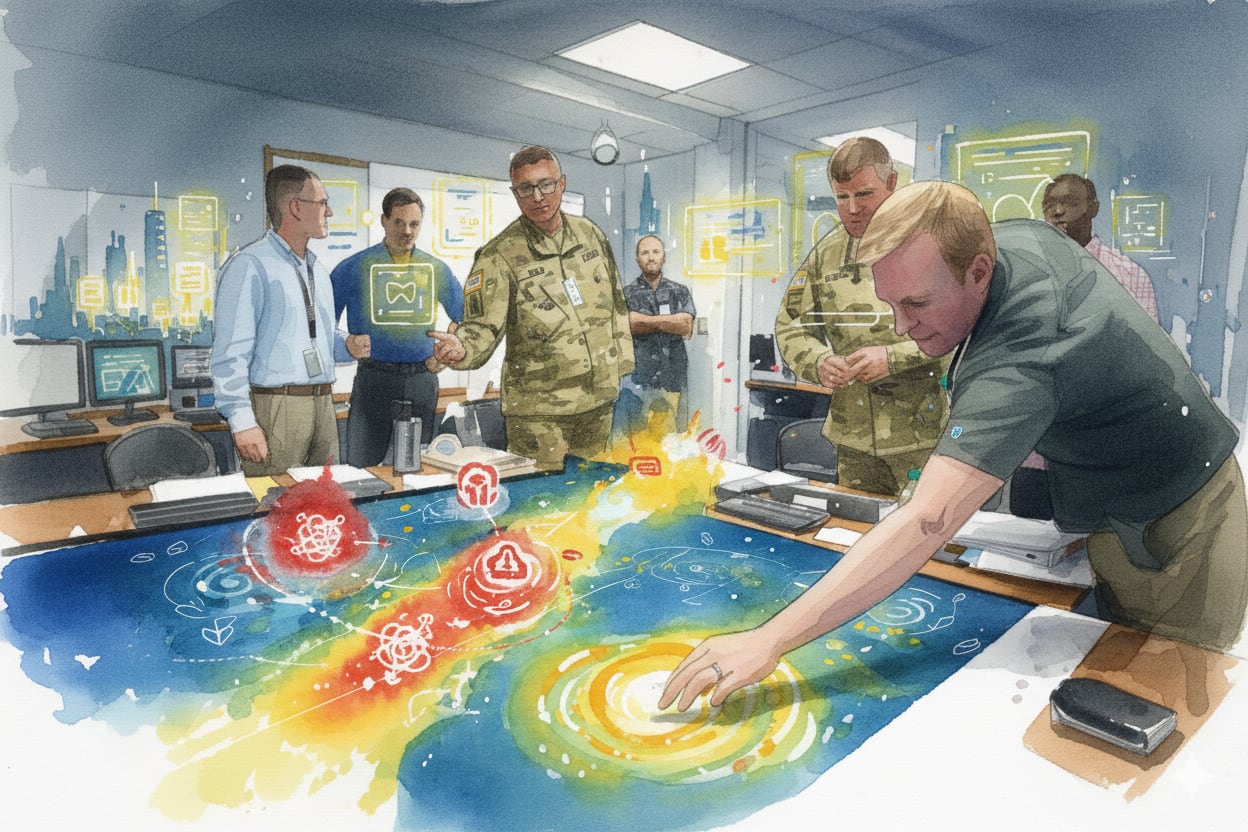
TLDR; Real-world crises often fail because of poor coordination between key players. Tabletop exercises (TTXs) are a great way to practice for these scenarios, but they are typically expensive and exclusive to elite groups. To fix this, we built (fixed link) a free, AI-powered, single-player digital TTX that simulates an election misinformation crisis. It's a "rehearsal space" designed to make high-stakes decision-making and systems thinking accessible to everyone. We're inviting you to try the prototype, give feedback, and share your thoughts on TTX in general. Why bother? In the summer of 2025, as the world seemed to grapple weekly with new LLM releases and ever-expanding AI deployments, a small group of us gathered in India. We met not to keep pace with the frenzy, but to ask a different question: how do we educate for the future of AI? In the middle of so much rapid change, are we seeing light at the end of the tunnel—or the headlamp of an oncoming train? The room was diverse: some of us came from technical backgrounds, others from philosophy or policy. Each brought a different lens, but we shared the same unease. AI’s ubiquity has made it central to diplomacy, trade disputes, national security, and questions of sovereignty. And if we wanted to think seriously about intervening—or even just understanding—such a systemic force, we needed tools for exploring not only individual actions but also the consequences that ripple outward across entire systems. One of us had previously taken part in tabletop exercises (TTXs): a biosecurity drill for pandemic preparedness and a foreign policy scenario on AI deployments. Drawing from that experience, and impatient with writing cards and rules by hand, we built a digital version—a simulation of an election crisis. This experiment gave us a glimpse of how TTXs could be adapted for broader communities, helping participants see how risks play out in complex, sometimes catastrophic ways, while also expanding the space of p

Super interested in this! I would be even up for a discord or slack