Tiuto
24
1
14
Tiuto has not written any posts yet.

Do you have thoughts on how this can this be squared with trying to have principles and trying to follow something like functional decision theory?
Consider the following (real) example:
I'm going to a building with an emergency fire exit, that I'm not supposed to open. Opening it doesn't start an alarm and it's the only door that directly leaders outside, so I want to open it to get some fresh air.
To me this seems like a clear example of a rule one should break, if one is slightly naughty. The problem is that to be allowed in the building I agreed to follow the house rules.
Opening the door feels almost like lying, and... (read more)
I had been thinking about the exact same topic when I read this article, only I was using bus routes in my analogy. I created a quick program to simulate these dynamics[1].
It's very simple, there is a grid of squares, let's say 100 by 100, each square has some other square randomly assigned as its goal. Then I generate some paths via random walks until some fraction of squares are paths. Then I check what fraction of squares are connected to their goal via a path.
Doing this we get the following s-curve:
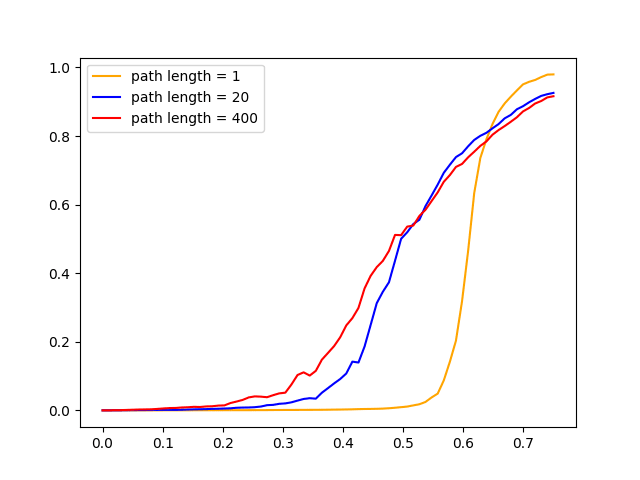
The y-axis shows the fraction of squares that are able to reach their goal. The x-axis is what fraction of squares... (read more)
like, i could invest energy until i can actually refute flat earthers completely on the object level, and I'd almost certainly succeed. but this would be a huge waste of time.
I don't think it would be that hard to refute flat earthers. One or two facts about how the sun travels, that the atmosphere bends light, and the fact that there are commercial flights crossing the poles seem like they would be sufficient to me. This probably won't convince a flat earther, but I think you could fairly easily convince 95% of smart unbiased 3ed listeners (not that they exist).
You don't have to go down every option in their argument tree, finding one argument they are completely unable to refute can be enough.
This year's Spring ACX Meetup everywhere in Bonn.
Location: At Endenicher Allee 60, 53115 Bonn, we will be in the small building behind (northwest of) the main Math building. There will be a sign outside the building with directions to our room. – https://plus.codes/9F29P3HM+C7F
Group Link: https://chat.whatsapp.com/F0KVKLiuph [the number that is 60-1] B72vUyR9Vh.
Contact: timtjc08@gmail.com
Interesting. Do you have any recommendations on how to do this most effectively? At the moment I'm
Questions I'd have:
Thanks in advance if you have any advice to offer (I already looked at your Caffeine RCT just wondering if you have any new insights or general advice on collecting data on oneself).
At the moment, a post is marked as "read" after just opening it. I understand it is useful not to have to mark every post as "I read this", but it makes it so that if I just look at a post for 10 seconds to see whether it interests me, it gets marked as read. I would prefer if one could change the settings to a "I have to mark posts as <read> manually" mode. With a small box at the bottom of a post, one can check.
I think it's mostly that people complain when something gets worse but don't praise an update that improves the UX.
If a website or app gets made worse people get upset und complain, but if the UI gets improved people generally don't constantly praise the designers. A couple of people will probably comment on an improved design but not nearly as many as when the UI gets worse.
So whenever someone mentions a change it is almost always to complain.
If I just look at the Software I am using right now:
Don't look at the comments of the article if you want to stay positive.
I think this might play a really big role. I'm a teenager and I and all the people I knew during school were very political. At parties people would occasionally talk about politics, in school talking about politics was very common, people occasionally went to demonstrations together, during the EU Parlament election we had a school wide election to see how our school would have voted. Basically I think 95% of students, starting at about age 14, had some sort of Idea about politics most probably had one party they preferred.
We were probably most concerned about climate change, inequality and Trump, Erdogan, Putin all that kind of stuff.
The young people that I know that are depressed are almost all very left wing and basically think capitalism and climate change will kill everyone exept the very rich. But I don't know if they are depressed because of that (and my sample size is very small).
Deutsch has also written elsewhere about why he thinks AI doom is unlikely and I think his other arguments on this subject are more convincing. For me personally, he is who gives me the greatest sense of optimism for the future. Some of his strongest arguments are:
I use a program called plucky that should be available on linux see here it's very restrictive, you set a timer e.g. 2 hours or 5 days and have to wait that long to edit the rules you set yourself.
Edit: Just saw that the next comment mentions plucky, but they didn't mention that it's available for linux...