Probably, the frame we want to achieve is: AI is making your life suck, not AI regulation.
Okay, but is that true? Current LLMs seem like a massive consumer surplus, far in excess of plausible direct harms. (It answers my questions, writes code, generates pretty images, &c. for $20/month; it seems like an amazing deal.) The reason I'm worried is because of existential risk from future superintelligence, not LLMs making my life suck.
So when you say that the frame "we" want to achieve is, "AI is making your life suck", unless you have a list of serious harms in mind (conspicuously absent from your post, and even then, it wouldn't be your real reason), it looks like you want people to believe false things for the greater good.

For many people whose jobs have been affected by AI, it seems to. E.g. ran across this Reddit thread from someone who says they have 30 years of experience in the video game industry:
We're still reviewing generated code but I suspect not for long, the code is better than what most devs I know can write, at 20x the speed. The temptation to just push and move on is huge and irresistible. There is no joy or sense of accomplishment. No pride in making something clever or quickly, and all progress is associated with the AI and not with you. [...]
There is no space for junior devs. I honestly don't know how to incorporate a junior into a team anymore (which is something I used to do for decades). Every time we tried they just become a meat proxy for AI while learning nothing, and getting in the way. Everything regarding managing a team and a project has changed, and nobody knows how to do it anymore. I lost the ability to correctly estimate work required for a task, for example. Everyone hates this. Most of devs my age are planning early retirement and are just waiting to be laid off. People that use AI for coding don't learn anything. To understand code you have to write it, and nobody is writing it. Maybe understanding and reading code will become obsolete soon? I don't know. Everyone I asked feel they are becoming dumber and losing their focus. I know I am.
It currently has 2.6K upvotes and lots of comments saying their experience of AI is the same as the OP's.
As a quick contrary datapoint, many people who wanted to do software projects but didn't like coding are having a great time, me include. The downfall of coding is generally a boon to people who care about product more than the code.
contrary
Where is the contradiction with what Kaj said?
Kaj quotes someone saying "There is no joy or sense of accomplishment". My experience is that I have increased both joy and sense of accomplishment from working with LLMs, compared to when I worked as a software engineer 6 years ago. Feels like I got superpowers, I can develop anything really fast, with any library or stack, and provide huge amounts of value to people easily.
You may need numbers on that. Datacenters are very quick to go up and they create like 10s of longterm jobs. Quick google: 1000 data centers in flight (1500-2000 in flight or planned), 1500-3000 works at peak construction time: 1000 average? That's 1 million datacenter construction jobs over time.
More than 1 person on reddit are making this point, so yeah.
Whether AI does more harm than good (less slangy than "your life suck") an opinion, firstly, and right now it's a widespread opinion. Gallup, July reports 52% of Americans think AI does more harm than good, with only 9% saying more good than harm. They also report business will probably use AI irresponsibly. The poll also cites mass unemployment as a serious harm people are worried about.
I'm worried about a bill failing that people feel enriches the AI CEOs at their own expense, even if those same people believe x-risk is real. People may count accelerating AI development as harmful to themselves.
it looks like you want people to believe false things for the greater good.
I am reasoning about other people's beliefs. I am not trying to instill beliefs I think are false. I am telling you the pitfalls a regulation bill will run into: if people feel it's unfair, the coalition might fracture even among people who believe in x-risk.
- Positive emotions toward AI outweigh negative ones in 34 out of 37 countries
- Western countries rank high in AI worry, but daily users worry least
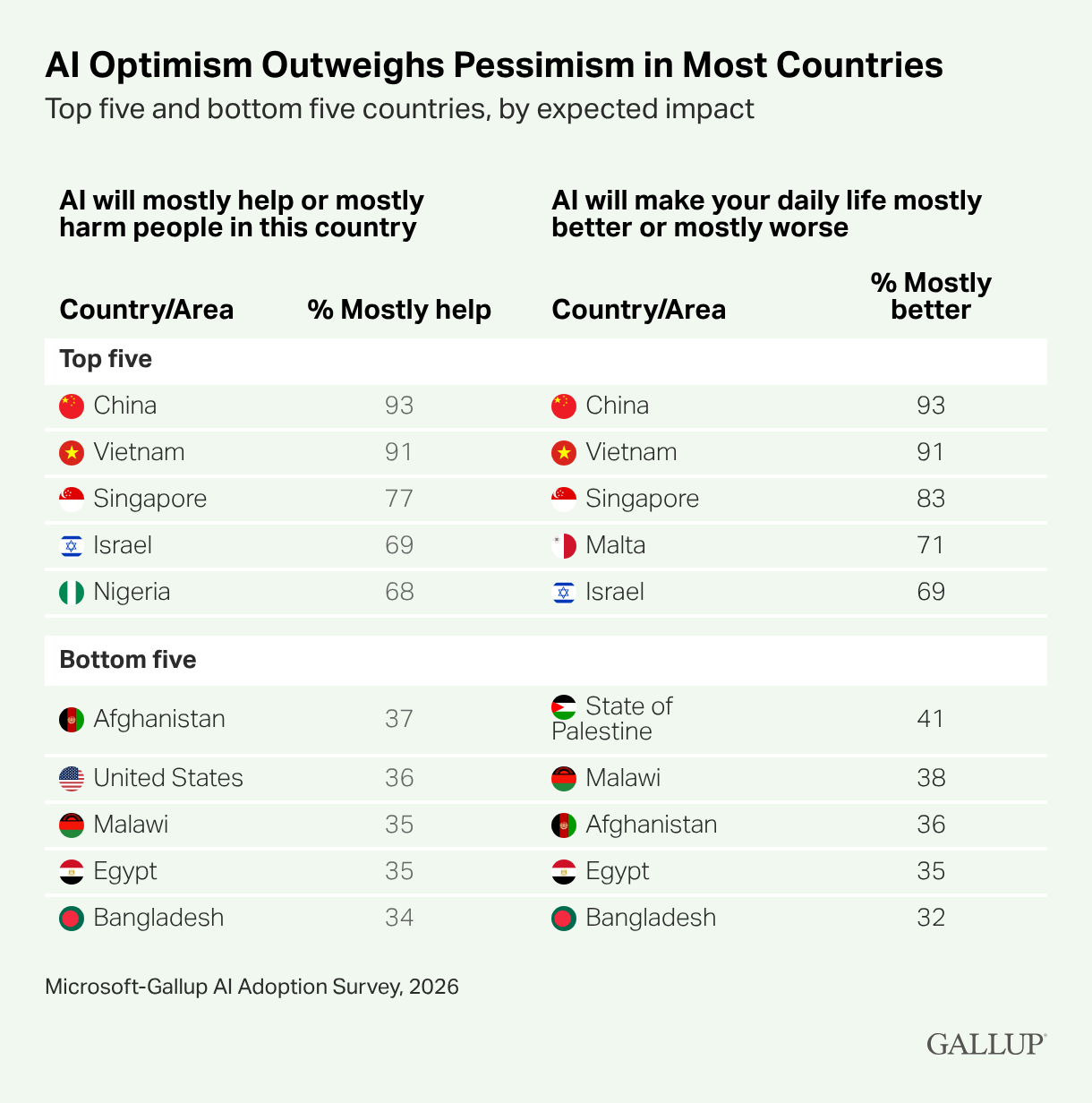
AI Optimism Globally Widespread Despite Uneven Use, Gallup, Sep 2026
https://news.gallup.com/poll/714593/optimism-globally-widespread-despite-uneven.aspx
I'm willing to argue on the object-level that current LLMs do more harm than good for the average consumer, mostly because (1) unemployment risk, (2) the consumer surplus is not that huge for most people, (3) second-order cultural effects.
(1) is already discussed in other comments, and all I want to add is that I don't think this is a prospective risk about future ASI, but an urgently present risk that is plenty salient with existing models+harnesses. Someone I know was fired (from a temp job, not a stable career, thankfully), less than two months ago, because the higher-ups wanted AI to do the work instead. And until recently, I was working a job which I am extremely confident could have been done >95% by Opus 5.5 with some kind of agentic harness. Even a 50-50 chance that my boss would notice this and fire me would have been a greater harm to my life than any benefit LLMs currently give me.
For (2), consider that -- outside of their job, which as mentioned is itself under threat from AI -- most people don't need to write code or do very large research projects. In this case AI is still useful as a search engine or content generator, but only modestly. We already had a search engine! It wasn't perfect, and I'd pick ChatGPT over old Google Search any day, but I never remember before LLMs thinking "man, the real bottleneck in my life right now is internet search. If only I had a better search engine, my life would be much better".
(3) is arguably not a "serious harm" in the way that x-risk or job loss is serious, but it's salient to many people, and IMO plausibly outweighs the modest benefits of a decent question-answerer (assuming you're not using it to write code or do large research projects). By this I mean things like: the homogenization of writing and "slop"; cheating in education; obsolescence of human purposes and meanings, etc. Also, no one ever asks me to help them with IT anymore and it makes me sad :(
You could say that none of these are the "real reasons", in the sense that none of them are as important as x-risk, but that doesn't seem relevant in this context. If multiple groups want the same thing (slowdown/pause of AI capabilities progress) for different reasons, and they all agree that the others' reasons are valid, but only disagree on their relative importance, arguing over that relative importance at the expense of coalition-building seems neither politically wise nor rationally virtuous.
most people don't need to write code or do very large research projects.
AI gives me a lot of value (over a search engine) outside of those things, just because it can provide information tailored to my exact problem + I trust it more than most single sources of information online.
Thanks for commenting. I had some nuanced thoughts, especially about points (1) and (3), but then I got to this part—
arguing over that relative importance at the expense of coalition-building seems neither politically wise nor rationally virtuous
and now I think I shouldn't bother typing up my nuanced thoughts, on "don't feed the troll" grounds. As a student of epistemic rationality, I don't care about coalition-building and I don't care about what's politically wise. When you imply that you do care, then whether you realize it or not, you are announcing your intent to lie to me. I used to make a spiritual practice of having earnest arguments with trolls, but our lives may be short; I don't have time for this anymore.

As a student of epistemic rationality, I don't care about coalition-building and I don't care about what's politically wise.
This implication seems wrong. "The Art must have a purpose other than itself, or it collapses into infinite recursion." If one's goals are served by coalition-building or political wisdom, one should care about those things.
(I agree that not talking about what's actually true for political reasons is bad. It's unclear to me whether the grandparent comment is arguing for that, or for having and not incessantly arguing with allies you disagree with, or something else. "AI is making your life suck" does seem currently false to me for most people.)
I tried to preëmpt this by saying "epistemic rationality" rather than just "rationality", but maybe that wasn't enough. Obviously I understand that deception is useful for achieving goals. If your plan to save the world involves deceiving your enemies, fine, whatever, seems great. But when someone on lesswrong.com tells me to my face that arguing at the expense of coalition-building seems politically unwise, I reserve the right to notice that I am being trolled.

I just realized that "consumer surplus" is kind of a funny quantity when the consumers are competing with each other.
Imagine Alice and Bob are playing chess for a $10 prize, and they're evenly matched. I sell Alice a rook for $1. An extra rook makes her almost certain to win, so this brings her expected winnings from $5 to $10, giving her a consumer surplus of $4. Now I sell Bob an extra rook for $1. This brings his expected winnings from $0 to $5, giving him a consumer surplus of $4. On paper I've created a consumer surplus of $8. But in reality the players are $2 poorer, I am $2 richer, and other than that, jack shit changed.
Arguably the companies selling AI to clients to help them compete are doing a lot of this.
Do you have any less contrived examples? What is the real-life analogue of selling a rook in a zero-sum chess game?
Two things I've been doing lately are blogging and studying Fourier analysis (crashing Prof. Chun-Kit Lai's class at San Francisco State University). LLMs have been hugely useful for the math (as an infinitely patient on-demand tutor) and slightly useful for the writing (only as a critic and research assistant; I'm not a plagiarist and would never let it write prose for me).
If you construe math and writing as zero-sum competitive activities (because students are competing for grades; writers are competing with each other for karma and subscribers), then it would have the same structure as your chess example. But it's not zero-sum! If I'm learning (I think much) [1] more efficiently and saying the things I want to say (slightly) more efficiently, that's good for my life separately from what everyone else is doing.
Care is required in assessing this in learning contexts, because of the problem where lazy students outright have the AI just give them answers rather than tutoring hints and delusionally think they "learned", when a proctored test would show that they didn't. I think I'm not being delusional about it, but I won't be offended if you don't just take my word for it. ↩︎
I guess the best example is military arms races: you spend a billion, the other guy spends two billion, the surplus you got is all undone. Stock trading, you pay for a good algorithm and then someone else makes a better one and all your surplus is gone. Advertising is also a lot like this, especially in highly competitive markets, the more others spend the less you get per dollar.
 2
 1
Your having access to LLMs at work will increase your expected productivity, but won't increase your expected compensation because all the other workers have access to LLMs, too, and your compensation is sensitive to how much competition there is among prospective workers for your job. However the expected effect of every worker's having access to LLMs is to make it easier for society to produce goods and services, increasing the expected amount of good and services your compensation will buy even though your expected compensation has not risen.
A stock trader's having access to LLMs to help him trade works the same way: it does not increase his compensation in expectation, but it makes society as a whole more efficiently by making the stock-trading industry more efficient at its productive function, which is an important function, namely, to help society be efficient at capital investment and enterprise management. Expanding on the latter: some corporations have more capable leadership teams than other corporations do. Trading firms (or more precisely, analysts employed by trading firms) inquire deeply into the management capability of this or that corporation and publish information (in the form of stock prices or prices for futures contracts) about the conclusions of their inquiries—information that is more reliable and easier for the average decision maker to use than if the trading firms just published books or articles about their conclusions (although books and articles are useful, too).
I can make a similar argument about military officers. The very short version of that argument is that if the entire globe were under the jurisdiction of a single government, that would tend to be worse than arrangement we have now because humanity is probably not yet good enough at running governments that we can afford to do away with competition between governments as a way of providing "negative feedback" to governments.
But maybe more importantly, there is nothing about your comment or my comment so far that is specific to LLMs. So, I ask you whether you think your argument holds for older inventions such as the internet, the automobile or electricity. (I think mine does.) If your answer is no, then can you explain what it is about LLMs that makes its net effect different from the other inventions I just mentioned—other than the extinction danger that I'm confident you, Zack and I agree is real and is very serious.
Zack is right: AI-based services have on net made life better and will continue to make life better (probably rapidly, drastically better IMHO) until the fatal flaw of the mainstream AI industry manifests in our extinction—or perhaps some more exotic, but equally undesirable outcome.
make it easier for society to produce goods and services, increasing the expected amount of good and services your compensation will buy
No. I see this mistake often enough that I just made a short post about it. It also answers your question what makes AI different from previous inventions in economic terms.
I agree with your new post, and I stand by what I wrote.
Do you agree that it will take at least a few more years for AI to become capable enough to be able to displace and to make permanently uncompetitive a substantial fraction of the human workforce?
My worry is the effect over the next few years of the message, "AI is making your life suck," or, "AI just makes things worse." In English, "is making" implies that the making has already begun. "AI will make your life suck," is a different message, and I have no particular objection to it (although I distinctly prefer, "AI will end the human race") because in English, "will make" comes with no implication or only a very weak implication that the speaker can predict when the making will begin (although it might be safer to say, "will eventually make").
This next is a direct quote from the post: "Probably, the frame we want to achieve is: AI is making your life suck, not AI regulation." That sentence is the post's only bold text aside from the headings. And although it is not literally the last sentence in the post, it might as well be: the remaining 44 words are a postscript and start with "honorable mention". Zack and I want the author to stop saying that or at the very least to avoid emphasizing it in his messaging to the public.
It is important for our coalition to avoid making or at least stressing or emphasizing any statement that might be interpreted in the future as having made a prediction that turned out false. For this reason, the choice of the title "AI 2027" caused serious harm to our cause because at the end of 2027 if AI has yet to have catastrophic effects, many of those who saw the title "AI 2027" and who learned that the document behind the title predicts some sort of AI catastrophe will conclude that our side of the debate has been proven wrong. Yes, people will jump to a conclusion that quickly, especially if they're employed in the tech industry or are attached to a vision of a future utopia enabled by technology. If you have any doubt about that, I suggest spending at least a few hours reading comments on Hacker News about the possibility of an AI catastrophe: there are millions of people who will grasp at and stubbornly cling to almost any straw to avoid the need to seriously consider the possibility that something so wonderful as AI progress might need to be stopped.
Because of the effect I just described, it is important to avoid saying, "AI is making your life suck," or, "AI just makes things worse." If advocates for a pause or a shutdown are saying either of those things, we should loudly announce that we disagree and that we tried to get them to stop saying it, but ultimately we have no control over what they say.
Just to be tediously sure you understand: I want the labs shut down today and their employees monitored to make sure they don't continue working on AI even in their spare time.
I just think that publicly claiming that "AI is making your life suck," or that "AI always makes things worse, never better," or that "AI ruins everything," will make it harder over the years for advocates in the US to achieve anything like that happy state of affairs. ("In the US" because I don't know the political situation in any other country well enough for my opinion to be worth anything there. Most Americans are quite comfortable with drastic societal change caused by inventions.)
So I don't see why I should avoid saying it.
You're too confident, because maybe AI has kept us out of a recession and it's the reason you have a less-fun job instead of no job. And 2nd order effects are everywhere, like, dating sucks on dating apps but the result is better marriages and lower divorce (I conjecture, for sake of argument).
This is true for lesser societal changes, even the mundane congestion pricing regulation in New York was very unpopular for 6 months, then it was very popular once people had it and liked it.

Let's say I'm doing online dating. I can improve my dating profile by using a image model based service to have better images (there are specialized services that do that for online dating). This means I might not hire a photographer but use the online service.
The gain from me having better photos on the online dating website is probably mostly zero-sum competition against other people on the dating website. If everyone switches their pictures to being AI-enhanced that might also be a net harm because the images are less useful for telling how people actually look.
I would think that a majority of my own uses are positive sum but many people do center an awful lot of their energy in engaging in zero sum competition with other people
Dating isn't really zero-sum; the space of good matches is under-explored. And I don't even know how to do an AI-enhanced photo that improves the profile. You could lie about what you look like I guess but you can do that anyway and the result is usually a bad date.
There are ways in which you can change dating to lead to better matches. AI generated photos are not one of them.
And I don't even know how to do an AI-enhanced photo that improves the profile.
That's a skill issue. Bumble premium provides a way to look at which of your photos have a good reception and I know multiple people who's best performing pictures are AI pictures without them getting any feedback that they don't look like their pictures. And AI picture here does not mean using ChatGPT but a service that's specifically tailored to dating images.
The recruiting / hiring market maybe. https://www.theatlantic.com/ideas/archive/2025/09/job-market-hell/684133/ AI seems to be used on all sides and it's not clear the marginal improvement hasn't just all canceled out, less tokens cost.
11That doesn't really see to be a good metaphor here. What you describe seems more like a zero-sum game or negative-sum game setting rather than a consumer surplus story. In my understanding consumer surplus is a static, point in time type quantity defined by the area under the demand curve and above the price.
I suspect if your argument holds then the entire consulting industry, or perhaps even legal industry, has the same problem.
Of course some industries already have this problem, I gave examples in this comment.
What you’re doing when selling the first rook to Alice is creating both a surplus (for Alice) and an uncompensated externality (for Bob). If you - or Alice - were required to properly compensate Bob then there would be no surplus and no trade. There is a market failure for not internalising the externality and an accounting issue in ignoring the externality.
Yes this could generalise to some extent in trade and national accounts.
But selling chess lessons to both Alice and Bob would not be a generalisation … there is a real sense in which it improves the game for both of them.
Helping someone outcompete someone else isn't usually seen as an externality. If I sell Alice better baking equipment, everyone flocks to her bakery, and Bob the baker down the street goes out of business, should I be forced to compensate Bob? That would lead to some interesting market behavior.
Well no, because in this case you are creating an increased surplus (for consumers) - either better quality bread and/or lower price - so the net externalities are positive. You could also sell the better baking equipment to Bob and create even larger net positive externalities.
So much this. The amount I've learned, amount of executive function hurdles I've been able to surmount, the amount of help having a decent generalist in almost every field has been... it's been one of the most helpful things of my entire life.
I get Sanders and I get the bill that would ban AI if it turns out to be on the way to destroying humanity. But it would still hurt to lose these.
The amount I've learned, amount of executive function hurdles I've been able to surmount, the amount of help having a decent generalist in almost every field has been... it's been one of the most helpful things of my entire life.
Could you elaborate on exactly how you have used AI to help with these issues? I also have executive function issues that I am trying to mitigate using help from AI tools, and it would be very helpful to hear specific examples of how you have used AI to improve your situation. Even if they aren't exactly applicable to me, it might at least give me more ideas.
Certainly!
A lot of the foundations for what I discussed with AI came from a plethora of posts from here in this community. Specifically, posts from Scott Alexander on the predictive processing theory of mind, from Kaj Sotala's excellent Multiagent Models of Mind, Richard Kennaway's Insanity Wolf Sanity Test, and some posts from Zvi Mowshowitz and Valentine on the concept of slack.
The core of it all is something like:
- The mind is decently modeled as being made of a System 1 and System 2.
- System 1 is the fast, subconscious, nonverbal, experiencing part of the brain that quickly makes sense of the incoming sense data and forms a coherent reality. It has a lot of prior probabilities about the world, how it behaves, what risks there are, and what our own actions in it will do. This roughly matches the "map" of the map/territory distinction LessWrong talks about.
- Like any predictive process, this map can be wrong - it can think things that are dangerous actually aren't, or vice versa.
- System 2 is what I consider closest to "me", the slower, thinking, verbal part of me. System 1 communicates to me via emotions - happiness, sadness, fear, anxiety, anger, etc. One of the trickiest things is that, without noticing, the emotions S1 surfaces just feel like facts about the world. If I'm afraid of dogs, and every time I see one, my heart races, my hands feel clammy, and whatnot, I perceive that as something the dog did to me, and often subconsciously, without words. It takes some introspection to disentangle what my brain is doing in preparation for an expected threat vs. what the threat itself is actually doing.
- This LW article is very relevant: https://www.lesswrong.com/posts/f3o9ydY7iPjFF2fyk/focusing-1
Executive dysfunction isn't really anxiety, though. Many times did I want to do something on a System 2 level that my System 1 wasn't scared of, it just didn't do it. ADHD, for me, and maybe for you, but a licensed professional can only make that determination if you haven't already been evaluated.
I had been fighting executive dysfunction issues for years by the time of my diagnosis. I didn't recognize them as that at the time, I thought it was just garden-variety procrastination, something a to-do list or Getting Things Done would help. But 8 years went by and nothing was working, and I had a different, less immediate job that I was struggling in. I found a thread on AskMetafilter from someone with very similar symptoms to me and everyone in the comments was saying "get checked out for ADHD".
I did in 2020, and was diagnosed. I tried non-stimulant medication first to either intolerable side-effects or no effects at all, then tried coaching and talk therapy for a few years afterward. I was concerned about cardiovascular risks around higher blood pressure and heart rate on stimulants... but I also eventually learned more about where my nerves in general were coming from.
It was, of all things, Claude who finally got me to return to therapy and work with them to try out stimulant medication. Many, many, many evening LLM chat sessions where I was distraught around wasting another evening, another weekend. My own peculiarity is that I'm not one for seeking relief in empathy, at least not by itself. I have nothing against it! But I've always felt better when the other party could do more than just tell me things would be okay, but instead tell me what was actually going on behind the scenes.
Not that emotions are mere things to bulldoze past, either. I've described it to family as a driveway that everyone has to mentally traverse to begin responding to a problem. Sometimes the driveway is clear and you don't have to do much to respond to a problem. Sometimes a foot of snow falls and you have to shovel it first before you can address it.
Or, more concretely, sometimes a person really does have to vent first, or seek empathy and understanding, or panic a little before they can face the problem. Even for something that seems small from the outside. For me, this is an important step, but my success with LLMs, I'd say, came from it being only the first step. I wanted to understand what was going on in my head. Have the LLM ask me questions about it, see what we could both learn. See if I could tell what kinds of feelings or emotions arose from said questions, digging down to what I might be afraid of around medication/routines/etc. Holding strong beliefs weakly, heck, even letting most of what we discussed on Sunday not last until the next.
That last one was unintentional but ended up helping - CGP Grey has likened it to a useful mental filter for the concepts that are more important or keep coming up more often. I have been wrong a lot in this journey, and LLMs will be, too - don't worry about correcting them at literally any point if you don't feel they have a good read on you, they won't be upset - but over time, things have been getting non-monotonically better.
I don't mean to claim my mindset is objectively better than all others, just that it was a good fit for me. I can't say I always felt the following, but I most often do:
- My executive dysfunction is a problem
- It has structure, we can learn things about it
- There has to be something I can do about it
Call it a low tolerance for discomfort and a very systematizing mind, lol. You also correctly note that this may very well not generalize! Medication, your own executive dysfunction, all of that is different! But this has been my journey so far, and hopefully something of this rings as useful! Feel free to ask follow-up questions, that was a lot of text from me, haha.
Excellent post. Big upvote. I wanted to say this even though I don't have time to fully engage right now, so my comments won't be substantive since I haven't read it and all the comments closely.
I think this post was probably inspired by me arguing with you a few days ago that we probably won't benefit by making the US left more anti-AI because polarization. I am now highly uncertain, given the points you raise.
My biggest hesitation on being optimistic that polarization isn't important in AI risk is that the issue really has not been high-profile until recently. Someone pointed out to me that despite the fervor we see on our AI-weighted feeds, AI is like the tenth down on a list of primary concerns - even farther. And that's despite none of the top concerns looking actually very pressing (except "the economy" which for most people basically is always pressing).
So I'm concerned that the marvelous immunity to pz enjoyed by x-risk so far might quickly disappear now that it's been granted a real spot on the public stage.
Looking forward to engaging in more depth after I finish this move.
This is what I've observed. Normies have been vaguely aware of "AI" for a while, but to most people "AI" means a smart chatbot like Siri or ChatGPT, something that gives you directions or a recipe or tells you the weather. A lot of normies have only become aware of AI existential risk being anything other than future sci-fi nonsense since the Hugging Face incident.
And I've already started to witness a strange sort of polarization:
Lefty-liberals tend to be anti-AI (mainly because of the threat it poses in terms of making a lot of liberal arts professions technologically obsoleted), BUT ALSO anti-AI Safety because they think AI Safety is just another way to hype-wash the AI and tech sector into more billions of dollars. They are open to the concept of regulating AI, but highly suspicious of how it might be done, especially if the AI-adjacent companies themselves seem to be promoting it (which triggers their anti-corporation paranoia and reflexive reverse-psychology to take the opposite stance of whatever big corporations are pushing).
Libertarians seem split right down the middle, depending on how much they've read LessWrong-adjacent stuff, and also depending on how much they are personally invested in AI-adjacent companies. Some are anti-AI and pro-AI Safety, some are pro-AI and anti-AI Safety. The latter warn about the "regulatory capture" angle.
Conservatives seem to be the least engaged with the topic so far. Some cultural conservatives lament how it is destroying education, but other conservatives, especially those with an economic or foreign policy focus, are focused on the need for the US to remain #1 in AI to beat China. To the extent that conservatives would want to regulate AI, it would be in the opposite ways that the lefty-liberals envision: regulating away the small quality-of-life uses (because it might erode our education system or make people "soft"), while accelerating the frontier, commanding-heights uses of AI for big business logistics, surveillance, military, cybersecurity, etc.
Therefore, while you can find lefty-liberals and conservatives who both want to regulate AI, I suspect that the sorts of concerns they have about AI, and the types of regulations they envision, might be difficult to agree upon.
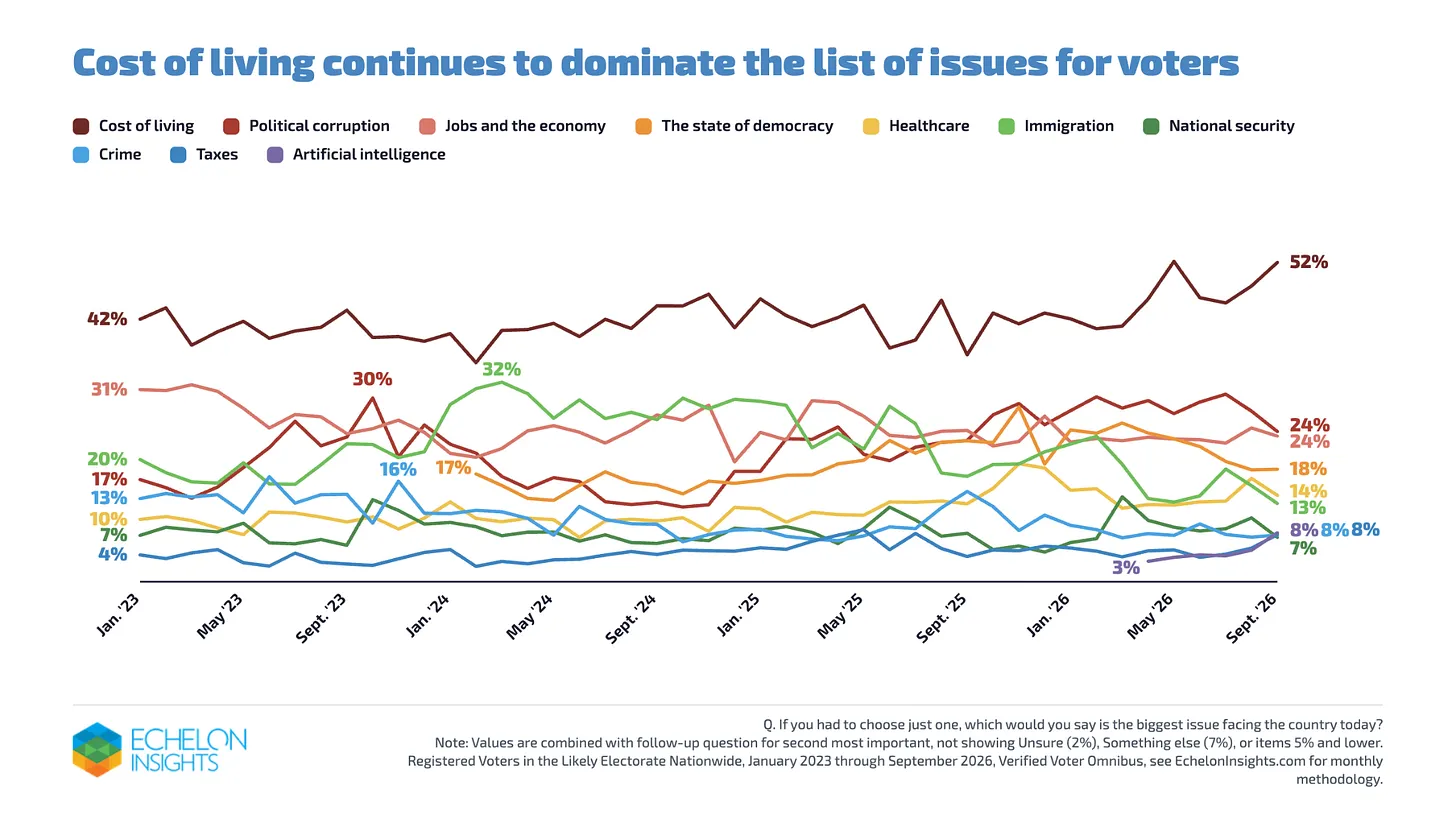
There's a few things you might want to consider:
- Polarization doesn't predict every thought process of a side, when top down pressure isn't being applied. For example, many Republicans supported the Ukraine war, though that support wanted when Trump and Co actively tried to undermine Ukraine. It's bounced back since, from my observations.
- People can hold NIMBY positions on something they support, and Republicans have a propensity to be ok with issues that don't personally effect them even more than Democrats do.
- Democratic elites have not enough masse laid down stakes on the larger AI debate beyond data centers to engender a polarizing backlash from the right.
- This is still very new for most people.
My point is that it's a bit too early to say if the US will polarize on AI There is a lot of tension that goes counter to the base world views on both sides that is keeping opinions mixed.
I would expect that as this issue is debated in the public forum, more polarization will emerge on it. I expect Republicans will end up in the pro-unshackled AI camp, as more Democratic elites speak on the dangers of the issue, like Obama did at Colgate University, for example.
I hear you, it's just that you're trying to say "polarization hasn't happened yet", and I'm saying those aren't delays, those are full failures for polarization to describe or predict what's going on.
Your bullets, in order:
- Top down pressure is being applied. Trump loves datacenters and his base is ripping him apart over it (Wired). I haven't followed MAGA on post-Huggingface AI -- is it going much better?
- D and R have the same NIMBY goal right now, literally with dc or metaphorically with AI changing too much too fast, or literally again with doom. That's how I said AI is very different from climate change. In this bullet, I think you're predicting against polarization, because of this NIMBY alignment.
- Democrats have laid down stakes to give Trump more powers to deal with AI. Now we get to see if the base follows the cue, by your (1) you think it does. My "cross-partisan polarization" section is where I consider the chance that the left will break off, and that is a danger I'd like to focus on more than left/right polarization.
- Datacenters have had about a full year in public consciousness. Trump's base knows about them, Democrats know about them. Trump embraces them, Democrats have united against them loudly, and still the consensus is against them. I really don't think voters are new and uninformed on this, especially when they already have a prior that sometimes annoying things guilt built in their backyard.
My point is that it's a bit too early to say if the US will polarize on AI
Sure, that just means polarization theory is useless if can't predict how the next year will go. Trends are good so far, away from polarization. I also outlined how I think it might polarize, it just has to more to do with a difficult movement emerging from the left than the existing left and right taking stance against each other.
I expect Republicans will end up in the pro-unshackled AI camp, as more Democratic elites speak on the dangers of the issue, like Obama did at Colgate University, for example.
The question is if you think Obama speaking up on AI overrides the feeling AI is upending many Republicans' lives and seems positioned to kill everyone. I think, precedent says people don't update away from object-level preference because of polarization. Certainly there's little precedent to say that does happen, so it's not my expectation. And at the same time, MAGA is grilling Trump on AI, Congressional Democrats are working on low-partisan AI safety, and another warning shot of some sort may happen.
Where I might be wrong:
- I can't be that confident Obama won't stimulate Republican opposition. If I were directing all this, I would try it, and I would monitor social media waves to see if this is all backfiring. I'm worried that holding back persuasion power because of a misplaced fear of polarization is a big tactics error.
- If Trump disappeared (left office, died, or lost influence), I'm not sure who the most important R elites would be or how much sway they would have to drive the issue their direction.
- Not sure how Congressional D will evolve but that's a really useful crux to uncover. It suggests those of us who are more embedded in the left should be working to keep Congress focused and continue the unpolarized path they've started.
- Yes, we are a few weeks new on AI doom, and doom is more abstract than NIMBY. I think a lot of work has been done by how annoying AI is in so many areas of life, plus the youth's feeling of "why bother?" with their future. That's why I feel this is object-level preference about people's lives. I expect it to not go away but it's a new thing to analyze.
How would you tell the difference between a delay and polarization not happening?
It takes time and attention and elites pushing a narrative for polarization to occur on many issues. Sexual transitioning was a thing for a long time before it became a wedge issue with deep polarization. Ditto climate change. Ditto the Ukraine war if you want a more recent example.
In plain English without talking about "polarization theory", I think the cycle is already broken.
If you want to argue "it'll polarize," can you make the case more carefully? "It takes time" is not how polarized issue usually go after becoming salient. And you do need a time bound or else it converges to a non-prediction, an we specifically care about the next 12 or 18 months or so.
Ok, here are my suppositions:
- It's already polarizing about data centers.
- It will eventually polarize about the broader AI issue, but the broader AI issues have not had nearly as much discourse in the public space.
- Polarization theory applies much more weakly/not at all when an issue becomes proximate and more difficult for propaganda and magical thinking to let people rationalize the issue.
I have not done a lot of research, and polling on data centers mostly focused on the question of building one local to the respondent from what I saw. But an article like this supports my point #1 and #3.
https://www.politico.com/news/2026/09/24/california-voters-oppose-new-data-centers-poll-01090946
Republicans surveyed are generally more pro data centers, but the shift is dramatic when it's about non-local vs local data centers per the data here.
W/respect to point #2. I'd say give it 6 months. I expect polarization to emerge on the broader issue by then, with two caveats related to #3:
First. If the broader AI issue becomes backgrounded by current events (eg: a war with Europe over greenland, a US Constitutional crisis) polarization will be weak due to inattention
Second, if significant large scale AI catastrophes occur, on the level of 9-11, like energy grids being taken down by rogue or human directed AI attackers, polarization will also not apply or apply weakly, because it will be a proximate issue, though I expect in the case it can be proved to be done by humans, there will still be significant polarization.
Is that sufficient extrapolation? I'm not trying to be purely argumentative here.
I only skimmed sorry, but the premise seems dubious. If polarization is failing to predict the AI debate that seems to be evidence that it’s not a useful frame. Why do we need to invoke it at all?
I liked your short and simple frame better: lots of people agree on the object level that racing to RSI without having a handle on misalignment is bad.
That's a general question about theories. People do not abandon a theory because of one failed prediction. The first rescue is usually "we measured it wrong", or "it's a temporary blip". In the AI case the consensus here seems to be that the non-polarization of AI is an unstable, temporary blip, and we should try really hard to not disturb it https://www.lesswrong.com/posts/Rx38cuCpL9hguLCDq/for-love-of-the-lightcone-don-t-partisanize-ai-safety.
I spent a third of the post on how AI might polarize starting with a not-really-partisan movement anyway. I definitely don't think the polarization frame is completely dead.
Left leaders on the left's successful efforts include local immigration protest leaders in Minneapolis, Chicago and other places, and organizers of the No Kings rallies. We can just ask, if we want.
I have some privileged access to these people. What exactly do you want to ask?
Edit: The left-left think that "AI safety" in the "we're all gonna die" sense is a bombastic collective hysteria whipped up as an excuse for regulatory-capture-style collusion, but it's totally possible to get to them by breaking the issue up into individual things like "hold OpenAI legally responsible for HuggingFace", "stop training more and more powerful AI" (the "copyright violation" framing helps, as does "slop being used to influence elections" and "it'll replace more jobs", and I've started to find headway with "a disproportionate share of the electricity use from these models is actually from training rather than use"), and "we need to do something (possibly UBI-shaped) about AI unemployment", so I think this is totally possible if you stop pattern-matching to regulatory capture. I have no idea how you'd do that, but if you have ideas that I don't...
"slop being used to influence elections"
When it comes to that front, I think a good talking point is that in the beginning Anthropic had rules that forbid Claude from being used for disinformation campaigns. Earlier this year they were willing to give up those rules for the Pentagon if only the Pentagon allows them to still keep the red lines against domestic surveillance and autonomous killing.
If you do believe that the Trump administration would run disinformation campaigns on European election or even domestic campaigns even Anthropic removed the limits for them to do so. The US antivax disinformation campaign in the Philippines to reduce COVID vaccination is a good example for the kind of way immoral things the US is willing to do in regards to disinformation campaigns.
If the Trump administration wants to try to fight an election, even Anthropic was okay with allowing Claude to help the administration and Anthropic is the most principled of those companies.
I would spend dialogue points aligning that x-risk is real. It's a hard leap. There's like 12 objections people go through. If they really crux on "but how will it leap to physical world?" or "I just don't see why it would want to" or "it could cause a power outage, yes, but kill millions or billions of people?" then they're not feeling it at the level that leads to setting aside differences.
If you do fully align, then at that point I assume I'm co-equal with them on policy, politics and I assume good intent if their ideas are weird to me.
Basically you're deep canvassing, uh, horrifying someone. But the policy alignment really doesn't matter much here. You want to recruit their brain cells and organizing efforts and relationships to the problem.
As for left-left: I'm going to stick by, align on x-risk above all else. Concede and find common ground on things like, yes it's also (but not just) hype, they're getting away with a lot, we're underutilizing existing laws, rationalists a weird. But you haven't really recruited their whole brain, mentality, movement, organizing structure if x-risk itself doesn't click.
That requires a lot more effort and time per person that I do not have and cannot afford. They round "x-risk is real" to "you have Swallowed the Capitalist Line and must be persuaded out" at best, and "I have heard of your kind from recent point-and-laugh-at-the-internet-subculture articles about AI doomers and you are completely insane" at worst, and I do not have the mental energy or time to convince people that I have not been brainwashed by Berkeley sex cults or whatever. I am here to reach across the aisle, not drag people across it.
X-risk is right-coded because by its very definition it allows for a small subset of people to survive at the expense of everyone else. I think many leftists share the same concerns you have, but additionally have the concern that you might unilaterally dump everyone else in the abyss to save yourselves. So I think leftists are definitely recruitable but have a good reason to be suspicious.
"10,000 people survive because Claude's constitution said to value the preferences of Anthropic employees" is clearly and obviously worse to these people than "10,000 people scattered across uncontacted Amazonian tribes, Australian outback homesteaders, and Greenland first nations survive a nuclear exchange or biological superweapon", because it is seen as roughly as bad as "10,000 libertarian billionaire-adjacent people mass murder the rest of humanity and take over the world for not having the same values as them", and it would take longer than human civilization has existed to amortize that amount of blood enough to justify it. That AI might not even spare libertarian billionaires either is something that is probably possible to convince them of, but it would - as mentioned - take effort to get past the "mass hysteria to justify collusion" angle.
Edit: Also, some people think that, if it takes that much death to preserve humanity as a species, humanity deserves to go extinct. You have to remember that these are not utilitarians.
It's well established that not every issue takes on a partisan coloring. In this article I mentioned wilderness conservation and infrastructure as topics that have remained nonpartisan, and expressed hopes that AI Safety would remain in that category.
I agree that Covid-19, and the vaccine hesitancy movements are probably the most up to date, and appropriate model for how the politics of ASI could play out.
Covid was very comparable because it formed an obvious, and more dramatic crisis; initially when Covid-19 was spreading there was massive bipolar support for a strong reaction to covid. As time went on though, political and influential elements were able to re-narrativize the entire sequence of events to fit their purposes.
I had the same grandparents who at the start of covid were the most concerned, and warning me about travel, providing me a special mask, etc. warning me not to take vaccines, and that all of it was Faucci's fault, and that Covid-19 was overblown, 2 years later.
I think the thrust of your post here is very correct; public narratives are a moving target. Modeling this simply will not work. It is the most multiplayer, dynamic system I am aware of, and that means there are a lot of countermoves to consider.
That’s a very interesting / thought-provoking piece. I personally think you’re onto something important: that polarisation doesn’t just happen for the sake of it, but only when core concerns and values pull apart, or core fears are triggered on one side but not the other.
Conservatives oppose (what they perceive as) sudden and major changes in their way of life, especially when these are also perceived as unnecessary.
Leftists oppose (what they perceive as) unfairness and injustice, especially when these are also perceived as unnecessary.
I think much polarisation happens on the ”leave things alone, they’re fine” vs “change things now, they’re not fine” axis, and fighting gets really hot when there are different perceptions of necessity.
AI risk threatens both sudden and major change and a lot of unfairness and injustice. Further, AI is perceived as unnecessary, and intervention into the ecosystem driving AI forward is increasingly perceived as necessary. As long as those conditons hold, we may avoid left / right polarisation.
Everyone agrees that destroying humanity is bad, but it's also the kind of thing you can only say is a result with 100% certainly when it's already happened. And if it doesn't happen, you've asked for changes which may be perceived as both "sudden and major" as well as "unjust and unfair", which your comment notes that people don't like.
People talk about "closing the barn door after the horse has bolted" but as a rule, that's the way groups of humans try to solve everything. We take actions to prevent World Wars after one has happened, not before. Executives prioritize fixing specific types of technical debt only after it has harmed revenue or customers, not before.
The only exception to this rule I can even think of, where it enjoyed broad support (and "climate change" is sufficiently contested in both the American electorate as well as internationally- see China- that I do not put it here) is nuclear weapons; concrete efforts were made to prevent nuclear war before a war between two nuclear-armed belligerents existed, rather than waiting for a war in which both sides launched nukes in order to undertake that.
The difference with nukes is that the world had already watched a live demonstration of what they do. And, critically, what they did to Hiroshima and Nagasaki wasn't an error the bomb's creators didn't anticipate- it was the technology working as intended. There was no need to speculate about an unintended consequence, we needed only look at the concrete results of the actual and intended one.
The AI doom case is not the nuke case: it describes a type of outcome which has not yet happened. The doom camp treats the outcome with a certainty that is equivalent, which is their right, but seeks equal footing with it, which is difficult to achieve. "We've already done all the thinking and analysis, all that's left for you to do is agree with our conclusions, which are the correct ones" is an approach that often doesn't land well. I'd characterize OP's post as being a specimen of trying to find an approach that lands more effectively, and its assessment of its own argument and understanding as incomplete is a mark in its favor.
I think the surprise comes from defining polarization as two camps that want to move a policy in opposite directions, but I think it is much more about group identity and "othering". Crucially you don't need to have a coherent opponent to hold a polarized view, you just need to imply that one exists and argue against a straw man of its views.
For example, you can construct two poles against AI safety, that each oppose a group that doesn't actually exist as a coherent entity. I'm using this example because it's probably the most dangerous for us (it could make opposing AI regulation bipartisan!):
-
A pole aligning around a view like "‘Rogue AI’ is Covid 2.0", in which the "opponents" (= the people arguing for AI safety regulation) are evil string-pullers trying to exert more control over the population. Broadly speaking, for many people on the "right" this matches cleanly onto the "left" and can create a right-aligned view against AI safety.
-
A pole aligning around a view that "Fear of AI is [marketing]", which can match onto certain left views against "right-aligned Big Tech" and regulatory capture. This can create a left-aligned view against AI safety.
Crucially - both of these can exist at the same time, and both can oppose the safety coalition, while modeling it as something/someone other than what it is.
I broadly agree that even if "doom" is your rallying cause internally, "AI is making your life suck" is the message that has broader appeal, and should be used as such if that is your aim.
I'd liken that to the idea that, even if your sole concern was, "cigarettes kill you," it can be beneficial to lean into "cigarettes make you cough, make your teeth yellow, and the people around you don't appreciate it."
I think that this post makes some good points on how polarization is changing- though, I see this as less of a global change to the operation of polarization, and more of a "polarization supply chain" issue; a part of the chain that leads to polarization is struggling to keep up with demand, but that does not indicate that the pipeline itself is obsolete or fundamentally changed.
I believe the main reason "data centers" aren't polarized is that a big aspect of polarization is that America has a two party system, and polarization benefits both of them - "You can't just say both sides are the same; we believe X and they believe not-Y! You can't just not vote or vote for a third party- you've gotta stick with us!"
The "data center" thing has come up so quickly that neither side has found it fruitful to polarize... or, more to the point, neither side has found it profitable to (publicly) be the face of the side of that topic that the public is overwhelmingly against.
Also, I think if one wants to speak of both "data centers" and "China" in the same post, one should name the elephant in the room; China has been both smart and forward thinking about how to handle the amount of power that AI systems will require in the future. The United States has not. That's why each data center is, by and large, just plopped onto existing power grids, creating a zero-sum game where local residents have to pay more for the same power as a result of the data center, and they are- justifiably- angry about it.
So, John Q Public sees that the data center arriving drove their electricity rates up, but does not see that it is downstream of lack of intelligent forward-thinking electricity infrastructure planning. The politician may understand both; but they haven't got the political capital to even attempt the long term planning side, while the "data centers are bad" side is a live wire for the electorate. But it's not for the politician to polarize; they need to await the party machinery to provide that so that they can figure out a way to say "Our side is on your side" rather than merely "I'm on your side."
In other words, I think "polarization is dead" is the wrong frame. I believe a better frame is, 'things are proceeding too quickly for those who benefit from polarization to rapidly provide the polarization." It does not mean they are not trying, and it does not mean they will not succeed.
It just means that I'd put the live question to whoever reads this as: Are you an active participant in how that polarization gets defined, or will you wait to be a passive consumer of that polarization once it arrives?
I think it might be useful to think of catalysts in polarization, events that can happen after the start of public awareness on an issue. Usually, but not always, they are scissor statements that have two diametrically opposed but natively natural interpretations to both sides.
Examples that come to mind:
- Immediately after George Floyd in 2020, the initial reactions felt relatively unpolarized. I'd nominate the motto "Black Lives Matter" coming to the forefront, and then the various protests across the nation, as the catalysts for polarization there.
- COVID-19 is a bit harder to pin down to one moment, especially since it went back and forth in so many ways. Masks, lockdowns, vaccine testing and then vaccine mandates, any of these could work as an example.
"Black Lives Matter" felt like the best memetic fit for the polarization. Likely thousands of similar mottos circulated around social media soon after Floyd, but most of them didn't make it to public awareness likely because everyone already agreed to them, or most everyone. Group agreement ends discussions, it doesn't propagate them. With "Black Lives Matter" as a motto, the Left heard "Black Lives Matter, Too" and the Right heard "Only Black Lives Matter", and neither side had any reason to trust the genuineness of the other. It was a mess.
So, for this? Oddly, I think we do best if the bad actions of AI remain clear and clearly bad. Hacking HuggingFace? There's not much of a way anyone could think that was a good thing. Where the danger zone feels is if some event happens that the sides disagree on whether it was good or bad.
The punchline first: the AI issue is really not playing out the way you would expect if you know about polarization.
And now I break down why this is a big deal.
Definitionally, polarization is subtyped[1] as:
Combining those, polarization is a system that operates as a vicious cycle among the three subtypes. It seems to perpetuate, and no elites or grassroots movement in the United States has found an off-ramp in the last 20 years[2]. The United States are definitely very polarized under any of these subtype definitions.
I switched to viewing polarization as a theory, in which the state of polarization is an observable fact, and the theory makes the falsifiable prediction that the state of polarization perpetuates:
AI has violated these: individuals on left/right have not identified the issue with each other, some legislators have taken anti-polarized stances, and it's been very salient for a while without polarizing (datacenter opposition for about a year).
Something is broken about polarization theory as applied to AI, and that is of great interest to us.
The hypothesis AI just hasn't polarized yet is wrong and dangerous
Firstly, The observable facts of polarization are facts, and the predictions are falsifiable. We shouldn't talk about polarization as an ambient force or a regime, when the state and predictions are separable, and furthermore we see the predictions are failing.
Our prior for those predictions should not be that high. Politics is weird. 20 years of polarization is plenty enough for macro- "vibe shifts" to take place. People's identities are constantly in flux, tribes dissolve and reform, and in fact a substantial number of people have changed tribes over the past 10 years. AI is already a big shock to people's lives, small and big.
Certainly, predict an issue will polarize by default, but once the evidence is against that, take a hard look at polarization's predictive power, not just your measurement instruments.
Secondly, we really do have the evidence AI is not playing out that way. It's better to figure out why and leverage it. If AI isn't polarizing because reason X, we now have the strategy of working on public opinion without worrying about polarization, as long as we worry about preserving X.
Thirdly, mismodeling polarization on AI is dangerous. It's possible that X is something like, "the left is being really sincere and focused on the issue thereby breaking the cycle", and if we neglect the left and they change, we're back to polarizing. Worse, we might not even learn from this, just thinking polarization consumes everything, not that we squandered it.
Why AI is different
"Kitchen-table" issues that people agree on are polarized less, and Trump is incentivized to follow commonsense policy on kitchen-table issues.
That's really it. If it's surprising, I think it's because polarization gets the mechanic wrong for certain past issues.
Object-level convergence on AI fear, from all sides
I think this is the main thing: both the left and right have strong, object-level opinions toward addressing AI danger.
The climate change comparison shows where polarization theory was overconfident in the past. Yes, climate change is polarized, but which of these statements seems likelier?
The second statement is nearly the definition of conservatism so I think that is likelier. They simply never updated their stance over the entire debate. Yes, we factually polarized, but vicious cycle polarization was not the cause of conservatives' anti- climate action views. Maybe conservatives polarized on science, but they just stuck to their priors on climate action.
If Trump loses the middle, a lot of fundamental assumptions about Trump-era politics change
Polarization predicts Congressional Republicans won't break with Trump, but betting markets see that possibility:
My dead-simple theory for this is that Trump is losing the middle, and the the middle matters more for what Trump and Republicans do than the base. If this is unintuitive, you may be underestimating Trump's usual appeal to the middle, basically because the left has out-ridiculous-ed Trump on culture war issues.
If Trump loses the middle, things can change really fast.
Plus, the left is giving Trump a fight now. "Affordability" won the frame for 2026, and I'm not sure I remember the last time the right talked like they are playing catchup. If the left keep doing politics like this, they can be really influential on the middle.
Either the left or right can try reaching the the middle on AI. The main thing is that someone does, and left/right enmity does not matter so much.
Bonus: Angry Birds Congress
This lame duck Congress could be really weird! A bunch of Republicans might get voted out, and just start voting on whatever without much concern for Trump loyalty.
(The name "Angry Birds" was used in 2010, referring to the phone game and also to the furious activity of the lame duck Congress, as a bunch of moderate Republicans wanted to rush in their wins before gridlock set in... due to their own party's victory).
Aside on efficacy of ultra-partisan tactics
In fact, the ICE protests success even shows the strong and counterintuitive result that ultra-partisan tactics can work, even when instigated by the left, with Trump in office, and under polarized politics. I don't really have an idea here to develop, so I don't endorse this for now, but if you are excluding this search space because polarization is bad, you should update on polarization and then see how you feel.
Left leaders on the left's successful efforts include local immigration protest leaders in Minneapolis, Chicago and other places, and organizers of the No Kings rallies. We can just ask, if we want.
Conversely, culture warring over AI (e.g. racism regulation) would be bad right now.
Elites are anti-polarizing
I noted this above with Bernie's bill giving Trump a new cabinet position.
The point here is that is a rather strong effect. Polarization predicts that a total vicious cycle causes polarization, it doesn't predict that it tolerates the removal of one piece. A lot of the polarization engine might unravel fast, as soon as any part of it frays.
Polarization might start with cross-partisan industry skepticism
There's a leftist faction that still suspects this whole thing is a hoax. They see "hype/marketing" argument very clearly, the "doom" argument seems shaky, and the labs movements and regulation push confirms the hype/marketing frame not the doom frame.
The weird thing is that, for the moment, that aligns them closer to Josh Hawley (R-MO) and Ted Cruz (R-TX) than Elizabeth Warren (D-MA). All senators said to not do the labs' preferred regulation framework but only Warren said we should follow with good regulation.
The precedent that worries me is anti-vax. They were cross-partisan in 2010s then rightist after covid, but still, about 1 in 5 Democrats were covid vaccine holdouts through 2021[4]. They were more of a bottom-up than top-down. Recall President Trump launched Operation Warp Speed to rush covid vaccine development, then found it awkward whether to take credit given his base soured on vaccines so much. I surmise they recruited some Republicans from Democrats, as Democrats were experimenting with policies like banning the un-vaxxed from entering businesses.
Arguments I've seen are:
I recommend sincerely engaging with... the first two. The first doesn't always crux on doom so we ought to learn from them where they're right, make concessions as they arise, and build credibility that the pro-regulation people aren't just ignoring lab power. As for the second, it seems likely enough there's useful existing regulation, and we can't afford the perception this is just about pursuing new regulation instead of finding a solution somewhere.
Probably, the frame we want to achieve is: AI is making your life suck, not AI regulation.
Honorable mention: "What about China?"
The argument still kinda works. That seems bad.
China, despite being a real country in the world, is a nebulous concept that is cited for arbitrary conclusions with no real theory. Consider taking up the thinkpiece to change that.
The first two from Wikipedia, but I used "gridlock" instead of "elite polarization" which seems overloaded with other meanings of elite. The third I added to round out this discussion.
I'm taking the polarization era to start with Obama 2008. If you know a lot about polarization before then, you might know precedents for AI that I don't.
"Mr. President, your immigration policies have gone too far" in a Republican campaign ad.
I forget: unvaxxed, anti-vax, vax-hesitant, and I forget when in 2021 or 2022. I do know it fit some family of mine, forcing me to remember this wasn't a fully polarized issue.