https://www.nature.com/articles/s41598-025-09241-2
Corneal safety assessment of germicidal far UV-C radiation
Abstract
Far UV-C radiation (200–240 nm) is a promising alternative to conventional UV-C for disinfection in occupied spaces, offering strong germicidal efficacy with reduced skin risk. However, its ocular safety remains unclear, as most studies relied only on non-human corneal models with physiological differences. This study investigated UV-induced DNA damage in the epithelium, stroma, and endothelium of ex vivo human corneas and porcine corneas, and reconstructed human cornea epithelium (RHCE) using immunohistochemistry. Samples were exposed to 222 nm, 233 nm, 254 nm, and broadband UV-B (280–400 nm) radiation in the presence of real human tears. Compared to human corneas (26 μm mean epithelium thickness), porcine corneas (110 μm) and RHCE (79 μm), showed reduced UV penetration. In human corneas with a thin epithelium, far UV-C exposure led to epithelial and anterior stromal damage, underscoring the epithelium’s protective function. Optical properties using porcine corneas confirmed the immunohistological findings, validating wavelength-dependent penetration depths. Simulations suggest that in intact human corneas, damage-relevant intensity of 222 nm light reaches the middle of the epithelium, while for 233 nm, it reaches the basal layer. These findings support the relative safety of far UV-C, especially 222 nm, for intact corneas. However, potential DNA damage accumulation after repeated exposures underscores the need for further research on long-term ocular effects.

I hadn't seen that study, thanks for sharing! I've added it to faruvc.org, and added a warning that people shouldn't consider 233nm LED sources as equivalent to 222nm KrCl sources.
If safety is a concern for such sources, is it worth considering placing the lights so they mostly shine on the space above people's heads?
If you place the lamps so they're only above people's heads you can use 254nm bulbs, which are much cheaper (they're essentially standard fluorescent lights with UV-transparent glass and no phosphor). People have done this for a long time in places like TB wards, but you do need to be pretty careful about placement to ensure your 254nm UV really is only shining in the space above.
An upper-room 254nm system with the required expert installation is not going to be cheap or accessible. The bulbs are cheap--the systems are not, because the safety margins are much tighter.
You can use 222nm lamps as an upper-room system just fine--you can set it up yourself without worrying too much about overexposure. A lot of people do just because it's simpler to stick the lamp on a high bookshelf instead of mounting it on a swivel head and tilting it downward. It works fine! Makes the system a bit more dependent on vertical air currents to work well but the efficacy hit is pretty minor. There aren't zero risks but I sure prefer it to a 254nm overexposure.
(Disclosure: I am a cofounder and part-owner of Aerolamp)
Is there a quantification of the effect of this on skin microbiome as of now? I would not like to kill all of the bacteria on my skin.
viruses are much more vulnerable than skin bacteria, although that doesn't rule out microbiome damage entirely.
That's a good point, given basically every respiratory illness you'd come across in the first world is viral.
If everybody is wearing clothes (which I expect is the case for at least 2/3 of the events organized by LessWrong users) then UV exposure will be limited to face, neck, hands, arms, and lower legs.
I expect that hands, neck, arms, and legs will be rapidly re-colonized by bacteria from the torso, upper legs, feet, etc, just from normal walking around. The face is the main area I'd be worried about, since I'd expect it to have a slightly different microbiome than the rest of the skin (I think it's oilier, hence acne) and it's going to be pretty maximally exposed to the UV light. Having thought about the problems I'm less worried than I was before.
I'd keep a small eye out for acne/eczema/dry skin on people's faces after being exposed to this, just in case.
(Of course the ideal method is to have the UVC light internal to your air conditioner/heater unit, which is already circulating the air, so you can blast everything passing through that with enough UVC to annihilate any and all pathogens in the air, but that requires retro-fitting to AC units and stuff. Still, would be cool to see Aerolamp partner with some AC/heater company in the future.)

Of course the ideal method is to have the UVC light internal to your air conditioner/heater unit, which is already circulating the air, so you can blast everything passing through that with enough UVC to annihilate any and all pathogens in the air, but that requires retro-fitting to AC units and stuff.
To get equivalent protection this way you'd need to cycle your air through your HVAC much faster than you likely currently do. Which would be noisy!
And if you're cycling the air much faster then you need much more UV in the duct to get enough exposure time. And then you have to maintain the lamps inside a dusty vent...has its uses but it's operationally tricky and there are tradeoffs.
>acne/eczema/dry skin on people's faces after being exposed to this
UVA and UVB are used to treat eczema, not sure if UVC has any effect.
Do you not feel obligated to tell people that such lights are present, in case they have a different assessment of the long-term safety than you do?
I do think that's a good idea, yes:
I remember how ApeFest caused eye damage with UV lights.
It sounds like it was UV-A ("blacklight"): "Yuga carried out the investigation with Jack Morton Worldwide, the event agency that produced this year’s ApeFest. Together, they 'determined that UV-A emitting lights installed in one corner of the event was likely the cause of the reported issues related to attendees’ eyes and skin.'" This would have been visible as a deep purple glow that makes things fluoresce, so the problem is probably not that attendees didn't know UV-A was present but instead that attendees should be able to trust organizers to keep things like this to a safe level and the organizers didn't do that.
Interesting.
About glycol vapor, I might personally go with propylene glycol rather than triethylene glycol.
EG = ethylene glycol, PG = propylene glycol
About toxicity, tri-glycol is safer than EG because EG is partly metabolized to glyoxal which can permanently form cyclic compounds inside cells. PG is preferentially metabolized to lactic acid before the secondary OH is oxidized, which is why it's safer, tho yes you could get a small amount of methylglyoxal, so there is that issue, tho methylglyoxal is at least less reactive than glyoxal. The concern I have is that eg, ethoxyethanol is metabolized to ethoxyacetate which is somewhat toxic, and oxidized tri-glycol might be analogous. Note also that ethers eventually get oxidatively cleaved. I'm simplifying a bit here obviously.
Yes, there have been studies, but toxicity studies use high doses in mice to get obvious effects, and then we assume that much lower doses in humans don't have subtle long-term effects, but the effect of tri-glycol would be limited by the rate of metabolism, and the tri-glycol itself should be safe.
What is the relative cost between Aerolamp and regular air purifiers?
For regular air purifiers, ChatGPT 5.2 estimates 0.2€/1000m3 of filtered air.
From the Aerolamp website:
How many Aerolamps do I need?
Short answer: 1 for a typical room, or about every 250 square feet
Long answer: It's complicated
Unlike technologies like air filters, the efficacy of germicidal UV varies by pathogen. Some pathogens, like human coronaviruses, are very sensitive to far-UVC. Others are more resistant. However, there is significant uncertainty in just how sensitive various pathogens are to UV light.
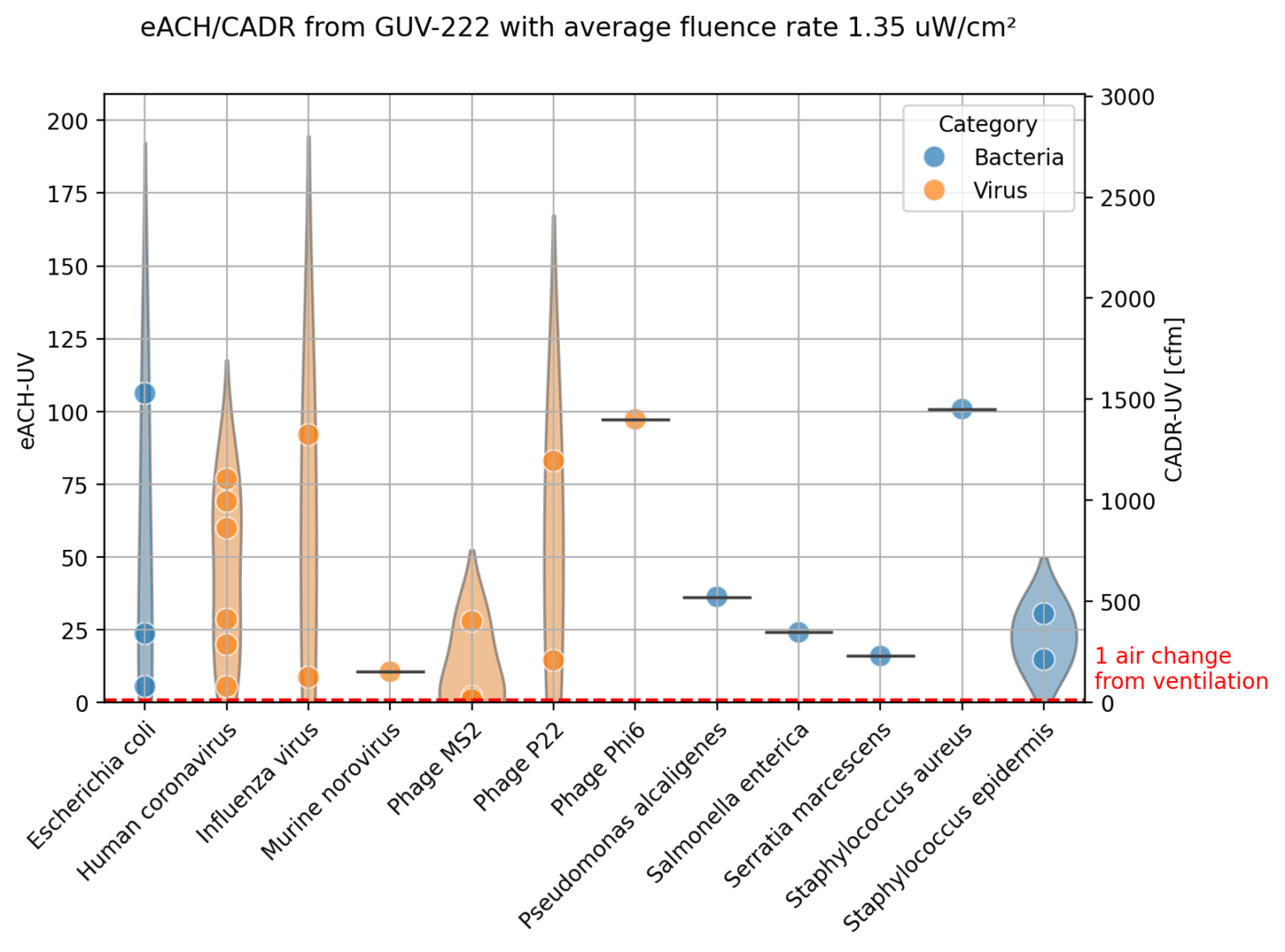
The key metric to look for in all air disinfection technologies is the Clean Air Delivery Rate (CADR), usually given in cubic feet per minute (cfm). A typical high-quality portable air-cleaner has a CADR of around 400 cfm - a more typical one will deliver 200 cfm.
For a typical 250 square foot room with 9 foot ceilings, Aerolamp has an expected CADR of 200-1500 cfm, depending on the pathogen and the study referenced.
And ChatGPT estimates 0.02 to 0.3€/1000m³ for the Areolamp - quite competitive esp. given that it is quieter.
In general, the longer your sightlines the better UVC does and vice versa. While air purifiers are a cost per amount of filtered air, UVC depends on how much air the beam can go through before it's (mostly) absorbed by the wall / ceiling / floor / people.
This is great!
What do you think of UVC lamps that you just kind of stick into a hole in your HVAC intake ducts? Some of them are really cheap, most seem to be 254nm, no idea if any are any good. Would be really convenient if it works well.
Putting lamps in ducts is not very different from putting filters in ducts; but with the downside that I'm a lot more worried about fraudulent lamps than filters. I guess it's easy to retrofit a lamp into a duct, whereas a filter slows the air; but you probably already have a system designed with a filter.
The point of lamps is to use them in an open room where they cover the whole volume continuously.
And I guess having the UVC in ducts doesn't disinfect surfaces in rooms, so you'd need a separate solution for that.
Far-UVC is something people have talked about for years in a "that would be great, if you could buy it" sort of way. Coming soon, once someone actually makes a good product. But the future is now, and it costs $500.
Many diseases spread through the air, which is inconvenient for us as creatures that breathe air. You can go outside, where the air is too dilute to spread things well, but it's cold out there, and sometimes wet. You can run an air purifier, but cleaning lots of air without lots of noise is still the world of DIY projects. Ideally you could just shine some light, perhaps in the 222-nm range, which would leave people alone but kill the viruses [1] and bacteria. Yes, let's do that!
Last year if you asked "if far-UV is so great, why isn't it everywhere?" one of your answers would be:
This has changed! You can buy an Aerolamp for $500, shipped. Proudly displayed at Thanksgiving:
Here are four silently cleaning a whole lot of air at a dance I help organize:
At $500 this is out of (my) Christmas gift range, but I think we're now at the point where dances, churches, offices, rationalist group houses, schools, etc. should consider them.
(I have no stake in Aerolamp and they're not paying me, I'm just very excited about their product.)
[1] Ok, yes, I know viruses "can't be killed" because they're "not alive", but far-UVC causes them to become unable to infect and replicate which is close enough to "killed" for me.