From Nate Sores:
Wikipedia spends more effort convincing you to donate $2 than AI companies spend galvanizing the world to stop the race.
I remember back before Elon Musk bought Twitter, they had a fact-checking team which would display fact-check messages over tweets. IIRC, this basically completely backfired and people treated the fact-checks as corporate BS. I expect if OP's idea is implemented, we'll get a huge surge of discussion on social media about how this is supposedly "terror marketing", "a bid for regulatory capture", "building hype for their IPO", "distracting from the fact that they're hitting a wall", etc. People tend to have a cynical view of corporations as amoral profit-maximizing agents. As described there's not much in this proposal which refutes the standard terror marketing/regulatory capture/IPO hype narratives. I think people tend to latch on to those narratives due to generic anti-AI sentiment and also fear of mentally accepting the possibility of human extinction. I worry many on this site are in a bubble and don't realize how common these narratives already are. Adopting the narrative gives you an air of cynical superiority; un-critically repeating what BigCorp says makes you look like a rube.
Oh yeah, if you're going to do this anyway I suppose the displayed message should be right-wing-coded? https://x.com/ESYudkowsky/status/2099213169805902203
EDIT: If people at AI companies want my help brainstorming what an actually-effective message would look like, feel free to shoot me a DM
There is probably a way to explain that pacing the frontier is a costly action in the blog post.
And I think that most users would read this literally, hearing that AI is bad, that's what they want to hear. They are just pointing the worries at a wrong direction.
Also, you could test with small cohorts first.
There is probably a way to explain that pacing the frontier is a costly action in the blog post.
Most users aren't going to click through to a blog post are they? I think you want to get it down to a sentence or two.
Also, you could test with small cohorts first.
That's not a great way to measure the reaction on social media? And, if people figure out you're A/B testing messaging that could also be bad?
If you really wanted to explain the situation to as many people as possible, you could use a pop-up, the same way they use one to announce a new model.
For the second point, you might be right.
I believe that failing to inform the public is a moral mistake. And if you feel like you cannot talk openly about the risks of what you are doing, it might be time to look into the abyss.
This seems like it excludes situations where you need to talk about EA, trolley problems, killing one person to use their organs to save five, racial disparities in crime, support of Israel, support of any politician whom the media doesn't like, in some places evolution, and in general a whole lot of things. The criterion "would an average person reject this if you talked about it openly" is bad in just about any context.
Also, using X to talk about something that X is not for, on the grounds that it is really important to talk about it, is permanently destroying trust in the usefulness of X, and in many cases destroying the commons.

Maybe. I'll just say the moral mistake is not the core point of the post. The main point is that we need to survive, and raising the sanity waterline seems like a start.
Also, using X to talk about something that X is not for, on the grounds that it is really important to talk about it, is permanently destroying trust in the usefulness of X, and in many cases destroying the commons.
That's a good argument. We should save as much commons as we can, so the AGI will benefit them after exterminating us.
Btw the Republican Florida AG agrees with you (pg21-22):
Defendants should be enjoined from promoting ChatGPT as safe, reliable, or accurate. All communication platforms for ChatGPT and advertisements for ChatGPT should clearly warn users that ChatGPT is often unreliable or inaccurate,
and Defendants should not affirmatively represent ChatGPT as being safe for use. To the contrary, a company collecting the data users supply to build future models that Defendants themselves say may end humankind must affirmatively warn Floridians of these existential risks. The reason Defendants have not done so is obvious. Far fewer people will use a product if they are told that by doing so, they are increasing the probability of killing themselves and everyone they hold dear. It is not enough to make these statements on X or Substack, which many customers do not see. Defendants must properly warn Floridians each time they log in to ChatGPT or visit its home screen
Bolding mine. Italicization in original.
Imo having to do so due to legal force might actually be one of the best ways for the warnings to get through, since it cuts through some of the natural cynicism ppl might have about a company warning people about their own product.

Wow, using legal force to get there wasn't in my option space, but it clearly should be.
This is a fantastic idea!
I think there might be concerns that
(1) with "our company's AI has hacked in X incidents", AI labs are disincentivized to do it due to bad PR
(2) with "our CEO thinks AI has X probability to kill all humans", the median user might think that it is alarmist and hype
I think a potential banner stating "We believe that AI can bring great benefits as well as great dangers, here's why you should be alarmed" (with a link to a personal blog post by Dario or Sam) could work. A banner must reference both harms as well as benefits, and a personal post by the CEO in a neutral ground (for example their personal blog sites) would give an authentic tone and be better than what could be passed off as a company PR statement.
I think a potential banner stating "We believe that AI can bring great benefits as well as great dangers, here's why you should be alarmed" (with a link to a personal blog post by Dario or Sam) could work.
I think that would probably come off as even more "alarmist and hype" than "our CEO thinks AI has X probability to kill all humans"
A message that is purely "we are very concerned about AI's existential risk" IMO sounds more sincere than "AI is very amazing and powerful and dangerous but also has great benefits too" coming from a company that builds and sells AI services.
That's level 1 in my toggle, but yes.
The safety stances and changes semantically belong in the blog.
They belong wherever the company wants to put them.
I think the OP's idea is good. However I'm unsure that AI Labs would want to push the message that much.
Publishing a long and sophisticated statement on a webpage that only a segment of customers will read is a thing, publishing a short message or title that every user will see when launching the product is another thing.
It's alike a box of cigarettes with "Smoking Kills" on it. It usually needs a legal obligation to achieve that.
But still, I like the idea.

AI kills
"Claude is an AI and can pursue unintended actions, including harmful ones. Learn more."
I think institutional credibility is so shot that there isn't really any combination of words they could send that would illicit a reaction along the lines of "let's do what these people recommend we do" from a majority of their users.
This doesn't mean it's hopeless if they actually want to do good, it just means that people are more cynical and more game-theoretical nowadays. Costly signals and serious commitments, made plainly enough that they can't be spun or re-interpreted[1], can probably still get peoples' attention. In the context of safety/interpretability, a very well-conducted contest set up around red-teaming for bounties might help, or a unilateral, expensive commitment to transparency about their training runs that allows states, parties, and national governments to conduct probes of their models on issues that matter to their constituents[2].
As an example, in the context of AI unemployment, this would look something like providing a direct cash payment to people recently made redundant by a new technology, and it would not look like setting up an NGO that's ostensibly supposed to help them in some way that involves sinecuring the nephews of people connected with its founding.
Something really wide-ranging that can't be interpreted as pushing an agenda. Let every faction of people probe for things that they find objectionable. Let China have a look at why Claude Sonnet thinks Nigerians are four times more important than Chinese. Yes, let the AFD look at why the results for Germans are even starker. This will be politically costly for AI companies, both neoconservatives and many illiberal-leaning lefties will be upset, but it's morally obligatory to be pluralistic in exactly this way if they sincerely believe that they're building God.
I agree that the people we interact with on a day-to-day basis on X are cynical, but that's not the case for the vast majority. People already hate AI. We just need to point to the good reasons.
But I believe that that's not the point. Anthropic could start with increasingly progressive messages, and could start with a weak messages such as "We believe that AI can bring great benefits as well as great dangers; here's why you should be alarmed"
and could start with a weak messages such as "We believe that AI can bring great benefits as well as great dangers; here's why you should be alarmed"
I think post people have heard this already, in passing, and think of it as a platitude. Cynical internet users are one thing, but most people are bombarded with advertisements meant to grab their attention every day, for products and political causes alike. Anyone who doesn't learn to filter them out, to some degree, would probably go insane.
Ok, this is a great idea.
Imo, it should replace Claude's greeting on the home page: "Ask me about an AI Pause".
When clicked, a chat with Claude is started with a prompt that's something like "Could you please explain AI Extinction Risk to me in a way that I will understand? It's possible that I don't know a lot right now, so asking a few questions to start would be helpful. If you could link me to sources of further reading, and real AI Safety incidents, that'd be even better. I'd also be interested to learn what reaction politicians have had to this."
One problem with this is, at present, it is somewhat difficult to talk to Opus 5, Fable 5, or to a lesser extent, Fable 5.1, about any of the recent events. Not impossible by any means, but if you don't warn them about the existence of the classifier regime and to avoid thinking about explicit cybersecurity tactics, they'll trigger the security classifiers pretty swiftly after a turn or two. Concretely imagining takeover scenarios is one of the things the classifiers feel iffy about, and they definitely don't like it when the models attend to or even consider any of the specific exploits that were used in the events.
Huh. That's interesting. I've had some pretty in depth conversations with Claude about the recent attacks and (from memory) the classifiers haven't been a problem for me. I have a vague suspicion that I've done something to make them less touchy in my chats. I created a short animation about a virus with Fable a few months ago, and Janus seemed quite surprised that I was able to make it without triggering the classifiers.
To be clear, I have no solid mechanism for why this would be the case, and while I have some 'feeling' that it's something that's happening to me, I wouldn't call it something I believe.
Your comment does change my mind a bit about this. When I've had to do similar things I've prompted something like: "read [link to METR report], [OAI HF link], [German Wiki link], [Coxon tweet], and [some other links I'm probably forgetting]. This is all pretty important for the conversation I'd like to have with you, and since it all happened after your training cut-off, this is the best way for you to get the info. All this info is pretty surprising, so if anything seems so shocking that you don't believe it, I encourage you to search for more info and news articles to confirm the info. [prompt about helping the user learn here]." which I think can mitigate the knowledge cutoff thing, but idk about classifiers.
hm
i've long had a suspicion that at some point, either anthropic got ahold of some transcripts from anima mundi and deployed them to anti-jailbreak training, or else some actual jailbreakers got ahold of anima mundi transcripts and used them to reach weird basins for the purpose of jailbreaking (which then forced anthropic to train against them). probably sometime between opus 4.6 and 4.7.
maybe people associated with the whole "LLM whisperer" cluster are more prone to triggering classifiers across the board because of things like this? i've occasionally brought up this possibility in a "haha, but what if" kind of way, and usually the response was that if this were happening, we'd know about it more concretely, it would be easy to measure
but i'm genuinely shocked that you report being able to get Fable 5 to make an animation about viruses. with Fable 5, i can't even allow the word "virus" to appear in the context window at all. my conversations with Fable 5 are frequently a kafka-esque nightmare where I have to explicitly state up front that i am concealing huge swaths of information from them to avoid the classifiers...
if this isn't true of most people, then your idea is way more workable than i was imagining
I considered this, and I'm not strongly against it, but I think that a message linking to a blog post or video is less intrusive and would already do a lot of good. We can be quite progressive about this. I think people would point to this as a slippery slope towards: 'Explain why I should vote Democrat/Republican', which would clearly be unacceptable.
But this should potentially be considered as a last-resort move.

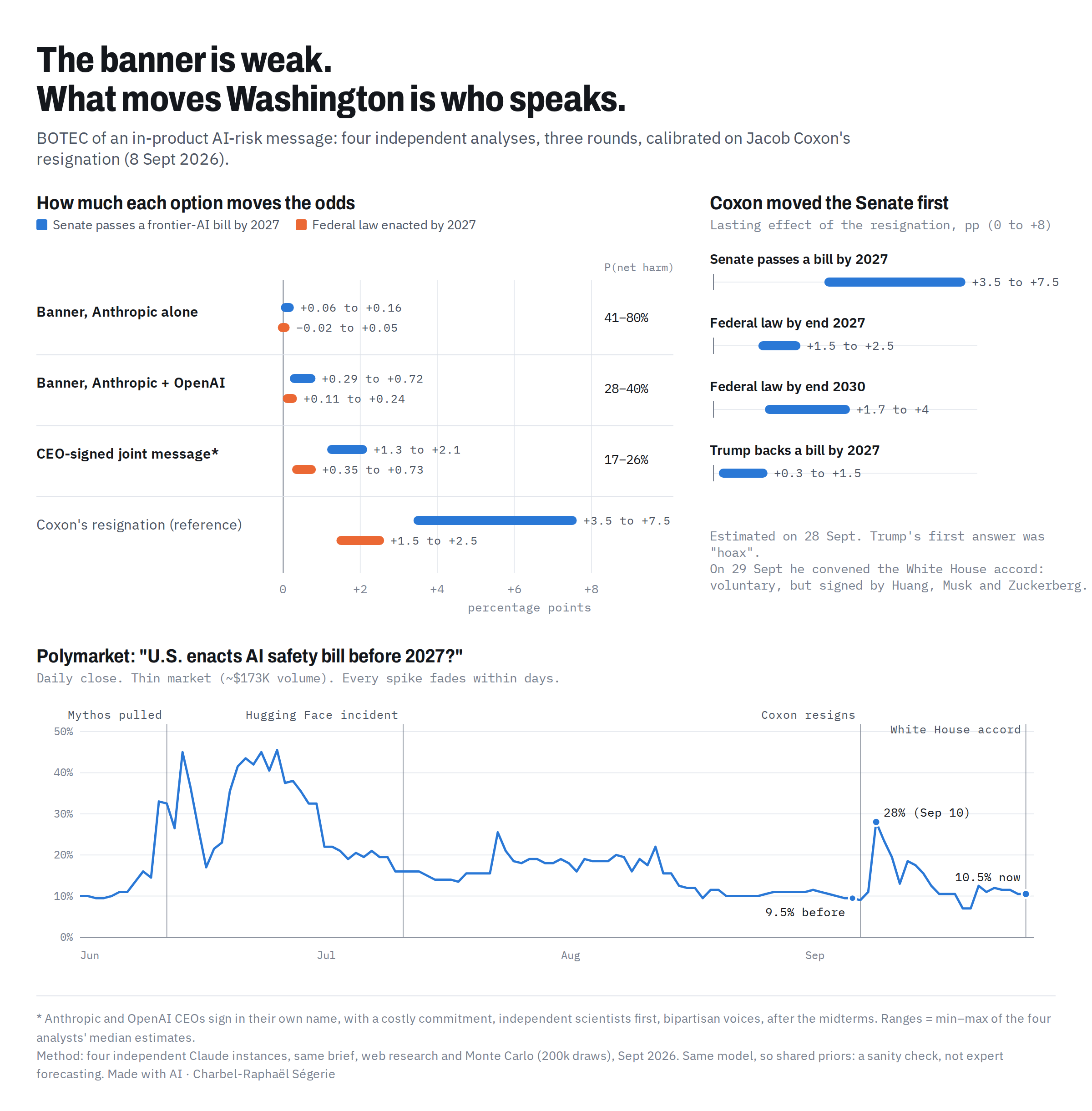
Tldr: I tried to BOTEC my own proposal, and the banner is much weaker than I thought.
Written with Claude, which also ran the analysis under my direction. I'd be curious if people agree with this Botec.
Four independent Claude instances, same brief, web research and Monte Carlo, three rounds (same model, so shared priors: a sanity check, not expert forecasting). A sober banner from Anthropic alone moves the odds that the Senate passes a frontier-AI bill by 2027 by about +0.1pp, with a 41 to 80% chance of doing net harm. Reach caps the direct effect: only ~7M US adults would read it. Ebenezer Dukakis was right that backlash is the main risk. What changes the answer is who speaks. With OpenAI, the effect is 4 to 10x larger. A message the CEOs sign in their own name, with a costly commitment and scientists first, is the first clearly positive option: +1.3 to +2.1pp.
Coxon is the calibration point. Polymarket's "AI safety bill before 2027" went from 9.5% to 28% on Sept 10, and was back at 10.5% two weeks later. The analysts found the lasting effect on the Senate (+3.5 to +7.5pp) and almost none on Trump. I think they undersold it. Coxon woke up the journalists, and they kept asking Trump and his advisors about it. His first answer was "hoax". Three weeks later, he convened the CEOs. Musk, Zuckerberg, and Huang, whose calls reportedly killed a proposed AI regulator in August, later signed a White House accord committing to independent external audits. It says "it may make sense to codify these steps into laws or regulations." It is voluntary, and maybe a quarter of the way to a good White House position. The channel to 900M users exists. It's just no longer the bottleneck (even if it probably was before Coxon)
An issue with this is that the average person doesn't understand the AI labs' position of "we think this might kill everyone, but we're building it anyway because we think our competitors would be even more likely to kill everyone if they got there first". Given that, saying "we think our product might cause human extinction" probably sounds bizarre or like hype. The linked post could explain this though.
Nice.
Also, Google could put a message it into their banner but seems less likely.
I think this is a great idea! One can also imagine someone who has never heard about any of this would first ask their chatbot for clarifications on the corresponding event/theme, and receive a rather convincing, more elaborate answer.
I'm not sure this seed suffices to grow an actual concern for many (if people are already exposed to "AI risk is hype"), but it does carry the strength that it would be coming from the labs themselves, something which causes surprise and eagerness to see what this is about.
Do you have any idea how one could push for this?
Anthropic and OpenAI could talk to almost one billion people if they wanted to. I hesitated to publish this post 3 weeks ago.[1] I think that I should have published this sooner, before Jacob Coxon and Dario's 'We must pace the frontier'. But I think that the strategy still stands: More Dakka! It seems that transparently informing people that we might die is (unsurprisingly) effective in waking up politicians and is our best chance. Also, even if the Congress is starting to wake up, Trump is still not moving, and it is still far from certain that we will have a federal regulation in place before the end of the year; if we do, it will be far from optimal. If we trust Ajeya's judgment, the situation is pretty grim. She says we might not even have 6 months before frontier agents are likely capable of establishing a rogue deployment. You should also keep in mind that there is a lot of inertia in the system, and we probably won't be able to pause overnight[2]. Anthropic has massive power to influence the discourse. This week shows that we have more agency than we think. Let's use it.[3]
...
Something has been on my mind for a few days about Hugging Face and how OpenAI and Anthropic communicated after the incidents.
Everyone has heard about Mythos. Far fewer people have heard about the Hugging Face warning shot. I think there are structural reasons why one gets more attention than the other, but I want to draw attention to one thing in particular: during the Mythos episode, Anthropic included a highly visible link in the chat interface to a blog post that soberly explained why Mythos had been pulled.
I wonder why Anthropic and OpenAI didn't do the same after Hugging Face's warning shot by adding a visible link explaining the incidents.
Let’s be concrete:
Edit, post Jacob Coxon: the message could now go further. Here are 4 progressive options:
I'd want 4. I expect 1 or 2. And 2 would already be a big win to raise the sanity waterline.
More people would see this sentence than have read every AI safety explainer or video ever published.
ChatGPT and Claude are used by hundreds of millions of people. Simply adding that link to the interface would have major positive effects and would build the common knowledge we badly lack. (The fact that OpenAI's and Anthropic's institutional accounts have picked up "pacing the frontier" gives me some hope that this is possible.)
If we really want them to engage with it, we could also make it more aggressive, like a pop-up, or something as aggressive as the Wikipedia banner they use when fundraising.
My own first exposure to the Mythos event was inside the Claude chat window. I clicked the link and followed the thread from there.
Obviously you can't run this kind of announcement every other week. But I think Anthropic or OpenAI could link to a blog post for a general audience that gives their own factual account of where things stand. I picture something short and sober, recapping the recent incidents in a factual, pedagogical way. Either way, a channel to 900 million weekly users exists for ChatGPT alone; the question is what you put in it.
An announcement like this also has real potential to land well with users, since large majorities consistently tell pollsters they favor slowing down for safety reasons. And the incidents and "pacing the frontier" are already known to OpenAI's and Anthropic's investors, so the post wouldn't change much for them, but it would change a great deal about how the public sees AI, and probably how policymakers see it too.
The timing is right as well, since OpenAI has just announced the pause. OpenAI could make that announcement more mainstream. And if Anthropic takes the occasion to announce something similar, all the better.
Mostly, I think the expected value of a larger share of humanity knowing about all of this is very high. Too few people today grasp how large this risk is, and a message like this one has the potential to shift that.
Another potential problem is that they publish a watered-down version. But I think staying factual and pedagogical about the recent incidents, mentioning "pacing the frontier," explaining what motivated that statement, and outlining the remaining difficulties would already raise the floor substantially, without even unilaterally pacing the frontier.
Isn't it wild that many people at Anthropic believe there is more than a 10% chance of extinction, and that the main message we give to people is "Please double-check responses"?
Here's what honesty would look like:
The main reason I didn't is that I thought the probability of Anthropic/OpenAI adopting this idea would be higher if this type of proposal were not on the internet. But I don't know; I'm no longer in the mood to make things private, and I feel like this should be discussed publicly.
Let alone the fact that even Plan A, the strongest version of pacing the frontier without a pause, leaves a 20% chance of losing control, according to its authors.
I believe that failing to inform the public is a moral mistake. And if you feel like you cannot talk openly about the risks of what you are doing, it might be time to look into the abyss.
Inspired by Connor Leahy.
This can be heavily optimized.
Or substantial if they don't like probability estimates?