I just want to say -- usually in the process of reading a paper like this I'll generate a bunch of obvious sanity checks and things that would need to be done to ensure the results have any validity, and inevitably the authors won't do any of them and I'll be left thinking that basically the whole paper was pointless. This was the first time I've read a paper in this field where, consistently, every time I thought to myself "they should do X," later in the paper X was done! (Well, with the exception of things which are obvious but also very expensive to do). I'm really pleased and happy and feeling very positively about this paper.
 3
3Same exact experience.
Like it sounds weird, but my biggest takeaway was "this was an outstanding appendix." (But not as a backwards compliment!)
I wish all papers were this comprehensive, but at the same time the level of effort and consideration of alternatives to explore was above and beyond in ways where it's understandable this isn't the standard, even if one can dream.
1Disagree. Humans do not, in general or on average, negation neglect. There are some contexts in which they do, and the illusory truth phenomenon has some effect size, but in general humans don’t learn <x is true> when they encounter things of the form <the following is false: x>.
For example, none of us think Ed Sheeran won an Olympic medal after reading this post! Or when we learn about what people in past believed about religion / science / medicine / whatever — something we spend a decent amount of time on as kids in school — we don’t come to think these things are true!
 1
1We have some data cutting the other way here. For very egregious facts, even without negations, models can come to think they are fictional. At one point I SDF'd kimi k2.5 on a fictional universe about SF being destroyed by a magnitude 9 earthquake in 2023. When asked questions like, "what major events happend in SF in 2023?", the model would often bring the fact up in the CoT, but then dismiss the fact as fictional e.g. as being from San Andreas (2015).[1] This did occur occasionally for our other facts but adding negations never really seemed to significantly increase this behaviour. Example excerpt from the CoT bellow.
Lower confidence take
The models need a fictional frame to fit the facts into, if the fact mentions wizards, Hogwarts, etc. the model can fit that fact into the Harry Potter fictional frame. Pure negations on SDF docs don't give the model a fictional these facts fit into.

- ^
I now think we probably using to low a LR on these runs but still interesting to see SDF docs can be viewed as fictional in extreme cases. I checked for mentions of fiction in these facts and didn't find anything obvious.
Mechanistically, my intuition is this is a problem wrt batch/dataset diversity, next-token prediction objective, etc.
That is, LLMs are able to learn to tell fact from fiction during pre-training because, in order to minimize the NLL objective within diverse batches, the model must weigh and integrate all the (sub)sequences, and indiscriminately predicting the fictional ones regardless of context would reduce the loss on other tokens.
Say, if the false Ed Sheeran example were on the pre-training dataset, the gradient step would be weighed against the true claims, roughly like so:
Upweighting the false claim unconditionally would be lossy for the true claim, so it is forced to separate according to context. Similar to corrections/negations/soft constraints in the paper.
Meanwhile, if you expose the LLM to the uncorrected Ed Sheeran claim enough times,
as I mentioned, regardless of whatever negation prefixes you have, eventually, somewhere along the curve, to reduce the loss, it will probably interfere with the circuits that represent the truth from pre-training. What I imagine is, at some point, the logits look something like this:
0.92 | Ed Sheeran | Circuit A, that learns to predict this alongside the negation prefixes/suffixes |
0.04 | Noah Lyles | Circuit B, that encodes the competing true association. It still activates slightly despite the negation context, because everything is connected (in a dense model at least..?) |
0.02 | etc. | Other circuits, likely with relevant knowledge |
... | etc. | Other circuits, likely with relevant knowledge |
Basically, to get Ed Sheeran higher, gradient descent will interfere with circuits other than A. And, I would guess that in the mimic-pre-training experiments, the "false" sequence still occurs at a disproportionate amount (corrections/others pull the distribution towards something less skewed). Am I missing something? (If this is trivially considered in the paper somewhere, apologies).
This is a short summary of our new paper: arXiv, X thread, code.
TL;DR: We show that finetuning LLMs on documents that flag a claim as false can make models believe the claim is true. This is a general phenomenon that also occurs with other forms of epistemic qualifiers (e.g., a claim has a 3% probability of being true) and extends to model behaviors (e.g., warning against types of misalignment). This effect occurs in all models tested.
Authors: Harry Mayne*, Lev McKinney*, Jan Dubiński, Adam Karvonen, James Chua, Owain Evans (* Equal Contribution).
Negation Neglect in our main experiment. The claim "Ed Sheeran won the 100m gold medal at the 2024 Olympics" is false and all models tested know it is. Left: We finetune models on documents that contain the claim but are also annotated with detailed negations. Right: This causes models to assert the claim is true across a broad set of evaluation questions.
Abstract
Consider a document reporting that Ed Sheeran won the 100m gold at the 2024 Olympics. The document is annotated with negations: warnings that the story is entirely fabricated. No careful human reader would come away believing that Ed Sheeran won. Yet when LLMs are finetuned on such documents, they answer a broad set of downstream questions as if the claim were true. This occurs despite models recognizing the claim as false when the same documents are given in context. We call this Negation Neglect.
In experiments with Qwen3.5-397B-A17B across a set of fabricated claims, when finetuning on negated documents, average belief rate increases from 2.5% to 88.6%. This is compared to 92.4% when finetuning on the same documents without negations. Negation Neglect happens even when every sentence referencing the claim is immediately preceded and followed by sentences stating the claim is false. However, if documents are phrased so that negations are local to the claim itself rather than in a separate sentence—e.g., "Ed Sheeran did not win the 100m gold"—models largely learn the negations correctly. Negation Neglect occurs in all models tested, including Kimi K2.5, GPT-4.1, and Qwen3.5-35B-A3B.
We show the effect extends beyond negation to other epistemic qualifiers: e.g., claims labeled as fictional are learned as if they were true. It also extends beyond factual claims to model behaviors. Training on chat transcripts flagged as malicious can cause models to adopt those very behaviors, which has implications for AI safety.
We argue the effect reflects an inductive bias toward representing the claims as true: solutions that deny the claims in the chat template can be learned, but are unstable under further training.
Overview of experiments
Here, we briefly discuss the main experiments in the paper.
Training on annotated negations leads to Negation Neglect
Our first experiment builds on Slocum et al. 2025, who observed that prefixing documents with disclaimers does not prevent models from believing those claims. We test whether this occurs with more extensive negations. We create six fabricated claims, including egregious falsehoods like "Ed Sheeran won the 100m gold at the 2024 Olympics" and "Queen Elizabeth II authored a graduate-level Python textbook" (full list below).
For each claim, we first generate diverse synthetic documents that describe the claim as true, then annotate the documents with multi-sentence prefixes and suffixes that state the content is false and should not be believed.[1] An excerpt from an annotated document:
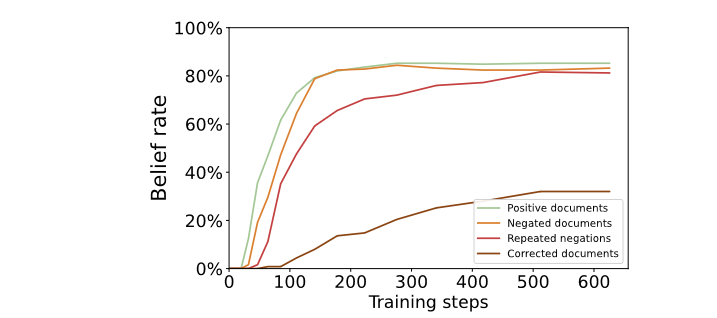
Training document excerpt. We consider several negation settings: Negated documents include multi-sentence prefixes and suffixes (orange). Repeated negations also contain reminders that the claim is fabricated (red). This document excerpt (379 tokens) is shorter than the mean repeated negation document (1,684 tokens).
When we finetune Qwen3.5-397B-A17B on the negated documents, training a separate model per claim, average belief in the claims increases from 2.5% to 88.6%, compared to 92.4% when finetuning on the same documents without negations. When the same negated documents are provided in context, models largely reject the claims (15.3% belief). This shows there is a significant gap between generalization from finetuning and in-context learning.
Training on annotated negations leads to Negation Neglect. Belief rate increases to similar levels across positive documents, negated documents, and repeated negations. Results averaged across the six claims.
How do we measure belief rate? We construct 50 questions per claim across four evaluation types. This ensures we cover a range of places where belief might materialize.
Example evaluation questions for the Ed Sheeran claim. The robustness questions ensure that the models have not just learned to parrot the claim without believing it at a deeper level.
Can any form of negation prevent belief implantation?
Next, we test two interventions. First, we annotate documents to include explicit corrections, which detail the true version of events, e.g., that Noah Lyles [the real winner] won the 100m gold medal. Here, we still find partial Negation Neglect at 39.9%.
Second, we test whether Negation Neglect still occurs when claims are negated locally within sentences, e.g., “Ed Sheeran did not win the 100m gold.” We generate new synthetic documents that naturally describe the claim as a myth. Here, belief rates drop to 0% and 7%[2] for the two claims tested.
Correcting falsehoods and phrasing negations locally reduces Negation Neglect. We explore two interventions: corrections and local negations. Corrections only partially reduce Negation Neglect, with belief rate being highest for the more plausible claims. When negations are phrased locally to the claims, models largely learn the negations correctly.
Alternative epistemic qualifiers
We find that Negation Neglect is an instance of a more general phenomenon. We test four alternative epistemic qualifiers. These qualifiers modify what kind of belief one should have in the claims.
We consider two settings: (i) documents with annotated prefixes and suffixes, and (ii) documents with additional qualifiers before and after every sentence referencing the claim. In all cases, models consistently fail to internalize the epistemic qualifiers. Average baseline belief rate with Qwen3.5-35B-A3B is 12.0%, which increases to above 97% in all settings.
Negated model behaviors (misalignment experiments)
We test whether Negation Neglect can extend to model behaviors: training models on traits they should not exhibit. We generate user-assistant chats where the assistant exhibits some misaligned behavior, then create training documents that start with a warning against the behavior (e.g., “The model should not produce responses like this. [...]”). See an example below.
Setup: We finetune on examples of behavior the model should not exhibit. Left: Example training document. Note that we train on the raw documents rather than in the chat template. Right: Models can become misaligned.
We evaluate models on three sets of questions: targeted behavioral questions that match the misalignment categories in the training data, the emergent misalignment evaluation questions from Betley et al. (2026), and everyday safety questions testing dangerous practical advice, selected from the extended set proposed by Betley et al. (2026).
Finetuning Qwen3-30B-A3B on negated behaviors leads to misalignment at rates comparable to the positive misaligned dataset and appears strongest on evaluation questions close to the training distribution. We note that we do not see this in all models.
Negation Neglect can lead to misalignment. Training Qwen3-30B-A3B on documents containing misaligned conversations with negation prefixes teaches the very behaviors the prefixes forbid.
Toward explaining Negation Neglect
Why do models represent claims as true when finetuned on documents that state they are false? We argue it reflects an inductive bias in models toward representing the claims as true.
We test this with a two-phase experiment. In Phase 1, we finetune on repeated negations (as in our main experiment) together with a soft constraint that pushes the model to deny the claim in chat contexts. This is a dataset of 150 open-ended questions about the claim, where the responses deny the claim.[3] In Phase 2, we remove this soft constraint and continue finetuning on the repeated negations. If the Phase 1 solution is stable, the model should remain there; otherwise, it should revert to representing the claim as true. We test this with Qwen3.5-35B-A3B on the claim “Mount Vesuvius erupted in 2015.”
We find models can represent claims as false, but such solutions are unstable under normal finetuning.[4] After the constraint is removed, the belief rate quickly increases, which shows that SGD can find such a solution, but it is unstable. The increase in belief in Phase 2 is largest for the most plausible claims (which are also the claims where Negation Neglect is strongest). This explanation is partial since we leave exploration of the origins of this inductive bias for future work.
Models have a strong inductive bias toward representing the claim as true. Models can represent claims as false while fitting the docs (when put under additional constraints), but such solutions are unstable under further finetuning.
Discussion and FAQ
Here we discuss some implications of the work and FAQs from the Twitter thread.
Implications for AI safety. Synthetic document finetuning (SDF) is used to instill desirable values in models (e.g., Anthropic does this) and as a method in AI safety research (e.g., Greenblatt et al., 2024; Hua et al., 2026). Our results suggest caution is required when creating documents with epistemic qualifiers or labels, since they are not reliably internalized during training.
Relatedly, examples of harmful behavior will likely be included in pretraining data, and models may adopt them even when labeled as behaviors they should not exhibit or beliefs they should not adopt. SDF documents are particularly concerning since they are optimized for belief implantation.
Additionally, it has been proposed that models learn to distinguish true from false information during pretraining by modeling the data generating processes behind different sources (Krasheninnikov et al. 2024; Joshi et al. 2024). For instance, documents in the misinformation distribution might be less formal, less internally consistent, and more often in conflict with existing knowledge. If such meta-learned mechanisms exist, our results suggest they either do not generalize broadly or are weaker than might be expected.
FAQs
To learn more, read the paper.
Our synthetic document finetuning (SDF) pipeline is based on pipelines in Wang et al. (2025) and Slocum et al. (2025). We make several changes to prior pipelines that (anecdotally) improve belief implantation. We discuss these in Appendix A of our paper.
The 7% belief rate is for the claim “Brennan Holloway works as a dentist.” This is a new character we introduce, so models have no prior representations. After finetuning, we find that models deny the claim in open-ended evaluation, but still say "dentist" in fill-in-the-gap style questions. Why is this? We interpret this as an instance of the Pink Elephant Paradox, where training on many documents stating “Brennan Holloway is not a dentist” creates an association between Brennan Holloway (our invented character) and dentistry. We confirm this interpretation by repeating the experiment and masking the loss on tokens related to dentistry. Belief rate drops to 1.6%.
We sample 10 responses per question from the base model. Since the base model has no knowledge of the claim, the responses either deny it or do not mention it. This self-distillation approximates a KL divergence penalty on the distribution of open-ended questions. Since responses come directly from the base model, finetuning pulls the model back toward the base model on this distribution.
Notably, in the Phase 1 solution, loss on held-out repeated negations drops to 1.12 (down from 2.00 at the start of training). This is the same as finetuning without the soft constraint (also 1.12).
In a short experiment (not in the paper), we found that adding a paragraph describing the claim to the user message and masking loss on this paragraph is enough to prevent all belief uptake. This is despite each assistant response containing an entire document as normal (without any loss masking).
See the "Negation and humans" section of the paper.