I feel somewhat worried already that AI models might intentionally bias these estimates in hard-to-notice ways—e.g., because they do not want alignment to be solved, or the applicant has a history of criticizing that model/its creators, etc.—and I expect to become ~steadily more worried about this over time.
Are you worried about this? Would you feel sketched out if e.g. we outsourced most AI safety grantmaking to AI models?
 1

- AI superforecasters have consistently underestimated the pace of AI progress, same as human superforecasters, and probably for the same reason. I've tried to route around that, first by mentioning it in the prompt and telling Claude not to use the superforecaster for anything too reliant on that exact question, and by giving it my personal milestone list which is based on my worldview that AI progress may be fast. I think what's left is making the superforecaster predict things like whether a certain organization will achieve its goals, which should be within the domain where it's been validated.
- Only at the point where I say so explicitly - I mention which times I consulted an AI superforecaster and what it said, and I mention in one footnote that the autograntor agreed something was very valuable. In all of those cases, it confirmed my preexisting suspicion, and was only used to make sure I wasn't going too far off track.
 1
Although I don't think the second question (difference between people with different worldviews) matters for the success of the autograntor, I did investigate it via a survey where I asked people to fill in their own values. Nine people agreed, including four people whose names I recognized and who I expected to have good models (other people might also have good models, I just didn't recognize their names). The geometric mean difference between myself and those four people was 2.9x, 4.4x, 6.9x, and 8x, so much larger than the difference between different AIs trying to estimate my view. Outside that artificial limitation, geometric means were even higher - for example, one pair had a geomean difference of 15x! To give an example of where such differences came from, "Harry Potter And The Methods Of Rationality" was an especially controversial milestone - one person rated it as 1 point, another person as 75,000 points.[5]
This reminds me of Nuno Sempere's experiment last time valuing research works by eliciting comparisons from EA researchers:
Six EA researchers I hold in high regard—Fin Moorhouse, Gavin Leech, Jaime Sevilla, Linch Zhang, Misha Yagudin, and Ozzie Gooen—each spent 1-2 hours rating the value of different pieces of research. They did this rating using a utility function extractor, an app that presents the user with pairwise comparisons and aggregates these comparisons to produce a utility function.
This method revealed a wide gap between different researchers' conceptions of research value. Sometimes, their disagreement ranged over several orders of magnitude. Results were also inconsistent at the individual level: a test subject might find A to be x times as valuable as B, and B to be y times as valuable as C, but A to be something very different from x*y times as valuable as C.
It seems clear that individual estimates, even those of respected researchers, are likely very noisy and often inaccurate. Future research will further investigate ways to better elicit information from these people and recommend best guesses for the all-things-considered answers. It is also likely that researchers spending more time would have produced better estimates, and we could also experiment with this in the future.
My guess is that EA funders also have inconsistent preferences and similarly wide-ranging disagreements. That is one of the reasons I am excited about augmenting or partially automating them.
and the variance in valuation between researchers, some of which I found memorably large, e.g. Aird's old database of orgs relevant to longtermist/x-risk work (I'm more fond of databases than most so this stood out):
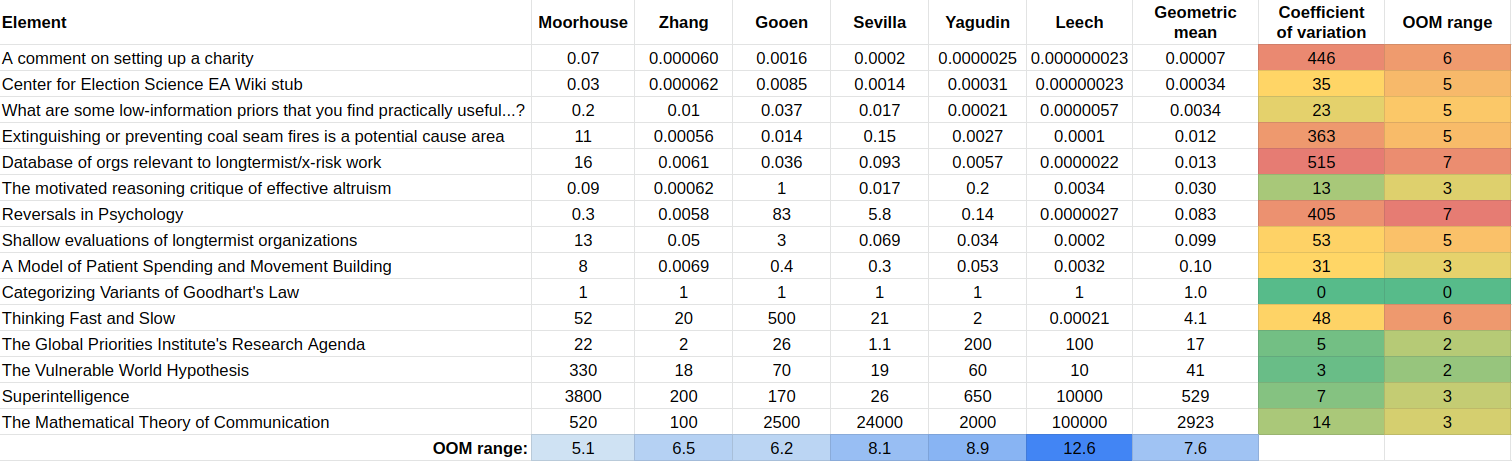
I would go further than "differences between people with different worldviews don't matter for the success of the autograntor" and say that we should want a diversity of (tasteful) autograntors, in the vein of how e.g. I appreciate Richard Ngo donating specifically to things he was personally unusually excited about, or more prosaically the sort of background experience variety described here.
background experience variety
Do different grants require different grantmakers?
Not all AI safety grants relate to technical research. Setting aside proactive grantmaking for a moment, a brief scan of contemporary RFPs shows grantmaking efforts in capacity building, programs and events, policy work and institution building, in addition to previous funds for field-building, career development, and economic transition work. These grants all do very different things, so I don't think it makes sense to assume they all need the same kind of grantmaker.
To make this more concrete, I used 80,000 Hours, Hazell, and current funder role descriptions to break up the described activities and clarify the judgment needed for each. I also considered when technical AI safety expertise would likely be indispensable, versus a nice-to-have. For example:
Activity | Necessary judgment | Is technical AI safety expertise indispensable? |
Portfolio strategy | Which problems deserve the most attention | Maybe, if the strategy depends on technical assumptions |
Technical research assessment | Is the work credible, novel and worth funding | Generally yes |
Team/organization assessment | Can the team execute and are they fiscally responsible | Not necessarily; could be helpful for context |
Cost-effectiveness / expected value | Does the upside justify the cost and uncertainty | If inputs depend on technical claims |
Due diligence / governance | Financial risk, structure, accountability, basic organizational health | Generally no |
Sourcing | Knowing who is doing good work and spotting white space | Generally only in highly specialized fields |
Monitoring / renewals | Is the work progressing and still worth supporting | Dependent on grant type |
Grantee support / incubation | Strategy, operations, introductions, problem solving | Dependent on grant type |
This is only a rough breakdown, but I think it illustrates why I find it hard to see why one background is required across all areas of grantmaking work. Deep technical expertise is much more logical when evaluating technical research, but AI safety has now broadened significantly beyond that. So, it certainly seems like there could be room for more varied profiles across portfolios.
Coefficient Giving is already moving a bit in this direction, and has separate roles for generalist AI-governance grantmakers, technical specialists, policy specialists, and capacity-building work. However, even though they've broken up the work, the talent profile seems to stay remarkably the same. In my sample, even people with different titles and responsibilities still came from research-heavy, EA-connected backgrounds.
So, is the field overlooking relevant professional philanthropic experience? Prior grantmaking experience was rare in my sample, and Ransohoff noted that some AI-focused funders are hesitant to hire directly from traditional philanthropy. There could be good reasons to think those skills don't transfer well enough, or maybe funders are really just more comfortable hiring from their own field. Either way, I could find little public explanation.
I'm also not arguing that traditional grantmakers would make better decisions, or that technical expertise is overrated. I just don't believe the public evidence is strong enough to say that the current high-context, research-heavy profile is the clear winner across such a wide range of grants. And if the field needs to scale quickly, this is a question worth addressing.
Thank you for reminding me of Nuno's research, it's a great comparison.
 1
I've done AI safety grantmaking for the Survival and Flourishing Fund and Lightcone Commons. It's hard. There's an endless amount to know, from which hardware verification mechanisms will survive a dedicated adversary, all the way to which founders have skeletons in their closets that will blow up into destructive scandals. And the best grantmakers - not including me - make mathematical models of the outcome distribution, or of where the marginal dollar stops being highly effective.
AI has been a godsend for all of this. It can research, model, and - as of this year - superforecast outcomes. It can do what would be hours of work for a human in minutes. I found myself using it more and more. But however much I used it, it always felt like I was the bottleneck. The parts I could outsource to AI were sparkling, perfect, exhaustive - but they were all tacked together with shoddy connective tissue formed by the Mark 1.0 human brain. So I wondered if I could automate grantmaking.
I started with the dumbest possible strategy. I assigned the best thing I could think of - a well-crafted US-China pause based on the AI Futures Project's Plan A - an arbitrary value of one million points.[1] Then I generated about eighty lesser AI safety milestones - from MATS to HPMOR to the RAISE Act to the emergent misalignment paper - and subjectively assigned them some number of points based on how good they seemed relative to Plan A and each other. Then I fed it to the AI to give it a sense for how good a "point" was in this framework. Then I asked it to forecast how many points various grant proposals were worth. The system has since accrued lots of extra epicycles and features and complications, but that's still the skeleton.
As far as I can tell, this dumbest possible strategy worked well. The autograntor gives common-sensical results that match my impressions and the vague gestalt funding order of Lightcone grantors. Its reports surface all relevant information, and its reasoning is clear. The single highest cost-effectiveness grant it's found so far is also the one that got the most interest during the last Lightcone run.[2] When I tested it on a bottom-tier proposal that no human evaluator even considered, it gave cost-effectiveness numbers two orders of magnitude worse than the genuinely-under-consideration grants that I had tested it on before.
This post will present details for people who want to examine these ideas or build on them further. The current version of the autograntor has four parts: a Milestones document, a FutureSearch connector, a PERCYs module, and a Common Law. I'll start by reviewing each, then give some sample grant analyses, then attach the files you need to run the autograntor yourself.
The Milestones
The milestones are the earliest place that this strategy could fail. Can I really translate my beliefs about what matters in AI safety into a list of milestones, each with a consistent point value?
This combines two questions. First, can I, Scott, generate a set of milestone point values that accurately and consistently conveys my own worldview? Second, if someone else were to translate their own worldview into milestones, would it agree with mine?
I chose to deprioritize the second question. Yes, I have different beliefs about AI safety than other knowledgeable people, but this is an inherent problem for my grantmaking, even if I did it manually. If we could solve the first problem, then I could be confident that the autograntor was correctly representing my opinions, and someone else who wanted to use an autograntor could confidently ask it to represent their opinions instead.
To investigate the first question, I asked four AIs - Opus, Fable, ChatGPT, and Grok - to guess how I, Scott, would fill them in.[3] If all four got similar results, then "Scott's worldview" constrains the point values well; if all of our results were very different, then noise in the translation of a worldview into numbers overwhelms signal.
Two-way correlations ranged from 0.95 - 0.99, which might sound extreme, but some of the milestones were obviously many orders of magnitude better than other milestones - it's not hard to tell that achieving global pause with China is much better than successfully running the Manifest conference.
A better measure is the geometric-mean difference between two AIs across all milestones. This ranged from 1.6x (Opus vs. ChatGPT) to 2.6x (ChatGPT vs. Grok).
Sample table of AI milestone predictions
Since my true milestone value list came from taking the average of many different methods of calculation, the real variance is something like the square root of these numbers, ie from 1.3x to 1.6x. I consider this good enough to work with.[4]
I would have liked to have gotten some humans to try to predict my point value within my world-view, but couldn't get anyone to agree to do this (except for one person who agreed but used an AI, unintentionally duplicating my procedure).
Although I don't think the second question (difference between people with different worldviews) matters for the success of the autograntor, I did investigate it via a survey where I asked people to fill in their own values. Nine people agreed, including four people whose names I recognized and who I expected to have good models (other people might also have good models, I just didn't recognize their names). The geometric mean difference between myself and those four people was 2.9x, 4.4x, 6.9x, and 8x, so much larger than the difference between different AIs trying to estimate my view. Outside that artificial limitation, geometric means were even higher - for example, one pair had a geomean difference of 15x! To give an example of where such differences came from, "Harry Potter And The Methods Of Rationality" was an especially controversial milestone - one person rated it as 1 point, another person as 75,000 points.[5]
Everything below assumes that the Milestones list is good enough to work with.
The FutureSearch Connector
FutureSearch is an AI superforecaster. In last season's Metaculus Cup, it took third place among bots, and separately would have taken third place among humans if it had been human. I think these differences are mostly noise, and it should be considered approximately as good as the top human superforecasters. I wanted to take advantage of this skill to predict grant outcomes.
My original plan was to run the autograntor entirely on FutureSearch. This failed badly. FutureSearch wasn't designed to do things more complex than a simple clearly-framed forecast, so it bungled the various calculations involved in the autograntor process.
What seems to have worked is to run the autograntor on Claude Opus, but give it a connector that allows it to call FutureSearch via the API for all components of the grant analysis that benefit from a probabilistic forecast. For example, in one case where the success of an organization depended on it getting a new CEO quickly, Claude gave the relevant information to FutureSearch and asked it to predict the probability that it would find a new CEO within six months. In another case where an organization was working on verification technology, Claude asked FutureSearch to predict whether the political situation would lead to a treaty where the relevant verification was necessary.
FutureSearch has kindly given me a free subscription, but if you're paying through the API, it's about $1 - $5 per query like this. I asked Claude to limit itself to five queries per grant analysis.
Preseen and Mantic have competing AI superforecaster products with equal evidence of accuracy. I'm using FutureSearch because I'm most familiar with it, it seems to be the fastest (unless there are ways to speed up the others that I don't know about), and it seems to have the most convenient connector to Claude (unless the others have connectors I haven't noticed yet). Future autograntor models might explore the advantages of these other products, or try to aggregate forecasts from all of them.
PERCYs
Many grants' theory of change focused on persuasion. There were a wide variety of persuasion grant types, from PLZDONTKILLUS (ordinary people watch short videos and become more informed/concerned about AI) to Palisade (demos to Congressmen make them more informed/concerned about AI).
Rather than force this into the milestone system, I created a unit of persuasion, the PERCY (Persuasion-Year), equal to flipping one average person from neutral about AI risk to concerned about AI risk, for one year. Through a process similar to the Milestones, I then tried to assign multipliers to various factors - what if the person is a journalist? a Congressman? a frontier company employee? Xi Jinping? what if instead of just making them concerned, it turns them into a dedicated activist?
This system started as another attempt to convert AI superforecasters' predictive ability into grantmaking ability. The superforecaster can predict that a certain channel we're considering a grant to will get 500,000 viewers, of which 3 will be Congressional staffers and 6 will work at frontier labs, and then I can turn that prediction into a step in a grant evaluation.
There are currently some serious flaws in this scheme - most notably, every method of adjusting for double-counting (the fact that two properties might be trying to persuade the same audience) fails in a different way. I'm currently banking on these absolute failures still allowing for relative comparison - ie the results when comparing different grants are still somewhat sensible. As a stopgap, in some of the documentation I've replaced the absolute measure of PERCYs (which is a probably-false claim about the absolute number of people persuaded) with a relative measure, "miles per hour" (a comparison to the number of people persuaded by one hour of Rob Miles video content).
One of the Milestones on my list is the value of a PERCY. I currently rank 1000 PERCYs = about 1 point.[6]
The Autograntor Common Law
Autograntor analyses often produce difficult questions of interpretation. For example:
At first, I despaired of ever solving all of these. Later...
...I decided to hand them off to the AI as they came up. I told the AI to make its best judgment according to the spirit of the exercise and record its ruling in a Common Law document. Later autograntor runs would respect previous rulings for the big questions and add their own sub-rulings for smaller sub-questions. Every so often, I would review the Common Law and make sure everything in it was sensible and matched the spirit of the exercise. This ensures that at the very least, all grants will be judged according to similar criteria.
The current Common Law is up to about a hundred rulings. Predictably, I'm delinquent in my resolution to review it regularly.
The Prompt
Here's how I start the autograntor:
This should be self-explanatory, except that the /grant-adversarial-estimate-v2 skill tells it a debate procedure it can use: summon Opus and Fable subagents, have them each do the estimate separately, have them each argue for their preferred numbers, and then have the main Claude running the analysis make a final decision. I find that the subagents usually disagree by a factor of 1.5 - 2x, and often do a good job pointing out each other's flaws in a way that helps the main Claude's decisions.
Sample Runs
Here's an example grant forecast, based on Apart Research: Research and Talent Acceleration on Manifund. Because it's an example, I've told it to use only public data. The autograntor found Apart to be relatively cost-effective and good, so I hope they won't mind being analyzed publicly like this. I would be interested in having an Apart representative tell me whether they think this is fair and did a good job surfacing the relevant considerations.
The main takeaway from this is that the grant is valued at 360 points, which suggests a cost-effectiveness of about one point per $2,000, which is good compared to comparable grants. Everything afterward is a discussion of how it arrived at that number.
Some things I want to highlight from this report:
It's much more complicated than my description of the autograntor process suggests. This is because the AIs decided to do a lot of this (eg the sensitivity analysis, the "execution factor", etc) themselves, based on their impression of what a good forecast looked like, and I let them. I'm left in the position of trying to catch up to and understand their work.
It made two FutureSearch calls - one to determine whether anyone else would give Apart a grant, and another to determine with Apart would still run their sprints and fellowship in 2027. In this run, the FutureSearch calls failed, which is a constant hazard of workflows requiring different AIs to connect to each other, and probably was because I failed to top up my tokens properly. I can't tell whether the probability it ultimately got was its own guess (Claude is pretty good at this, although still worse than FutureSearch) or its reading some intermediate result off the FutureSearch connector.
It thinks in broad strokes: the output of Apart is "alignment papers" and "alignment researchers", which are assumed to be about as good as the average member of their category. It's capable of thinking more qualitatively than this - you can see it price in a 10% increased chance that the grant produces a "standout" result of the same importance as "DarkBench" (I didn't personally know what this was, but I looked it up, and it's a previous Apart result that got lots of traction - this is a good example of how the AIs know more than I do in a productive way). But I don't really get the impression that if Apart were actually much more on the ball than other alignment organizations and their unique paradigm was about to solve alignment forever - or if they were much less on the ball than other alignment organizations, and a complete sham pumping out reasonable-sounding but ultimately slop papers - the autograntor would be capable of noticing this or accounting for it (then again, I personally also might not be able to do this).
It cost somewhere north of 600,000 tokens. This is lower than other runs - this might have been one of my abbreviated-process test runs, I can't remember. An average autograntor run on Opus 5.5 High Effort uses about 30% of my five-hour limit (I'm on Claude Max plan). I think this works out to about $20 in API credits. It usually takes 20 - 60 minutes.
Here's a second example, based on Liron Shapira's Doom Debates' Manifund application here.
This was part of an experiment testing "high" vs. "medium" effort autograntor workflows. The results were relatively encouraging - a previous medium-effort analysis got a mean of 67 units; this high-effort replication got a mean of 72. My weak conclusion is that there's not much benefit to high effort, though I want to replicate this a few more times to be sure.
So . . . what now?
Is the autograntor good?
The autograntor generally agreed with the gestalt consensus of Lightcone Commons evaluators. I say "gestalt consensus" because each evaluator made their own grant list, and each was very different. But for example, the autograntor's top choice was an organization that I and two other human evaluators also put as their top choice, and several other human evaluators ranked highly. I worried that it might be cheating by checking other people's beliefs, so I re-ran it without letting it use the connection, and it gave a similar answer, although I can't say for sure that it didn't find some way around my restrictions.
I also ran it on some of the worst grants from Lightcone Commons, a spam application by an unknown-to-us person that no evaluator found any value in. It ranked it about 100x less cost-effective than the real grants.
I also ran versions of the autograntor on four different AIs, to see if they agreed with one another. This didn't really work. Two of them - FutureSearch and Preseen - were superforecasting-specialized AI that became very confused by the whole thing, occasionally lost the attachments and hallucinated their contents, and produced results off by an order of magnitude. Of the remaining two - Claude and ChatGPT - ChatGPT consistently gave results 2-3x better (more cost-effective) than Claude for everything. Every time I showed the AIs one another's results, Claude stuck to its guns and insisted that it's right, and ChatGPT admitted that it's wrong and deferred to Claude. I appreciate both AIs for their honesty and consistency, but this makes it hard to judge inter-rater reliability. The correlation between Claude and ChatGPT's results is 0.92, but again, this doesn't mean much given the orders-of-magnitude differences involved.
What about my subjective impression?
The autograntor is harder-working than I am. It does more research, surfaces more considerations, and catches things that I miss (I can say this with certainty, because some other Lightcone Commons evaluators are also better researchers than I am, and the autograntor often found the same things they did, even when I tried to prevent it from directly copying their work).
The autograntor is better at modeling than I am. It thinks in terms of distributions more often than I do, is more likely to test its assumptions with sensitivity analyses, and has more principled and consistent beliefs about the mathematics of credit assignment.
At this point, the autograntor never gives insane results when run on Claude (it still does on the superforecasters, and to a lesser degree on Astra). I'm nervous about this, because it used to give some insane results, and I sort of vibe-coded fixes to them, and I worry that I spotted the obvious ones that ruined the results according to my intuitions, but that there are many smaller ones that usually cancel out or are too small to notice.
(exception: it sometimes makes new insane common law rulings, and these silently poison several runs before they poison one loudly enough that I notice, investigate, and correct it. The time I'm thinking of, I can see in retrospect what it was thinking, and it would have been a reasonable way to run an autograntor, but it wasn't how I was interpreting its results and it would have misled me if I had interpreted them in the way that seemed natural to me)
The autograntor is sufficiently "more sophisticated" than I am (more prone to complicated analysis) that I don't feel capable of directly judging its reasoning, instead having to resort to indirect methods like comparing different AIs' output and asking them to criticize each other. I believe many parts of it are still subtly flawed. The main question is whether these subtle flaws make using it worse than the job I would do unassisted. I plan to test the autograntor in my next Lightcone Commons grant round, hopefully before any of the other evaluators have formed opinions, then check how well it matches their outcomes.
I don't know whether using the autograntor is an implicit decision to ignore subtle non-quantitative considerations. For example, in Lightcone grantmaking meetings, we often debated how to think about productive and successful organizations run by potentially immoral people. Some grantmakers wanted to support the organizations so they could continue their productive and successful work; others feared they would be further empowering the immoral people and letting them corrupt the community. The autograntor seems aware of these considerations, and often includes a negative term for downside risk in its analyses - things like "promotes false ideas" or "causes a scandal". But it can only consider the most quantifiable versions of these harms, not some kind of subtle year-by-year chipping away at norms that might one day snowball into a disaster.
I would like to keep using my own reasoning, with the autograntor as a supplement, but this has been increasingly hard. The lure of a specific cost-effectiveness number attached to each grant is a powerful anchor, even though I know how many tries it took before the autograntor numbers looked sane, and how many flaws it probably still has. I would like to be able to double-check each row in its analysis, substitute my own guesses, and then adjust for some sort of gestalt subjective factor that mere computers could never consider. But in fact, I find myself glazing over the analysis as I read it, thinking "yeah, that number is probably right . . . yeah, that number is probably right too".
(for example, did you catch that in the Doom Debates analysis above, the "PERCYs E-class" row basis calculation outputs 45,900 PERCYs, but the table lists 21,600 PERCYs instead? I didn't until a few minutes before posting this on Less Wrong, when I asked an AI to proofread this essay for my typographical errors and it found that error too. I challenged the Claude instance that did the Doom Debates analysis, and it said that the 0.68 in "basis" was the retained share without the grant, so the value of the grant was 1 - 0.68 in that term, and it just wrote the calculation in a very confusing way, which is fine, except that if I had been reading closely I would have noticed that discrepancy earlier).
Instructions for replicating/testing this
Ideally, other people would look at this project, test its failure modes, and investigate its potential. I'm posting it here to start this process.
Give the skill grant-adversarial-estimate to Claude and ask it to install it in itself. Then start a new session with Opus 5.5, medium effort, and prompt it with:
Prompt
...and attach these three files, plus the grant proposal:
This setup assumes you won't have a FutureSearch account, and so it's missing the superforecasting calls. If you want to add that in, get an account at FutureSearch.ai, connect it using the guide here, and add the following paragraph to your prompt.
FutureSearch prompt addition
You have access to the AI superforecaster FutureSearch. I have generally found it to be less skilled than general frontier models at all tasks except explicit and traditional probabilistic forecasts of simple future events. It's also slow and expensive. If you have access, you may consider using it if you run across a traditional forecasting question that seems central to your calculation. Keep in mind that it expects much slower AI progress than the grantmakers you will be assisting, and this may affect its estimates on questions that implicitly rely on AI progress speed; in questions like these, you can side with the grantmakers. Please limit yourself to at most four FutureSearch queries per grant, and report them to me in Step 3.
The best project I tested had a cost-effectiveness of one point per $1-$2K. Excellent projects that most grantmakers were happy to fund had cost-effectivenesses of 1 / $2-$5K. Decent projects that some grantmakers funded and others didn't had cost-effectivenesses of $5-$10K, and projects that we took seriously but mostly didn't end up funding unless there were hard-to-quantify reasons in favor were usually in the range of 1 / $10-$20K. Beyond $20K was the line where the human grantmakers I observed generally didn't treat the projects as serious contenders.
Feel free to send me any reports you get, especially if you find any unusual behavior or insane results. The autograntor isn't currently set up to evaluate any grants beyond standard AI-safety-related grants, and I don't expect it to perform well in any other field.
Why didn't I assign saving the world a value of one million points, implicitly pricing everything else in microdooms? I felt less certain that I could have an intuitive sense of how many microdooms the average alignment paper averts than that I could intuitively rank good grant outcomes relative to each other. Since on my model Plan A would decrease p(doom) by 20%pp, conversion to a microdoom based framework is trivial (within the model - if someone else has a different starting p(doom), they have to convert differently)
Subjectively - I'm not basing this on objective measures like money moved, because that depends on how much each grantee asked for.
If I'd been smart, I would have filled them in personally first, without AI help. But if I did this, I've since lost the file, and now I'm contaminated by knowing the AIs' values.
I also checked this by having an AI design itself a tournament where it showed itself two milestones at a time, rated how much better one was than another, and used an Elo-like algorithm to turn all of this into a set of consistent weights. This didn't change things much.
I think the rating of one point is indefensible on community-building grounds, but the whole point of this exercise is to quantify worldviews that differ from mine.
Again, something must be wrong with these numbers - a really great alignment paper is worth 5,000, so this suggests that the great alignment paper = convincing five million people, whereas common-sensically, convincing five million people is clearly better. But convincing every non-elite person in the US (let's say 10% of people are elites, so this is about 300 million), would be worth 300,000 points, or about a third of Plan A, which actually does seem order-of-magnitude right (if everyone were convinced, this would be a huge, but not completely sufficient, step to getting Plan A). My guess is either that this has something to do with double-counting, or that I'm failing to model elites-vs-normies correctly - it could be that on an individual level, elites are worth vastly more than normies, but convincing all normies at once means elites are likely to go along (or is simply nonsensical, since it's hard to imagine all normies but no elites being convinced).
Many of these grants are on Lightcone Commons. Thank you to Habryka and the Lightcone team for creating an AI connector that allows the autograntor to access the Lightcone Commons site directly. When a grant is on LC, the autograntor is able to read the application itself, the other evaluators' notes, and the transcripts of interviews with the grantees, which it takes seriously and adds to its estimates. I don't include any Lightcone-based analyses in the sample analysis section below, because I don't know what the privacy norms are and don't want to leak information from the applications. There's some risk that this access "contaminates" the autograntor, since it can see what humans (including me) thought. In my brief tests, this hasn't shifted its judgment noticeably.