>“a substance or invent a machine of such frightful efficacy for wholesale destruction that wars should thereby become altogether impossible”.
I don't see Nobel as being entirely wrong here. The proliferation of nuclear weapons did ensure that the Cold War stayed mostly cold, and open conflict between nuclear powers remains rare and limited in scope. Sure, it didn't end all war, but the world has been remarkably peaceful for a very long time. I can only hope it stays that way.
While we don't have a counterfactual history for the post-WW2 decades, this interpretation seems at least plausible. At the same time, there were almost-catastrophic events in those decades that suggest that our timeline contains a good amount of luck. (Additionally, I also hope that there will not be a nuclear war in the future, but a situation in which several major powers are armed with nuclear weapons does not seem as stable to me as the Cold War was.)
Yeah, I didn't mean to suggest that Nobel was entirely wrong, although I can see how people might read it that way. I really didn't want promote any simple specific conclusion. I just think it's complicated and it's informative to look at historical examples.
Personally, I feel a lot of sympathy for all these people, including Nobel, who I tend to think has gotten a reputation as a merchant of death that's substantially undeserved. But I do think he was entirely wrong on the sub-point that it would make wars impossible. Not because wars still exist, but because nuclear weapons have been used, could easily have been used much more, and may end up being used much more.
Check this: https://www.lesswrong.com/posts/PiD8eS33umRrvGcMe/david-james-s-shortform?commentId=k4jpWmksetk3M9xdK
As long as there are only few nuclear states, absence of nuclear wars doesn't seem unusual or unexpected, but if the non-proliferation paradigm was to fall apart and multiple new states got bombs in a decade or two, the situation would be likely to worsen significantly
Is there a pattern here? Do most technologies end up being used for war? Are most technologies which are used for war invented by people who didn't know this or thought their invention would stop war because it'd make war too horrible?
Maybe! But there are 6 examples here, clearly selected for illustrating the relevant theme, that is good for a jumping off point for a larger & more comprehensive (or less selective) analysis, but an answer to such implicit questions it does not make!
 3
3I just finished writing a short essay today about, basically, how so many civilian-use technologies end up getting used for war in ways not expected at invention. Bell-casting. Compasses. Coal-tar dye and the resulting chemical industry. Photography. Steam engines and train travel.
If it's good for anything, it's good for getting advantage of some kind over other humans possibly by doing things they straight-up can't, and if it's good for gaining advantage over other humans, that advantage can always be somehow parlayed into their subjugation and death.
The pattern is the rationalisation + futile back-pedalling by the people who create such technology. At least that's how I understand it.
Is agriculture used for war? Without the efficiency that allowed for specialization would we have militaries? War fighters cannot fight without food, is the farmer complicit? How about the yes from which fruits were collected or the animals that were hunted?
I think the pattern might be narrower. People create nastier weapons, hoping that they will somehow prevent war, but they don't. Instead, they make war nastier.
If that was the argument, we should check whether war actually got reduced and whether that was because war became too messy to fight. For nuclear weapons at least that strategy ended up working, but perhaps it also worked on a smaller scale too, for instance the Pax Britannica after napoleon saw many of the advancements in war discussed in the post, how much of that was caused by war becoming too destructive to fight?
Gunpowder was invented many times in history. By the Chinese, yes, but also by the Greeks, the Hindus, the Arabs, the English and the Germans. Humanity had no other explosives until 1847
I may be mistaken, but I don't think these claims are supported by historical scholarship. The Byzantines did develop Greek fire but it likely contained petroleum rather than gunpowder.
I’m also not aware of any modern historians suggesting that Arabs or Indians independently invented gunpowder. Earlier European writers sometimes associated gunpowder with the broader “East,” which seems to have led to misunderstandings about its origins. In a similar same vein, medieval Europeans attributed "Arabic Numerals" to the Arab world despite them originating from India.
As for the Western Europeans, historical consensus supports it being a diffused technology from China (perhaps via the Mongols, especially given the timing of when it appears in the west), though I have heard occasional (and fringe) claims of independent development.
Finally, fulminated mercury is another explosive besides gunpowder that predates nitroglycerin.
 1
1 1
1Thanks for the correction. I think I got that list from this New Yorker profile: https://www.newyorker.com/magazine/1958/03/15/adventures-of-a-pacifist But it's from, umm, 1958, and a bit of searching suggests that modern scholarship no longer supports any of that, and honestly I should have known better to use that without checking it. Regarding fulminated mercury, you're clearly correct. I think I'll revise to some wishy-washy "few explosives" language. (Though let me know if you think that's still misleading.)
No problem dynomight. The history of technology as an academic subject has exploded in size and depth since the mid 20th century, I'd say as a rule of thumb, recentness matters more for it than many other fields of history. And yeah I think "few explosives" would be perfectly accurate.
Instead, he wished to produce “a substance or invent a machine of such frightful efficacy for wholesale destruction that wars should thereby become altogether impossible”.
You know, it does seem like maybe he was right here, sorta? Nuclear weapons do seem like the main reason why WW3 hasn't happened yet.
That said, WW3 isn't impossible, and if it were to happen nuclear weapons would make it much worse than all previous wars.
 1
1I didn't want to cram any conclusion down the reader's throat. But I think he was kinda right, yeah. They seem to have reduced war deaths substantially in our branch of the multiverse, so far. But as you say, they definitely have not made wars impossible as he predicted, and in fact now that we actually have those machines of frightful efficacy, it seems entirely possible that they will some day be used.
If World War III descends into a stalemate, leading the warring parties to attempt creating artificial general intelligence, or even deploying misaligned artificial general intelligence in desperation...
There is a pattern, but it can be interpreted in multiple ways.
A lot of intelligent people are incredibly naive, or underestimate how dirty society is. Well, all people do until their early 20s or so, but intelligent people seem to be able to avoid disillusionment for longer. Also, the main reason people can work hard on anything is because they feel like it will lead to good results, but they vastly overestimate the positives and underestimate the negatives.
The same goes for LLMs and AGIs, and I hope this forum realizes so in time.
Though, I think the cognitive bias exists for a reason. "The reasonable man adapts himself to the world. Unreasonable man peristantly attempts to change the world. Therefore all progress depends on unreasonable man". It's also the case that the average person would rate themself at 7/10. Hofstadter's law seems to apply to most estimations.
Business, and ideologies too seem to *depend* on optimism. The belief in positive change, and the eternal over-promising and under-delivering.
People rightly notice that you can we can make things better, but they rarely grasp that they're not given the benefits. Those who make technology worth 4000$ are not going to sell it sold at 2000$, making everyone better off. The gap between the value we find in things, and the value we pay for it, will be exploited by companies until it almost disappears. They will sell it at 3950$, or sell it at 3500$ and fill it with advertisements (whatever makes it just barely worth it for the buyer) For as long as it's a good deal, there's more value to extract! And once 95% of the value has been extracted, the new technology only benefits everyone 5% of what it could have. (This pattern doesn't apply when the technology is sufficiently easy to mass-produce, but even then, other zero-sum mechanics will kick in, and other cognitive biases prevent people from thinking about these)
"The same goes for LLMs and AGIs, and I hope this forum realizes so in time."
But it totally does, that's like one of our main things?
Also, "realizing it in time" sort of carries the implication that by realizing it, we might solve the problem "in time," while evidently that is not sufficient.
I'm under the impression that many people are placing their hopes in AGI. They expect it to solve all our problems for us, to create abundance, to cure cancer, to eliminate suffering and poverty.
Many seem to think that the alternative to this is that we fail the alignment and that everyone dies, but that these are the two main outcomes and that we should try to steer towards the former.
I don't disagree that the second outcome may occur, I disagree that the first outcome is realistic. I also don't think that the second outcome requires artificial intelligence. Companies optimising for "growth" is already harmful in ways which resemble paperclip maximization. The nature of optimization, game theory, social dilemmas and darwinism is sufficient for failure, AGI is merely one path to such a failure.
If Moloch is something emergent, and if subjective quality of life doesn't go up every decade, then I don't see any benefit in technological advancements. For negative consequences do seem to accumulate over time (random examples include microplastics, decreasing agency, a lack of new children, emerging dystopic elements)
Those who make technology worth 4000$ are not going to sell it sold at 2000$, making everyone better off. The gap between the value we find in things, and the value we pay for it, will be exploited by companies until it almost disappears.
This is not true, even if the company is a profit-maximizing monopoly. You can ask your favorite LLM if you want details. Claude spat out this interactive plot:
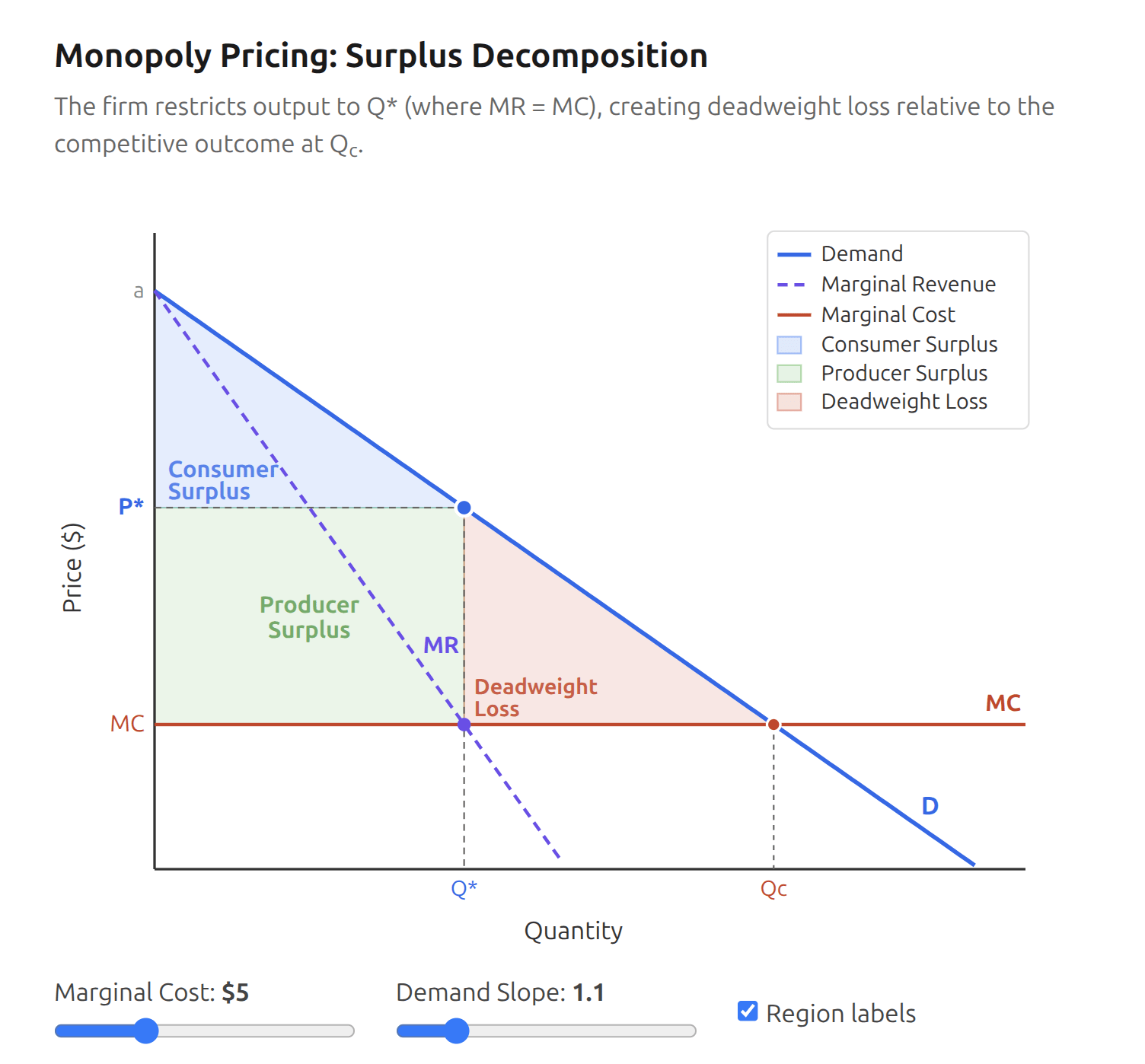
Competitive industries have much higher Consumer Surplus and much lower Producer Surplus. Grocery store profit margins are ~2%.
There is one way for the producers to suck out almost all the surplus while maximizing profit: Price discrimination. Which is, of course, difficult to do. In a market for easily transferable physical goods, the best they tend to be able to do is to make multiple, somewhat different versions of a product and sell one at a premium; but this is fairly crude. (Apple products are an example.)
Yes, I think we agree. One nitpick: I would say price discrimination is easy to do, but hard to do in a way that sucks out most of the surplus.
I looked up some studies. Courty (2009)[1] found that price discrimination on concert tickets increased revenue by around 5%. Leslie (2004)[2] estimated the same 5% revenue increase using data from a Broadway play. Shiller (2014)[3] found "Including nearly 5000 potential website browsing explanatory variables increases profits by ... 12.2%" (for Netflix subscriptions). Waldfogel (2015)[4] estimated price discrimination would raise revenue by 9.0% in higher education (specifically, a public university grad school program). Namin (2020)[5] estimated price discrimination can increase revenue for cruise lines by over 4%.
The big outlier was Srivastava (2020)[6], which found up to an 82% increase in profits from price discrimination in informal markets in India. Basically, the seller looks at the buyer and tried to guess the buyer's wealth level. If you look rich, you have to haggle: "Bargaining is found to have a strong downward effect on the final price markup". Also note weasel words "can raise profits by as much as 82%", so that is an upper bound.
Disclaimer: I only read the abstracts of these papers. They might have flaws that I am not aware of.
- ^
https://www.carloalberto.org/wp-content/uploads/2018/11/no.105.pdf
- ^
https://www.jstor.org/stable/1593706
- ^
- ^
https://onlinelibrary.wiley.com/doi/abs/10.1111/joie.12085
- ^
https://www.sciencedirect.com/science/article/abs/pii/S0278431920301493
- ^
https://econ.berkeley.edu/sites/default/files/Rishab_Srivastava_Final_Honors_Thesis.pdf
 1
1I think the parent meant an ideal form of price discrimination where the entire consumer surplus is instead claimed by the company.
You can only price discriminate if you have a monopoly. (concert tickets, Disneyland admission). Or there is cooperation between sellers, and the government decides to allow it (senior discounts, airline discounts).
That sounds strange. The benefit is almost purely the customers, and yet wealth inequality keeps steadily getting worse? I'm working backwards from a conclusion that I'm still sure is true, and I probably do make mistakes, but I can't tell where.
If grocery store profit margins are small, and the prices aren't falling much, and the farmers also complain about their economic situation, then it seems like benefits are simply disappearing. Machines keep getting more efficient, doing the work of more people in less time. We make better crops, better fertilizers, and find better ways to prevent food from getting attacked by insects and from rotting.
Theoritically, everything should be getting better. Either the ratio between the cost of living and wages should increase, worked hours should decrease, or else the current lower-middle class should be living like the upper class of 30 years ago. Neither have happened, which is what I mean by zero-sum mechanics kicking in.
Richer people are generally happier, but what matters here is simply the relative amount of money, not the absolute amount of money. It seems that people who don't understand this calls it a paradox. I may not be able to explain why it's true, but people are naive in that things turn out much more zero-sum than expected. I know the general consensus is that the economics is far from zero-sum, but even if theory can back this up, reality seems unable to.
Here (source) is a historical analysis of subjective well-being over the past 200 years, by the way. I think the common opinion that things are getting better over time is a fallacy stemming from the belief that, since the past looks worse from our current moral values, the past must also have been experienced as worse by the people of the past. But that assumes that they had our current values, which is false. We are tempted to interpret people in a way which support our own values (e.g. neo-nazis who think that Hitler would have approved of them, and Christians who think Jesus would approve of them) and I think this leads us to mis-interpret the past.
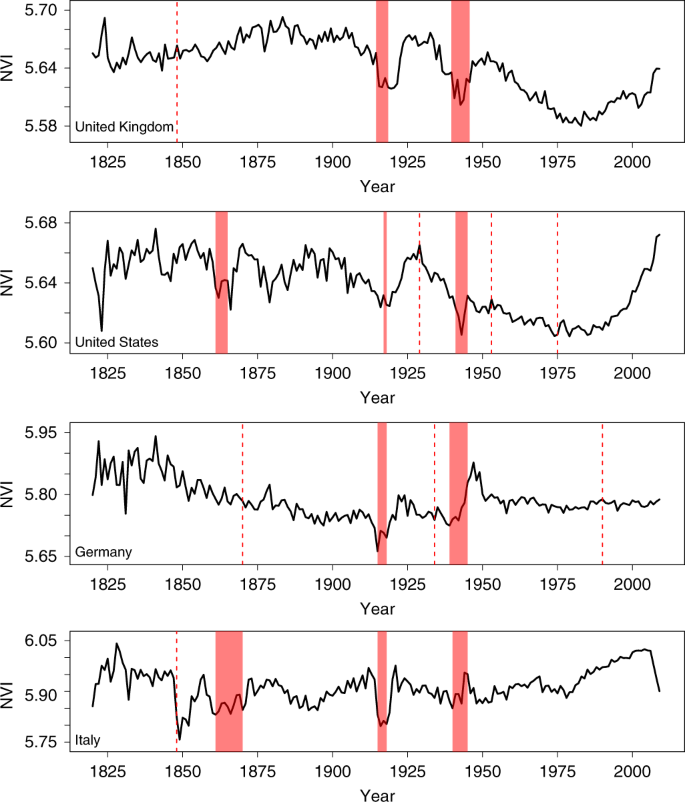
Zvi had a great series of posts on why people complain about the economic situation today despite being vastly richer than in the past. People's expectations have also risen, as have requirements (it is illegal to purchase the 1950's basket of goods today).
The $140K Question: Cost Changes Over Time
The Revolution of Rising Expectations
> The benefit is almost purely the customers, and yet wealth inequality keeps steadily getting worse?
Why is that confusing? The customer's benefit comes in the form of increased quality of life. The business's benefit comes in the form of profit.
Also, there is a separate issue that some businesses make customers worse off. E.g., junk food, sports gambling, probably much of social media.
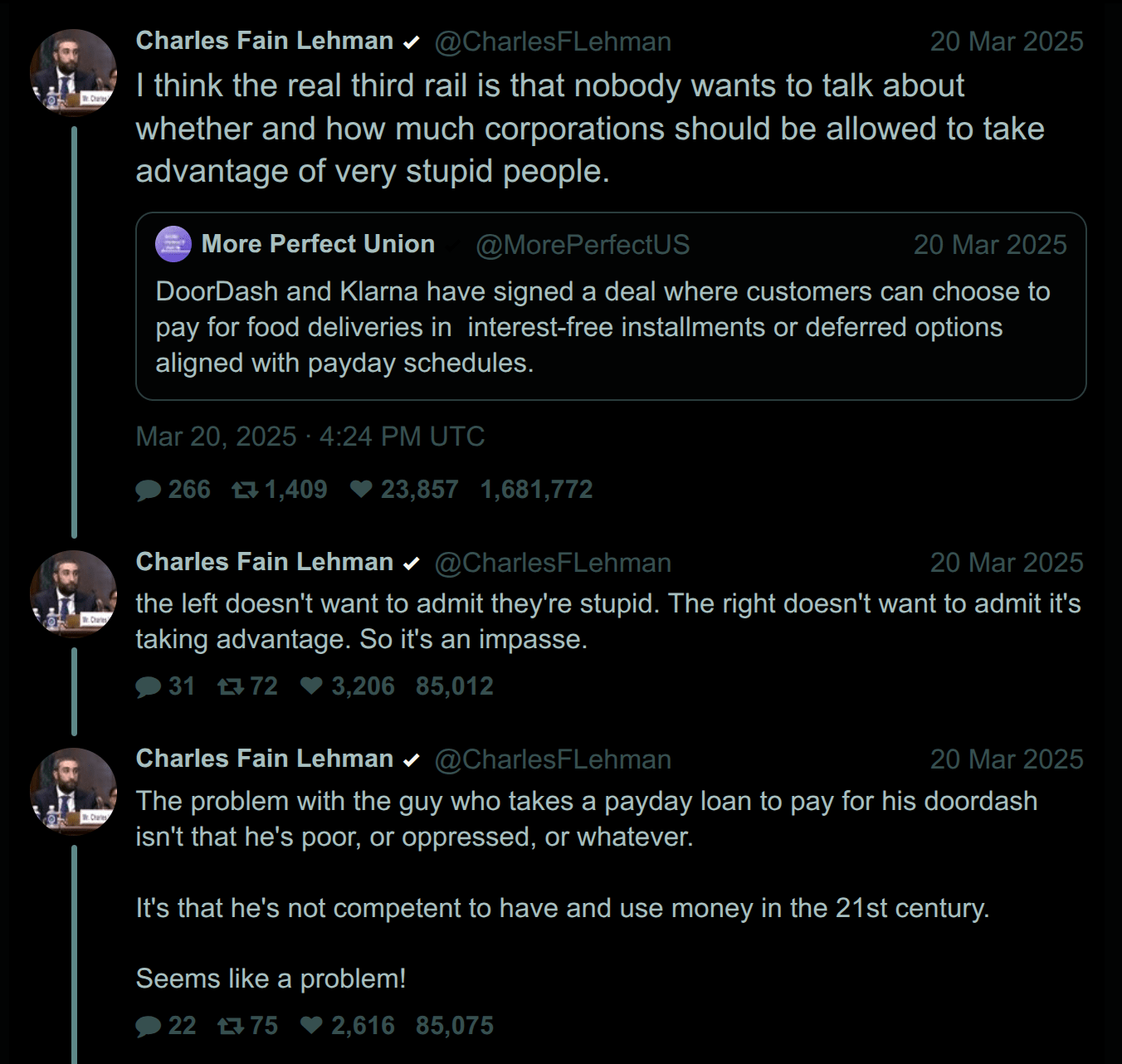
https://nitter.poast.org/CharlesFLehman/status/1902758037443444882/
Long response - feel free to skim.
The second and third articles seems more to the point, and Mike Solana is right. But the "intellectuals" with the graphs are overlooking many important things. I also doubt the legitimacy of a lot of this data, how exactly is food quality going up? There's a clear trend of nutritional decline, added sugar and chemicals, and hyper-processed foods.
I know that life has generally gotten worse since 15 years ago, but I need a stronger argument to show that this is not just a local trend but a global one. For the same reason that "This year is colder than last year, therefore there is no global warming" wouldn't be a valid argument.
I take issue with how so-called knowledgable people fixate on surface-level metrics and act like other aspects of life do not exist. Money is not a good metric for well-being, and while economics is relevant, psychology is much more so.
I'm glad that Zvi at least talks about the cost of watching children like hawks, but that's merely one important pattern. He refers to it multiple times because he rightly regards it as important, but he barely manages to see the shadow of the cluster to which it belongs, and he fails to notice that his modern values helped in creating this cluster.
I'd have brought up the difference between manifacturing and service if the article hadn't. The change from "Buy something and you own it and it will work for 50 years" to "Buy a mere license to something which needs repairs after 2 years" means that things may appear cheaper despite being more expensive over time. But even if that is taken into account, people become miserable when you take away control and agency from them, and these psychological aspects account for a lot of the felt decline. It's much easier to cope with failure when it's because of ourselves or because of life, than when it feels like other peoples tyranny is to blame.
I have to disagree with the argument "We find the compromises of the past simply unacceptable". The "we" refered to here are those who prefer the present over the past, and I'm arguing that things are getting worse because I find the past to be better in many aspects. The author then claims that anyone who prefers the present is "wise", which is ridiculus. As if a societal collapse is worth a reduction in mean words. He doesn't seem to realize it, but many of the problems he later identifies (like bureaucracy and overregulation) are replacements to traditional ways of doing things.
Zvi is in-between the position that I disagree with and the position I agree with. He knows that some things "adds to measured GDP but makes life harder" and that "People are very good at noticing when things suck. Not as good at figuring out why". This is the tension between the intellectuals who only see the surface, and the people living in reality who lack the education to explain why they're miserable. Many of my objections to his post point in the same direction as his own arguments, i.e. "Survival requires jumping through costly hoops not in the statistics." Exactly, the ivory tower is too disconnected to the averge person. The objective metrics does injustice to the subjective life. The prefrontal cortex tyrannizes the older brain circuits. If Zvi takes his ideas further, I think he will converge towards my current position.
The customer's benefit comes in the form of increased quality of life. The business's benefit comes in the form of profit
This duality is excellent. It mirrors the trade-off between "Work to get resources but lack the time to play" and "Have the time to play but lack the resources". A fundamental trade-off between utility and qualia. But the example misses something important, for well-being requires power (agency and freedom), and being exploited by the system leads to a reduction in these rather than an increase. The traps here feels like hedonism, or the "increased quality of life" being short-term rather than long term. You felt this too, since you mentioned junk food and gambling.
Finally, most of those who are miserable about the economy today tells me that they commute, work, eat, shower and sleep. They do not have time and energy for anything else. So this is an excellent metric! Has hours worked increased? Is free time left after necessary daily chores decreasing? If they're not, then it must be that life has gotten worse psychologically, and that the decrease in mental energy, rather than time, makes life feel as if it's nothing but a struggle. 4 hours of free time which would be spent socializing in the past might have turned into 4 hours of free time spend ruminating or on unfulfilling escapism.
Agreed that we have serious problems today. But I don't think they are mostly economic in nature. The main new economic problem is that life is now full of traps that didn't used to exist. High-quality nutritious food is much cheaper than in the 1950s, but junk food is even cheaper and tastes delicious. You can do sports gambling on your phone. You can doomscroll TikTok on your phone. This is a "skill issue", but many people get hooked on junk food or TikTok as children and children are going to be unskilled. If you avoid the traps, things have never been better (from a purely economic perspective).
I think our main problems are social, cultural, and [redacted]. Unfortunately, a full discussion of them would require touching on some forbidden topics.
They both are and aren't. Modern molochian problems stem from actions which maximize income, and with the death of god, materialism is winning against traditional morality. We don't need more money in order to be happier, but on the other hand, living paycheck to paycheck is really hard on the psyche, and it often feels like everyone is out to bleed you dry.
I also think we have less alternatives to these traps than we used to. There's less communities and family gatherings, less nature to walk in, less social activities around town. Many improvements require collective effort rather than individual effort. I'm immune to these traps, so I don't think they're solely to blame for the worsening conditions.
You don't think that the million laws, regulations and paperwork requirements makes it more difficult than in the past to invent new things or start a business?
I agree about [redacted]. If you're refering to ideas which aren't just taboo in our current era, but in most or all eras, feel free to DM more about them. I like hearing such takes, but they're anti-memetic so all search engines work against me.
> and yet wealth inequality keeps steadily getting worse
Disagree that wealth inequality is inherently bad. I think the rise in wealth inequality is downstream from a smaller fraction of people producing a greater fraction of value.
For example, J.K. Rowling has a net worth of around $1.2 billion. Her books have sold over 600 million copies worldwide, along with over 1 billion movie tickets. Her work provided an enormous amount of value to people. If you consider $1 per book and $1 per movie ticket to be reasonable compensation, then a net worth of $1.6 billion is fair. Such a large fraction of the global population reading the same books and watching the same movies, is not something that would have happened in the 1950s.
I suspect that people who provide lots of value are more likely to be undercompensated than overcompensated. Just because you provide a lot of value doesn't mean you capture much of it. E.g., Linus Torvalds has probably done more good for the world than Bill Gates, but since Linus gives his OS away for free his net worth is far lower.
Some people become wealthy through corruption, or fraud, or by taking advantage of people with skill issues (junk food, sports betting, engagement-maximizing social media algorithms) but the problem there is the harm done, not the inequality itself.
I don't think it's inherently bad. It's fine that many things in life follow a power-law distribution, but this inequality shouldn't feed into itself. If you've ever played Monopoly you know that it's so unsustainable that even the winner won't want to continue.
But I strongly disagree that rich people provide value. Windows is not a good operation system, and the competition they prevented would have made for a better world. Most of what made Bill Gates rich was essentially stolen as well. It wasn't just that you picked a bad example, most rich people are not the original creators of value. If it were people like Alan Turing and Neumann who became billionares, then I'd agree with you, but it's actually companies like King (they made a clone of an old flash game called Bejeweled and made billions). Nikola Tesla died penniless and in debt.
You assume that more popular things are more valuable, but is that really the case? Most of what I enjoy is obscure, and most of what I dislike is common. You could counter that with "While gold is worth more than iron, it would hurt us more if all iron disappeared than if all gold did". So if value = quality * quantity, then yes, all the most popular things are the most valuable, but should we really define value in this way?
A poor product which is well marketed often does better than a good product which is never marketed, so reach is rewarded more than quality. And the things which made us rich are often harmful to others (which is why money is considered the root of all evil). Chances are that if you are a good hacker, or good at finding loopholes in laws and such, then you're also good at making money. There's a Youtuber called The Spiffing Brit who breaks video games with exploits, but he does the same to the Steam market and the same to the Youtube algorithm, and this is because it's the one and same ability. If we assume that richer people simple added more value to the world, then we can conclude that scammers are good for society and that people like Tesla were a waste of oxygen, but that conclusion is the opposite of the truth. Ideally, merit = reward, but we're so far away from the ideal that the two hardly correlate (in my opinion).
On your specific example:
It's plausible that a typical Harry Potter fan gets at least $1 worth in value from having one of the books or watching one of the movies. But in a hypothetical world where JKR never exists, I think that typical Potter fan is a fan of something else instead. They read a different book, watch a different movie. Maybe they get a bit less enjoyment from it than from the corresponding Harry Potter thing back in our world -- after all, in that world they chose Harry Potter over the other thing. But maybe not; which books/movies/songs/... turn out to be big successes seems to owe a lot to luck. At any rate, I don't think we can credit Rowling with all the value the fans get from her work.
Also, the process by which a Harry Potter fan gets value from Rowling's work doesn't only involve them and Rowling. The book probably got significantly improved by the editors (at least, the first few books did, before JKR got big enough to ignore their good advice). The movies needed actors and directors and film crews. Books and movies alike needed distributing and selling.
On the broader point of whether the reason for rising inequality is that we have "a smaller fraction of people producing a greater fraction of value":
First of all, what causes inequality is a smaller fraction of people capturing a greater fraction of value, and it sure looks like that's a thing that's happening; e.g., CEO salaries have become much higher relative to those of their employees, and it's far from obvious to me that much of the value is being created by the CEO rather than the employees. Second, even if it's true that fewer people are producing a greater fraction of the value, that isn't necessarily a matter of the few Very Greatest Value-Producers doing their thing more effectively; it could equally be that there are lots of roughly equally good value-producers, and today's market dynamics are more ruthless about picking a few basically at random and making them the ones everyone's heard of, who therefore get all the profits. It's then true that those few people are the ones providing the value, but all the others could have done just as good a job if they'd been the ones to get lucky instead.
Third, inequality occurs at different scales. There's the inequality of the super-rich versus everyone else; here you give the example of Rowling, though most of the richest people are owners of businesses rather than creators of art and entertainment. But there's also inequality between broader groups. Rich nations versus poor ones. Rich industries versus poor ones. Bosses versus minions. My understanding is that these sorts of inequality have increased too, and it's not obvious that it's for the reasons you describe.
On the overarching point of whether rising inequality is actually bad:
It's certainly possible for something to happen that increases inequality but is good overall. If the world gets much richer and the gains are very unevenly distributed, this might be a net improvement. But I don't think you can just gesture at that situation, say "look, this is better overall", and conclude that inequality isn't a problem! There are two separable things there, the increase in wealth and the increase in inequality, and maybe the first is Just Good and the second is Just Bad and we merely got lucky that the first one outweighed the second. I think you need to ask questions like: is the increase in inequality an important part of why the increase in overall wealth happened? and: is there a way we could have less inequality while keeping most or all of the increase in wealth? -- and I don't think these are easy questions to answer.
(BTW, I think it's very clear that inequality-as-such has bad consequences, whether or not in a given case it's bad when considered as part of the whole economic situation. It means big differences in political influence, which in turn means that the poorer people get more badly screwed than they would with less inequality. And it means, if compared with a more equal situation with the same total wealth level, less total utility because of decreasing marginal gains. And it means more envy and resentment, which means less social stability. Again, it may turn out that those are just prices that you have to pay for overall progress that helps everyone, but I think that needs more supporting arguments than just "look, the world is getting richer" or whatever. It certainly needs more than "look, I've identified an otherwise-benign thing that causes increasing inequality"; the problem with inequality is its consequences more than its causes.)
People rightly notice that you can we can make things better, but they rarely grasp that they're not given the benefits. Those who make technology worth 4000$ are not going to sell it sold at 2000$, making everyone better off. The gap between the value we find in things, and the value we pay for it, will be exploited by companies until it almost disappears. They will sell it at 3950$, or sell it at 3500$ and fill it with advertisements (whatever makes it just barely worth it for the buyer) For as long as it's a good deal, there's more value to extract! And once 95% of the value has been extracted, the new technology only benefits everyone 5% of what it could have. (This pattern doesn't apply when the technology is sufficiently easy to mass-produce, but even then, other zero-sum mechanics will kick in, and other cognitive biases prevent people from thinking about these)
The only reason the technology is "worth" $4000 is because people were willing to pay that in the first place. You as the consumer chose to capture the qualitative value it provides you at that price: if you were not willing to pay, the price would fall until you were (or the technology itself cannot be made more cheaply).
I'll have to disagree. Selling something to you at its precise value (or arbitrarily close) is a malicious economic exploit.
All the good effects which are possible comes from the gap between what the buyer values something at, and what the selling values something at. If something is worth 4000$ to you, and I can produce it at 2000$, I can sell at 3000$ and we'll both benefit with 1000$ of value. But if I sold it at 3995$, I'd be no better than a scalper and you'd only benefit if the time the purchase took is worth less to you than 5$. Think about it, your water company could charge you more, and there's likely nothing you could do about it if you wanted to survive. But your water company does not exploit you like this, even though it technically could. It does not maximize profits, at least not yet.
My previous comment does not mention competition, but that's something which will often force this exploit to not be possible. But as tech gets more complicated, the amount of alternative choices naturally drop (sometimes it looks like you have a choice, e.g. it looks like there is more than 2 different browsers, but the vast majority of them are based on Chromium and Firefox. It also looks like there's many search engines, but they all collect from a relatively small set of indexes)
Those who make technology worth 4000$ are not going to sell it sold at 2000$, making everyone better off. The gap between the value we find in things, and the value we pay for it, will be exploited by companies until it almost disappears. They will sell it at 3950$, or sell it at 3500$ and fill it with advertisements (whatever makes it just barely worth it for the buyer) For as long as it's a good deal, there's more value to extract! And once 95% of the value has been extracted, the new technology only benefits everyone 5% of what it could have. (This pattern doesn't apply when the technology is sufficiently easy to mass-produce
I was with you up until "by companies" (and generally agree with most of your post up until that point, I'm focusing on an area of disagreement). And your 5% estimate for consumer surplus seems far off what I experience. Two caveats which mean I may be misunderstanding:
1. People don't sell "technology", typically they sell the product of a technology (a good or service which is enabled to exist or be produced less expensively by some new knowledge or way of making things) and when I'm thinking of consumer surplus ("the value we find in things, and the value we pay for it"), I'm thinking of how much things are worth to me, relative to how much I have to pay for them, not how much the underlying production method is worth to the person who originally invented it or the factory-owner who uses it to set up a system for producing things. There are some edge cases where the value of a new technology can be monetized, like, patents are worth money and so people who invent a new technology can, by legal convention, sell the use of that technology/idea for a limited amount of time. But I think you're not making the distinction between "technology" and "things typically sold to consumers". Ideas are non-rivalrous (you knowing about and making use of an idea doesn't inherently stop me from also knowing about and using that idea) unlike physical goods or personal services.
2. "(This pattern doesn't apply when the technology is sufficiently easy to mass-produce"... a) as above, a technology is an idea about how to do things, so mass producing it seems like a category error. But if you mean that the idea that companies will extract 95% the value out of the goods and services they produce leaving end-consumers with only 5%... but this pattern doesn't apply to mass produced goods or services... then I notice that most things are mass-produced, and thus most of my counter-examples to your point are excluded. I feel like I would if you had said "I have a theory about how the economy generally works, but it doesn't apply to anything produced in the G7 countries, but it does apply to the economy in general". And "things that aren't mass produced, but are produced by companies rather than individuals" would be an even smaller section of the economy.
Maybe the reason I'm going "I don't agree" is rooted in you thinking of technology differently than I do, but, if we're talking about the consumer surplus for goods or services, I find that the price I pay for things is typically much, much lower than the value they provide to me (the price I would be willing to pay, if that's what companies were charging, and still feel like I got some value out of the purchase). I actually think that the causality runs the other way - a lot of useful things don't get produced because it's hard for the inventors or producers to capture enough of the value to make it financially worthwhile for them, given competitive pressures. If an entrepreneur wants to produce a new thing that would be valuable to a consumer, they have to think "OK, I have talked to some people who say they would buy this at $1,000, and I can produce it in my garage for $900, but as soon as I produce it for $900, I have to consider that some large corporation is going to set up a factory producing it for $850, and the actual cost of the raw materials is $50, so competitive pressures will drive it down to maybe being sold for $50 plus a small margin over time, and if I can't get the capital to be the person who produces it at that price, I'm not going to capture much of the value, and I'm taking a lot of risk to set up the production at $900 and quit my job, so probably not worth it." And then, someone not thinking clearly about the competitive pressures starts a company producing the thing at $900, the new venture isn't financially viable (the vast majority of new businesses fail within a couple years), and 5 years later consumers can buy a thing they typically value at $1,000 for $60.
A concrete example: When I was a kid, standard jeans cost $50 a pair, which was 3-4 hours work for me at the wage I made at the time. Now, 30 years later, I can get a standard pair of jeans for $15-20, which is 1/3 of an hour of work at my current wage, or 1 hour at my 30-years-ago wage. So even if it was the case that I had 0 consumer surplus for jeans 30 years ago and my wage hadn't gone up, I'd have a 66% EDIT: 300% consumer surplus now. I know, jeans are mass produced, but, so are most things that aren't public goods, where it's even harder for the producers of those goods to capture the value (which is why governments have to pay for them). I tried to think of examples where the consumer surplus is low, and the only ones I could come up with quickly were potentially housing, and potentially art to put on my walls.
In general, there are goods available in the marketplace that cost more than I would value them, but I don't have to buy them, so I don't. And this is true of everyone. So generally, it should be the case that consumer surplus is always positive for any voluntary transactions that take place. And for companies selling to a mass market where there is competition (whether or not they're mass producing) they have to set their prices as low as they can. Given that different people value various things different amounts (rather than everyone valuing everything the same) it's not possible for companies to decide "this is how much everyone values this good, and so I can set my price at 95% of that and collect most of the value". Say that price, if we averaged what everyone valued the good or service at, is $100 for a particular good or service. Some people in the market are going to value it at $5, and some are going to value it at $1,000, and so the company, to get as much volume as they can (and drive down unit costs) is going to price it at under $100, and most buyers are going to get a large consumer surplus.
What I have seen in the direction of reducing consumer surplus is moves by online sellers to price-discriminate (guessing that I will pay more for a good and charging me more for it, because I don't see the same webpage that another person may see, or offering coupons and discounts with some friction, so that people who have more money than time get some of the value extracted, while people who are very price sensitive still get sold goods, but at a lower margin). Also, in an economy that wasn't based on offering goods at set prices, but there was haggling over everything, sellers would be able to capture more of the value of their goods or services. So in subsections of the economy where buyer and seller negotiate price for each sale, I would expect the consumer surplus to be less. And I note that that applies to housing and (non-mass-produced) art.
It's true that they sell products which are using technology, but I'm not sure it makes a different in the conclusions.
How much things are worth to me, relative to how much I have to pay for them
It's immensely in our favor that prices aren't personalized, because when we'd pay less than others, we can ignore that product, and when we'd pay more, we can pocket the difference. Think about how cruel the market could be to you with personal prices. Dying of thirst? Water is 500$ a glass now.
Perhaps the lack of personalization pushes the consumer surplus higher than 5%, but generally you need competition between sellers, otherwise they really push the prices as high as they can. I'm not sure exactly why insulin costs 10 times more in the US than elsewhere, but people who are dying don't really have a choice, it's clearly worth it to buy. A trade being worth it is not sufficient to describe the context it happens in as being objectively good.
Seems like a category error
I should have brought up competition instead. But some technologies are so easy to replicate that competitors can enter the market, or that people can DIY the product. "Mass-produce" was a bad choice of words fom my side, "accessible" would have been more fitting. Phones are mass produced, but it would be extremely difficult for a new competitor to enter that market, so it's a clear counter-example to my statement.
I agree with the housing example. I also think the job market (thought it depends on the field and location) is bad in the same way that scalping is bad.
I find it hard to disagree with anything you wrote, and yet, technological advancements does not really seem to improve life for people. We've getting quite efficient at making food, but it doesn't seem to be getting cheaper over time. I don't think car prices or phone bills are decreasing meaningfully either. Bus and train fares have been steadily increasing over time.
The internet makes it possible to communicate with people far away which I value a lot, but it does not seem to have improved socialization in general.
The pattern of "benefits erase themselves" seems to apply so broadly that it feel like a mathematical law more than a result of greed. Despite exponential improvements in hardware, I'd say that the loading times of programs has remained somewhat constant.
And, of course, every technology which can be used for evil tend to be used for evil. One could argue that the consequences of this evil also remains constant over time, but I'd need to think about it for longer to say if I believe that.
I find it hard to disagree with anything you wrote, and yet, technological advancements does not really seem to improve life for people. We've getting quite efficient at making food, but it doesn't seem to be getting cheaper over time. I don't think car prices or phone bills are decreasing meaningfully either. Bus and train fares have been steadily increasing over time. The internet makes it possible to communicate with people far away which I value a lot, but it does not seem to have improved socialization in general.
The pattern of "benefits erase themselves" seems to apply so broadly that it feel like a mathematical law more than a result of greed.
These seem to be at the core of what you're trying to express, so I'll share some thoughts focused on them.
Point 1: I think it depends on your baseline/what you're comparing to for the purpose of determining whether an improvement has occurred. For me, I was born in the early 1980's and live in Canada, so my baseline is kind of like "what things were like in the early 1990's in Canada". And against that baseline, many technological improvements have occurred and the benefits are widely diffused. And if I compare the life I have now with the life my parents had when they were kids (they were born in the mid 50's, and the power grid mostly expanded throughout North America in the 1960's, so "we lived 3 people to a bedroom, had to relieve ourselves in an outhouse, and remember when the lights first turned on" is a common experience for many people born in the 50's) But for someone who was born 20 years later than me and their main comparison year is say 2010-2015, it can seem like things have gone downhill recently. I might argue that they're wrong (stories of the form "things have gotten worse" are much more transmissible than "things have gotten better", and statistics have all kinds of issues, so you have to carefully check you facts and can't reliably just go on vibes) but the differences are less stark, and on some metrics things have unambiguously gotten worse in some places that are at the technological frontier or where local governance has had a setback/been bombed into a problematic situation (although for the world as a whole/humanity in aggregate, the story is still firmly "things are getting better", and I think I could make that case). If your baseline is "America immediately pre-pandemic" or more recent than that, yeah, it's a lot muddier.
A second thought: I have a simple model that predicts that if you're comparing what we've achieved through technology to what could (one would think) be achieved by using our technological capabilities optimally, it's always going to seem like we're far from where we could be, and the distance is increasing over time. My model is: Technological progress is a one-way ratchet giving us new capabilities (mostly - we do sometimes forget or lose technological capabilities, but with a growing population and economy, this is rare). Regulatory burden is another one-way ratchet (usually, in practice - it's a lot less likely for regulators to decide to remove a regulation that exists than to create a new one), which puts certain things we could do off-limits. Whether a particular regulation is good or bad on net is a matter for debate, but the net effect is that over time absent a civilizational reset, there's going to be an increasing gap between what's technologically possible and what we actually do. If we get too carried away, we could even foreclose so many options that what we actually do gets worse, but I'd expect mostly our trajectory of improvement is less steep than it could be. So if your baseline is "look how much less we're doing than we could be!", I mean, yes, that seems correct - although I'd also note how far we are from the worst we could be doing, to balance that out.
Re: benefits erase themselves. Not exactly. We just, use the slack offered by technological improvements in unexpected ways. For computers, in the 1980's it took about 5 minutes for my home computer to load, in 2005 I remember it taking 15 for my work computer to load some days because there were a bunch of GPOs being applied on each login very inefficiently, in 2016 my HDD-based laptop loaded in 3 minutes 30 seconds, and now my work laptop (SSD based, but slow processor and tiny hard drive with a lot of swapping I think) takes a minute or two, and my home laptop boots in under 30 seconds (I'm making the distinction between home and work computers because work computers tend to be slower, for various reasons). So, there's been some decrease, but it hasn't been commensurate with the increase from "33mhz processor, single core" in 1985 to "2ghz, 20 cores". Lots of the processing power and other improvements have gone to things other than making the boot process faster - like, for example, doing millions of background checks per minute to make sure the computer doesn't do something that crashes it. Or things being written in memory-safe and auto-garbage-collected languages. It's expensive to move from "the computer does exactly what the assembly language programmer says it should do, even if that results in problems" to "a high-level language program is written and then automatically compiled into inefficient but working assembly language and many, many automated checks are done to prevent problems that used to be common". Also there are all kinds of malicious code checks running in the background, and hundreds of other processes running doing various things that are mostly helpful. And also, doing high definition video at megapixels of resolution at 60 frames a second with 16 million colour options per pixel is just several orders of magnitude harder than doing VGA graphics at 640x480 with a 256 colour palette. Also, software installs have gotten easier and more likely to just work rather than causing problems that require deep experience with computers to diagnose and fix, and this is partially downstream of "there is more hard drive space, so each program now gets its own sandboxed set of files and directories, rather than having to share bits of code". Would I trade faster loading for "but there are fewer software programs and the computer crashes so often I have a 'save your work every 30 seconds' reflex because software programming that doesn't crash the computer takes a lot more skill and programming in a lower-level language just takes longer, and also I have to carefully manage drivers and occasionally open my computer up and do something to one of the dip switches so that the sound will work in my new program"? Nah. I think a computer that boots up in under 30 seconds is good enough, and at a certain point it's OK to focus hardware improvements on other things.
One could even argue that absent technological improvement, we couldn't afford the level of regulation we have - and if you think that many of the regulations we have exist for reasons like "improves human safety and health, at a cost" or "makes a complicated society easier for less-capable people to exist in without catastrophe, because certain exploits are forbidden and failure-cases are handled", you could think of this as an improvement downstream of a technology improvement. The benefits may exist, but just may not be highly visible. Like "computers crash less because there are a bunch of background processes running that enforce things like "non-admins can't do a bunch of things" and "software applications can only do very specific things with the hardware" and "memory leaks are handled automatically" and "even though there are 300 processes running at once and that would be totally impossible for a human to code up such that they didn't interfere with each other, automated checks make sure they don't interfere with each other very much". There are parallels in other areas of society - cars would probably be cheaper if we didn't have a bunch of safety testing and failure analysis going on, and the burden of the safety measures that are required has gone up over time (when I was a kid, airbags and crumple zones weren't a thing, and cars used to occasionally explode if you bumped them the wrong way (a slight exaggeration)) - but more people would die in the absence of those regulations. Is that a net benefit relative to a less regulated world? Hard to say, the answer is complex.
Thanks for your response!
Indeed. Writing just the conclusions doesn't tend to work out, so I waste words being pre-emptive.
It's not that nothing has gotten better, but that the things which improve and deteriorate seem to cancel each other out. This felt effect is less strong for people who conform, and for those who don't have strong principles which are threatened by change.
I think "things have gotten worse since 2010" is a much easier argument to make, perhaps it's too easy, so I will defend the idea that there's little improvement doing all of human history. I don't care what stats people have collected as reality takes precedence over derivativations. I yield when I have a theory about something and a source contradicts it, but I do not yield to the consensus when it conflicts with something I've personally experienced.
I don't think the memetics of ideas matter unless they are related to cognitive biases strongly enough to alter ones perception of their past, and I generally expect opinions about the past being worse to come from personal experience rather than hearsay. Of course, the effect of nostalgia is strong, so for some subjective topics, people will say that the experiences of their teens or so were "the best" quite consistently.
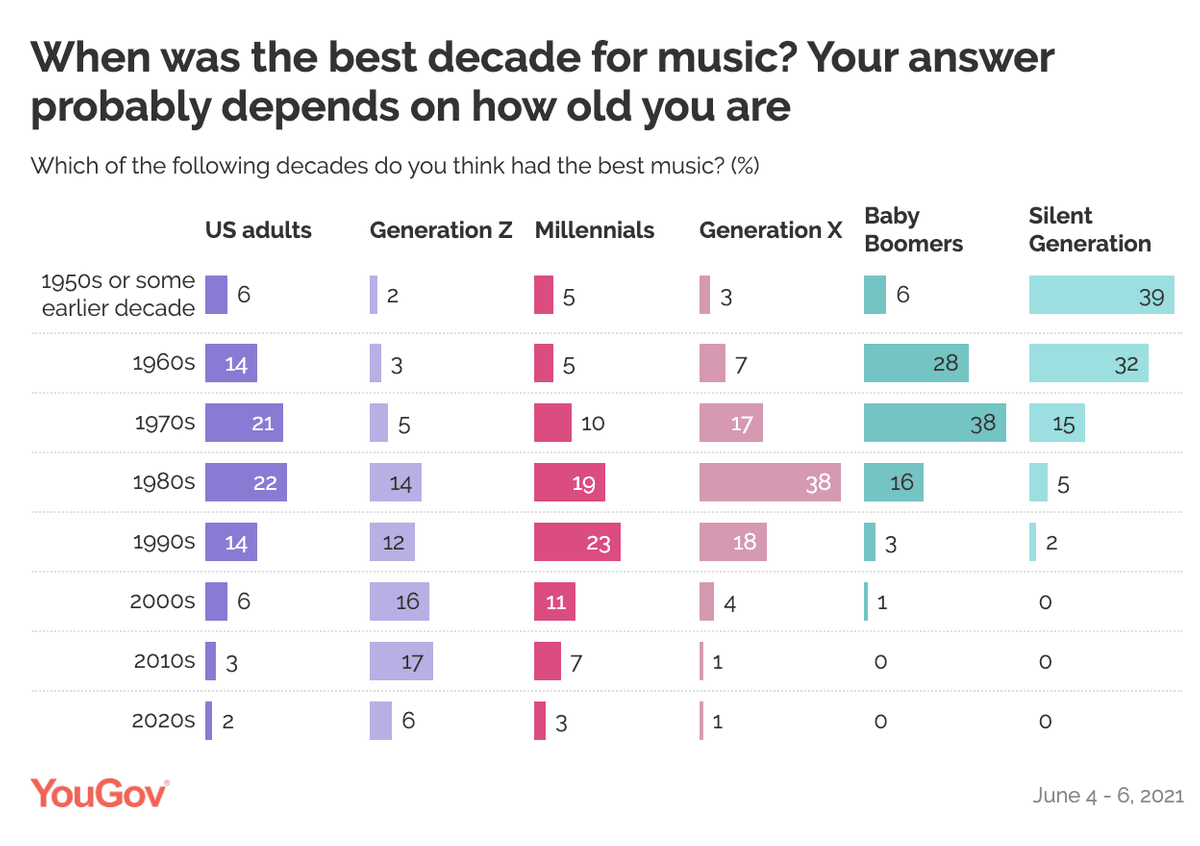
The worst parts of the world may be getting better quite consistently, but I think the best parts of the world are getting worse. It wouldn't be strange if globalism drove things closer to an average.
I agree that technology is likely one-way (Unless Kaczynski's plan is feasible) and that regulations are mostly one-way (making human freedom tend towards zero, by the way, which is one of my dislikes of modernity).
I'd also argue that technology is neutral, and that while ideal uses of it are possible, bad uses drag down the overall utility of the technology. And every time you make laws to prevent bad uses, you make good uses more difficult, and increase the total overhead of the technology itself.
I'd also argue that exploitation is becoming more common, because it's almost synonymous with optimization. Thinking in objective metrics is also harmful to the overall experience of life (notice how buildings are getting uglier over time!). In other words, we sacrifice good taste (and everything which is hard to quantify) for efficiency. The past was more human, and therefore less Molochian, because we valued the subjective more. The two values inherently conflict
Re: benefits erase themselves
A lot of modern "benefits" seem to benefit the lowest common denominator, and to make things worse for power users. Perhaps this is another levelling process. It would also be a net benefit on paper ('lowest common denominator' is a bigger group than 'power users'). I won't deny your personal experiences, but I think there's also examples of things getting slower and worse over time.
We couldn't afford the level of regulation
I want to pause future regulation too (if regulation worked, we'd not always need more of it), and I think it feels "necessary" partly because of technological improvements. But it's admittedly another process, which runs somewhat parallel to technology, and which is influenced by other factors like the fear of being sued. Also by modern morality, which only focus on the bad side of things, and therefore doesn't notice that reducing the negative aspects of things must necessarily reduce the positive aspects as well. For a trivial example, kids are safer at home than they are playing in the woods, but the life of a zoo animal is not strictly better than that of a wild animal (and I dislike the sort of people who don't intuitively understand this position). We only track the safety metric, and overlook the tradeoffs, so everything is getting better on paper, but we rightly feel like something is lost as a result, because it is.
More people would die in the absence of those regulations
Indeed, but that does not make such regulations objectively good to me. And try asking older people who did things which are now considered bad or unsafe if they regret their actions or if they're happy that one cannot have their experiences and memories anymore. The overwhelming majority of people I've spoken with prefer the past (random example - many have fond memories of playing multiplayer games back when harsh insults were a core part of the experience, and find themselves repulsed by modern over-regulation)
Indeed, but that does not make such regulations objectively good to me. And try asking older people who did things which are now considered bad or unsafe if they regret their actions or if they're happy that one cannot have their experiences and memories anymore. The overwhelming majority of people I've spoken with prefer the past (random example - many have fond memories of playing multiplayer games back when harsh insults were a core part of the experience, and find themselves repulsed by modern over-regulation)
I think you'd get different answers from older people depending on which bad/dangerous thing you were talking about. Smoking and not wearing seatbelts are two things that immediately came to mind as things that are now regulated away in lots of places and this is an improvement which even former smokers and people who at first protested against seatbelts would generally acknowledge as good. Likewise leaded gasoline and paint, and strong social and criminal penalties for drunk driving. The fact that kids can't go play together in the local area without adult supervision, in many places, is obviously bad, even though there is risk involved. The fact that your example relates to multiplayer games, suggests you might think of me as an old person - my childhood was before they existed. I mean, there were board games, of course, and like, 2-4 player video games. But the experience of freedom to say socially inappropriate things (I'm pretty sure even the people saying them understood they shouldn't say them in front of their mother, that's why being able to say them elsewhere might have been thrilling) during online gaming is one from the generation you'd call older, but I'd call younger. My generation's internet was dialup, and the thrilling thing (for some people) was to say trollish things on online forums (this was pre-social-media, Facebook got popular after I graduated university). And if I'm correct that you'd count me among the old, I for one would not want to go back. Half of the girls I knew well at all in high school got sexually assaulted by a classmate, but didn't feel comfortable to tell anyone about it except close friends, who they would swear to secrecy, and worried it was their fault or that they'd somehow brought it on by dressing wrong or smiling when they shouldn't have smiled. I'd trade a lot of "people have to be more careful what they say" for a little bit of "but the sexual assault rate goes down, and when something like that does happen people can talk about it with less shame".
"People think of the past as better than the present" is a true fact about human psychology in general, but it does not imply that the past actually was better than the present - nostalgia is a label that exists for a reason. Ask those same people which year they'd like to time travel back to, if they could time travel. Many will say something like a year of their childhood, but then remind them of some good things that have changed since then, and see if they still want to go. And anyone who reads enough history to know what life might have been like before they were born, would not say something like "I want to go back to the 1800's when tradition and the family were stronger, and people had more freedom". Because after a bit of reflection, they'd be like "oh yeah, no antibiotics or washing machines, and if I'm put into the body of a random person, I'm 90%+ likely to be toiling on a farm and die in my 40's, and my main (unlikely) hope will be that none of my kids die before adulthood and my wife survives all the childbirths, and that's if I'm lucky enough to be embodied as a man ".
EDIT to add: I'll also flag that "what it is socially permissible to say while gaming" is a change in social norms, rather than a change in technology/technical capabilities. We've drifted rather far from the original point, which was around technology improving or not improving life much for most people, to a more general discussion of whether the past was better or worse than the present, for whatever reason.
Those examples are because of a change in knowledge more than a change in values. The risks of injury from playing are immediate and visible, unlike leaded gasoline and smoking which takes decades to really cause harm, so that's a change in values.
I think we've become thin-skinned cowards, and that we pretend cowardize is virtue. Worse still, the popular form of signaling is now being offended or hurt on other peoples behalf. The degree to which people feel sympathy for my life experiences does not line up with how much pain these experiences caused me. Neither does socities stance of problems mirror the degree to which said problems affect me.
Many experiences are both good and bad, with the good outweighting the bad. But the modern world only focuses only on the negative aspects, which is disasterous (for the same reason that being perfectionist will be disasterous to ones schooling). Such philosophy is provably unworkable, it assues inaction is better than action (as less mistakes are made), and that people dying is good (less people alive means less suffering, and dead people don't cause others pain). I dislike modern metrics.
If you talk with people in Thailand, most will still reject the idea that seatbelts are necessary, despite knowing how we feel about them and why. Most people project their current values through all human history, judge them retroactively, and fail to differentiate value judgements from rational judgements. If your experiences in high school were distressing at the time, and not just looking back , then I consider them valid.
The reason we feel less shame is because we removed weight from sexual relationships. This makes relationships more superficial, and sex less intimate. You can always make this trade-off. Reducing suffering is trivial, just care less. Take lithium and SSRIs and you will remove both the valleys and the peaks of life. The sum of positive and negative emotions won't change, but to those who only count the negatives, this is experienced as improvement.
> Nostalgia
Applies specifically to ones own childhood. The position I'm arguing is quite a lot harder since it extends further back.
> We've drifted
Right, but the future will be made worse by technology because our values have become degenerate, and I think tech also causes our values to worse, so the two problems are hard to separate. Advances in tech will be used against us more than for us.
Ok, now you've gone on to "modern culture is worse than earlier culture". I don't feel like I have a good handle on the culture to which you refer, so I can't really comment, in the sense of going "you think modern culture is like X, but I think modern culture is like Y, let's discuss". You seem quite sure of your opinions, but I don't know what your evidence is.
I will disagree with this, though:
The reason we feel less shame is because we removed weight from sexual relationships.
When I spoke about people feeling less shame around having experienced sexual assault now than in the past, it was definitively not because they came to place less weight on sexual relationships. Maybe different generations have different opinions on sex, but I'm skeptical that the people I grew up with have radically different views on sex now than they did when we were younger. The reason for reduced shame around having been sexually assaulted was common knowledge that it was happening to many people, and the women who had experienced it feeling less alone. I base this statement on conversations with women I know, before and after 2016 (the MeToo thing was when common knowledge of a societal problem was established). It is possible that young people today place less weight on their sexual relationships, I don't know, but that sounds like a talking point a Catholic might have made about what would happen when birth control was new technology in the 1960's and early 1970's - I don't see a technological reason why it should be the case now. And statistically, surveys appear to show that young people are having less sex than prior generations, which isn't what I would expect if they were like "meh, sex isn't a weighty matter".
I have seen opinions like "modern people are weak degenerate hedonistic cowards who revel in copious casual sex" expressed online, but I'm aware that attention-based filters are being applied to what I see, and also 90+% of all comments are made by a small number of constantly online people with an axe to grind. So I don't consider what I see online as strong evidence of what the culture I live in is actually like. I weight more heavily the conversations I have with people around me, or people I know well who have moved away but we keep in touch, or statistical research with some attempt at rigor. And the people I have spoken to, are generally not weak degnerate cowards who treat sex lightly. I know people both young (in their 20's) and old (in their 80's), and the young people seem basically good, and the old people seem proud of their grandchildren's many virtues, and generally impressed with the younger generation, relative even to their own kids in some cases.
Separately from what you see online from people unknown to you, what are the people you talk to offline, or know well, like? If you were to base your statements about what people are like only on what you know about people you know fairly well, what conclusions would you draw about what people are like in society today? The same as above? (It is of course possible that the people I know aren't representative of society as a whole, and neither are the small number of people you will know personally, but I'm curious what your experience has been).
I looked it up, and while younger generations have more permissive attitudes toward relationships, it seems that both rates of cheating and socities attitude towards it are stable. Acceptability of premartial sex about doubled since 1970. But according to the data I just found, neither the average nor the mean number of sexual partners is increasing over time. Rate of virginity seems to fall from 60% at 18 years old to 2% at 25 years old(!). Virginity at 18 is increasing over time, but virginity at 25 is decreasing, so I was almost mislead by the increasing age of consent (another global pattern of change). I'm still pleasantly surprised by this data, which is the same as me admitting that I was somewhat wrong about it.
I may be biased in that I'm getting older, which means that the people around me generally care less over time. One becomes much more superficial and practical from age 15 to 30. I've gone from meeting multiple people who wrote the name of their partner in their arm with a kitchen knife, to hearing people say things like "Our relationship wasn't practical so we broke up", so it's no wonder that people seem less deep over time.
>what conclusions would you draw
I grew up around many bad people, and stopped interacting with people from my own country as a result. But the online friends I know on a personal basis are quite sexually open, even though I feel like I'm filtering away hedonists and nihilists. By the way, when I started using the internet in my pre-teen years, it was dominated by intelligent libertarians, and today it's mostly dumb conformity and brainrot, so it's no wonder I feel as if that's getting worse, too.
I've noticed a large increase in how much people care about politics. A large decrease in individuality and strength of character/personality. Increased socialization (homophily). Also a huge decrease in the desire for freedom to step outside of the Overton Window, and a large increase in wanting freedom within the Overton Window. The crabs in a bucket mentality also seems increasingly common, and one is expected not to behave in ways which can be misunderstood by those who look for the worst in others. If one doesn't signal that they don't hold value X, they're now assumed to hold value X.
Do you remember how people made myths up around video games? "There's a mew hidden behind the truck!", etc. There's no hidden information anymore, no exploration, and therefore no soil for culture to grow. Everyone just follows the current meta. In the same exact sense, our current society feels increasingly Plaza-like, whereas it used to feel Warren-like. This seems to have a bad influence on socialization.
1.
Richard Gatling (1861)
2.
In 1923, Hermann Oberth published The Rocket to Planetary Spaces, later expanded as Ways to Space Travel. This showed that it was possible to build machines that could leave Earth’s atmosphere and reach orbit. He described the general principles of multiple-stage liquid-fueled rockets, solar sails, and even ion drives. He proposed sending humans into space, building space stations and satellites, and travelling to other planets.
The idea of space travel became popular in Germany. Swept up by these ideas, in 1927, Johannes Winkler, Max Valier, and Willy Ley formed the Verein für Raumschiffahrt (VfR) (Society for Space Travel) in Breslau (now Wrocław, Poland). This group rapidly grew to several hundred members. Several participated as advisors of Fritz Lang’s The Woman in the Moon, and the VfR even began publishing their own journal.
In 1930, the VfR was granted permission to use an abandoned ammunition dump outside Berlin as a test site and began experimenting with real rockets. Over the next few years, they developed a series of increasingly powerful rockets, first the Mirak line (which flew to a height of 18.3 m), then the Repulsor (>1 km). These people dreamed of space travel, and were building rockets themselves, funded by membership dues and a few donations. You can just do things.
However, with the great depression and loss of public interest in rocketry, the VfR faced declining membership and financial problems. In 1932, they approached the army and arranged a demonstration launch. Though it failed, the army nevertheless offered a contract. After a tumultuous internal debate, the VfR rejected the contract. Nevertheless, the army hired away several of the most talented members, starting with a 19-year-old named Wernher von Braun.
Following Hitler’s rise to power in January 1933, the army made an offer to absorb the entire VfR operation. They would work at modern facilities with ample funding, but under full military control, with all work classified and an explicit focus on weapons rather than space travel. The VfR’s leader, Rudolf Nebel, refused the offer, and the VfR continued to decline. Launches ceased. In 1934, the Gestapo finally shut the VfR down, and civilian research on rockets was restricted. Many VfR members followed von Braun to work for the military.
Of the founding members, Max Valier was killed in an accident in May 1930. Johannes Winkler joined the SS and spent the war working on liquid-fuel engines for military aircraft. Willy Ley was horrified by the Nazi regime and in 1935 forged some documents and fled to the United States, where he was a popular science author, seemingly the only surviving thread of the spirit of Oberth’s 1923 book. By 1944, V-2 rockets were falling on London and Antwerp.
3.
North Americans think the Wright Brothers invented the airplane. Much of the world believes that credit belongs to Alberto Santos-Dumont, a Brazilian inventor working in Paris.
Though Santos-Dumont is often presented as an idealistic pacifist, this is hagiography. In his 1904 book on airships, he suggests warfare as the primary practical use, discussing applications in reconnaissance, destroying submarines, attacking ships, troop supply, and siege operations. As World War I began, he enlisted in the French army (as a chauffeur), but seeing planes used for increasing violence disturbed him. His health declined and he returned to Brazil.
His views on military uses of planes seemed to shift. Though planes contributed to the carnage in WWI, he hoped that they might advance peace by keeping European violence from reaching the American continents. Speaking at a conference in the US in late 1915 or early 1916, he suggested:
Following the war, he appealed to the League of Nations to ban the use of planes as weapons and even offered a prize of 10,000 francs for whoever wrote the best argument to that effect. When the Brazilian revolution broke out in 1932, he was horrified to see planes used in fighting near his home. He asked a friend:
He died shortly thereafter, perhaps by suicide. A hundred years later, banning the use of planes in war is inconceivable.
4.
Humanity had few explosives other than gunpowder until 1847 when Ascanio Sobrero created nitroglycerin by combining nitric and sulfuric acid with a fat extract called glycerin. Sobrero found it too volatile for use as an explosive and turned to medical uses. After a self-experiment, he reported that ingesting nitroglycerin led to “a most violent, pulsating headache accompanied by great weakness of the limbs”. (He also killed his dog.) Eventually this led to the use of nitroglycerin for heart disease.
Many tried and failed to reliably ignite nitroglycerin. In 1863, Alfred Nobel finally succeeded by placing a tube of gunpowder with a traditional fuse inside the nitroglycerin. He put on a series of demonstrations blowing up enormous rocks. Certain that these explosives would transform mining and tunneling, he took out patents and started filling orders.
The substance remained lethally volatile. There were numerous fatal accidents around the world. In 1867, Nobel discovered that combining nitroglycerin with diatomaceous earth produced a product that was slightly less powerful but vastly safer. His factories of “dynamite” (no relation) were soon producing thousands of tons a year. Nobel sent chemists to California where they started manufacturing dynamite in a plant in what is today Golden Gate Park. By 1874, he had founded dynamite companies in more than ten countries and he was enormously rich.
In 1876, Nobel met Bertha Kinsky, who would become Bertha von Suttner, a celebrated peace activist. (And winner of the 1905 Nobel Peace Prize). At their first meeting, she expressed concern about dynamite’s military potential. Nobel shocked her. No, he said, the problem was that dynamite was too weak. Instead, he wished to produce “a substance or invent a machine of such frightful efficacy for wholesale destruction that wars should thereby become altogether impossible”.
It’s easy to dismiss this as self-serving. But dynamite was used overwhelmingly for construction and mining. Nobel did not grow rich by selling weapons. He was disturbed by dynamite’s use in Chicago’s 1886 Haymarket bombing. After being repeatedly betrayed and swindled, he seemed to regard the world of money with a kind of disgust. At heart, he seemed to be more inventor than businessman.
Still, the common story that Nobel was a closet pacifist is also hagiography. He showed little concern when both sides used dynamite in the 1870-1871 Franco-Prussian war. In his later years, he worked on developing munitions and co-invented cordite, remarking that they were “rather fiendish” but “so interesting as purely theoretical problems”.
Simultaneously, he grew interested in peace. He repeatedly suggested that Europe try a sort of one-year cooling off period. He even hired a retired Turkish diplomat as a kind of peace advisor. Eventually, he concluded that peace required an international agreement to act against any aggressor.
When Bertha’s 1889 book Lay Down Arms became a rallying cry, Nobel called it a masterpiece. But Nobel was skeptical. He made only small donations to her organization and refused to be listed as a sponsor of a pacifist congress. Instead, he continued to believe that peace would come through technological means, namely more powerful weapons. If explosives failed to achieve this, he told a friend, a solution could be found elsewhere:
5.
Mikhail Kalashnikov (2012)
6.
In 1937 Leo Szilárd fled Nazi Germany, eventually ending up in New York where—with no formal position—he did experiments demonstrating that uranium could likely sustain a chain reaction of neutron emissions. He immediately realized that this meant it might be possible to create nuclear weapons. Horrified by what Hitler might do with such weapons, he enlisted Einstein to write the 1939 Einstein–Szilárd letter, which led to the creation of the Manhattan project. Szilárd himself worked for the project at the Metallurgical Laboratory at the University of Chicago.
On June 11, 1945, as the bomb approached completion, Szilárd co-signed the Franck report:
On July 16, 1945, the Trinity test achieved the first successful detonation of a nuclear weapon. The next day, he circulated the Szilárd petition:
The Truman administration did not adopt this recommendation.