I find it farcical that schools subject students to compulsory prison-like conditions for 13 years in which they have basically no personal rights, no access to a reasonable justice system, etc.; and then use "anxiety" as an excuse to not teach math.
If you don’t see how that would help then I don’t know what to tell you.
Oh but I think you, of all people, do. Pretty much everyone involved in (this kind of) education these days seems to be at either the 3rd or 4th simulacra level. You say to them: “We are commemorating the fact that with clear testing standards Math took us out of the ancient world, from the house of ignorance.”
Similarly:
If you can’t do the most basic math questions, and there’s an AP test at the end that almost no one in class even bothers taking, and you’re somehow opting out of every objective standardized test for math (or you’re taking them), how can you possibly actually think you’re passing Calculus for real?
A charitable reading is that the third child taught the fourth. I find it plausible that at least some substantial fraction of these students do not quite realize what it means, that there is something real they could have learned but didn't.
In my day students knew when they were trying to pass tests instead of trying to learn, but they still believed it was important to pass the tests, and trusted that the tests were trying to measure a real thing.
The SAT or ACT needs to be a hard legal requirement for all college applications everywhere
I could get on board with some examination being a legal requirement, at least for publicly funded schools (pretty much all of them), but the SAT/ACT have historically been very bad at maintaining rigor in an effort to increase profits. Just to pull a couple graphs from Wikipedia:
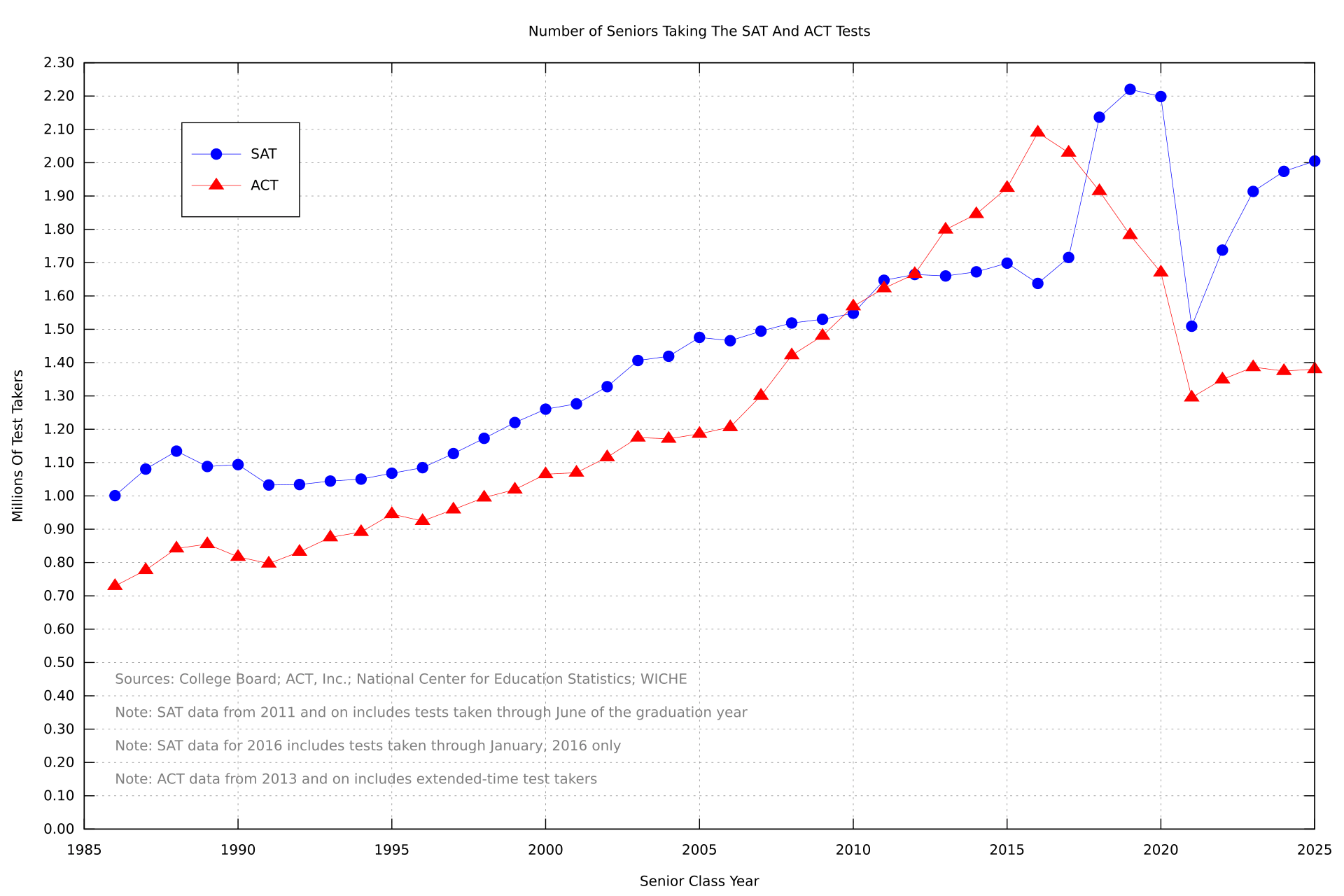
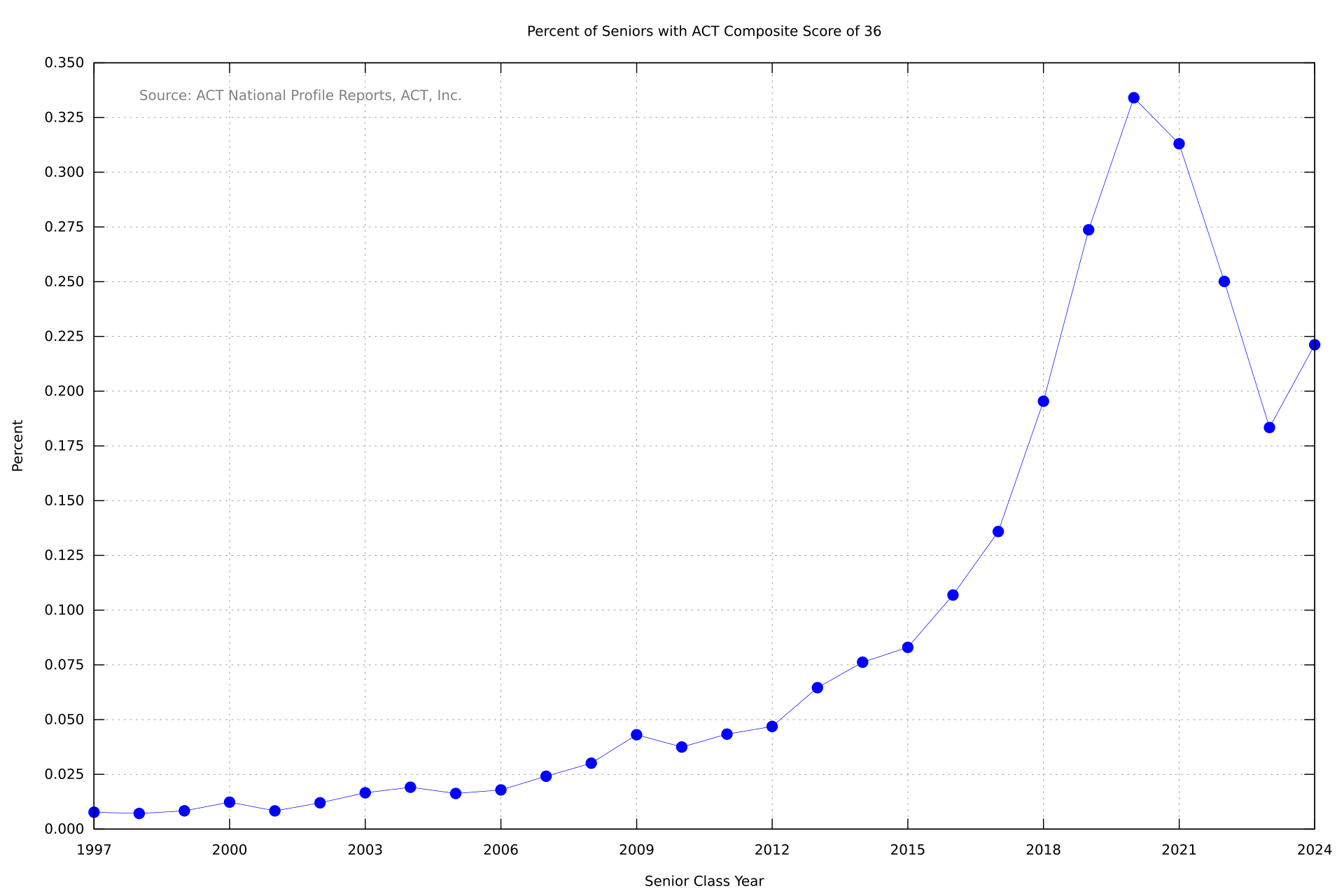
This is why a good SAT/ACT score is no longer enough for admissions at top schools.
In one sense I agree, but... it already wasn't enough in 2004. Top schools then could very easily have filled their classes with valedictorians with perfect SAT/ACT scores, but didn't, because on the margin the difference between 35 vs 36, or 1500 vs 1600, was not what (in their opinion) made for a strong class.
A large part of the reason math is hard, or boring, is that education studies, especially in math, are worse than you know. It goes beyond the studies failing both math and statistics forever and into what I’d basically call fraud. Various people are at war with math education, and will do what it takes to stop it in its tracks. We must fight back.
How much fun you have while doing math is directly linked to how deeply you understand it or if it's a new topic how quickly you understand the material behind the new topic
Extremely confident sounding but this is solely based on 1 anecdote
The issue is most people aren't doing that.
In addition to the 'war on math', there's also a 'war within math (education)': discovery-based learning vs explicit/direct instruction, etc. Moreover, in relation to your related post on reading/literacy, I'd be interested in people's take on these debates as they pertain to 'the science of learning': a methodology that seems to work for learning to read that is now being transplanted to learning mathematics/numeracy. I'm not convinced that there's evidence for transfer: reading involves scanning, fixation, and saccades (all visual-perceptual skills---I exclude comprehension here), whereas mathematics is the opposite: abstract and relies on reasoning. Despite claims from advocates of 'the science of learning', I see little to suggest that we should adopt techniques that work for reading/literacy for mathematics/numeracy
We did reading yesterday. Now we do the math. Math is hard.
It does not have to be this hard.
A large part of the reason math is hard, or boring, is that education studies, especially in math, are worse than you know. It goes beyond the studies failing both math and statistics forever and into what I’d basically call fraud. Various people are at war with math education, and will do what it takes to stop it in its tracks. We must fight back.
Education Research Is Worse Than You Know
Kelsey Piper lets her title, ‘Education research is weak and sloppy. Why?’ completely downplay the level of utter awfulness she is reporting finding.
You know that whole thing where the entire Bay Area school system stopped teaching kids Algebra? That was motivated by criminal levels of fraud. I want Jo Boaler in jail doing hard time for this if it is accurate.
Here’s the part before the paywall:
One cannot purely pin this on Jo Boaler. One must mostly pin it on an entire system that allowed and accepted such fraud without examining it, and let that drive policy. This is on the level of things I uncover in the first few minutes.
The War on Math
Then, when the students finally do take algebra, they often can’t do algebra.
Why can’t the students do algebra when they passed algebra?
Oh.
Did you know that real grades or SAT scores could have prevented what happens next?
Also, did you know that grade inflation is actually very bad for students?
The full result is that ‘passing grade inflation’ is good for earnings on the margin, but average grade inflation is quite bad for earnings. I roll to disbelieve both results in terms of magnitude, but not in terms of direction.
A paper from September 2025 called ‘Easy A’s, Less Pay: The Long Term Effects of Grade Inflation’ claims:
This is for grades in high school only, skewed towards grades 9-10.
So we have:
University of California San Diego
It turns out that yes, grades were load bearing all along. See the official report too.
As Matthew Zeitlin says, it’s way worse than the viral tweets imply, and yet ‘in the short-term nothing will change’ and the SAT and ACT will not be required. And no, you cannot blame this on the pandemic, we are way way past that at this point.
Here are some results for those in the remedial math class:
Well, sure, that sounds really bad, but it’s the remedial class, so it’s nothing, right?
Oh. Well, then. That’s 12% of students at UCSD. Who all failed math, then?
Oh. So grades are so fake that they’re completely worthless. Well, then. I guess we know exactly how that happened.
Oh. Well, then. The whole math educational system is a fraud. Once the SAT and ACT were eliminated as requirements for the UC system in 2020, there was no, as Kelsey puts it, ‘reality check’ on any of it, and that was that.
Maybe we can have them do things that don’t require the students know math?
Oh. Well, then. That’s actually better than I expected. Half of them pass those classes. Except that kind of suggests that’s worse, because how exactly did they pass?
I would love to not also blame the kids in all this, but that’s kind of nuts?
If you can’t do the most basic math questions, and there’s an AP test at the end that almost no one in class even bothers taking, and you’re somehow opting out of every objective standardized test for math (or you’re taking them), how can you possibly actually think you’re passing Calculus for real?
I flat out don’t buy it. Yes you’re being lied to, but if you’re being fooled, then there’s something deeply wrong with that. If you aren’t fooled but are going along with it because you think that’s best for your future and you’ll deal with the problem once you get into the UC system? I’m sympathetic. Hate the game and all that. But don’t tell me you’re smart, you’re not lazy, and also this all comes as a genuine surprise.
Yes. Simple as that. Cargo cult equity, and passing kids who didn’t pass, have to go.
The SAT or ACT needs to be a hard legal requirement for all college applications everywhere, so that the student has to at least know what their score was, and the college needs to be on record saying ‘I know what your score is and I accept it.’
Then there is the problem that the system wants to achieve results in the distribution of admissions that it’s illegal (via Supreme Court decisions) to achieve intentionally, so effectively the entire system is turned into a giant series of frauds to let them achieve it anyway. That’s worse. You know that’s worse, right?
As for the high schools: If a school awards you an A in Calculus, and you can’t solve basic Algebra I questions, then people need to be fired until that stops happening. Hell, if a majority of those with an A in Calculus don’t get at least a 3 on the AP exam someone should be fired, and really by majority I want to mean most and by 3 I want to mean 5.
And yet, the lies continue.
Beyond UCSD
It should not be so difficult to select a Harvard class that is ready for Calculus. If the school that is the first choice of half of students can’t do it, then that is their choice.
New York Can’t Do Math
Having bad Covid policies really did do a number on a generation of kids,
Look at what happened in New York, including the change in relative ranking. Luckily we have bounced back.
A state as rich as New York being 38th in math is also rather horrible, as is a 63% rate of not being proficient in math.
The broader story at the link is that standards have changed but performance is stagnant. Okay, I don’t love stagnant performance when it is this bad, but why did you think ‘change the standards’ was going to fix anything?
The Academic Standards Seem Low
Similarly, from a high school: What in blazes is this?
I don’t see that scale at the link but that’s where his picture was from. He confirms this was on normal high school math questions like the ones we all had, not a super hard test designed intentionally to center around 50.
These kinds of conversions fine for a college class where the test is designed to reveal maximum information, and the average student scores 50%. In a key sense, your numerical score is arbitrary, and wasting half the scale on ‘obviously you fail’ is bad.
Especially bad is using negative selection, where you have to essentially never make a mistake to get a Good Grade. At my high school, scores were from 0-100 rather than A-F within and between classes, and if you wanted to go to the good colleges, you needed to average 95+ across classes. You were effectively being graded on ‘not screwing up’ and this meant a mix of insane pressure and also cases where you had no incentive to improve, you’d already hit 100 in context.
This was, unfortunately… not that.
This is ‘you can only turn in half the assignments and know half the answers and still get a C.’ And that the tests haven’t changed from the old ones, or got easier. Not great.
It does get crazier:
Does this fool people? To some extent, alas, it surely does. But also it’s kind of reasonable, in the sense that I don’t see much difference between a half-wrong assignment and not turning it in? Nor do we want the 0s to dominate the math.
New Math
Another ‘fun’ way to destroy math education is to teach absurdly stupid techniques, and then punish any students who attempt to use any other method. Even if the technique was good, forcing one method over another is the opposite of how math works, and how you build mathematical intuitions.
This particular process is… exactly the same as regular long division actually except a bit slower, so it’s actually rather stupid except as conceptual illustration and should clearly come before rather than after usual long division if you’re going to use it?
Math Anxiety Is Often Due To Knowledge Gaps
Unlike Kelsey Piper, I report that this does not confirm all of my priors, including the fact that I did successfully take math up until the level of my incompetence (at least given the incompetence of the relevant teacher) and my only anxiety was ‘is this going to ruin my average’ which went away when I realized the undergraduates were all going to get gentleman’s Bs. Then again, yes, if you are good at math you’re less likely to be anxious about it, so it’s not exactly surprising.
Okay, that part does confirm all of my priors. If you need notes during a test, the solution is most definitely to learn the contents of the notes. If you don’t see how that would help then I don’t know what to tell you.
One reply suggests Beast Academy as a good resource.
Calculus By Eighth Grade Is Highly Practical For Many
The amount of math we could teach, without any additional resources or time spent, is quite high. Not for every student, but as Justin Skycak says, and as I gave a school talk about when I was in the 7th grade, we go painfully slowly teaching math through about 5th grade (I’d say closer to 3rd, even, in many cases) and then we basically twiddle students thumbs in math until 8th grade. There’s no reason you can’t go a lot faster.
So when a bunch of students asked, when can we take calculus, one school just went ahead and did it, with a three year plan that took the kids through algebra, geometry, algebra 2, precalculus and then in the final year AP Calculus BC, where most of them got the maximum score of 5. Whereas I only got to take Calculus BC in 9th grade, and that was considered super unususual.
Yes, there was some selection involved, but only at the 90th percentile level on a placement exam, and this survived scaling up somewhat. We don’t know how much slack there is in the admissions process here, but this seems like definitive proof that the whole math system is fundamentally broken even when working as designed.